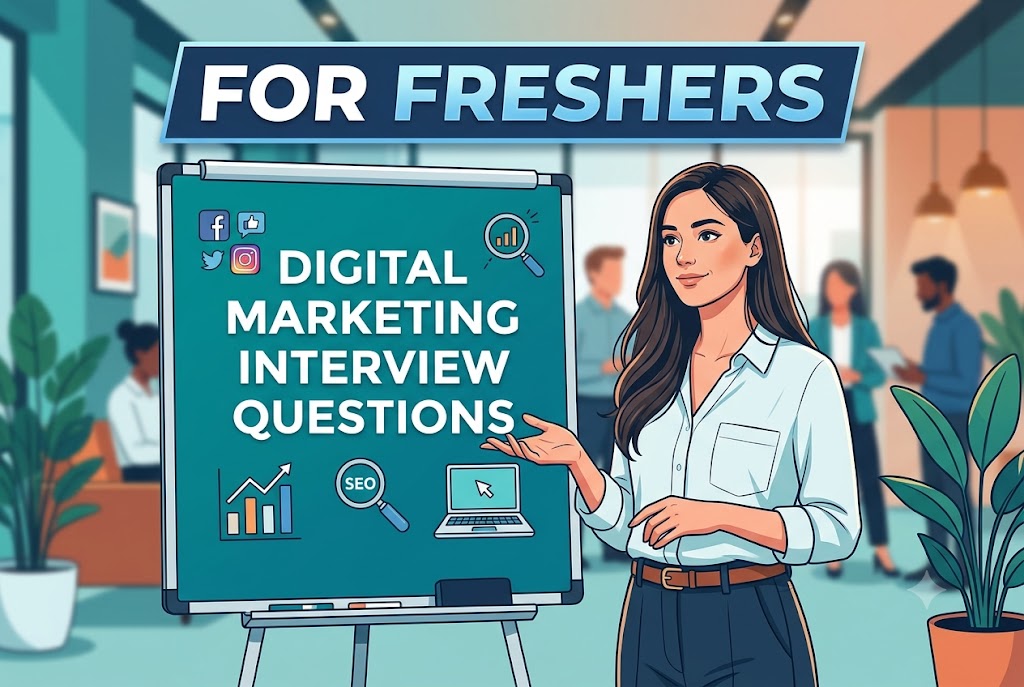
Why Digital Marketing Interview Preparation Matters
Digital marketing has become one of the fastest-growing career fields in the United States.
As businesses continue shifting online, companies increasingly need professionals who can help them:
- Generate leads
- Improve online visibility
- Manage advertising campaigns
- Build brand awareness
- Increase website traffic
This growing demand has created exciting opportunities for beginners and entry-level professionals.
However, getting hired in digital marketing is not always easy.
Many freshers struggle during a Digital Marketing Interview because they lack preparation.
Some candidates:
- Don’t understand basic marketing concepts
- Struggle to explain SEO and paid ads
- Feel nervous during interviews
- Lack confidence in practical skills
The good news?
Most digital marketing interviews for beginners focus on:
Fundamentals.
Employers usually want to know:
- How well you understand digital marketing basics
- Whether you are eager to learn
- Your problem-solving ability
- Your communication skills
Whether you are:
- A recent graduate
- Switching careers
- Looking for your first marketing role
understanding common digital marketing interview questions for freshers can significantly improve your chances of getting hired.
In this guide, we’ll cover:
- Top interview questions
- Beginner-friendly answers
- SEO interview basics
- Google Ads questions
- Social media interview tips
- Mistakes to avoid during interviews
Let’s get started.
Read Also : Why Practical Training Matters in Digital Marketing Courses
What Is a Digital Marketing Interview?
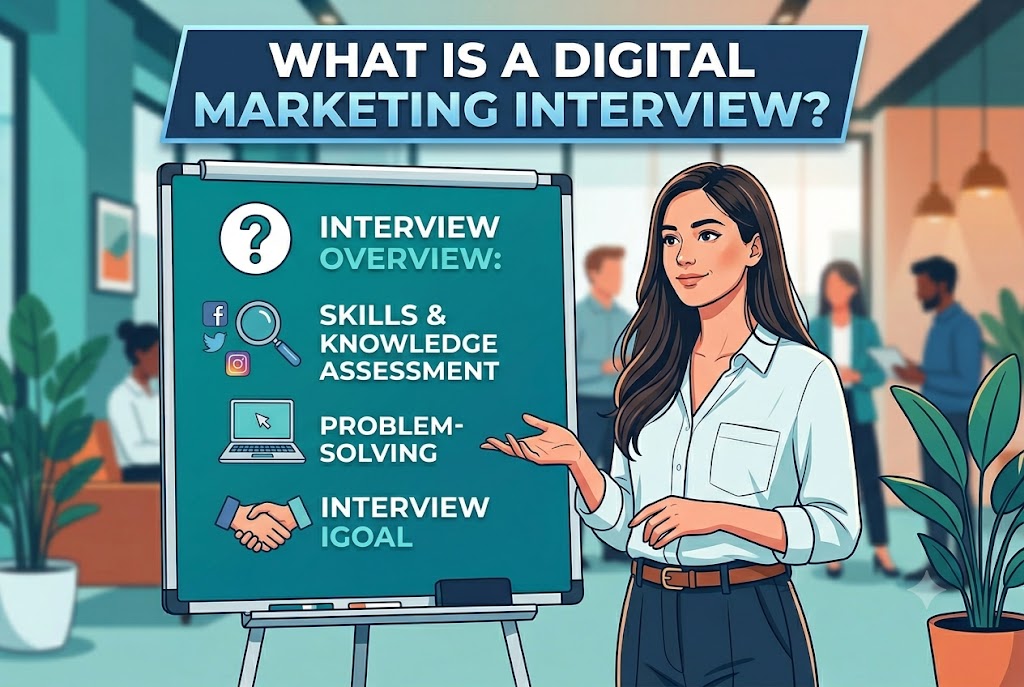
A digital marketing interview is the hiring process companies use to evaluate candidates applying for marketing roles.
Interviewers typically assess:
Technical Knowledge
How well you understand digital marketing concepts.
Communication Skills
How clearly you explain ideas.
Practical Understanding
Whether you can apply concepts in real situations.
Problem-Solving Ability
How you approach marketing challenges.
For freshers, employers generally focus more on:
Learning potential
rather than years of experience.
This means even beginners can perform well with proper digital marketing interview preparation.
Why Freshers Need Digital Marketing Interview Preparation
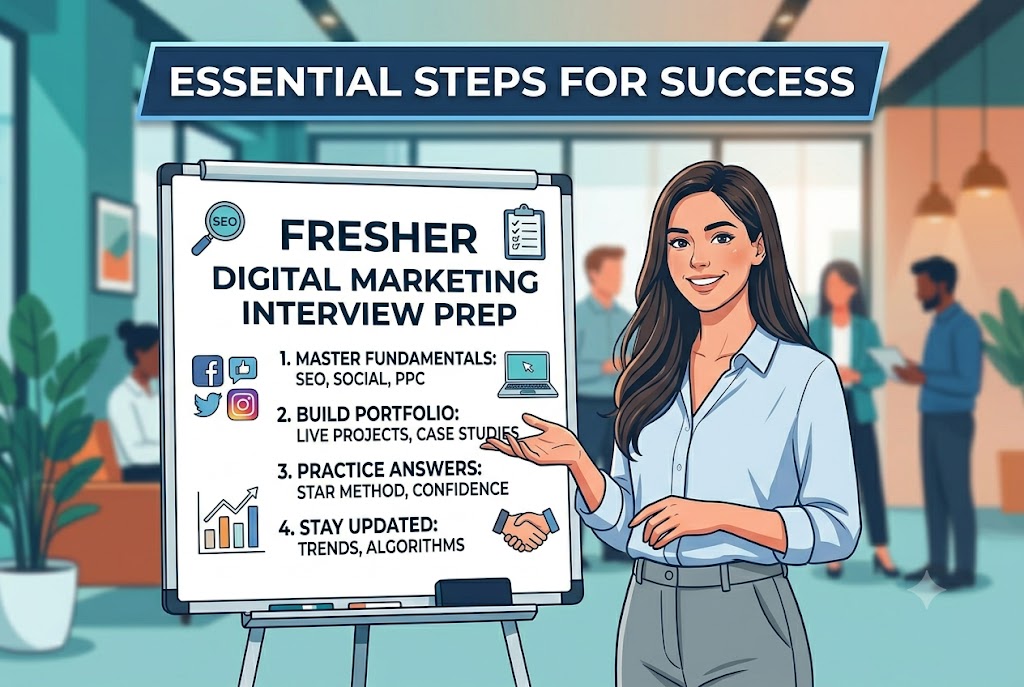
Many beginners assume:
“I’ll just answer questions naturally.”
Unfortunately:
That rarely works.
Preparation matters.
The digital marketing job market is highly competitive.
Employers often interview multiple candidates for one role.
Being prepared helps freshers:
Build Confidence
Practice reduces nervousness.
Improve Communication
Prepared answers sound more professional.
Understand Industry Expectations
Candidates learn what recruiters actually want.
Increase Hiring Chances
Prepared candidates often stand out.
This explains why proper digital marketing job preparation matters.
Top Digital Marketing Interview Questions for Freshers
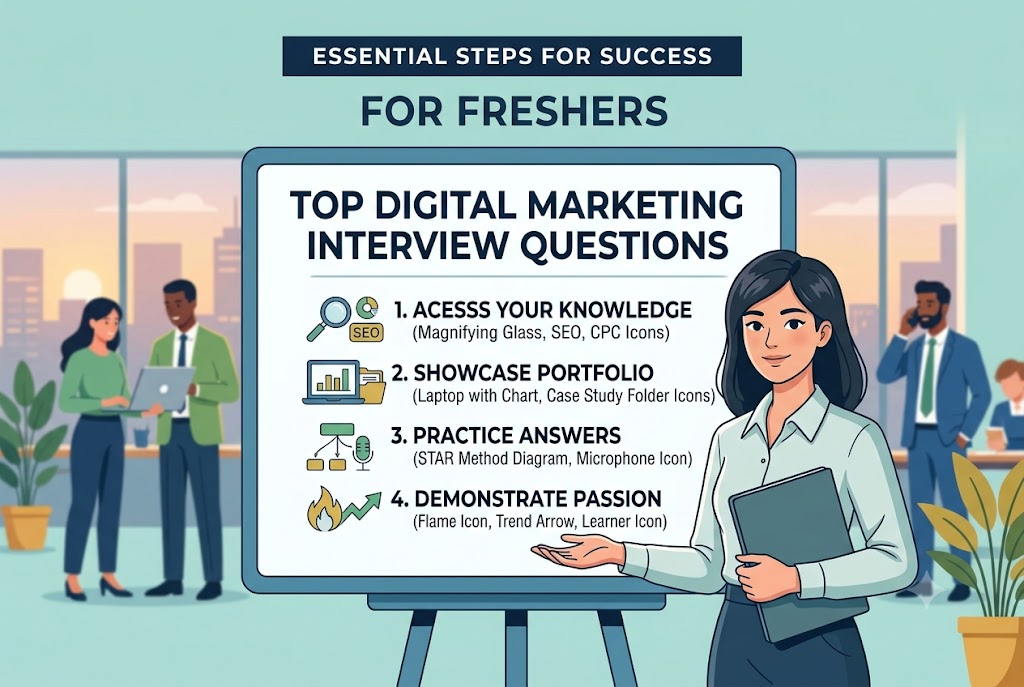
Let’s review some of the most commonly asked interview questions.
1. What Is Digital Marketing?
This is often the first question in a digital marketing fresher interview.
Why Employers Ask
They want to evaluate your basic understanding.
Sample Answer
Digital marketing refers to promoting products or services through online channels such as:
- Search engines
- Social media
- Websites
- Email marketing
- Paid advertising
The goal is to attract, engage, and convert customers online.
Pro Tip
Keep answers simple and confident.
Avoid sounding overly technical.
Read Also : Digital Marketing Salary in India: Freshers vs Experienced
2. What Are the Main Types of Digital Marketing?
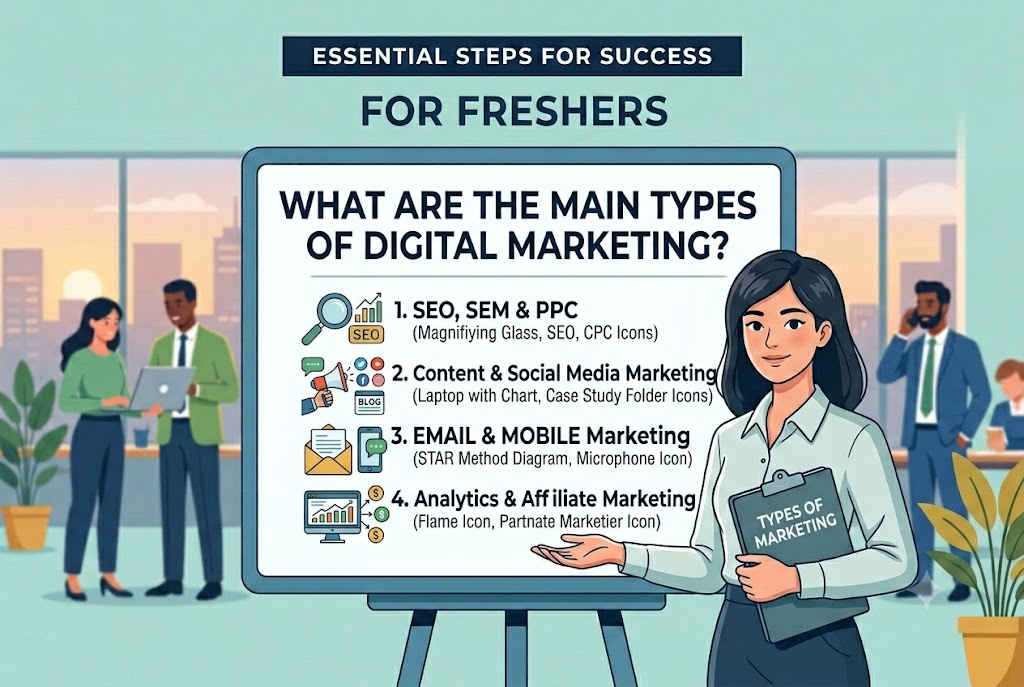
Interviewers often test whether candidates understand major marketing channels.
Common Types Include:
- Search Engine Optimization (SEO)
- Pay-Per-Click Advertising (PPC)
- Social Media Marketing
- Content Marketing
- Email Marketing
- Affiliate Marketing
Best Answer Strategy
Briefly explain each method.
Show practical understanding.
3. What Is SEO?
This is one of the most common SEO interview questions for freshers.
Simple Answer
SEO stands for Search Engine Optimization.
It is the process of improving a website’s visibility on search engines like Google.
The goal is:
Higher rankings → More traffic
Mention Key SEO Areas
- On-page SEO
- Off-page SEO
- Technical SEO
Interviewers appreciate structured answers.
4. What Is the Difference Between On-Page and Off-Page SEO?
Another common beginner question.
On-Page SEO
Optimizing website content and structure.
Examples include:
- Keywords
- Meta tags
- Internal links
Off-Page SEO
Activities outside the website.
Examples include:
- Backlinks
- Social sharing
- Brand mentions
Clear examples help freshers answer confidently.
5. What Is Keyword Research?
Keyword research is essential in SEO.
Sample Answer
Keyword research involves identifying terms users search on Google.
Marketers use these keywords to optimize content and improve rankings.
Mention Common Tools
Examples include:
- Google Keyword Planner
- SEMrush
- Ahrefs
Knowing tools adds credibility.
6. What Is Google Ads?
This is among the most popular Google Ads interview questions.
Beginner-Friendly Answer
Google Ads is an online advertising platform where businesses run paid campaigns to appear in search results.
Advertisers pay when users click ads.
This model is called:
Pay-Per-Click (PPC)
7. What Is PPC in Digital Marketing?
Simple Explanation
PPC stands for:
Pay-Per-Click advertising
Businesses pay only when users click their ads.
Platforms include:
- Google Ads
- Facebook Ads
- LinkedIn Ads
PPC helps businesses generate quick traffic.
8. What Is Social Media Marketing?
This is a common social media marketing interview question.
Sample Answer
Social media marketing involves promoting brands through platforms such as:
- TikTok
The goal is to:
- Increase engagement
- Build awareness
- Generate leads
9. What Is Content Marketing?
Content marketing focuses on creating valuable content to attract audiences.
Examples include:
- Blog posts
- Videos
- Guides
- Infographics
Its goal is:
Building trust and attracting customers organically
10. What Is Email Marketing?
Email marketing helps businesses communicate directly with customers.
Common purposes include:
- Promotions
- Newsletters
- Customer retention
It remains one of the highest ROI marketing channels.
11. What Is CTR (Click-Through Rate)?
This is one of the most common metrics-related questions in a Digital Marketing Interview.
Simple Answer
CTR stands for:
Click-Through Rate
It measures how many people clicked an ad or link compared to how many people saw it.
Formula
CTR = (Clicks ÷ Impressions) × 100
Example
If an ad receives:
- 1000 impressions
- 50 clicks
The CTR would be:
5%
Why CTR Matters
A higher CTR usually means:
- Better ad relevance
- Stronger audience targeting
- Better content performance
Interviewers ask this to check if freshers understand marketing performance metrics.
12. What Is Bounce Rate?
Another commonly asked beginner question.
Simple Answer
Bounce rate refers to the percentage of visitors who leave a website without taking any action.
For example:
A user visits a webpage and exits immediately without:
- Clicking links
- Visiting another page
- Interacting
Why It Matters
A high bounce rate may indicate:
- Poor content
- Slow loading speed
- Weak user experience
Fresher Interview Tip
Keep the explanation practical.
Interviewers prefer simple clarity over complicated definitions.
Read Also : Top 10 Reasons Students Choose Digital Marketing Over MBA
13. What Is Google Analytics?
Many companies ask this question during entry level digital marketing jobs interviews.
Sample Answer
Google Analytics is a tool used to track website performance and visitor behavior.
It helps marketers understand:
- Website traffic
- User demographics
- Page performance
- Traffic sources
Why Businesses Use It
Businesses use Google Analytics to improve:
- Website performance
- Marketing campaigns
- User experience
Mentioning practical use cases creates stronger answers.
14. What Is Conversion Rate Optimization (CRO)?
Freshers may also encounter this question.
Beginner-Friendly Answer
Conversion Rate Optimization (CRO) is the process of improving a website or landing page to increase conversions.
Examples of conversions include:
- Purchases
- Form submissions
- Signups
Example
Improving a CTA button may increase conversions.
Interviewers appreciate practical examples.
15. Why Do You Want a Career in Digital Marketing?
This question evaluates motivation.
Common Mistake
Many candidates answer vaguely.
Example:
“I heard digital marketing has good jobs.”
Weak answer.
Better Answer Strategy
Talk about:
- Interest in technology
- Creativity
- Data-driven marketing
- Business growth
Sample Answer
“I’m interested in digital marketing because it combines creativity and analytics. I enjoy understanding how businesses grow online and want to build practical skills in SEO, content marketing, and paid advertising.”
Authentic answers work best.
Read Also : Digital Marketing Institute Near Me – What to Look For
Digital Marketing Interview Questions and Answers for Freshers
Let’s explore additional frequently asked questions.
What Is the Difference Between Organic and Paid Traffic?
Organic Traffic
Traffic earned naturally through SEO.
Paid Traffic
Traffic generated through advertisements.
Example:
Google Ads campaigns.
What Is a Landing Page?
Simple Answer
A landing page is a dedicated webpage created for marketing campaigns.
Its purpose is:
Generate conversions
such as:
- Signups
- Purchases
- Leads
What Is Domain Authority?
Domain Authority predicts how well a website may rank in search engines.
Higher authority generally means:
Better ranking potential
What Is Remarketing?
Remarketing helps businesses target people who already visited their website.
Example:
Seeing ads after visiting an online store.
What Is A/B Testing?
A/B testing compares two versions of:
- Ads
- Emails
- Webpages
to determine which performs better.
SEO Interview Questions for Freshers
SEO questions are extremely common in beginner interviews.
Here are important ones.
What Is a Backlink?
Sample Answer
A backlink is a link from another website pointing to your website.
Backlinks improve:
- Website authority
- SEO performance
What Are Meta Tags?
Meta tags provide information about webpage content.
Examples include:
- Meta title
- Meta description
These help search engines understand content.
What Is Keyword Stuffing?
Keyword stuffing means excessively adding keywords unnaturally.
Google discourages this practice.
Fresher Tip
Mention:
Good SEO focuses on user experience.
What Is Technical SEO?
Technical SEO improves website performance.
Examples include:
- Website speed
- Mobile optimization
- Crawlability
Google Ads Interview Questions
Paid advertising questions are increasingly common.
What Is CPC?
CPC stands for:
Cost Per Click
Advertisers pay whenever users click ads.
What Is Quality Score?
Quality Score measures ad quality based on:
- Relevance
- Landing page experience
- CTR
Higher quality scores can lower ad costs.
Why Are Keywords Important in Google Ads?
Keywords help match ads to user searches.
Better keyword targeting often improves campaign performance.
Social Media Marketing Interview Questions
Freshers applying for content or social media roles often hear these questions.
Which Social Media Platform Is Best for Marketing?
Beginner-Friendly Answer
It depends on the target audience.
Examples:
Best for B2B marketing
Best for visual brands
Good for community engagement
TikTok
Popular for younger audiences
How Do You Measure Social Media Success?
Metrics include:
- Reach
- Engagement
- Clicks
- Conversions
Employers like candidates who understand performance measurement.
Digital Marketing Skills Employers Look for in Freshers
Recruiters don’t expect freshers to know everything.
However, they often look for core skills.
Communication Skills
Clear communication matters.
SEO Basics
Understanding search optimization helps.
Social Media Knowledge
Practical platform understanding matters.
Analytics Understanding
Basic performance tracking knowledge helps.
Adaptability
Digital marketing evolves quickly.
Candidates willing to learn often stand out.
How to Prepare for a Digital Marketing Interview
Interview preparation plays a major role in landing your first job.
Even freshers with limited experience can perform well if they prepare strategically.
Here are proven ways to improve your digital marketing interview preparation.
1. Learn Practical Skills
One of the biggest mistakes beginners make is relying only on theory.
Recruiters increasingly prefer candidates with:
Practical understanding
Even basic hands-on experience can help.
Try learning:
- SEO basics
- Google Ads fundamentals
- Social media marketing
- Content creation
- Website analytics
Beginner Tip
Practice on personal projects.
For example:
- Start a blog
- Run a social media page
- Explore SEO optimization
Practical exposure improves confidence dramatically.
2. Practice Mock Interviews
A digital marketing mock interview helps reduce nervousness.
Mock interviews help freshers:
- Improve confidence
- Practice answers
- Identify weak areas
Ask friends or mentors to conduct practice interviews.
You can also practice common questions aloud.
Confidence matters just as much as technical knowledge.
3. Build Basic Portfolio Projects
Freshers often worry:
“I don’t have experience.”
That’s okay.
Small projects still matter.
You can build a beginner portfolio through:
Personal Blog
Practice SEO and content marketing.
Social Media Pages
Grow engagement on Instagram or LinkedIn.
Small Campaign Experiments
Explore basic paid ads.
Even small projects demonstrate:
Initiative
Recruiters appreciate candidates who actively learn.
4. Stay Updated with Digital Marketing Trends
Digital marketing changes constantly.
Freshers should stay informed about:
- SEO updates
- Google algorithm changes
- Social media trends
- AI in marketing
Interviewers may ask:
“What recent digital marketing trend interests you?”
Being informed helps candidates stand out.
Common Mistakes Freshers Make in Digital Marketing Interviews
Even talented candidates sometimes struggle because of avoidable mistakes.
Let’s review them.
1. Lack of Basic Knowledge
Some candidates apply without understanding fundamentals.
Always prepare core concepts like:
- SEO
- PPC
- Content marketing
- Analytics
Basic knowledge matters.
2. Giving Overly Complicated Answers
Freshers often think complex answers sound smarter.
Not true.
Recruiters prefer:
Simple, clear explanations
Focus on clarity.
3. Poor Communication Skills
Technical knowledge matters—
But communication matters too.
Practice speaking clearly and confidently.
Avoid:
- One-word answers
- Nervous speaking
- Overexplaining
4. Ignoring Company Research
Many candidates skip researching the company.
Before interviews:
Check:
- Company website
- Social media presence
- Services offered
This shows professionalism.
5. Not Asking Questions
At the end of interviews, employers often ask:
“Do you have any questions?”
Always ask thoughtful questions.
Examples:
- What does success look like in this role?
- What tools does your marketing team use?
Good questions show interest.
Read Also : Top 10 AI Tools Every Digital Marketing Student Should Learn
Digital Marketing Job Preparation Tips for Freshers
Preparing beyond interviews increases success rates.
Optimize Your Resume
Freshers should highlight:
Certifications
Mention:
- SEO training
- Google certifications
- Marketing courses
Skills
Include:
- SEO basics
- Social media marketing
- Content writing
- Analytics
Projects
Even small personal projects matter.
Recruiters value initiative.
Improve Your LinkedIn Profile
Many recruiters check LinkedIn.
Your profile should include:
- Professional headline
- Skills section
- Certifications
- Projects
LinkedIn visibility can improve hiring chances.
Apply for Entry-Level Roles
Freshers should target:
entry level digital marketing jobs
Examples include:
- SEO Executive
- Social Media Assistant
- Content Marketing Intern
- PPC Assistant
Starting small builds experience.
Network with Marketing Professionals
Networking often opens hidden opportunities.
Ways to network:
- Marketing webinars
- Online communities
Learning from professionals improves confidence.
Why Digital Marketing Certifications Help
Many freshers ask:
Do certifications matter?
The answer:
Yes—but skills matter more.
Certifications improve credibility.
Popular learning areas include:
- SEO
- Google Ads
- Analytics
- Social media marketing
Many freshers choose a digital marketing course with placement to improve job readiness.
Practical training combined with certification often creates stronger outcomes.
Future Scope of Digital Marketing Careers in 2026
The future of digital marketing looks promising.
Companies increasingly rely on digital platforms for growth.
High Demand Continues
Businesses need professionals for:
- SEO
- Paid advertising
- Social media
- Email marketing
AI Is Changing Marketing
Marketers now use AI tools for:
- Content creation
- Customer insights
- Campaign automation
Freshers willing to learn new technologies will have stronger opportunities.
High-Growth Digital Marketing Roles
Popular future career options include:
SEO Specialist
PPC Expert
Content Strategist
Social Media Manager
Marketing Analyst
Digital marketing offers strong career growth for beginners.
Conclusion
Getting your first marketing job may feel challenging—
But preparation makes a huge difference.
A successful Digital Marketing Interview depends on:
- Understanding basics
- Practicing answers
- Building confidence
- Learning practical skills
Freshers should focus on:
- SEO fundamentals
- Paid advertising basics
- Social media knowledge
- Analytics understanding
Remember:
Recruiters don’t expect beginners to know everything.
They want candidates who show:
Curiosity, willingness to learn, and strong fundamentals.
Before your next interview:
Practice common digital marketing interview questions for freshers, improve communication skills, and stay updated with industry trends.
The more prepared you are—
The higher your chances of landing your first digital marketing role successfully.
Read Also : 10 Reasons to Join a Digital Marketing Course After 12th