


What Does the Keyword Difficulty Score Tell You
If you’ve been doing SEO for some time, you know that not every keyword is worth chasing. From my 10+ years as a digital marketing trainer, one lesson I always share with students is this: smart SEO starts with choosing the right keywords. That’s where the Keyword Difficulty Score becomes extremely useful.
Keyword Difficulty Score tells you how hard it will be to rank on Google for a specific keyword. It is usually shown as a number (from 0 to 100) by SEO tools. A lower score means less competition, while a higher score means many strong websites are already ranking.
SEO tools use this metric because Google ranking depends heavily on competition. According to Ahrefs data, over 90% of web pages get zero traffic mainly because they target keywords that are too competitive. Keyword difficulty helps you avoid that mistake by showing whether your website realistically has a chance to rank.
This score predicts ranking competition by analyzing the top 10 search results on Google. If those pages belong to big brands with strong backlinks and authority, the difficulty goes up. If smaller or newer websites are ranking, the difficulty stays low.
Also Read: Bad & Toxic Backlinks You Should Avoid
In simple terms, the Keyword Difficulty Score measures four main things:
- Backlinks pointing to ranking pages
- Domain authority of competing websites
- Page-level strength of existing content
- Overall SERP strength (how powerful the results are)
For example, a keyword with a difficulty score of 15–25 is often ideal for beginners, while keywords above 60 usually need strong authority and consistent SEO work. Understanding this score helps you choose keywords that bring traffic without wasting months of effort.
Also Read: How to Find Guest Post Opportunities | “Write for us”
How Keyword Difficulty Scores Are Calculated
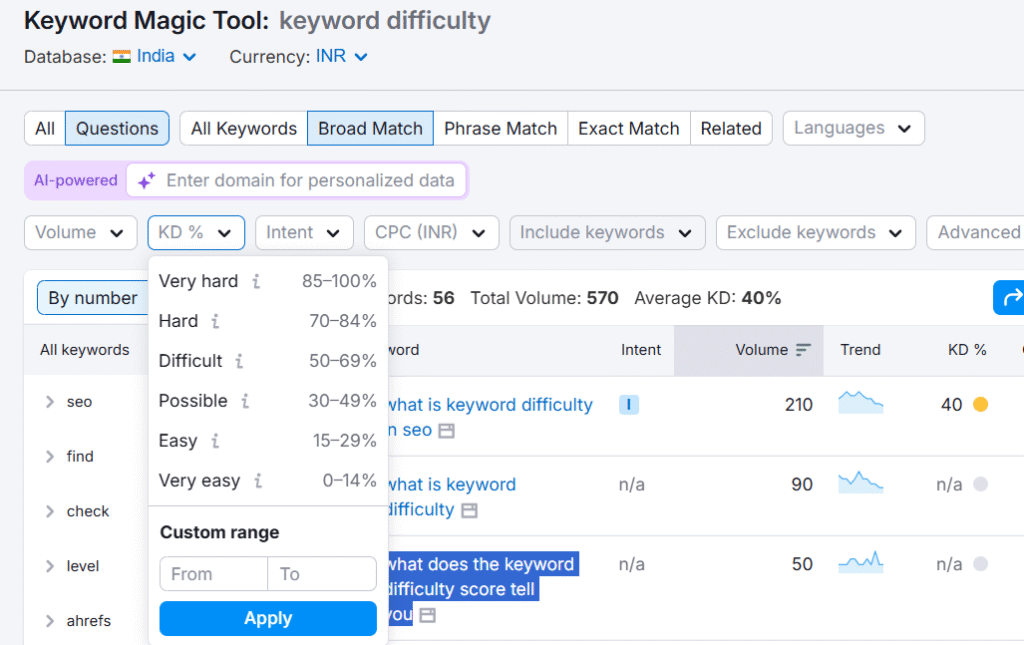
One question I hear often from my students is, “Sir, who decides this keyword difficulty number?” I can tell you that the Keyword Difficulty Score is not random. It is calculated using real data from Google search results.
First, SEO tools study the backlink profiles of top-ranking pages. Backlinks are still one of Google’s strongest ranking signals. A study by Backlinko shows that pages ranking on page one have 3.8x more backlinks than those on lower pages. If the top 10 results have many high-quality links, the keyword difficulty increases.
Next comes domain authority vs page authority. Domain authority looks at the overall strength of a website, while page authority focuses on the specific page ranking for the keyword. Sometimes, a strong page on a medium website can rank better than a weak page on a big domain. SEO tools combine both to calculate a more accurate Keyword Difficulty Score.
Another important factor is content quality and search intent match. If top-ranking pages clearly answer the user’s question with detailed, helpful content, the competition becomes tougher. Google rewards relevance, not just links. That’s why good content can sometimes beat high authority.
Finally, every tool calculates difficulty differently:
- Ahrefs focuses mainly on backlinks
- SEMrush includes links, traffic, and SERP features
- Moz combines link metrics with page authority
That’s why the Keyword Difficulty Score may vary slightly across tools—but the goal remains the same: helping you judge ranking difficulty before investing your time.
Also Read: How the Web Search Engine Works [Crawling, Indexing & Ranking Explained]
What Does the Keyword Difficulty Score Tell You About Ranking Chances?
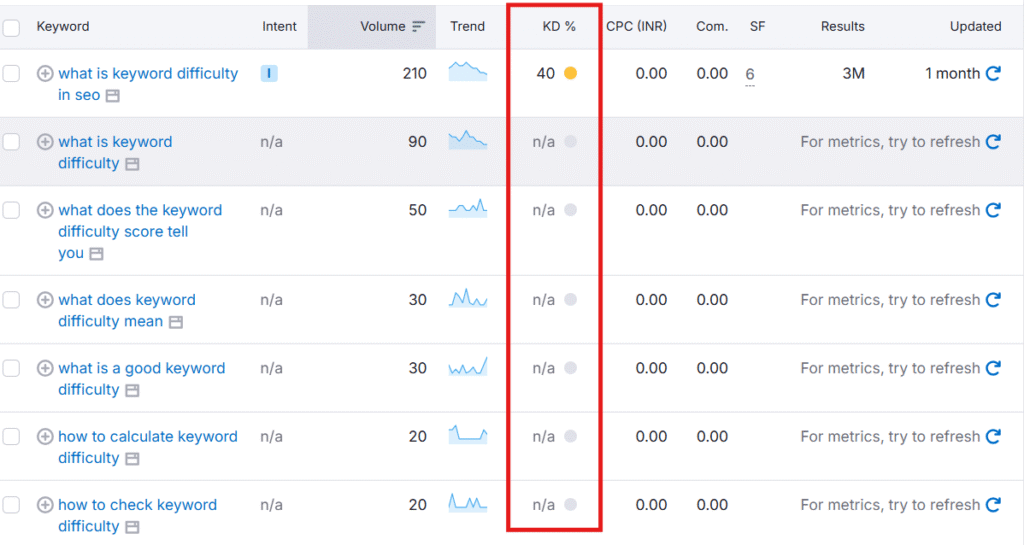
In my years of SEO experience, I’ve seen many people fail not because SEO is hard, but because they choose the wrong keywords. The Keyword Difficulty Score gives you a clear idea of your real ranking chances before you start creating content.
Low Keyword Difficulty Score (0–25) keywords are the best for quick wins. These keywords usually have fewer strong competitors and lower backlink requirements. For new websites or blogs, targeting low KD keywords can bring traffic within 30–90 days if the content is well-optimized. This is how many of my students get their first organic leads and confidence boost.
Medium KD keywords (26–50) are perfect for a balanced SEO strategy. These keywords have decent Keyword search volume and manageable competition. You may need good content, internal linking, and some backlinks, but results are realistic. According to SEMrush, websites that consistently target medium-difficulty keywords see 40–60% steady traffic growth over time.
High KD keywords (51+) indicate tough competition. These keywords are dominated by strong brands, news websites, or industry leaders. Ranking here takes time, strong domain authority, and continuous SEO efforts. I recommend using them only for long-term authority building, not quick traffic.
However, high difficulty keywords can still be worth targeting when:
- You already have topical authority
- You offer better, deeper content than competitors
- The keyword brings high business value
In short, the Keyword Difficulty Score helps you decide whether to rank now, rank later, or skip the keyword entirely—saving both time and effort.
Also Read: A Deep Dive into Technical SEO
Ideal Keyword Difficulty Score for Beginners vs Agencies
Over the years, I’ve noticed one common mistake beginners make—they try to compete with big brands too early. Choosing the right Keyword Difficulty Score depends on your website’s age, authority, and resources.
For new websites, the best KD range is usually 0–20. These keywords have low competition and don’t require many backlinks. If your site is less than 6 months old, this range gives you the highest chance to rank and start getting organic traffic without frustration.
For blogs and niche websites, a safe KD score is between 15–30. These keywords often have clear search intent and reasonable volume. With good content and internal linking, many niche sites start ranking within 2–3 months. This is the range I recommend to most students starting their blogging journey.
Agencies and established brands can follow a more advanced approach. With strong authority and backlink power, they can target keywords in the 40–70 KD range. The focus here is not quick results but building long-term visibility, trust, and brand dominance in search results.
Let me share a real-world example. One of my students targeted a keyword with KD 18 instead of KD 55. Within 45 days, the page ranked on page one and started generating leads. The competitor chasing the higher KD keyword was still stuck on page three after six months.
That’s why understanding the Keyword Difficulty Score helps you choose smarter keywords—not harder ones—and grow consistently in SEO.
Also Read: How to Write An SEO Title?
Common Mistakes When Using Keyword Difficulty Score
Even after teaching SEO for more than a decade, I still see people misusing the Keyword Difficulty Score. The tool is powerful, but only when used the right way. Here are the most common mistakes you should avoid.
The first mistake is choosing keywords only by KD. A low score looks attractive, but if the keyword has no real search intent or business value, it won’t bring results. Always balance difficulty with relevance and purpose.
Another big mistake is ignoring search intent and content depth. Google ranks pages that solve the user’s problem clearly. If top-ranking pages are detailed guides and you publish a short article, even a low Keyword Difficulty Score won’t help you rank.
Many people also skip manual SERP checking. Tools give numbers, but Google shows reality. Before finalizing a keyword, search it on Google and see who is ranking. If the results are full of strong brands, videos, or featured snippets, ranking may be harder than the KD suggests.
The last and most costly mistake is targeting competitive keywords too early. New websites chasing high KD keywords often wait months without results. I always advise building authority first with easier wins, then moving up.
Used wisely, the Keyword Difficulty Score saves time—but used blindly, it can slow down your SEO growth.
Also Read: How to reduce spam score of website
How to Use Keyword Difficulty Score in Your SEO Strategy
I can confidently say that the Keyword Difficulty Score works best when it’s part of a system—not when it’s used alone. Here’s a simple and practical way to use it in your SEO strategy.
Step-by-step keyword filtering process:
Start by listing keywords related to your topic. First, remove keywords with extremely high difficulty. Then, shortlist keywords with low to medium difficulty that clearly match user intent. This saves time and helps you focus only on keywords you can realistically rank for.
Let me explain this with a simple, real example from my training experience.
Suppose your topic is “digital marketing course”. When you list related keywords, you may find:
- digital marketing course
- digital marketing course in India
- digital marketing course in Delhi
- free digital marketing course
- advanced digital marketing course fees
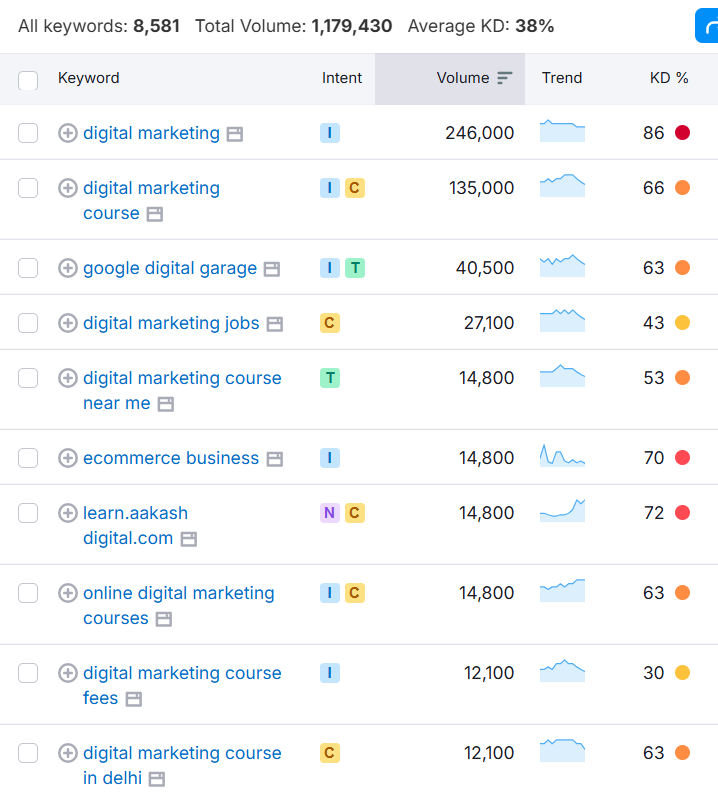
Now, check their difficulty in an SEO tool. You’ll notice that “digital marketing course” has very high competition because big institutes, ads, and authority websites dominate the results. This keyword is difficult to rank for, especially if your website is new, so you remove it.
Next, you look at keywords with low to medium difficulty, such as:
- digital marketing course in Delhi for beginners
- practical digital marketing course in Delhi
- digital marketing course with job assistance
These keywords have clearer search intent and fewer strong competitors. A person searching for them knows exactly what they want, which makes ranking and conversions easier.
Instead of writing one generic article, you now create focused content around these easier keywords. In many real cases, pages like this start ranking within 30–60 days, while high-competition keywords may take months.
This is how keyword filtering helps you choose keywords you can realistically rank for, grow traffic faster, and build authority step by step.
Combine KD with search volume and CPC:
A low KD keyword with zero searches is useless. Always check search volume along with difficulty. CPC also gives a strong hint about commercial value. According to SEMrush data, keywords with moderate CPC often convert better because they show buying intent. This balance makes the Keyword Difficulty Score more meaningful.
In real SEO work, I always tell my students not to look at the Keyword Difficulty Score alone. A keyword may be easy to rank for, but if no one is searching for it, it won’t bring traffic or leads.
For example, imagine two keywords:
- Keyword A:
KD: 12
Search Volume: 20/month
CPC: ₹0 - Keyword B:
KD: 22
Search Volume: 900/month
CPC: ₹45
Keyword A looks attractive because of its low difficulty, but with almost no searches and zero CPC, it has very little value. Keyword B has slightly higher difficulty, but it gets good searches and advertisers are paying for it. That CPC tells us people are ready to spend money, which means strong buying intent.
SEMrush data shows that keywords with moderate CPC often convert better than very high CPC keywords because competition is balanced and intent is clear. When you combine KD, search volume, and CPC, you get a keyword that is easy enough to rank for and valuable enough to convert.
That’s why balancing these three factors makes the Keyword Difficulty Score truly useful in your SEO strategy.
Build topical authority using low-KD clusters:
Instead of targeting one keyword, create content clusters around low difficulty keywords. When multiple related pages rank, Google starts seeing your website as an authority. I’ve seen websites grow traffic by 2x within 3–4 months just by following this approach.
In my experience, ranking becomes much easier when you stop targeting one keyword and start building content clusters around low difficulty keywords. This is one of the fastest ways to build trust with Google.
For example, instead of writing just one article on “SEO basics”, you create multiple pages around related low-KD keywords such as:
- what is SEO
- on-page SEO checklist
- off-page SEO techniques
- SEO tools for beginners
- common SEO mistakes
Each page targets a different low-difficulty keyword but links to each other naturally. When several of these pages start ranking, Google understands that your website covers the topic in depth.
I’ve personally seen websites double their organic traffic in 3–4 months using this method. Rather than competing with big brands on one tough keyword, you win by covering the full topic better.
This approach works because Google prefers websites that solve the user’s problem completely, not partially. Building low-KD clusters helps you grow faster, rank more pages, and establish long-term authority.
Tools checklist for accurate analysis:
Over the years, I’ve learned one important lesson: never trust a single SEO tool blindly. For accurate decisions, always cross-check data. This is how I personally use tools to understand the Keyword Difficulty Score better.
First, I use Ahrefs to check backlink-based difficulty. It shows how many quality links the top-ranking pages have. If those pages have strong backlinks, I know ranking will need link-building effort.
Next, I use SEMrush for an overall competition view. It helps me understand keyword difficulty along with search volume, CPC, and SERP features. This gives a broader picture of whether the keyword is informational or commercial.
Finally, I always do manual Google checks. I search the keyword myself and study the top 10 results. If I see forums, blogs, or small websites ranking, it’s a good opportunity. If only big brands dominate, I rethink the keyword.
When you combine these tools, the Keyword Difficulty Score becomes a clear roadmap for steady rankings—not a guessing game.
Final Answer: What Does the Keyword Difficulty Score Tell You?
The Keyword Difficulty Score tells you how realistic your chances are to rank on Google for a keyword. It shows how strong your competition is based on links, authority, and the overall strength of the top search results. It does not promise rankings, but it clearly warns you where effort will be high or low.
The most important thing to remember is to use the score as a guide, not a rule. A low score does not guarantee success if your content is weak or irrelevant. At the same time, a high score does not mean you should ignore the keyword forever. Your website’s authority, content quality, and consistency play a huge role alongside the Keyword Difficulty Score.
Here’s the actionable takeaway for faster rankings:
- Start with low difficulty keywords that match clear search intent
- Create helpful, well-structured content
- Build topical authority before chasing competitive keywords
When you combine smart keyword selection with quality content, the Keyword Difficulty Score becomes one of your strongest SEO decision-making tools—helping you rank smarter, not harder.

Founder at Digital Marketing Marvel | Founder at RKDMT – Raju Kumar Digital Marketing Trainer | Best Digital Marketing Trainer in Delhi/NCR – Digiperform | Project Manager | 5+ years | Genius Study Abroad & Inlingua’s Digital Marketing Head | Learn Digital Marketing