


What are Different Types of Google Ads Campaign Objectives
When I speak with business owners or students, the first mistake I notice is not the ad copy or budget—it’s choosing the wrong campaign objective.
Hi I’m Raju Kumar with my 10+ years of experience in digital marketing, I’ve learned one simple truth: if your objective is wrong, even the best Google Ads campaign will fail. That’s why understanding Different Types of Google Ads Campaign Objectives is the foundation of profitable advertising.
Google Ads campaign objectives are the goals you select before running an ad. These goals tell Google what result you want—brand awareness, website traffic, leads, app installs, or sales.
According to Google, campaigns aligned with clear objectives deliver up to 30% higher conversion efficiency compared to random goal selection. In simple words, objectives decide what success looks like for your campaign.
Choosing the right objective directly impacts your Return on Investment (ROI). For example, if you want leads but select a traffic objective, Google will show your ad to people who click a lot but may never fill your form.
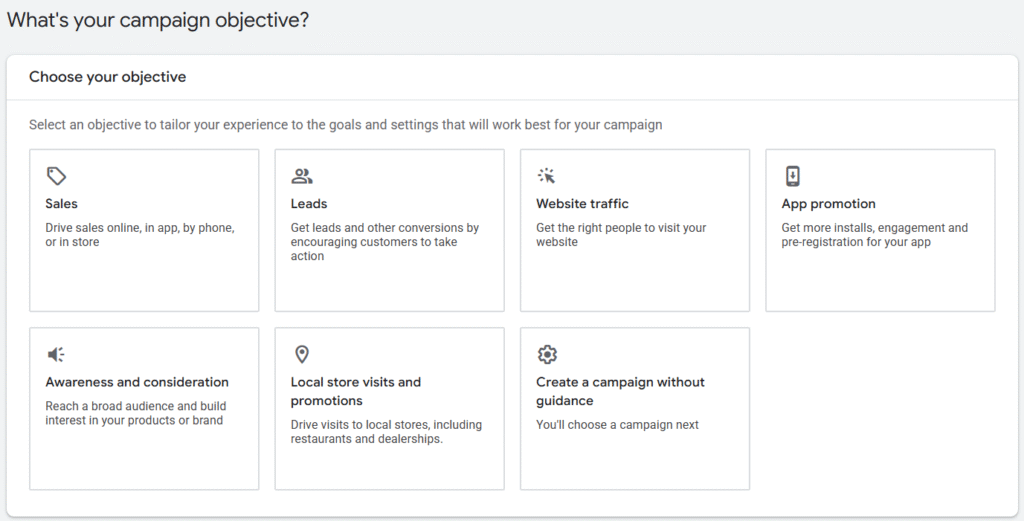
On the other hand, a conversion-based objective trains Google’s algorithm to find users who are more likely to take action. This is why businesses that optimize objectives see lower cost per lead and better quality conversions.
Campaign objectives also guide ad formats, bidding strategies, and placements. A brand awareness objective may show your ads on YouTube and Display Network, while a sales objective focuses more on Search, Shopping, or Performance Max campaigns.
Even your bidding—like Maximize Clicks or Maximize Conversions—is decided based on the objective you choose.
In short, if you want Google Ads to work in your favor, you must first understand Different Types of Google Ads Campaign Objectives and match them with your business goal—not guesswork.
Also Read: 50+ Google Ad Formulae Everyone Should Know
Awareness Objectives (Build Brand Visibility)
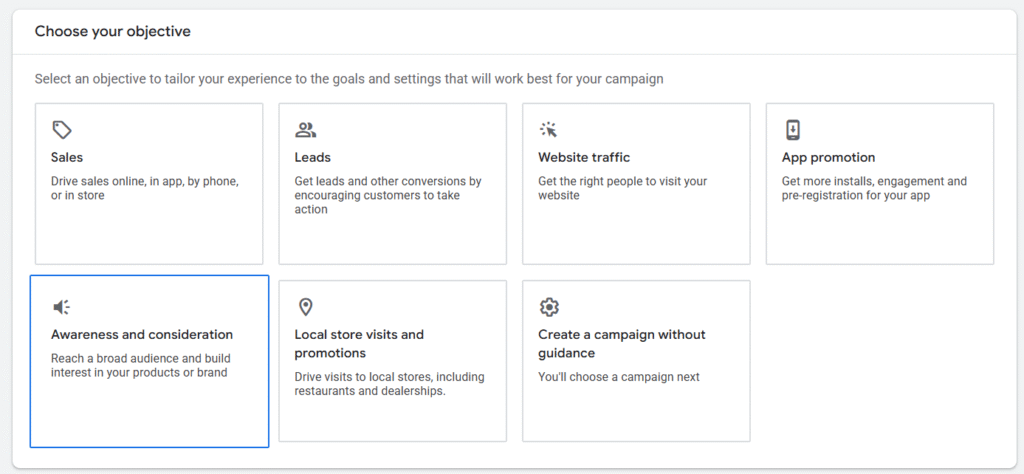
The Awareness objective in Google Ads is designed to put your brand in front of the maximum number of relevant people. The main goal here is not instant sales or leads, but to reach new audiences and improve brand recall.
In my experience, businesses that invest in awareness campaigns early build trust faster and see better results in later conversion campaigns. This stage is an important part of understanding the Different Types of Google Ads Campaign Objectives.
Google’s own data shows that brands using awareness-focused campaigns on YouTube and Display can increase ad recall by up to 30–40% within a few weeks. This means people may not buy immediately, but they remember your brand when they are ready.
Key Campaign Types for Awareness
- Display Ads
These ads appear on millions of websites, apps, and blogs across the Google Display Network. For example, a new coaching institute can show banner ads on education-related websites to build visibility. - YouTube Ads (Video Views & Reach)
YouTube is powerful for storytelling. Video reach campaigns help you show your ad to a large audience at a low cost, while video view campaigns focus on users likely to watch your video. - Discovery Ads
These ads appear on YouTube Home, Gmail, and Google Discover. They work well to attract attention using visuals and short messages, especially for lifestyle and service-based brands.
Best For
- New businesses that want people to know they exist
- Product launches where visibility is more important than sales in the beginning
- Branding-focused campaigns aiming to build long-term trust
Key KPIs to Track
- Impressions – how many times your ad is shown
- Reach – how many unique users see your ad
- Brand Lift – improvement in brand awareness or ad recall measured by Google
Awareness campaigns may not show immediate ROI, but they prepare the audience for the next stages of the funnel. When planned correctly, they make other Different Types of Google Ads Campaign Objectives perform much better.
Also Read: 100+ Google Ads Glossary: Terms & Definition You Should Know
Consideration Objectives (Drive Engagement & Traffic)
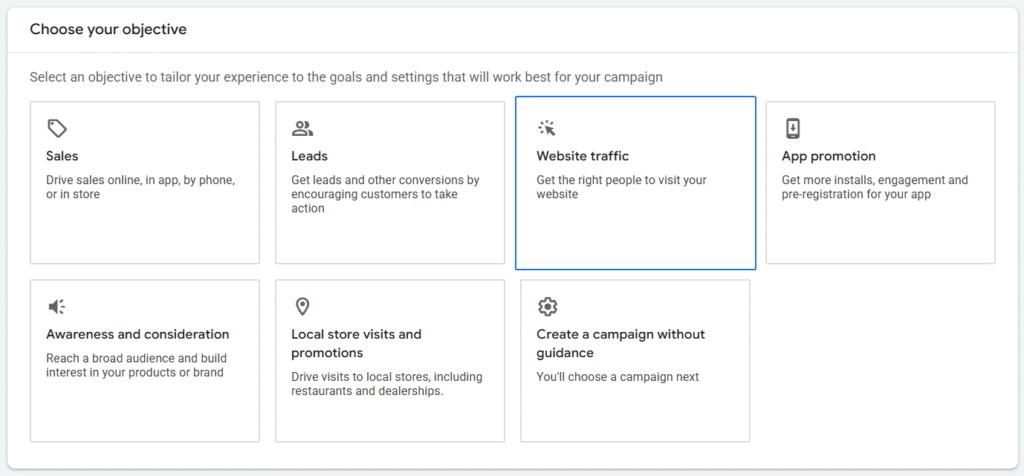
The Consideration objective is used when you want people to explore your brand, visit your website, or interact with your content. At this stage, users already have some interest, and your job is to guide them one step deeper. From my experience, this objective works best when awareness is already created and now you want quality traffic, not just visibility. This is a key stage while understanding Different Types of Google Ads Campaign Objectives.
Google reports that campaigns optimized for consideration can improve click-through rate (CTR) by 20–35% compared to non-optimized traffic campaigns. This happens because Google shows ads to users who are more likely to click and engage, not just scroll.
Key Campaign Types for Consideration
- Search Ads
These ads appear when users actively search on Google. For example, someone searching “digital marketing course near me” is already interested and more likely to visit your website. - Display Ads
Display ads help you bring back users who have seen your brand before or attract new users with interest-based targeting. - Video Ads (In-stream)
These ads play before or during YouTube videos. They are effective for explaining services, showing demos, or sharing short educational content. - Discovery Ads
Discovery ads work well to drive curiosity and clicks, especially when promoting blogs, offers, or app pages.
Best For
- Website traffic campaigns to increase visitors
- Content promotion like blogs, webinars, or landing pages
- App installs where awareness is created and action is expected
Key KPIs to Track
- Click-through rate (CTR) – shows how relevant your ad is
- Website visits – total users landing on your site
- Time on site – how long users stay, showing content quality
Consideration campaigns help warm up users before conversion. When planned properly, they support other Different Types of Google Ads Campaign Objectives by delivering engaged and intent-based traffic that converts later.
Also Read: Complete Guide to Google Ads Assets
Conversion Objectives (Generate Leads or Sales)
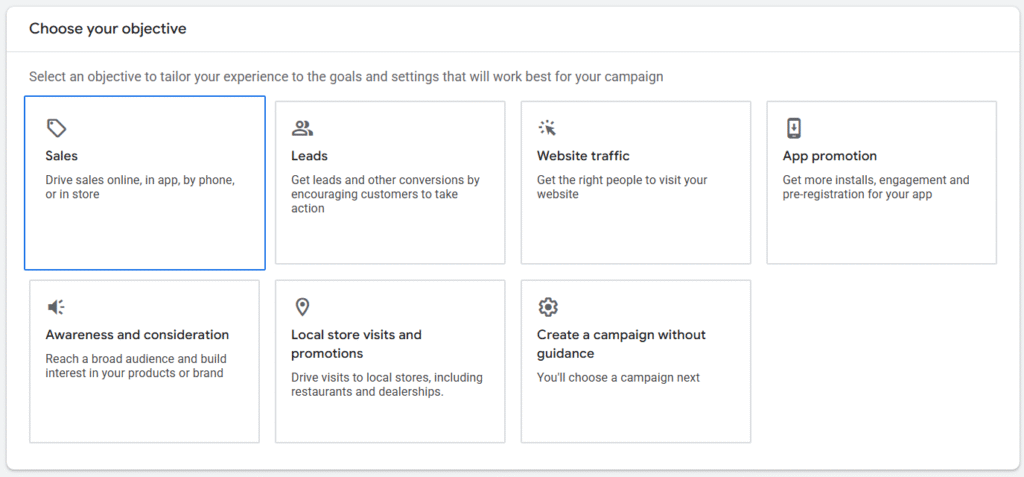
The Conversion objective is where Google Ads starts delivering real business results. The main goal here is simple—make users take action, such as filling a form, calling your business, or purchasing a product.
In my experience, most advertisers want results from day one, but conversion campaigns work best when tracking is set correctly and some data is already available. This stage is one of the most important parts of Different Types of Google Ads Campaign Objectives.
According to Google, advertisers using conversion-based bidding like Maximize Conversions see up to 20% more conversions at a similar cost compared to manual strategies. This happens because Google’s system learns who is most likely to convert and prioritizes showing ads to those users.
Key Campaign Types for Conversion
- Search Ads
Search ads work best for high-intent keywords. For example, a user searching “buy running shoes online” or “digital marketing course fees” is ready to take action. - Performance Max
Performance Max uses Google’s AI to show ads across Search, Display, YouTube, Gmail, and Discover. It is highly effective for both lead generation and sales when proper conversion tracking is in place. - Shopping Ads
These ads are ideal for e-commerce businesses. Product images, prices, and offers are shown directly on Google, increasing purchase intent. - Display Remarketing
Remarketing ads target users who have already visited your website but did not convert. Data shows remarketing can improve conversion rates by up to 2–3 times compared to cold traffic.
Best For
- Lead generation for services like education, real estate, or consulting
- E-commerce sales for online stores
- Service bookings such as appointments or inquiries
Key KPIs to Track
- Conversions – total actions completed
- Cost per conversion – how much you pay for each lead or sale
- Conversion rate – percentage of users who take action
Conversion campaigns are result-driven and require patience, clean data, and the right objective setup. When done correctly, they deliver the strongest ROI among all Different Types of Google Ads Campaign Objectives.
Also Read: 6 Smart Ways to Reduce Google Ads CPC & Maximize Budget
Sales Objectives (Maximize Revenue)
The Sales objective in Google Ads is focused on one clear outcome—generating direct purchases and maximizing revenue. This objective is best used when your business already has a working product, proper conversion tracking, and a clear understanding of customer buying behavior.
From my experience, sales-focused campaigns perform best when Google is given enough data to optimize toward revenue, not just clicks. This objective plays a major role in Different Types of Google Ads Campaign Objectives.
Google’s internal studies show that advertisers using smart bidding for sales, such as Target ROAS, can increase conversion value by up to 35% while maintaining profitability. This makes sales objectives ideal for businesses aiming to scale.
Key Campaign Types for Sales
- Shopping Ads
Shopping ads show product images, prices, and offers directly in search results. For example, an online clothing store can attract ready-to-buy customers searching for specific products. - Performance Max
Performance Max campaigns work across all Google platforms and are highly effective for scaling sales. They use machine learning to focus on users most likely to purchase. - Search Ads (High-Intent Keywords)
These ads target keywords like “buy,” “best price,” or “online store,” which indicate strong purchase intent and higher chances of conversion.
Best For
- Online stores selling physical or digital products
- D2C brands looking to grow revenue directly
- Product-based businesses with multiple SKUs
Key KPIs to Track
- Revenue – total sales generated from ads
- ROAS (Return on Ad Spend) – revenue earned for every rupee spent
- Average order value – average purchase amount per customer
Sales objectives are ideal when your goal is profit and scale. When aligned correctly, they deliver the strongest revenue impact among all Different Types of Google Ads Campaign Objectives.
Also Read: What is a Good Cost Per Click (CPC)
Local Store Visits & Promotions Objectives
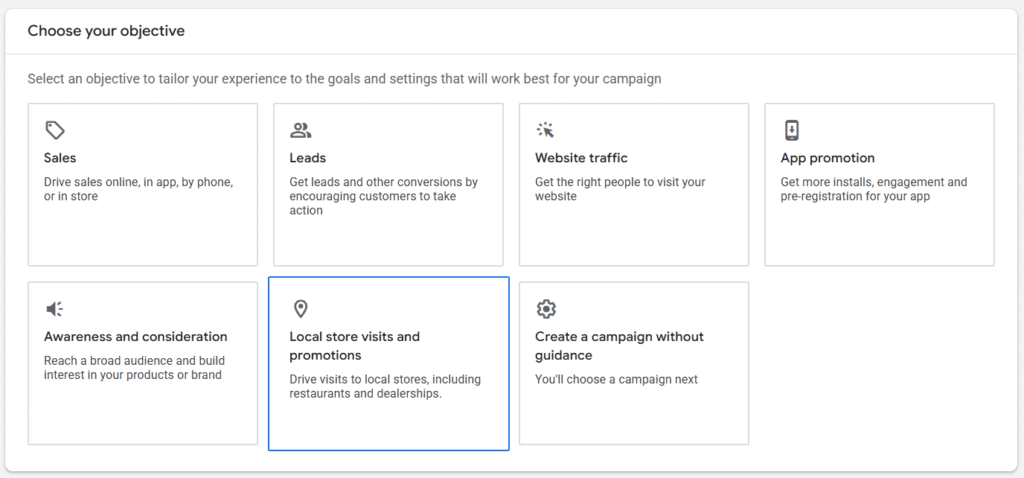
The Local Store Visits & Promotions objective is designed for businesses that want to bring people to their physical location. This objective focuses on converting online searches into offline visits.
In my experience, local campaigns work extremely well when users search with intent like “near me” or “open now.” This objective is an important part of Different Types of Google Ads Campaign Objectives for offline businesses.
Google data shows that 76% of people who search for a local business on mobile visit a store within 24 hours, and nearly 28% of those visits result in a purchase. This clearly proves how powerful local-focused campaigns can be when set up correctly.
Key Campaign Types for Local Objectives
- Local Search Ads
These ads appear when users search for nearby services. For example, a user searching “mobile repair shop near me” is shown ads with location, call, and direction options. - Performance Max for Store Goals
This campaign type uses Google’s AI to promote your store across Search, Maps, Display, YouTube, and Discover, all with a focus on driving store visits. - Display Ads with Location Targeting
These ads help increase awareness in a specific area by showing banners to users within a selected radius of your store.
Best For
- Local businesses like clinics, coaching centers, or gyms
- Retail stores with walk-in customers
- Service centers such as repair shops or salons
Key KPIs to Track
- Store visits – estimated foot traffic driven by ads
- Direction requests – how many users asked for navigation
- Call clicks – number of phone calls from ads
Local store campaigns connect digital ads with real-world results. When used properly, they strengthen the impact of Different Types of Google Ads Campaign Objectives by turning online intent into offline action.
Also Read: What is a Good Google Ads Quality Score?
App Promotion Objectives
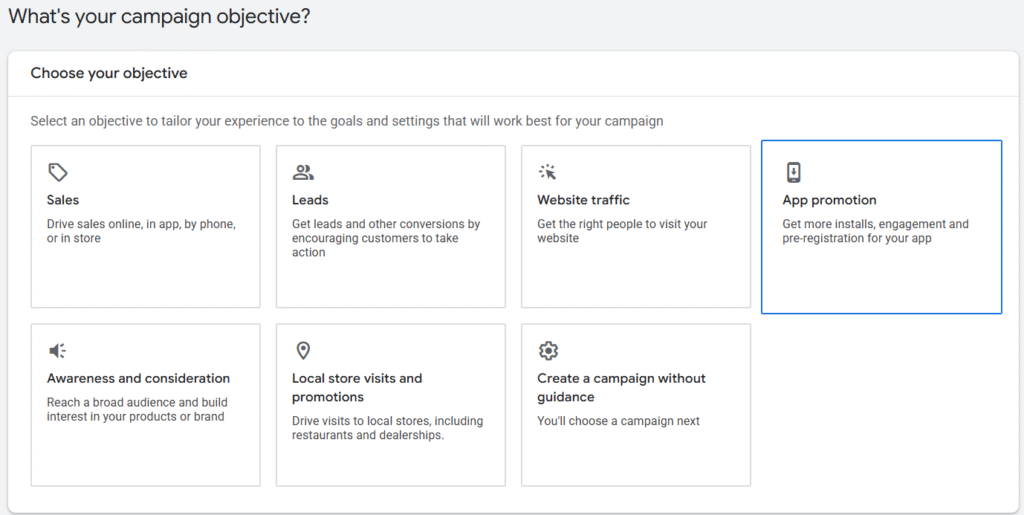
The App Promotion objective is used when the main goal is to increase app installs and keep users active inside the app. This objective helps businesses reach people who are more likely to download an app or complete actions like sign-ups, purchases, or subscriptions.
From my experience, app campaigns perform best when the app has a smooth user experience and proper tracking through Firebase or similar tools. This objective is a key part of Different Types of Google Ads Campaign Objectives for app-based businesses.
Google reports that app campaigns powered by machine learning can deliver up to 30% lower cost per install (CPI) when optimized correctly. This is because Google automatically finds users who frequently install and use apps.
Key Campaign Types for App Promotion
- App Install Ads
These campaigns focus on getting new users to download your app. Ads are shown across Google Search, Play Store, YouTube, Display, and Discover. For example, a food delivery app can target users searching for “order food online.” - App Engagement Ads
These ads target users who have already installed your app and encourage actions like purchases, upgrades, or renewals. They are highly effective for increasing repeat usage.
Best For
- Mobile apps offering services or tools
- Gaming apps aiming for high install volume
- Subscription-based platforms looking to increase active users
Key KPIs to Track
- App installs – number of new downloads
- In-app actions – events like sign-ups or purchases
- Cost per install (CPI) – amount spent to acquire one user
App promotion campaigns help scale both installs and engagement. When aligned properly, they play a strong role within Different Types of Google Ads Campaign Objectives by focusing on long-term user value, not just downloads.
Lead Generation Objectives
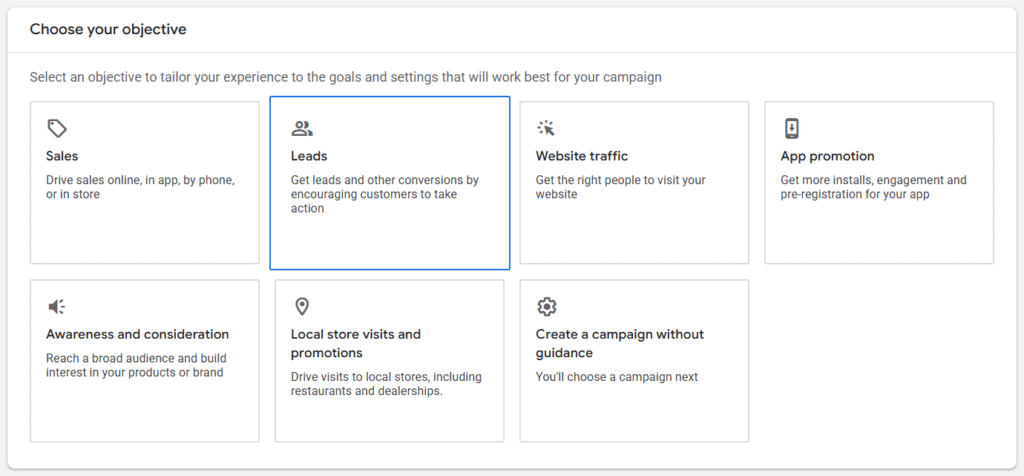
The Lead Generation objective is focused on one clear task—capturing user details like name, phone number, email, or inquiry forms. This objective is ideal for businesses where sales do not happen instantly and follow-ups are required.
In my experience, lead-based campaigns perform best when the offer is clear and the form is simple. This objective is an essential part of Different Types of Google Ads Campaign Objectives for service-driven businesses.
Google data shows that lead form ads can improve conversion rates by up to 20% compared to sending users to long landing pages, especially on mobile. This is because users can submit their details without leaving the platform.
Key Campaign Types for Lead Generation
- Search Ads
Search ads work best for high-intent keywords like “course fees,” “consultation,” or “service near me.” Users searching these terms are already interested. - Display Lead Form Ads
These ads allow users to submit their details directly from the ad. For example, an education institute can collect student inquiries without redirecting them to a website. - YouTube Lead Ads
YouTube lead ads combine video engagement with instant lead forms, making them effective for awareness-to-lead strategies.
Best For
- Education institutes collecting student inquiries
- Service providers like consultants, agencies, or clinics
- B2B companies with longer sales cycles
Key KPIs to Track
- Leads – total inquiries received
- Cost per lead – amount spent per lead
- Lead quality – relevance and conversion potential of leads
Lead generation campaigns require proper tracking and follow-up systems. When executed correctly, they deliver consistent results and strengthen the overall performance of Different Types of Google Ads Campaign Objectives.
Choosing the Right Google Ads Objective
Choosing the right Google Ads objective is where most success or failure begins. Many advertisers jump straight to sales or leads without matching the objective to their actual business goal. From my experience, campaigns perform best when the objective is selected logically, not emotionally. This step ties everything together in Different Types of Google Ads Campaign Objectives.
Business goal vs campaign goal should always be clear. Your business goal might be to grow revenue, but your campaign goal could be awareness or traffic in the beginning. For example, a new brand cannot expect instant sales without first building trust. In such cases, starting with awareness or consideration delivers better long-term results.
Budget consideration also plays a big role. Awareness and traffic campaigns usually need lower budgets and help collect data. Conversion and sales campaigns require more budget because Google needs enough signals to optimize properly. Running a sales objective with a very small budget often leads to poor performance.
Funnel stage mapping is another important factor. Awareness works at the top of the funnel, consideration in the middle, and conversion or sales at the bottom. When your objective matches the funnel stage, your ads feel natural to the user instead of pushy.
Lastly, think about short-term vs long-term results. Lead and sales campaigns give faster results, while awareness and consideration campaigns build brand value over time. The best strategy is to combine objectives, not depend on just one.
When you align goals, budget, and funnel stage, Different Types of Google Ads Campaign Objectives start working together instead of against each other.
Common Mistakes While Selecting Objectives
Even with good budgets and creatives, many Google Ads campaigns fail because of wrong objective selection. Over the years, I’ve seen the same mistakes repeated again and again. Avoiding these errors can save money and improve performance across Different Types of Google Ads Campaign Objectives.
One common mistake is choosing conversion objectives without enough data. New accounts often start with “Maximize Conversions” without any past conversions. In such cases, Google has nothing to learn from, which leads to higher costs and poor results. Starting with traffic or consideration first is usually smarter.
Another big mistake is running awareness campaigns and expecting direct sales. Awareness ads are meant to build visibility, not immediate purchases. When businesses expect sales from branding campaigns, they feel Google Ads is not working, even though the strategy itself is wrong.
Many advertisers also ignore proper tracking setup. Without conversion tracking, Google cannot optimize your ads correctly. This results in wasted budget and unclear performance. Accurate tracking is the backbone of every successful campaign.
Lastly, using the wrong bidding strategy hurts results. For example, using Maximize Clicks when the goal is lead generation attracts low-quality traffic. Bidding should always match the objective.
Avoiding these mistakes helps all Different Types of Google Ads Campaign Objectives deliver better ROI and consistent growth.
Final Thought
Google Ads can deliver powerful results, but only when the right campaign objective is chosen. In this guide, we covered all major options—from awareness and consideration to conversion, sales, local store visits, app promotion, and lead generation. Each objective serves a different purpose and fits a specific stage of the customer journey. Understanding these options is the key to using Different Types of Google Ads Campaign Objectives effectively.
The most important lesson is alignment. Your campaign objective must match your business goal, budget, and funnel stage. If your goal is visibility, awareness works best. If you want traffic and engagement, consideration is the right choice. For leads and revenue, conversion and sales objectives deliver results—but only when tracking and data are in place. When objectives and goals are aligned, Google’s system works in your favor and improves ROI over time.
For beginners, my final recommendation is simple: don’t rush for sales on day one. Start by building awareness or traffic, collect data, set up proper tracking, and then move toward conversions. This step-by-step approach creates a strong foundation and helps you get consistent results.
When used correctly, Different Types of Google Ads Campaign Objectives are not confusing—they are powerful tools that can grow any business in a structured and profitable way.

Founder at Digital Marketing Marvel | Founder at RKDMT – Raju Kumar Digital Marketing Trainer | Best Digital Marketing Trainer in Delhi/NCR – Digiperform | Project Manager | 5+ years | Genius Study Abroad & Inlingua’s Digital Marketing Head | Learn Digital Marketing
What is a Google Search Campaign: Basics & Best Practices
[…] Also Read: What are Different Types of Google Ads Campaign Objectives […]
What are Google Display Ads: Basics & Best Practices
[…] Also Read: What are Different Types of Google Ads Campaign Objectives […]
Create a Video Campaign Google Ads Help - Complete Guide
[…] Also Read: What are Different Types of Google Ads Campaign Objectives […]
What Is Google Ads? A Complete Beginner’s Guide
[…] Also Read: What are Different Types of Google Ads Campaign Objectives […]