


Search Intent Mistake Killing Your Rankings
Search Intent Mistake Killing Your Rankings
You followed the rules. You added keywords, optimized headings, maybe even built backlinks. Everything looks “SEO-friendly,” yet your content still doesn’t rank. That’s where most people get misled. Ranking failure today isn’t about doing less—it’s about doing the wrong thing for the wrong intent. This is where the real problem begins: a search intent mistake.
Most creators assume rankings depend on technical factors like keyword density, backlinks, or content length. While those still matter, they are no longer the deciding factor. Google now prioritizes whether your content actually satisfies the user’s intent. If it doesn’t, your page won’t rank—no matter how well optimized it is.
This is why many pages fail despite having “good SEO.” They look optimized, but they are not aligned. For example, someone searching “best SEO tools” expects comparisons, features, and maybe pricing. But if your content explains “what is SEO,” even if it’s detailed and well-written, it doesn’t solve the user’s immediate need. The result is simple—users leave quickly, engagement drops, and rankings follow.
If you want to understand this deeper, you need to focus on SEO concepts that drive ranking, because modern SEO is no longer about isolated tactics. It’s about alignment between content and intent.
Google’s algorithm has evolved significantly. It no longer rewards pages just for including keywords. Instead, it evaluates whether your content solves the user’s problem better than other results. According to Google Search Central, content should be created with a people-first approach. This means usefulness, clarity, and relevance matter more than keyword placement. That’s why a shorter but relevant page can outrank a longer, more detailed one—because relevance wins.
This isn’t just theory. A Backlinko study found that top-ranking pages consistently align with search intent. Pages that fail to match intent may rank temporarily, but they struggle to stay there. Google continuously measures user behavior—whether people click, stay, or leave. If users don’t find what they need, rankings drop.
A search intent mistake usually happens when you choose a keyword without analyzing the search results, assume what users want instead of verifying it, or focus on writing “good content” instead of the right content. The issue isn’t visible in your writing—it’s visible in the mismatch between your content and user expectations.
Consider this simple example. Someone searches “best digital marketing course.” They expect comparisons, options, and reviews. But if your page talks about the importance of digital marketing or career benefits, it completely misses the intent. Even if your content is valuable, it doesn’t answer the query—and that’s enough for Google to push it down.
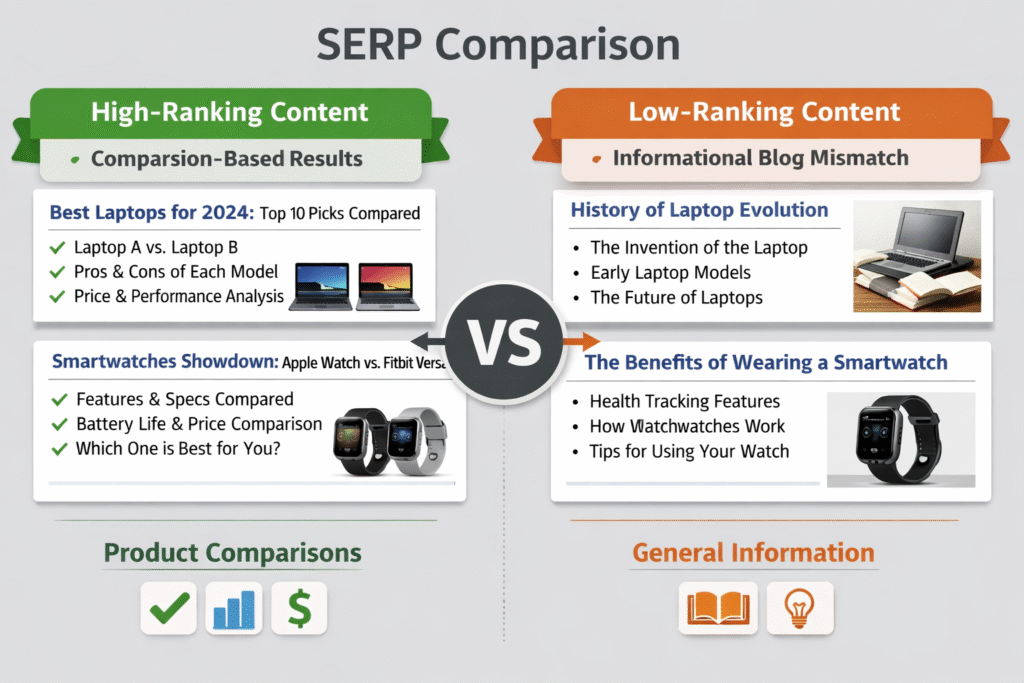
The biggest shift you need to understand is this. Old SEO thinking was: if I optimize well, I will rank. New SEO reality is: if I match intent better than others, I will rank. Once you understand this, your entire approach changes. You stop writing for keywords and start writing for outcomes. And that’s how you fix the search intent mistake that’s silently killing your rankings.
What Is Search Intent (And Why It Controls Rankings)
Most people think SEO starts with keywords. In reality, it starts with understanding why someone is searching in the first place. That “why” is called search intent—and it has quietly become the foundation of modern rankings.
Search intent refers to the purpose behind a user’s query. When someone types something into Google, they are not just looking for information—they are trying to solve a problem, make a decision, or take an action. If your content doesn’t align with that purpose, it doesn’t matter how optimized it is. This is exactly where many creators fall into a search intent mistake without even realizing it.
In earlier versions of search engines, ranking was heavily based on keyword matching. If your page contained the right keywords, you had a good chance of ranking. But search has evolved. Today, Google focuses more on understanding context, meaning, and user expectations. According to Google Search Central, content should be designed to be helpful and relevant to users, not just optimized for search engines. That shift moved SEO from keyword-focused to intent-focused.
This evolution is why intent now controls rankings. Google analyses what users expect to see for a query and then ranks content that matches that expectation. It looks at patterns—what type of pages are ranking, how users interact with them, and whether they actually solve the query. If your content doesn’t fit into that pattern, it gets filtered out, even if it is technically strong. That’s how a search intent mistake can override all other SEO efforts.
To understand this better, you need to break search intent into its core types.
The 4 Types of Search Intent
Every search query falls into one of four primary categories. Identifying these correctly is the first step to avoiding a search intent mistake.
| Intent Type | Example Query | Content Type | Goal |
| Informational | what is SEO | Blog/Guide | Learn something |
| Navigational | Facebook login | Homepage | Find a specific site |
| Transactional | buy SEO course | Landing/Product Page | Take action or purchase |
| Commercial Investigation | best SEO tools | Comparison/List | Evaluate options |
Informational intent is when users want to learn. They are looking for explanations, guides, or tutorials. Navigational intent is straightforward—they already know where they want to go and are using Google as a shortcut. Transactional intent shows strong action—they are ready to buy or sign up. Commercial investigation sits in between, where users are comparing options before making a decision.
The key is this: each intent demands a different content format. If you mismatch the format—even slightly—you risk losing rankings. For example, writing a long educational blog for a transactional query will almost always fail, because it doesn’t align with what users expect at that stage.
This is why search intent is not just a concept—it’s a filter. Google uses it to decide which content deserves to rank. Once you understand that, SEO becomes less about guessing and more about aligning your content with what already works.
The Search Intent Mistake That Kills Rankings
Most SEO problems don’t come from lack of effort—they come from misalignment. You choose the right keyword, create detailed content, optimize everything… and still don’t rank. The reason is simple: your content doesn’t match what the user expected to find. That gap is the core search intent mistake.
At its simplest, this mistake happens when the content you create does not align with the purpose behind the search query. You’re targeting the keyword, but not the intent behind it. And in today’s SEO, intent matters more than the keyword itself.
Think about how people search. When someone types a query into Google, they already have a clear expectation. They’re not exploring randomly—they’re looking for a specific type of answer. If your page doesn’t deliver that exact format or outcome, users leave. And when users leave, Google takes that as a signal that your page isn’t relevant.
This is where most content fails. Not because it’s low quality, but because it’s solving the wrong problem.
One of the most common patterns of a search intent mistake is creating the wrong type of content for a keyword. For example, someone searches “buy digital marketing course.” This is a transactional query. The user is ready to take action—they want options, pricing, or a direct way to purchase. But instead of a landing page or product-focused content, you publish a blog explaining what digital marketing is. Even if that blog is well-written, it doesn’t match the intent. The result is immediate disengagement.
The opposite mistake also happens. A user searches “what is SEO,” which clearly indicates informational intent. They want a simple explanation or a beginner-friendly guide. But if your page is a sales-heavy landing page pushing a course or service, it creates friction. The user came to learn, not to buy. Again, mismatch—and again, rankings suffer.
Another subtle version of this mistake is trying to target multiple intents within a single page. For instance, combining a guide, a comparison, and a sales pitch all in one piece of content. While it may seem comprehensive, it actually confuses both users and search engines. Google prefers clarity. It wants to know exactly what your page is meant to do. When your content tries to do everything, it ends up doing nothing well.
The deeper issue here is misunderstanding how Google evaluates relevance. It doesn’t just scan your content for keywords—it compares your page against what’s already ranking. If the top results are list-based comparisons and you provide a long-form theory article, you’re already misaligned. That’s the moment a search intent mistake becomes unavoidable.
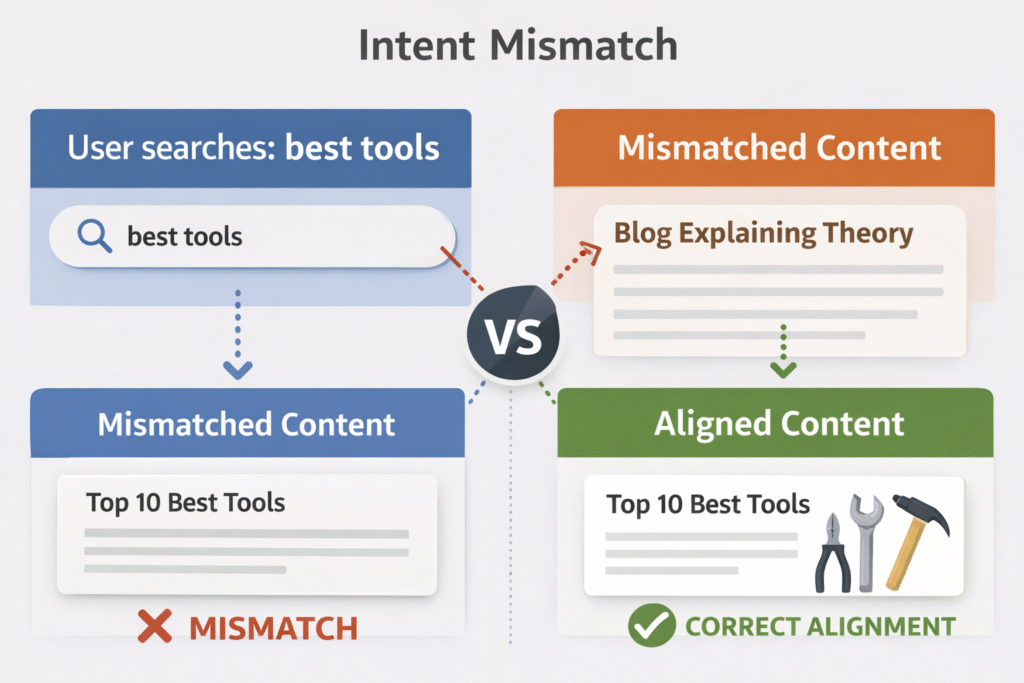
The impact of this mistake is bigger than it seems. It affects:
- Click-through rates, because users don’t find your result appealing
- Engagement, because the content doesn’t meet expectations
- Rankings, because Google sees the mismatch
Over time, even a well-optimized page will struggle to maintain visibility if it keeps failing to satisfy intent.
The shift you need to make is simple but powerful. Stop asking, “Am I targeting the right keyword?” Start asking, “Am I solving the exact problem behind this search?” That one change eliminates the search intent mistake and aligns your content with what actually ranks.
How Google Detects Search Intent (Behind the Scenes)
Google doesn’t guess what users want—it learns from patterns. Every time someone searches, clicks, stays, or leaves, it feeds data back into the system. Over time, this creates a clear understanding of what users expect for specific queries. That’s how Google detects search intent, and that’s why a search intent mistake becomes so easy for the algorithm to identify.
The first layer of this process is the SERP itself. When you search a keyword, the top-ranking pages are not random—they are Google’s interpretation of what satisfies that query. If most results are blogs, Google has identified informational intent. If they are product pages, the intent is transactional. If they are comparison lists, it’s a commercial investigation. This means the SERP is not just a result page—it’s a blueprint of user intent. Ignoring it is one of the fastest ways to make a search intent mistake.
The second layer is content format patterns. Google doesn’t just look at topics—it looks at how content is presented. For example, “best tools” queries usually return listicles, “how to” queries return step-by-step guides, and “buy” queries return product or service pages. Even if your content covers the same topic, using the wrong format creates a mismatch. This is why two pages targeting the same keyword can perform completely differently—one matches the expected format, the other doesn’t.
The third and most powerful layer is user behavior signals. Google constantly measures how users interact with search results. It tracks whether people click on your page, how long they stay, and whether they return to the search results. These signals help Google understand if your content is actually satisfying intent.
Industry studies consistently show that pages with higher click-through rates (CTR) and stronger engagement tend to perform better over time. If users click your page and stay longer, it signals relevance. If they leave quickly, it signals mismatch. This is where a search intent mistake becomes visible—not in your content, but in how users react to it.
To simplify how these signals work together, here’s a breakdown:
| Signal | What It Indicates | SEO Impact |
| CTR | How appealing your result is to users | Higher CTR can improve rankings |
| Dwell Time | How long users stay on your page | Longer time signals relevance |
| Bounce Rate | Whether users leave quickly | High bounce may indicate a mismatch |
| SERP Pattern | Type of content ranking for a query | Defines expected intent |
The key takeaway is this: Google doesn’t rely on one signal. It combines SERP patterns, content formats, and user behavior to understand intent with high accuracy. If your page doesn’t align with those signals, it gets pushed down—even if everything else looks optimized.
Once you understand this system, SEO becomes more predictable. You stop guessing what might work and start aligning with what already works. And that’s how you avoid making a search intent mistake in the first place.
Common Search Intent Mistakes (With Real Scenarios)
Most SEO mistakes are obvious—broken links, missing tags, slow pages. But search intent mistakes are different. They look invisible. Your content feels “right,” yet it underperforms. That’s because the problem isn’t technical—it’s contextual. You’re solving the wrong problem for the user.
Once you understand these patterns, you’ll start spotting exactly where content goes wrong—and more importantly, how to fix it.
1. Targeting the Wrong Intent
This is the most direct and damaging search intent mistake. You choose a keyword, but you misunderstand what the user actually wants behind it.
For example, you target the keyword “best SEO tools.” On the surface, it seems like a general topic. But when you check the search results, you’ll notice something specific—almost every top-ranking page is a list or comparison article. That tells you the intent is commercial investigation. Users are comparing options before making a decision.
Now, imagine you publish a blog explaining “what SEO tools are” instead of listing them. Even if your content is high quality, it won’t rank. Why? Because it doesn’t match the expected outcome.
This mistake often starts at the research stage. If you want to avoid it, you need a clear understanding of keyword research for beginners, because intent is not just about keywords—it’s about what those keywords represent.
2. Mixing Multiple Intents on One Page
Trying to cover everything in one piece of content might feel like a smart strategy—but it often backfires.
When a page tries to serve multiple intents at once, it creates confusion. For example, a single page that:
- explains a concept (informational)
- compares tools (commercial)
- pushes a product (transactional)
From a creator’s perspective, this looks comprehensive. From Google’s perspective, it looks unclear.
Search engines prefer pages that serve a single, focused intent. When your content tries to do too much, it dilutes its relevance. Users also feel this confusion—they don’t know whether they’re supposed to learn, compare, or buy.
This is a subtle search intent mistake, but it significantly reduces ranking potential because clarity is lost.
3. Ignoring SERP Patterns
One of the easiest ways to understand intent is also the most ignored—simply looking at what’s already ranking.
The top results on Google are not random. They are the result of tested user behavior. If most pages are listicles, that’s what users prefer. If they are step-by-step guides, that’s the expected format.
Ignoring these patterns leads to misalignment.
For example, if the SERP is filled with “top 10” lists and you publish a long theoretical article, your content may be valuable—but it won’t match what users are clicking on.
This is why analyzing the SERP is not optional. It’s the fastest way to avoid a search intent mistake before you even start writing.
4. Writing for Keywords, Not Users
This is the classic mistake—and still one of the most common.
Many creators focus so much on inserting keywords that they forget the actual purpose of content: solving a problem. The result is content that feels forced, repetitive, and disconnected from user needs.
Keyword stuffing might have worked in the past, but today it creates a negative experience. Users can immediately tell when content is written for search engines instead of people.
Modern SEO is about intent satisfaction, not keyword frequency. If your content answers the query clearly and effectively, rankings follow naturally. If it doesn’t, no amount of keyword optimization will save it.
This is where the shift happens:
From writing to rank → to writing to solve.
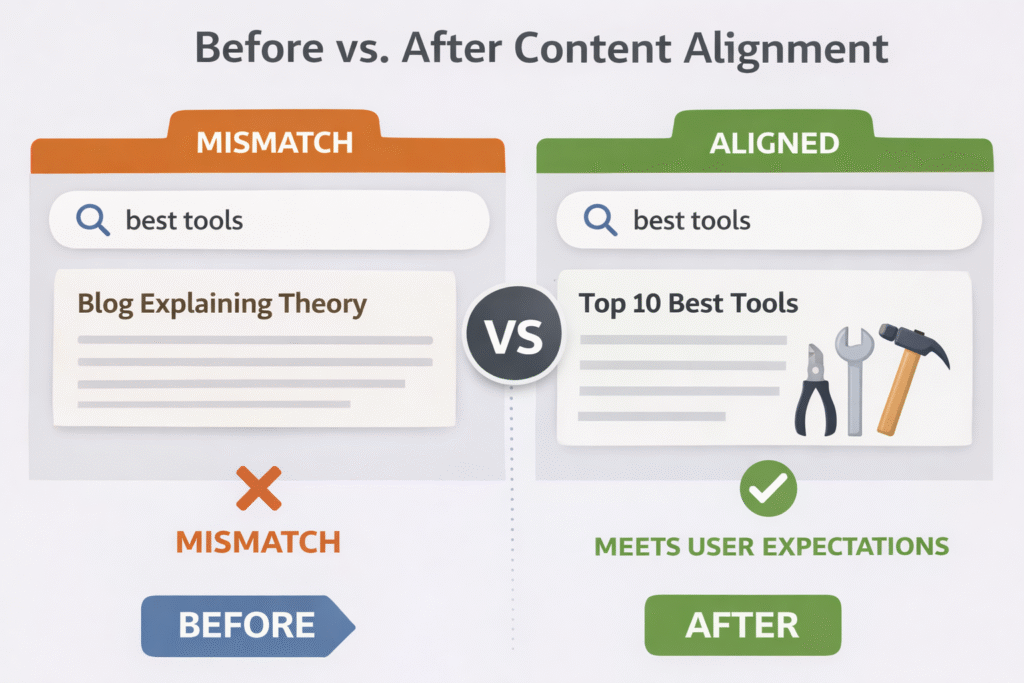
These mistakes are common because they’re easy to overlook. But once you start identifying them, your entire content strategy improves. You stop guessing, stop over-optimizing, and start aligning your content with what users—and Google—actually expect.
How to Identify Search Intent Correctly
Most people guess search intent. That’s the problem. Intent is not something you assume—it’s something you observe and decode. If you skip this step, you’ll almost always make a search intent mistake, no matter how good your content is.
The good news is that identifying intent is not complicated. It just requires a structured approach. Once you follow this process consistently, SEO becomes far more predictable.
Step 1 – Analyze the SERP
Before writing a single word, open Google and search your target keyword. The top 5–10 results will tell you everything you need to know.
Look closely at what is ranking:
- Are they blogs, product pages, or videos?
- Are they guides, lists, or comparisons?
- Do they follow a similar structure?
This is not a coincidence. It’s Google showing you what users prefer for that query.
If most results are listicles, that means users want options. If they are step-by-step guides, users want instructions. Ignoring this is one of the fastest ways to make a search intent mistake.
Think of the SERP as a blueprint. Your job is not to reinvent it—but to match it and improve it.
Step 2 – Understand Content Format
Once you analyze the SERP, the next step is identifying the dominant format.
Content format plays a huge role in rankings. Even if your topic is correct, the wrong format can ruin performance.
Common formats include:
- Blogs (informational guides)
- Listicles (top 10, best tools, comparisons)
- Product or landing pages (transactional intent)
- Tutorials or walkthroughs (how-to queries)
For example, a keyword like “best SEO tools” almost always favors list-based content. If you write a long theoretical article instead, it won’t match expectations.
This is where many creators fail—they focus on what to write, not how to present it. Format is part of intent.
Step 3 – Identify User Goal
Now go deeper. Ask a simple question:
What is the user actually trying to achieve?
Every search has a goal behind it:
- Learning something new
- Comparing options
- Solving a specific problem
- Making a purchase decision
Your content should directly support that goal.
For example:
- “What is SEO?” → user wants understanding
- “Best SEO tools” → user wants comparison
- “Buy SEO course” → user wants action
If your content doesn’t help the user move toward that goal, it creates friction—and that’s where a search intent mistake happens.
Step 4 – Match Content Depth
Intent is not just about topic or format—it’s also about depth.
Some queries require:
- Beginner-level explanations
- Step-by-step breakdowns
- Advanced strategies
If your content is too basic for an advanced query, it feels shallow. If it’s too complex for a beginner query, it feels overwhelming.
Matching depth means aligning your content with the user’s level of understanding.
If you want to refine this further, studying an SEO content writing guide can help you structure content in a way that matches both intent and readability.
Quick Reference
| Keyword | Intent Type | Recommended Content |
| What is SEO | Informational | Beginner-friendly guide |
| best SEO tools | Commercial investigation | Listicle/comparison |
| Buy a digital marketing course | Transactional | Landing/product page |
| SEO tips for beginners | Informational | Step-by-step tutorial |
Identifying search intent correctly is not about guesswork—it’s about pattern recognition. Once you train yourself to read the SERP, understand the format, define user goals, and match depth, you eliminate the chances of making a search intent mistake. And that’s when your content starts aligning with what actually ranks.
Search Intent vs Keywords: What Matters More?
Most people entering SEO start with one belief: keywords are everything. And they’re not entirely wrong—keywords do bring visibility. But visibility alone doesn’t guarantee rankings or results. That’s where the confusion begins.
Keywords help your content get discovered. Search intent determines whether it deserves to stay.
This is the difference most people miss. You can rank temporarily with the right keyword, but if your content doesn’t match intent, it won’t hold that position. Google doesn’t just rank pages—it continuously evaluates whether they satisfy users. If they don’t, rankings drop.
This is why focusing only on keywords often leads to a search intent mistake. You might target a high-volume keyword, create content around it, and still see poor performance. Not because the keyword is wrong, but because the intent behind it isn’t properly addressed.
Think of it this way. Keywords bring users to your page, but intent decides what happens next. If your content aligns with what the user expects, they stay, engage, and take action. If it doesn’t, they leave—and that signals Google that your page isn’t relevant.
This is also why two pages targeting the same keyword can perform completely differently. One matches intent, the other doesn’t. And in most cases, the one that aligns with intent wins, even if it has fewer backlinks or lower domain authority.
To make this clearer, here’s a direct comparison:
| Factor | Keywords | Search Intent |
| Role | Helps content get discovered | Determines if content ranks |
| Focus | Words and phrases | Meaning behind the query |
| Impact | Brings traffic | Drives engagement and conversions |
| Priority | Important | Critical |
| Longevity | Short-term ranking potential | Long-term ranking stability |
The key takeaway is not that keywords are unimportant—they are still essential. But they are only the starting point. Without intent alignment, they lose effectiveness.
Modern SEO works like a two-step system:
- Keywords bring traffic
- Intent determines rankings and results
If you ignore the second step, you end up with impressions but no clicks, traffic but no engagement, and content that never reaches its full potential.
The real shift happens when you stop asking, “Which keyword should I target?” and start asking, “What does the user expect when they search this?” That’s when you stop making a search intent mistake and start creating content that actually ranks and converts.
How Search Intent Impacts SEO Performance
SEO is often measured through metrics—traffic, rankings, engagement—but what drives those numbers is not always obvious. At the core of all these metrics is one factor: how well your content matches user intent. When you get that right, performance improves naturally. When you don’t, even well-optimized pages struggle. This is where a search intent mistake directly affects measurable results.
The first and most immediate impact is on bounce rate. When users land on your page and realize it doesn’t match what they were looking for, they leave almost instantly. This increases your bounce rate, which signals to Google that your content is not relevant for that query. On the other hand, when your content aligns with intent, users stay longer, explore further, and engage more. The difference is not in the quality of writing—it’s in the relevance of the content.
Closely connected to this is dwell time, or how long users spend on your page. When your content answers the user’s query clearly and completely, they don’t need to go back and search again. They stay, read, and sometimes interact further. This extended engagement tells search engines that your page is useful. In contrast, a search intent mistake often leads to short visits, quick exits, and low interaction—all of which weaken your ranking signals.
These behavioral patterns directly influence rankings over time. While Google does not rely on a single metric, it evaluates a combination of signals—click-through rates, dwell time, and user satisfaction. According to guidance from Google Search Central, creating helpful, user-focused content is key to ranking success. This indirectly confirms that engagement signals, driven by intent alignment, play a crucial role in how pages perform.
The impact of intent can be seen as a chain reaction. When your content matches intent:
- Users click because the title feels relevant
- They stay because the content meets expectations
- They engage because the information is useful
- Google rewards the page with better visibility
When your content misses intent:
- Users click but leave quickly
- Engagement drops
- Signals weaken
- Rankings decline
This is why fixing a search intent mistake often leads to noticeable improvements without changing anything else. You’re not adding more keywords or backlinks—you’re simply aligning your content with what users already expect.
In practical terms, search intent acts as the bridge between content and performance. It connects what you publish with how users respond. And in modern SEO, that response is what ultimately determines whether your content grows or disappears in search results.
Advanced Strategy: Using Search Intent for Content Clusters
Most websites don’t struggle because of lack of content—they struggle because their content is scattered. Random blogs, disconnected topics, and no clear structure. Even if each piece is well-written, it fails to build authority. This is where search intent becomes a strategic advantage, not just a ranking factor.
Instead of creating isolated articles, you can organize your content into clusters based on intent. This means grouping multiple pieces of content around a single topic, but targeting different user intentions at each stage. When done correctly, this builds strong topical authority and makes your site more valuable in Google’s eyes.
Think of it like this. A single keyword has multiple layers of intent. For example, someone entering your niche might go through this journey:
- First, they want to understand a concept
- Then, they want to explore options
- Finally, they want to take action
If your content only targets one stage, you lose the rest of the journey. But if you build content around all stages, you create a complete system.
This is where a search intent mistake often happens—people create content for one keyword, but ignore the different intents behind it. As a result, their content stays limited instead of expanding into authority.
How Intent-Based Clusters Work
A content cluster typically consists of:
- One pillar page (broad topic, high-level coverage)
- Multiple supporting pages (specific topics targeting different intents)
For example, if your main topic is SEO:
- Pillar page → Complete SEO Guide (informational)
- Supporting blog 1 → Keyword research guide (informational)
- Supporting blog 2 → Best SEO tools (commercial investigation)
- Supporting page 3 → Buy SEO services (transactional)
Each piece serves a different intent, but all are connected.
This creates a strong signal to Google:
“This website covers the topic deeply and from multiple angles.”
Why This Strategy Improves Rankings
When you cluster content by intent, three things happen:
First, you increase topical authority. Instead of having one article on a topic, you build a network of related content. Google sees this as expertise.
Second, you improve internal linking strength. Each page supports the others, passing relevance and authority across the cluster. This makes it easier for all pages to rank.
Third, you capture users at different stages. Some visitors are learning, some are comparing, and some are ready to act. Your content meets all of them.
If you want to strengthen this system further, integrating tools like AI tools for SEO can help you identify content gaps and generate cluster ideas faster.
From Isolated Content to Content System
The biggest shift here is moving from:
- Writing individual blogs
to - Building a connected content ecosystem
Instead of asking:
“What should I write next?”
You start asking:
“Which intent within this topic have I not covered yet?”
That’s how you avoid repeating content and eliminate the risk of a search intent mistake across your site.
Search intent is not just something you optimize within a page—it’s something you structure your entire content strategy around. When you use it to build clusters, you don’t just rank for one keyword. You dominate the entire topic.
Tools to Analyze Search Intent
Understanding the search intent conceptually is useful, but real SEO performance comes from applying it consistently. And the truth is—you can’t rely on assumptions. You need tools that show you what users are actually doing, what Google is ranking, and how intent is being interpreted in real time.
This is where most people slip into a search intent mistake. They think they understand intent, but they never validate it. As a result, they create content based on guesswork instead of data.
The right tools eliminate that guesswork. They don’t just give you keywords—they reveal patterns, behaviors, and expectations. When you combine these insights, search intent becomes predictable instead of confusing.
Google SERP (The Most Accurate Intent Source)
The most powerful tool for analyzing search intent is also the simplest—Google itself.
When you search a keyword, the results page is not random. It is a direct reflection of what Google believes satisfies user intent for that query. In other words, the SERP is your blueprint.
Instead of just looking at titles, analyze deeper:
- What type of content dominates the page (blogs, product pages, videos)
- What format is used (guides, lists, comparisons, tutorials)
- Whether featured snippets appear (definitions, steps, FAQs)
- Presence of “People Also Ask” questions
For example, if the top 10 results are listicles, that’s not a coincidence. It means users prefer comparison-style content. If you ignore that and write a long theoretical article, you’re already making a search intent mistake before publishing.
The SERP also shows intent evolution. Sometimes, results include mixed formats—blogs + videos + tools. That indicates layered intent, where users expect multiple types of content.
This is why SERP analysis should always be your first step before creating any content.
Ahrefs (Deep Keyword + Intent Analysis)
Ahrefs goes beyond surface-level analysis and helps you understand how keywords behave across different intents.
With Ahrefs, you can:
- Analyze top-ranking pages for any keyword
- See which content formats dominate
- Identify keyword variations and their intent
- Study traffic distribution across pages
One of the most useful features is the ability to compare multiple pages’ rankings for the same keyword. This reveals patterns—whether Google prefers guides, tools, or product pages.
For example, if all top-ranking pages are long-form guides with step-by-step sections, it clearly signals informational intent. If they are landing pages or pricing pages, the intent is transactional.
Ahrefs also helps you avoid a search intent mistake by showing when a keyword has mixed intent. In such cases, you can decide whether to target one intent or split content into multiple pieces.
SEMrush (Competitor + SERP Behavior Insights)
SEMrush adds another layer—competitor intelligence.
Instead of just analyzing keywords, it helps you understand:
- What type of content are your competitors ranking with
- How their pages are structured
- Which keywords bring them traffic
- How intent shifts across related queries
This is important because Google often defines intent based on what’s already working. If multiple competitors are ranking with similar formats, that becomes the expected standard.
SEMrush also highlights SERP features like:
- Featured snippets
- Knowledge panels
- Video results
These features give additional clues about intent. For example, if video results dominate, users likely prefer visual explanations. Ignoring this leads to a search intent mistake even if your written content is strong.
Google Trends (Understanding Intent Over Time)
Search intent is not static—it evolves.
Google Trends helps you track how interest in a topic changes over time. This is especially useful for identifying:
- Seasonal intent shifts
- Rising topics
- Declining queries
For example, a keyword might have informational intent most of the year, but during certain periods, it becomes transactional. If you don’t track these shifts, your content may become outdated or misaligned.
Google Trends also helps you understand contextual intent. A keyword may mean different things depending on the context. By analyzing trends, you reduce the risk of misreading search intent due to outdated assumptions.
Tool Comparison Table
| Tool | Use Case | Best For |
| Google SERP | Analyze ranking content patterns | Identifying intent quickly |
| Ahrefs | Keyword + content analysis | Deep intent and competitor study |
| SEMrush | Competitor and SERP insights | Strategy and content planning |
| Google Trends | Trend and behavior analysis | Intent shifts over time |
How to Use These Tools Together
The real advantage comes from combining them.
- Start with Google SERP to identify basic intent
- Use Ahrefs to validate content patterns
- Use SEMrush to analyze competitors
- Use Google Trends to check timing and relevance
This layered approach removes guesswork completely.
Instead of asking:
“What do I think users want?”
You start asking:
“What does the data clearly show users want?”
The biggest difference between average and high-performing content is not effort—it’s clarity. And clarity comes from validation. When you consistently use these tools, you stop making assumptions and stop repeating the same search intent mistake. Instead, you create content that aligns with real user behavior—and that’s what actually ranks.
Fix the Search Intent Mistake Before It Costs You Rankings
You don’t have a content problem. You have an alignment problem.
Most pages don’t fail because they lack effort, keywords, or optimization. They fail because they don’t match what the user actually wants. And that’s exactly what a search intent mistake does—it disconnects your content from the purpose behind the search.
Throughout this guide, one pattern becomes clear. Keywords bring visibility, but intent determines performance. You can write detailed blogs, optimize every heading, and still struggle to rank if your content doesn’t align with user expectations. On the other hand, even simpler content can outperform stronger competitors when it matches intent precisely.
The shift is straightforward, but powerful. Stop focusing only on what people are searching. Start focusing on why they are searching. That single change transforms how you approach SEO.
When you:
- Analyze the SERP before writing
- Match the correct content format
- align with the user’s goal
- structure content based on intent
…you eliminate the biggest barrier to ranking.
This is what intent-first SEO looks like. It’s not about doing more—it’s about doing it right.
The longer you ignore this, the more your content works against you. But once you fix a search intent mistake, results often improve faster than expected because you’re finally aligned with how Google evaluates content.
So before you create your next piece of content, pause and ask one question:
“Does this actually match what the user wants?”
Because in modern SEO, that answer decides everything.
What is search intent in SEO?
Search intent in SEO refers to the purpose behind a user’s query. It explains why someone is searching—whether they want to learn something, compare options, find a specific website, or make a purchase.
What is a search intent mistake?
A search intent mistake happens when your content does not match what the user expects. For example, writing an informational blog for a transactional query creates a mismatch, which leads to poor rankings.
How do I identify search intent?
The easiest way is to analyze the Google SERP. Look at the top-ranking pages, their format (blog, list, product page), and what type of content dominates. This reveals what users expect.
Why is search intent important for SEO?
Search intent directly affects rankings and engagement. When your content matches intent, users stay longer, interact more, and Google rewards the page with better visibility.
Can wrong search intent affect rankings?
Yes. If your content does not align with user expectations, users leave quickly. This sends negative signals like low dwell time and high bounce rate, which can lower rankings.
How do I fix search intent issues?
Start by auditing your content, analyze the SERP, match the correct content format, and update depth and structure. Aligning your content with user intent is key.
What are types of search intent?
There are four main types: informational (learning), navigational (finding a site), transactional (taking action), and commercial investigation (comparing options).
Is search intent more important than keywords?
Both are important, but intent plays a bigger role in rankings. Keywords help your content get discovered, while intent determines whether it ranks and performs.
How does Google understand intent?
Google uses algorithms and user behavior signals like clicks, dwell time, and engagement patterns, along with SERP analysis, to determine intent.
What tools help analyze search intent?
You can use Google SERP for direct analysis, Ahrefs and SEMrush for keyword and competitor insights, and Google Trends to understand intent shifts over time.
💡 Interested in learning more? Contact RKDMT – Raju Kumar Digital Marketer – Best Digital Marketing Training Institute
🔗www.rajukumardigitalmarketing.com
📞 +91-7303933302, +91-9217057127
📧 rkdmt@rajukumardigitalmarketer.com

Founder at Digital Marketing Marvel | Founder at RKDMT – Raju Kumar Digital Marketing Trainer | Best Digital Marketing Trainer in Delhi/NCR – Digiperform | Project Manager | 5+ years | Genius Study Abroad & Inlingua’s Digital Marketing Head | Learn Digital Marketing