


Powerful Trends & AI in B2B SEO Reshaping Growth
B2B marketing is undergoing one of the fastest transformations in its history. Digital channels now dominate how businesses research, evaluate, and purchase solutions — and search engines sit at the center of that journey.
As competition intensifies and buyer expectations rise, Trends & AI in B2B SEO are no longer optional innovations; they are becoming essential growth drivers for modern organizations.
Today’s B2B buyers are more informed, more independent, and more selective than ever. Instead of responding to cold outreach or traditional advertising, decision-makers conduct extensive online research before ever speaking to a sales representative.
This has led to longer, more complex buyer journeys, involving multiple stakeholders, touchpoints, and stages of evaluation. A single purchase decision may include months of research across search queries, content assets, reviews, and competitor comparisons.
At the same time, sales cycles in B2B are expanding, and every interaction must deliver value. Businesses can no longer rely on basic keyword targeting or static SEO tactics. The challenge is not just ranking — it’s understanding buyer intent, predicting needs, personalizing content, and measuring impact across the entire funnel.
This is where AI-powered SEO is transforming the game.
Artificial intelligence enables marketers to analyze massive volumes of data — far beyond what manual SEO processes can handle. From identifying emerging search trends to optimizing content in real time, AI is helping B2B firms shift from reactive SEO to predictive, performance-driven optimization.
Instead of guessing which keywords or topics might perform, companies can now leverage machine learning to forecast demand, map content to buyer stages, and continuously refine strategy based on live data.
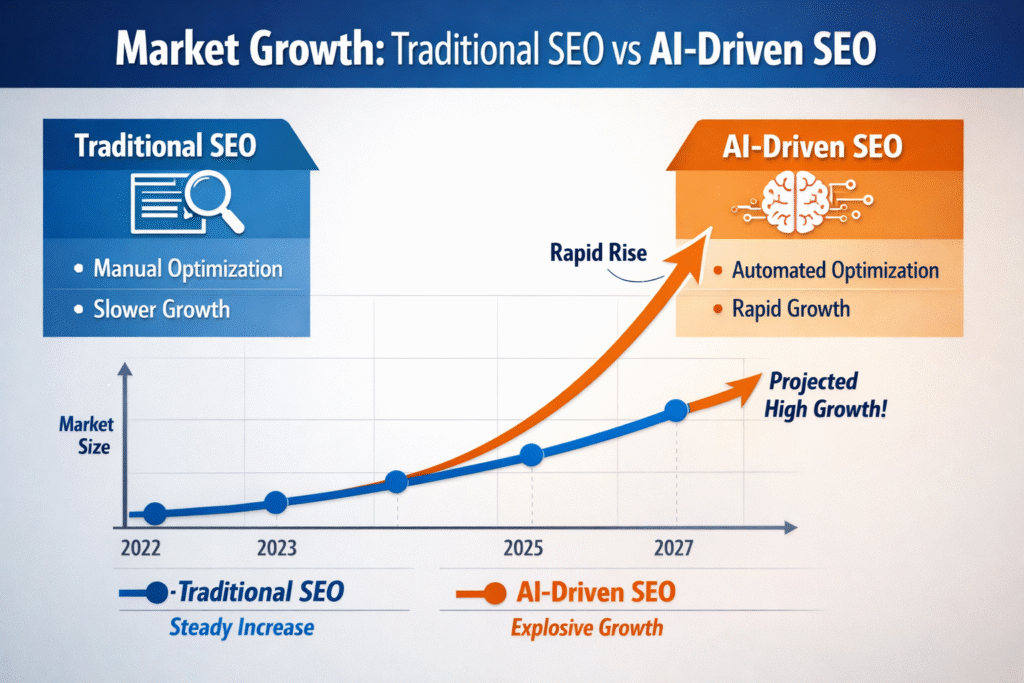
Industry trends show that AI adoption in marketing is accelerating, especially in areas like content optimization, technical SEO, user behavior analysis, and conversion rate optimization.
Businesses investing in AI-driven SEO are seeing improvements in efficiency, scalability, and return on investment. SEO is no longer just a traffic channel — it’s becoming a revenue engine tied directly to pipeline growth.
Another key factor driving this shift is the growing importance of data-driven decision-making. Modern B2B teams must justify marketing spend with measurable outcomes. AI helps bridge the gap between traffic metrics and business results by linking search performance to lead quality, conversion rates, and customer lifetime value. This enables marketing leaders to allocate budgets more effectively and prove SEO’s real business impact.
As a result, many B2B firms are moving away from traditional SEO approaches — such as one-time keyword research or static content plans — and adopting AI-powered optimization models. These models continuously monitor performance, adapt to search algorithm changes, identify new opportunities, and improve content relevance at scale.
In a market where competition is rising and buyer attention is harder to earn, leveraging Trends with AI in B2B SEO is becoming a strategic advantage. Companies that embrace this shift early are positioning themselves to outperform competitors, capture high-intent demand, and build sustainable long-term growth.
Defining Trends in B2B SEO: Landscape & Evolution
Trends & AI in B2B SEO refers to the modern shift from traditional, keyword-focused search optimization toward intent-driven, predictive, and AI-enhanced strategies designed specifically for complex business buying journeys. It combines emerging SEO trends with artificial intelligence technologies — such as machine learning, natural language processing (NLP), and algorithmic automation — to improve visibility, relevance, and revenue impact in B2B markets.
To understand this evolution, it helps to look at how SEO has transformed over time.
From Keyword-Based SEO to Intent-Driven Optimization
In its early stages, SEO was largely keyword-centric. Success depended on identifying high-volume keywords, optimizing page titles and meta tags, and building backlinks. Rankings were influenced heavily by keyword frequency and domain authority, with a limited understanding of actual user intent.
As search engines evolved, algorithms began prioritizing content quality, relevance, and user experience. This marked the transition from simple keyword matching to intent-based search, where Google and other platforms analyze what users mean, not just what they type.
Today, SEO is no longer about ranking for isolated keywords — it’s about understanding buyer intent, context, and behavior across the entire search journey. This shift is especially critical in B2B, where purchase decisions involve research-heavy, high-consideration processes.
The Role of AI in Modern SEO
Artificial intelligence now plays a central role in how search engines operate and how marketers optimize content. Core AI-driven technologies include:
- AI in search algorithms: Search engines use machine learning systems to interpret queries, rank content, and refine results based on user behavior and engagement signals.
- Natural Language Processing (NLP): NLP enables search engines to understand semantic meaning, context, and conversational queries — making it possible to match content with complex, long-tail B2B searches.
- Machine learning in SEO: Marketers use ML models to predict ranking opportunities, identify content gaps, automate technical audits, and personalize content recommendations at scale.
These technologies allow SEO to move from reactive optimization to predictive and adaptive performance strategies — where content, keywords, and technical improvements evolve continuously based on data insights.
How B2B SEO Differs from B2C SEO
While both B2B and B2C rely on search visibility, B2B SEO operates in a more complex and high-stakes environment.
Key differences include:
- Longer sales cycles: B2B buyers take weeks or months to evaluate solutions, requiring SEO strategies that support multiple research stages.
- High-value, low-volume leads: Instead of targeting mass consumer traffic, B2B SEO prioritizes fewer but more valuable leads with higher revenue potential.
- Multiple decision-makers: Content must address different stakeholders — such as executives, technical teams, and procurement — each with unique search intent.
- Industry-specific intent: B2B searches often include technical terms, product comparisons, solution frameworks, and problem-solving queries rather than impulse-driven keywords.
Because of these factors, B2B SEO benefits more from AI-powered segmentation, intent modeling, and personalization, ensuring the right content reaches the right decision-maker at the right time.
Evolution of Enterprise SEO Strategies
Enterprise B2B SEO has progressed through several phases:
- Traditional SEO Phase: Manual keyword research, static content creation, and backlink-focused optimization.
- Content & Authority Phase: Emphasis on thought leadership, topical authority, and high-quality long-form content.
- Data-Driven SEO Phase: Integration of analytics, conversion tracking, and ROI measurement tied to business outcomes.
- AI-Powered SEO Phase (Current): Predictive modeling, automated optimization, real-time content updates, intent clustering, and performance forecasting powered by machine learning.
Modern enterprise SEO teams now use AI to scale content production, detect emerging search trends, optimize technical performance, forecast demand, and connect SEO metrics directly to revenue pipelines.
What “Trends & AI in B2B SEO” Means Today
In today’s landscape, Trends & AI in B2B SEO represents a strategic framework where businesses:
- Monitor evolving search behavior and industry trends
- Use AI to predict buyer intent and content opportunities
- Optimize for semantic relevance rather than just keywords
- Automate technical SEO and performance monitoring
- Align search strategy with pipeline growth and revenue outcomes
It is no longer just about ranking higher — it’s about building an intelligent, scalable SEO engine that drives qualified leads, supports long sales cycles, and strengthens long-term competitive advantage.
Core B2B SEO Trends Driving Growth
B2B SEO is no longer about maximizing traffic volume — it’s about attracting the right decision-makers, improving lead quality, and accelerating revenue pipelines. As search engines evolve and buyer behavior becomes more complex, modern B2B brands are adopting advanced SEO trends that focus on authority, intent, experience, and conversion impact rather than just rankings.
Below are the core B2B SEO trends driving sustainable business growth today, along with why they matter beyond traffic metrics.
1. Topical Authority Over Isolated Keywords
One of the biggest shifts in SEO is the move from targeting single keywords to building topical authority.
Instead of ranking one page for one term, B2B brands now create deep content ecosystems that cover an entire subject area — including guides, use cases, comparisons, FAQs, and industry insights. Search engines increasingly reward websites that demonstrate expertise, depth, and consistency across a topic.
For B2B companies, topical authority helps:
- Build credibility with decision-makers
- Rank for multiple related high-intent keywords
- Own entire niche conversations instead of competing page-by-page
- Drive higher-quality leads who trust the brand as an industry leader
Use case direction: Enterprise brands build authority hubs around core solutions (e.g., “B2B marketing automation” or “enterprise cybersecurity”) to dominate high-value search spaces.
2. Content Clusters & Pillar Page Strategy
Closely tied to topical authority is the rise of content clusters — a strategy where a central pillar page links to multiple supporting sub-pages targeting related subtopics.
This structure:
- Improves internal linking and crawlability
- Signals topic depth to search engines
- Enhances user navigation and time on site
- Supports long sales cycles by addressing multiple buyer questions
In B2B SEO, content clusters help brands guide buyers across awareness, consideration, and decision stages, increasing the likelihood of conversion.
Instead of publishing disconnected blog posts, high-performing B2B teams now design structured content ecosystems that mirror buyer journeys.
3. Buyer-Intent Targeting Over Traffic Volume
Modern B2B SEO prioritizes search intent — not just search volume.
Rather than targeting broad informational keywords, brands focus on high-intent queries, such as:
- Product comparisons
- Solution-based searches
- Vendor evaluations
- Industry-specific problem queries
- Pricing, demos, and implementation terms
This shift results in:
- Lower traffic but higher conversion rates
- Better alignment with sales-qualified leads
- Improved marketing ROI
- Stronger pipeline contribution
SEO success is increasingly measured by lead quality, revenue attribution, and deal influence, not pageviews.
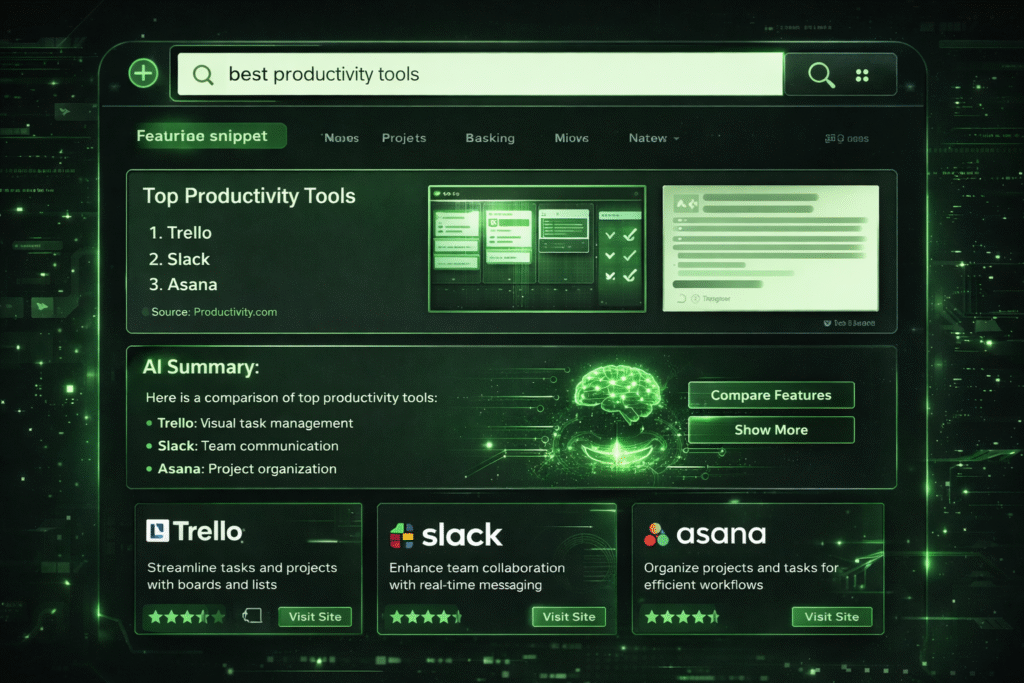
4. Zero-Click Search Optimization & SERP Feature Targeting
Search engine results pages (SERPs) now feature AI summaries, featured snippets, People Also Ask boxes, knowledge panels, and rich results — meaning users often get answers without clicking through.
To adapt, B2B brands optimize for zero-click visibility, ensuring their content appears in:
- Featured snippets
- FAQ schema results
- How-to rich results
- AI-generated search summaries
This helps brands:
- Maintain visibility even when clicks decline
- Build authority through SERP dominance
- Influence buyer perception early in the research cycle
- Stay competitive in AI-enhanced search environments
Rather than relying only on organic clicks, modern SEO focuses on owning the search experience itself.
5. Voice Search & Conversational Query Optimization
As voice assistants and conversational search grow, queries are becoming longer, more natural, and question-based.
B2B SEO teams now optimize for:
- Conversational keyword patterns
- Natural language phrasing
- Question-style content
- FAQ-driven optimization
This trend aligns closely with NLP (Natural Language Processing) advancements in search algorithms, enabling brands to rank for complex, multi-part B2B queries such as:
- “What is the best CRM for enterprise SaaS companies?”
- “How to scale B2B lead generation for IT services?”
Optimizing for conversational search improves discoverability among high-intent researchers and executives.
6. Experience-Driven SEO (UX, Engagement & Performance)
Search engines increasingly prioritize user experience signals, including:
- Page speed
- Mobile usability
- Core Web Vitals
- Engagement time
- Navigation clarity
For B2B, a strong SEO strategy now includes:
- Conversion-focused page design
- Lead capture optimization
- Trust-building elements (case studies, reviews, certifications)
- Clear content hierarchy for executive readers
Better user experience leads to:
- Higher engagement
- Stronger brand perception
- Improved lead conversion
- Better long-term rankings
7. Data-Driven Content Performance & Optimization
Modern B2B SEO relies heavily on data-driven decision-making.
Brands now use analytics to:
- Identify high-converting content
- Refresh outdated pages
- Expand top-performing topics
- Eliminate low-impact content
- Predict future keyword opportunities
Enterprise SEO teams measure success using metrics such as:
- Pipeline contribution
- Revenue influence
- Lead-to-customer conversion rate
- Content-assisted deal value
SEO is shifting from a content volume game to a performance optimization engine.
8. Authority-Building as a Competitive Growth Strategy
High-performing B2B brands use SEO not just to rank — but to dominate entire niches.
By combining:
- Thought leadership
- Deep educational content
- Expert insights
- Original research
- Strong backlink profiles
They create defensible market positions that competitors struggle to replicate. This authority-first approach builds long-term search equity, stronger brand trust, and sustainable lead flow.
Old vs Modern B2B SEO Trends
| Aspect | Old B2B SEO Approach | Modern B2B SEO Trend |
| Keyword Strategy | Single-keyword focus | Topic clusters & intent modeling |
| Goal | Traffic growth | Lead quality & revenue impact |
| Content | Standalone blog posts | Pillar pages & content ecosystems |
| Optimization | Manual & static | Data-driven & AI-assisted |
| SERP Strategy | Organic links only | Featured snippets & rich results |
| Measurement | Rankings & visits | Pipeline, conversions & ROI |
| Authority | Limited link building | Niche dominance & thought leadership |
Why These Trends Drive Pipeline Growth
These SEO trends shift focus from vanity metrics to business outcomes. Instead of attracting random visitors, B2B brands now attract high-intent buyers, influence decision-makers, shorten sales cycles, and increase deal conversion rates.
SEO is evolving into a strategic revenue channel, not just a marketing tactic.
How AI Is Transforming B2B SEO Strategy

Artificial intelligence is reshaping B2B SEO from a manual, reactive discipline into a strategic, predictive growth engine. Instead of relying on guesswork, static keyword lists, or slow experimentation, B2B marketers are now using AI to understand buyer intent, forecast rankings, automate optimization, personalize content, and prioritize revenue-driving opportunities.
This transformation goes far beyond tools — it fundamentally changes how SEO strategy is planned, executed, and measured.
From Reactive SEO to Predictive, Intelligence-Driven Strategy
Traditional SEO relies on historical data: marketers analyze what already performed well and then adjust strategy accordingly. AI changes this by enabling predictive decision-making.
With machine learning models analyzing search trends, competitor performance, and user behavior, B2B teams can:
- Forecast keyword performance before investing resources
- Predict ranking movement based on content changes
- Identify emerging opportunities before competitors act
- Anticipate shifts in buyer demand and search behavior
This shift allows SEO teams to move faster, reduce wasted effort, and focus on opportunities most likely to drive pipeline impact.
AI-Driven Intent Mapping: Targeting Buyers, Not Just Keywords
One of the most powerful transformations is AI-driven search intent modeling.
Instead of treating all keywords equally, AI can cluster queries based on buyer intent, such as:
- Awareness-stage research
- Problem identification
- Vendor evaluation
- Pricing and purchase readiness
This allows B2B marketers to map keywords directly to funnel stages, ensuring content supports:
- Early-stage education
- Mid-stage comparison
- Late-stage conversion
By understanding what a buyer means, not just what they type, AI helps brands prioritize high-conversion keywords over high-volume but low-value traffic.
Use-case direction: A B2B SaaS company uses AI to identify keywords with strong commercial intent — such as “enterprise CRM comparison” — and prioritizes content that attracts decision-makers rather than casual readers.
Content Intelligence: Creating What Buyers Actually Want
AI transforms content strategy through content intelligence — the ability to analyze what performs best across competitors, industries, and SERPs, then recommend data-backed improvements.
AI can help B2B SEO teams:
- Identify content gaps competitors haven’t covered
- Optimize structure, tone, and depth for ranking potential
- Recommend topics based on demand and intent trends
- Refresh outdated content to maintain performance
- Align messaging with executive-level decision-makers
Instead of publishing content based on assumptions, marketers now build strategic content portfolios guided by performance data and predictive insights.
This ensures content investments are tied to lead quality, authority building, and revenue outcomes — not just volume.
Predictive Ranking & Performance Forecasting
Ranking prediction is another major AI-powered breakthrough.
Machine learning models analyze factors such as:
- Backlink profiles
- Content depth and relevance
- SERP competition
- Technical SEO health
- Historical ranking trends
Using these insights, B2B teams can estimate the likelihood of ranking for a keyword before producing content. This allows them to:
- Avoid overly competitive, low-ROI targets
- Prioritize keywords with realistic ranking potential
- Allocate budgets more efficiently
- Build faster paths to revenue impact
Predictive ranking turns SEO from a gamble into a strategic investment decision.
Technical SEO Automation at Enterprise Scale
AI dramatically reduces the manual workload involved in technical SEO.
Instead of relying on periodic audits, AI-powered systems can continuously monitor and detect issues, such as:
- Broken links and crawl errors
- Duplicate or thin content
- Page speed and performance issues
- Indexing problems
- Internal linking gaps
More importantly, AI doesn’t just identify problems — it can recommend or automate fixes, helping enterprise B2B websites maintain strong SEO foundations at scale.
This frees SEO teams to focus less on maintenance and more on strategy, content, and growth.
Personalization: Delivering the Right Content to the Right Decision-Maker
B2B buyers vary widely — from technical specialists to C-suite executives — and AI enables content personalization at scale.
AI helps tailor SEO experiences by:
- Adapting content based on industry, company size, or behavior
- Serving personalized landing pages for different intent levels
- Recommending content based on previous user actions
- Optimizing CTAs and messaging for higher conversion
This means SEO no longer drives generic traffic — it drives highly relevant, conversion-ready visitors who see content aligned with their specific needs and role in the buying process.
Smarter Keyword Prioritization Based on Revenue Potential
One of the most valuable impacts of AI in B2B SEO is smarter prioritization.
Rather than selecting keywords based only on volume or difficulty, AI evaluates:
- Conversion likelihood
- Revenue impact
- Sales cycle influence
- Customer lifetime value
- Funnel-stage relevance
This allows marketers to focus on keywords that generate pipeline — not just traffic.
Use-case direction: AI helps a B2B services company prioritize keywords that historically produce high-value leads, even if search volume is lower, maximizing ROI.
AI-Driven SEO Workflow vs Manual SEO Workflow (Chart Suggestion)
Manual SEO Workflow:
- Manual keyword research
- Static content planning
- Periodic technical audits
- Reactive ranking adjustments
- Limited personalization
AI-Driven SEO Workflow:
- Automated intent clustering
- Predictive keyword selection
- Performance-based content planning
- Continuous technical optimization
- Real-time ranking forecasting
- Personalized search experiences
This evolution transforms SEO into a continuous optimization loop powered by data and intelligence.
Strategic Impact: SEO Becomes a Revenue Intelligence Channel
AI elevates B2B SEO from a tactical marketing function into a strategic business intelligence channel.
Instead of asking:
- “How do we rank higher?”
Teams now ask:
- “Which search opportunities drive the most qualified leads?”
- “Which content accelerates deal conversion?”
- “Where should we invest SEO resources for maximum revenue impact?”
By combining AI-driven intent mapping, predictive rankings, content intelligence, technical automation, and personalization, B2B organizations gain a scalable, high-ROI SEO engine built for long sales cycles and high-value customers.
AI Tools, Automation & Practical Use Cases

As B2B SEO grows more complex, AI tools and automation are becoming essential for scaling performance, improving efficiency, and increasing ROI. Instead of replacing strategy, AI strengthens it — enabling teams to execute faster, optimize smarter, and produce higher-impact content at scale.
This section explores the key categories of AI tools used in B2B SEO, how they improve tool stack efficiency, and real-world use cases showing how teams scale SEO production using AI workflows.
Why AI Tool Stacks Matter in B2B SEO
Enterprise SEO requires managing large websites, thousands of keywords, long sales cycles, and multi-stakeholder buyer journeys. Manual execution alone cannot keep up with the speed of market changes.
AI-powered tool stacks help B2B teams:
- Increase content velocity without sacrificing quality
- Automate repetitive SEO tasks
- Reduce operational costs and improve automation ROI
- Focus human effort on strategy, creativity, and decision-making
- Scale performance across multiple markets, products, and verticals
The goal isn’t just more tools — it’s smarter, integrated workflows that multiply output and impact.
1. AI for Keyword Research & Intent Automation
Traditional keyword research can be slow and limited. AI automates and enhances this process by:
- Clustering keywords based on search intent
- Identifying high-conversion opportunities, not just high-volume terms
- Predicting keyword trends before they peak
- Mapping keywords to buyer funnel stages
- Prioritizing keywords based on ranking potential and revenue impact
Practical Use Case
A B2B SaaS team uses AI to analyze thousands of keywords and automatically identify commercial-intent queries, allowing them to focus on keywords that attract decision-makers rather than casual searchers.
Impact: Faster research, higher lead quality, better ROI.
2. AI Content Optimization & Content Intelligence Platforms
AI-powered content tools help teams plan, write, optimize, and refresh content at scale.
These platforms support:
- SERP-driven content recommendations
- NLP-based optimization for semantic relevance
- Competitor content analysis
- Automated content briefs
- Performance-based content refresh suggestions
- Optimization for featured snippets and AI summaries
AI also improves content velocity — allowing B2B brands to publish more authoritative content faster without lowering quality.
Practical Use Case
An enterprise marketing team uses AI to generate optimized content briefs and update existing articles, helping them scale blog production while maintaining consistent ranking performance.
Impact: Faster publishing, stronger rankings, improved authority.
3. AI Technical SEO Crawlers & Site Auditing Automation
Technical SEO at enterprise scale can be overwhelming. AI-powered crawlers automate:
- Site audits and crawl diagnostics
- Broken link detection
- Duplicate content identification
- Indexing issue tracking
- Internal linking recommendations
- Core Web Vitals and page speed monitoring
Instead of periodic audits, AI enables continuous monitoring and real-time alerts, ensuring websites remain search-engine friendly at all times.
Practical Use Case
A large B2B website uses AI to monitor crawl errors and automatically flag high-impact technical issues, reducing SEO downtime and ranking loss.
Impact: Better site health, fewer technical risks, improved scalability.
4. Predictive Analytics & SEO Forecasting Tools
Predictive analytics tools help B2B teams forecast SEO outcomes before investing resources.
AI models analyze:
- Ranking probability
- Traffic growth potential
- Competitive difficulty
- Conversion likelihood
- Revenue contribution
This enables marketers to prioritize SEO efforts based on business impact — not guesswork.
Practical Use Case
A B2B services company uses AI to forecast which keywords are most likely to rank within 3–6 months, helping allocate budgets toward high-probability, high-ROI opportunities.
Impact: Smarter planning, reduced wasted effort, better revenue alignment.
5. Workflow Automation & SEO Process Scaling
AI-driven workflow tools help automate end-to-end SEO execution, including:
- Content pipeline management
- Automated reporting dashboards
- Performance alerts and monitoring
- Task prioritization and project tracking
- Collaboration between SEO, content, and sales teams
This reduces manual overhead and allows teams to scale SEO production without scaling headcount.
Practical Use Case
A B2B agency automates SEO reporting and performance tracking, cutting reporting time by 70% and freeing teams to focus on strategy and client growth.
Impact: Higher productivity, faster execution, lower operational costs.
6. AI Personalization & Conversion Optimization Tools
Beyond rankings, AI tools enhance personalization and conversion performance by:
- Customizing landing pages based on visitor behavior
- Personalizing CTAs for different industries or job roles
- Recommending content dynamically
- Optimizing lead capture forms for higher conversion
This ensures SEO traffic is not only relevant but more likely to convert into pipeline opportunities.
Practical Use Case
A B2B company personalizes landing page messaging for enterprise vs SMB visitors, increasing lead conversion rates from organic traffic.
Impact: Better engagement, stronger pipeline contribution.
AI Tool Categories vs B2B SEO Use Cases
| AI Tool Category | Primary Function | Key B2B SEO Use Case |
| Keyword Research Automation | Intent clustering & keyword prioritization | Targeting high-conversion queries |
| Content Optimization Platforms | SEO-driven content creation & refresh | Scaling authoritative content |
| Technical SEO Crawlers | Site audits & performance monitoring | Maintaining enterprise site health |
| Predictive Analytics Tools | Ranking & traffic forecasting | Prioritizing high-ROI SEO opportunities |
| Workflow Automation Tools | Task & reporting automation | Scaling SEO production efficiently |
| Personalization & CRO AI | Conversion optimization | Improving organic lead conversion |
How AI Workflows Scale SEO Production in B2B
AI enables B2B teams to build repeatable, scalable SEO workflows, such as:
- Automated keyword research → intent clustering → content brief creation
- Content generation → optimization → publishing → performance tracking
- Continuous technical monitoring → automated alerts → prioritized fixes
- SEO performance forecasting → budget prioritization → ROI measurement
This creates a high-efficiency SEO engine where teams can produce more content, optimize faster, and improve results without increasing workload.
Also Read Our: Why SEO for B2B Businesses Matters More Than Ever
Strategic Outcome: Efficiency, Speed & Competitive Advantage
By leveraging AI tools and automation, B2B organizations gain:
- Higher tool stack efficiency
- Faster execution and greater content velocity
- Improved automation ROI
- Stronger alignment between SEO and revenue goals
- The ability to scale growth faster than competitors
AI transforms SEO from a labor-heavy process into a scalable, performance-driven growth system — enabling B2B brands to compete at enterprise scale with leaner teams and smarter workflows.
Data, Predictive SEO & Decision-Making
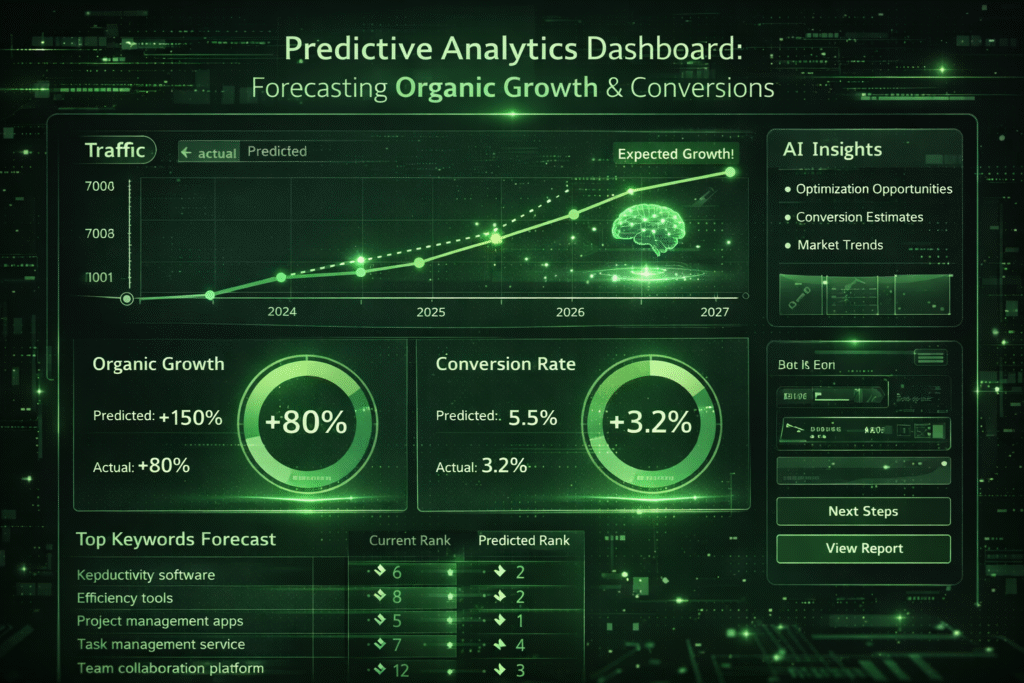
In modern B2B marketing, SEO success is no longer driven by intuition or historical guesswork — it is powered by data, predictive models, and forward-looking decision-making. As Trends & AI in B2B SEO continue to evolve, SEO is shifting from a reactive practice (responding to rankings after they change) to a proactive growth strategy that forecasts outcomes before they happen.
This transformation allows businesses to improve lead quality, prioritize high-impact campaigns, maximize content ROI, and anticipate market shifts with greater accuracy.
From Historical Reporting to Predictive SEO
Traditional SEO analytics focuses on past performance — tracking traffic, rankings, impressions, and conversions after results are already visible. While useful, this approach limits strategic agility.
Predictive SEO changes this by using machine learning models, historical data, competitive signals, and behavioral patterns to forecast:
- Future traffic trends
- Ranking movement over time
- Keyword opportunity potential
- Content performance before publishing
- Lead and revenue impact from SEO campaigns
Instead of asking “What happened?”, B2B teams now ask “What is likely to happen next — and how do we prepare?”
How Predictive SEO Improves Forecasting Accuracy

Predictive SEO models analyze multiple data layers, including:
- Search volume trends and seasonality
- SERP volatility and competition changes
- Backlink growth patterns
- User engagement and conversion signals
- Historical ranking performance
By combining these inputs, AI-driven forecasting tools can estimate traffic potential and ranking outcomes with increasing accuracy — enabling smarter planning and budget allocation.
Key advantage: Marketers can estimate whether a keyword or content investment is likely to generate qualified leads and revenue, not just clicks.
This improves:
- Forecasting accuracy
- Resource allocation
- Campaign confidence
- ROI predictability
Better Lead Quality Through Data-Driven Targeting
One of the biggest benefits of predictive SEO in B2B is improved lead quality.
Instead of targeting keywords based solely on search volume, data models help identify:
- Keywords with high commercial intent
- Queries that historically produce sales-qualified leads
- Topics that influence pipeline progression
- Content types that drive high-value conversions
This ensures SEO teams focus on traffic that converts, rather than broad, low-intent audiences.
Result: Fewer wasted visits, stronger pipeline contribution, and higher customer lifetime value.
Smarter Campaign Prioritization Using Predictive Models
With predictive analytics, B2B marketers can prioritize SEO campaigns based on projected business impact.
AI can estimate:
- Expected ranking difficulty vs reward
- Time-to-rank projections
- Potential revenue from keyword clusters
- Competitive gap opportunities
- Long-term value of content investments
This enables teams to focus on high-impact opportunities rather than spreading efforts across low-ROI initiatives.
Example
A B2B SaaS company uses predictive ranking models to determine which keywords are most likely to reach page one within six months — allowing them to prioritize content that delivers faster revenue impact.
Optimizing Content ROI with Performance Forecasting
Content production is one of the largest SEO investments — and predictive data helps maximize return on that investment.
Predictive content models can:
- Estimate expected traffic before publishing
- Identify topics with high ROI potential
- Recommend updates to underperforming content
- Forecast the lifespan and scalability of content assets
- Predict conversion potential tied to specific topics
This ensures content strategies are guided by performance data, not assumptions, improving both efficiency and long-term impact.
Predicting Ranking Shifts Before Algorithm Updates
One advanced use case of predictive SEO is anticipating ranking changes before algorithm updates or SERP shifts occur.
AI models monitor signals such as:
- SERP volatility patterns
- Competitor movement trends
- Engagement and user behavior shifts
- Technical site health fluctuations
By analyzing these signals, B2B teams can:
- Detect early warning signs of ranking drops
- Adjust content or technical SEO before impact occurs
- Protect organic visibility from algorithm volatility
- Maintain stable long-term growth
Use-case direction: Predicting ranking shifts before algorithm updates allows companies to adapt proactively instead of reacting to traffic losses.
Traffic Prediction Models: Planning Growth with Confidence
Predictive traffic models allow B2B organizations to estimate future organic growth under different scenarios, such as:
- Publishing X number of new content pieces
- Improving site speed or technical health
- Building backlinks in key topic areas
- Expanding into new keyword clusters
These forecasts help SEO leaders:
- Set realistic growth targets
- Secure stakeholder buy-in
- Plan budgets more effectively
- Align SEO strategy with revenue goals
Strategic Impact: SEO Becomes Proactive, Not Reactive
By integrating data analytics, forecasting models, and AI-driven predictions, B2B SEO transforms into a proactive intelligence system.
Instead of reacting to traffic drops or ranking changes, businesses can:
- Anticipate market demand
- Prioritize high-value opportunities
- Allocate budgets with confidence
- Protect visibility before losses occur
- Drive higher-quality leads and stronger ROI
In the era of B2B SEO, data and predictive insights don’t just support SEO — they power smarter decisions, faster growth, and sustainable competitive advantage.
Limitations, Challenges & Ethical Considerations

While AI and automation are transforming B2B SEO, they also introduce important limitations, risks, and ethical challenges. As businesses adopt AI-driven optimization, it becomes critical to balance efficiency with human oversight, brand integrity, compliance, and long-term trust.
This section explores the key risks — and why human-led strategy remains essential in AI-powered B2B SEO.
1. The Risk of Over-Automation
One of the biggest challenges in AI-driven SEO is over-automation — relying too heavily on machines to make decisions without strategic review.
AI can accelerate keyword research, content creation, and optimization, but blind automation may lead to:
- Low-quality or repetitive content
- Misaligned messaging with business goals
- SEO strategies optimized for rankings but not revenue
- Loss of creative differentiation
In B2B markets — where credibility, trust, and thought leadership matter — strategy cannot be fully automated. Human expertise is needed to guide positioning, messaging, and long-term brand direction.
Use-case direction: The most effective teams use AI for execution speed, while humans control strategy, prioritization, and final decision-making.
2. AI Bias & Data-Driven Distortions
AI models learn from existing data — and biased or incomplete datasets can reinforce inaccurate or unfair outcomes.
Potential risks include:
- Over-prioritizing keywords that historically performed well while ignoring emerging opportunities
- Reinforcing dominant industry narratives instead of promoting diverse perspectives
- Misrepresenting niche markets or underserved audiences
In B2B SEO, this can result in skewed content strategy, missed innovation opportunities, or inaccurate targeting of decision-makers.
This is why AI governance and regular auditing are essential — ensuring models align with business ethics, fairness, and strategic objectives.
3. Content Authenticity & Trust Concerns
As AI-generated content becomes more common, content authenticity and credibility are growing concerns.
Risks include:
- Generic or formulaic content that lacks original insight
- Reduced thought leadership and subject-matter depth
- Content that feels automated rather than expert-driven
- Potential damage to brand trust if content feels inauthentic
B2B buyers — especially executives and technical decision-makers — value expertise, originality, and credibility. Overusing AI without editorial oversight can weaken brand voice, authority, and trust.
Key principle: AI should assist content creation, but humans must ensure accuracy, originality, tone, and brand voice protection.
4. Algorithm Dependency & Platform Risk
Another major challenge is over-dependence on search engine algorithms.
AI-driven SEO strategies often optimize aggressively for ranking signals — but search algorithms constantly evolve. Over-optimization can lead to:
- Traffic volatility after algorithm updates
- Over-reliance on a single acquisition channel
- Short-term gains at the expense of long-term brand equity
B2B brands must ensure SEO remains part of a diversified growth strategy, not the only pillar supporting pipeline generation.
5. Compliance, Privacy & Regulatory Challenges
B2B SEO often intersects with data privacy, industry regulations, and compliance requirements — especially in sectors like finance, healthcare, SaaS, and enterprise technology.
Key concerns include:
- Responsible use of customer and behavioral data
- Compliance with privacy laws and data protection standards
- Ethical personalization and targeting
- Avoiding misleading claims or auto-generated misinformation
AI systems must be governed with clear policies on data usage, content accuracy, transparency, and accountability.
This makes AI governance frameworks essential — ensuring SEO automation aligns with legal, ethical, and brand standards.
6. Why Human Oversight Remains Essential
AI can optimize performance — but it cannot replace human judgment, creativity, ethics, and strategic vision.
Human involvement is essential for:
- Editorial quality control and fact-checking
- Brand voice consistency and storytelling
- Strategic prioritization and business alignment
- Ethical decision-making and compliance oversight
- Long-term positioning beyond algorithmic trends
Human vs AI-Driven SEO Decision-Making
| Aspect | AI-Driven SEO | Human-Led SEO |
| Speed & Scale | High | Moderate |
| Data Processing | Excellent | Limited |
| Creativity & Originality | Limited | Strong |
| Brand Voice Control | Risk of inconsistency | Strong |
| Ethical Judgment | Weak | Essential |
| Strategic Vision | Limited | Critical |
The most successful B2B teams use a hybrid model — combining AI efficiency with human editorial, strategic, and ethical leadership.
Strategic Takeaway: Responsible AI Creates Sustainable Growth
AI offers enormous power in B2B SEO — but unchecked automation can create risks to trust, quality, compliance, and brand credibility.
The future of SEO lies in responsible AI adoption, where:
- Machines handle scale, speed, and data
- Humans control strategy, creativity, ethics, and brand identity
By balancing automation with editorial and strategic control, B2B organizations can build scalable, ethical, and sustainable SEO growth.
Case Study or Framework Outline: Implementing Trends & AI in B2B SEO
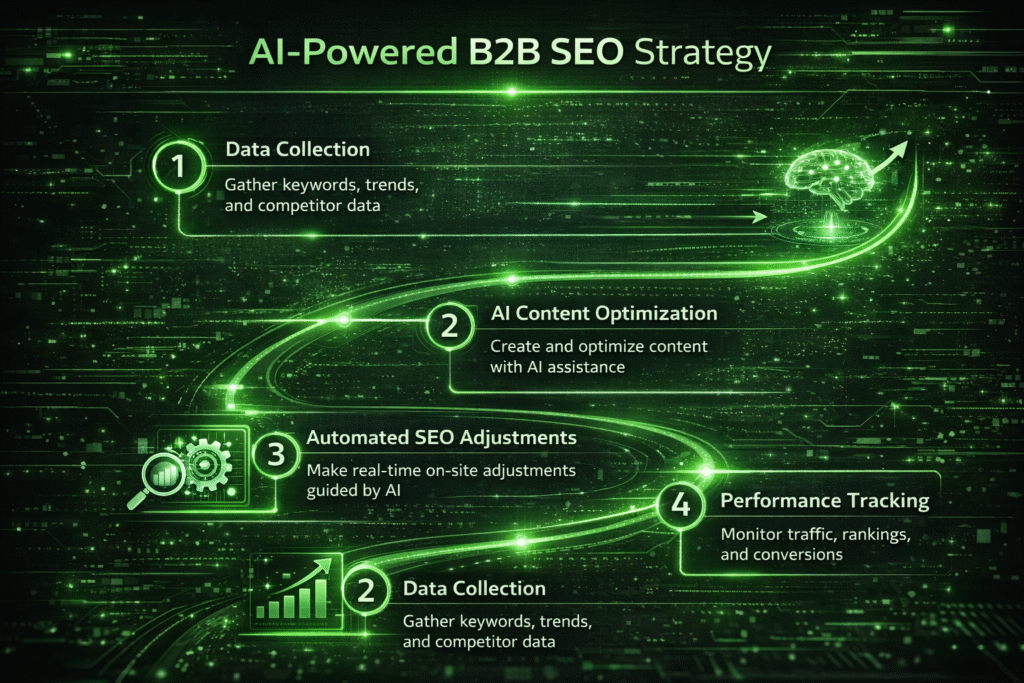
This section outlines a structured framework template that B2B organizations can use to plan, implement, and scale Trends & AI in SEO. Rather than presenting a single case study, this framework serves as a repeatable blueprint that companies can adapt based on their industry, company size, and growth goals.
The framework is divided into five strategic phases, guiding teams from goal setting to execution, optimization, and long-term scaling.
Phase 1: Business Goal Definition
Purpose: Ensure SEO efforts are aligned with core business objectives before tactical execution begins.
Key structure elements:
- Define primary business goals (e.g., pipeline growth, lead quality, revenue targets, brand authority)
- Identify priority products, services, or solution areas for SEO focus
- Clarify target industries, ideal customer profiles (ICP), and buyer personas
- Align SEO objectives with sales funnel stages and revenue outcomes
- Establish key performance indicators (KPIs) tied to business impact
Framework output:
- Documented SEO mission aligned with business strategy
- Defined success metrics tied to leads, pipeline, and revenue
- Stakeholder alignment across marketing, SEO, and sales teams
Phase 2: SEO Baseline Assessment
Purpose: Create a benchmark to understand current SEO performance and identify gaps.
Assessment structure areas:
- Current organic traffic, keyword rankings, and visibility trends
- Content inventory analysis and topical authority depth
- Technical SEO health (indexation, crawlability, performance, site structure)
- Backlink profile and authority benchmarking
- Lead quality and conversion performance from organic traffic
- Competitive landscape and SERP feature presence
Framework output:
- SEO baseline performance report
- Competitive gap and opportunity analysis
- Priority improvement areas (content, technical SEO, authority, intent)
Phase 3: AI Integration Phase
Purpose: Integrate AI capabilities into SEO planning, intelligence, and forecasting.
Structural components:
- AI-powered keyword & intent mapping
- Group keywords by buyer intent, funnel stage, and conversion potential
- Group keywords by buyer intent, funnel stage, and conversion potential
- Predictive SEO & forecasting models
- Estimate ranking probability, traffic growth, and ROI impact
- Estimate ranking probability, traffic growth, and ROI impact
- Content intelligence integration
- Identify content gaps, optimize topical coverage, and generate content briefs
- Identify content gaps, optimize topical coverage, and generate content briefs
- Technical SEO automation setup
- Enable AI-driven site audits, monitoring, and issue detection
- Enable AI-driven site audits, monitoring, and issue detection
- Workflow & reporting automation
- Automate reporting, performance alerts, and production pipelines
Framework output:
- AI-enhanced SEO roadmap
- Prioritized keyword clusters and content opportunities
- Performance forecasts and growth projections
Phase 4: Execution & Optimization
Purpose: Deploy AI-assisted SEO initiatives while maintaining human editorial and strategic control.
Execution structure areas:
- Content creation using AI briefs with human editorial validation
- Development of pillar pages and content clusters to build topical authority
- On-page SEO optimization using intent-driven and NLP-based insights
- Technical SEO improvements guided by automated recommendations
- Authority-building initiatives (link acquisition, PR, partnerships)
- Conversion optimization and personalization for organic visitors
Optimization loop structure:
- Continuous performance tracking and iteration
- Refreshing and expanding content based on engagement and ranking signals
- Adjusting keyword priorities using predictive insights
- Testing messaging, CTAs, and conversion paths to improve lead quality
Framework principle:
AI accelerates execution — humans retain strategy, quality control, and brand voice ownership.
Phase 5: Measurement, Learning & Scaling
Purpose: Evaluate results, refine strategy, and scale successful SEO systems.
Measurement structure areas:
- Organic lead volume and lead quality metrics
- Pipeline and revenue contribution from SEO
- Keyword ranking growth and SERP visibility expansion
- Content ROI and engagement performance
- Forecast accuracy vs actual performance
- Efficiency gains from automation (cost, time, output)
Scaling structure components:
- Expanding into new keyword clusters, industries, or geographies
- Replicating high-performing content frameworks
- Increasing AI automation across workflows
- Strengthening authority within niche verticals
- Applying predictive insights to new markets and campaigns
Framework output:
- Scalable SEO growth model
- Documented learnings and optimization playbooks
- Long-term roadmap for AI-powered SEO expansion
Step-by-Step Framework Roadmap
| Phase | Strategic Focus | Key Activities | Primary Outcome |
| Business Goal Definition | Strategy alignment | Define goals, ICP, revenue targets | SEO tied to business outcomes |
| SEO Baseline Assessment | Performance benchmarking | Analyze traffic, content, and technical health | Clear benchmark & gap analysis |
| AI Integration Phase | Intelligence & automation | Intent mapping, forecasting, and content insights | AI-powered SEO roadmap |
| Execution & Optimization | Implementation & iteration | Content, technical SEO, and authority building | Ranking & lead growth |
| Measurement & Scaling | Growth & expansion | ROI tracking, scaling, automation | Sustainable SEO engine |
Strategic Value of This Framework
This structured outline helps B2B companies transition from ad-hoc SEO tactics to a systematic, AI-enabled growth model. It ensures SEO remains:
- Business-driven, not traffic-driven
- Data-backed, not assumption-based
- Scalable, not resource-limited
- Human-guided, not fully automated
By following this framework, organizations can implement Trends & AI in B2B in a controlled, measurable, and scalable way — turning SEO into a long-term revenue and authority engine.
Future Trends & Growth Predictions in B2B SEO

The future of B2B SEO is being reshaped by rapid advances in artificial intelligence, evolving search engine behavior, and changing buyer expectations. As AI adoption accelerates and search platforms become more intelligent, SEO is shifting from keyword-based optimization toward predictive, personalized, and autonomous growth systems.
In the coming years, B2B SEO will become less about ranking pages and more about influencing decision-making across the entire customer journey. Below are the key future trends and growth predictions shaping where B2B SEO is headed.
Generative Search & AI-First SERPs
Search engines are moving toward generative, AI-driven results that summarize answers instead of simply listing web pages. AI-first SERPs now feature:
- AI-generated summaries
- Conversational responses
- Zero-click answers
- Rich, contextual recommendations
This means B2B brands will need to optimize not just for rankings, but for visibility within AI-generated responses.
Future SEO success will depend on:
- Being cited in AI-generated summaries
- Structuring content for machine-readable trust and authority
- Publishing high-quality, expert-backed insights that AI systems prioritize
Prediction: SEO will evolve into “Answer Engine Optimization”, where credibility, structure, and semantic relevance outweigh raw keyword targeting.
Autonomous SEO Agents & Self-Optimizing Systems
A major future shift is the rise of autonomous SEO agents — AI systems that can monitor performance, test strategies, optimize content, and make adjustments with minimal human input.
These agents will be able to:
- Identify ranking opportunities in real time
- Optimize pages dynamically based on performance signals
- Adjust internal linking and technical SEO automatically
- Predict ranking drops and prevent losses before they occur
For B2B organizations, this means SEO will become continuous, self-improving, and adaptive — reducing operational workload while increasing speed and scalability.
Prediction: SEO teams will transition from execution-heavy roles to strategic oversight and AI governance roles.
Hyper-Personalized Content & Search Experiences
Future SEO will move beyond generic content toward hyper-personalized experiences tailored to:
- Industry
- Company size
- Job role
- Buyer intent stage
- Past search and engagement behavior
AI will enable B2B brands to serve different versions of content to different decision-makers, improving relevance, engagement, and conversion rates.
Examples of personalization-driven SEO:
- Customized landing pages for CFOs vs technical buyers
- Industry-specific SEO content hubs
- Dynamic CTAs based on visitor intent
- Personalized educational content throughout the funnel
Prediction: SEO traffic will become smaller but far more valuable, with higher lead quality and stronger pipeline conversion.
Predictive Customer Journey Optimization
As predictive analytics improves, SEO will increasingly focus on forecasting and influencing buyer journeys before conversion happens.
AI models will predict:
- Which content accelerates purchase decisions
- When prospects are likely to convert
- What information buyers need at each decision stage
- How SEO contributes to long-term customer lifetime value
This allows B2B teams to optimize content for journey progression — not just traffic acquisition.
Prediction: SEO performance will be measured by pipeline velocity, deal influence, and revenue impact, not only rankings or clicks.
Voice, Conversational & Multimodal Search Expansion
Search behavior is becoming more conversational, voice-driven, and multimodal (text, voice, image, and video combined).
Future-ready B2B SEO strategies will optimize for:
- Natural language and question-based queries
- Voice search and spoken intent
- Visual and video search discovery
- Conversational AI interfaces and assistants
This will require content to be more human, contextual, and structured for conversational discovery.
Prediction: Long-form educational content and expert-driven thought leadership will outperform short, keyword-stuffed pages.
Market Growth & AI Adoption Forecasts in SEO
AI adoption in marketing and SEO continues to grow rapidly, with more enterprises investing in:
- AI-driven content intelligence
- Predictive SEO analytics
- Automated technical optimization
- Personalization engines
As competition increases, B2B firms that adopt AI-first SEO early will gain a compounding advantage — building stronger authority, deeper data insights, and more efficient growth engines.
Prediction: SEO budgets will increasingly shift toward AI-powered workflows and predictive optimization models.
How Future-Ready B2B Firms Are Preparing
Forward-thinking B2B organizations are already preparing for AI-driven search by:
- Investing in topical authority and expert content
- Structuring data for machine-readable SEO
- Building AI-powered content and analytics workflows
- Prioritizing intent-based and predictive SEO models
- Training teams in AI governance, ethics, and strategy
Instead of reacting to change, they are designing SEO strategies built for long-term adaptability.
Strategic Outlook: SEO as an Intelligent Growth Engine
The future of B2B SEO lies in automation, personalization, predictive intelligence, and generative search ecosystems. SEO will evolve from a marketing tactic into a business intelligence and revenue acceleration engine.
B2B brands that embrace these trends early will:
- Adapt faster to search engine evolution
- Capture higher-quality demand
- Build stronger long-term authority
- Sustain competitive advantage in AI-driven markets
Conclusion & Strategic Takeaways

Trends or AI in B2B SEO are redefining how businesses attract, engage, and convert high-value buyers. SEO is no longer just about rankings or traffic — it has evolved into a strategic growth engine powered by data, intelligence, and long-term planning.
AI enables B2B organizations to understand buyer intent more deeply, predict performance outcomes, scale content production, automate technical optimization, and personalize experiences at scale. But the real advantage doesn’t come from tools alone — it comes from how strategically those tools are applied.
The most successful B2B brands will focus on sustainable growth, not short-term SEO wins. That means investing in topical authority, content credibility, predictive insights, and strong human oversight to maintain brand trust and long-term visibility. AI should enhance strategy, not replace it — accelerating execution while humans guide positioning, ethics, creativity, and business alignment.
To stay competitive, B2B leaders must adopt an innovation mindset — continuously testing new approaches, adapting to search evolution, and preparing for AI-driven search ecosystems. Companies that combine strategic adaptation with responsible AI adoption will build a durable competitive advantage that compounds over time.
In the future, SEO will belong to organisations that treat it as a long-term investment in authority, intelligence, and revenue growth — not just a tactical marketing channel.
💡 Interested in learning more? Contact RKDMT – Raju Kumar Digital Marketer – Best Digital Marketing Training Institute
🔗 www.rajukumardigitalmarketing.com
📞 +91-7303933302, +91-9217057127
📧 rkdmt@rajukumardigitalmarketer.com

Founder at Digital Marketing Marvel | Founder at RKDMT – Raju Kumar Digital Marketing Trainer | Best Digital Marketing Trainer in Delhi/NCR – Digiperform | Project Manager | 5+ years | Genius Study Abroad & Inlingua’s Digital Marketing Head | Learn Digital Marketing