


Internal Linking Strategy Used by SEO Experts
Internal linking is one of the most underestimated ranking factors in modern SEO. While most marketers focus heavily on backlinks, technical audits, and content production, high-performing websites quietly rely on a well-structured internal linking strategy to amplify results across every page.
At its core, internal linking is not just about connecting pages—it is about guiding search engines, distributing authority, and shaping how your entire website is understood. In 2026, as Google continues to evolve with AI-driven ranking systems and entity-based indexing, the role of internal links has become even more strategic.
According to Google Search Central, internal links help Google:
- Discover new pages faster
- Understand the relationship between content
- Determine which pages hold more importance within a site
This means even the best content can struggle to rank if it is not supported by a strong internal structure.
The Hidden Power of Internal Links
Most websites publish content in isolation. A blog is written, uploaded, and left without meaningful connections to other pages. From an SEO perspective, this creates content silos without authority flow, often referred to as “orphan content.”
A strategic internal linking strategy solves this by:
- Passing link equity (ranking power) across pages
- Strengthening topical clusters
- Improving crawl depth and indexing speed
- Increasing user engagement and session duration
Industry studies from platforms like Ahrefs and Botify have shown that websites with optimized internal linking structures can experience up to 20–40% improvement in crawl efficiency. This directly impacts how quickly and effectively pages get indexed and ranked.
Internal Linking vs Backlinks: The Overlooked Advantage
Backlinks are external and often difficult to control. Internal links, on the other hand, are fully within your control.
This gives internal linking a unique advantage:
- You decide which pages get priority
- You control anchor text relevance
- You define site architecture
In fact, many SEO experts use internal linking to push rankings of existing pages without building new backlinks.
For example, when you publish a guide like an internal linking strategy, you can strengthen it by linking from related content, such as:
- keyword research guide
- content marketing strategy
- learn digital marketing at home
This creates a network of relevance, signaling to Google that your content is interconnected and authoritative.
How Internal Linking Supports Topical Authority
Google no longer ranks pages in isolation—it ranks topics and entities. This means your ability to rank depends on how well your content ecosystem is structured.
A strong internal linking strategy helps you:
- Build clear topic clusters
- Reinforce keyword relationships
- Establish authority within a niche
For instance, if your website covers SEO, linking related posts like:
- technical SEO basics
- keyword research guide
- content marketing strategy
…back to a central pillar page creates a clear topical hierarchy.
This approach is commonly used by high-authority sites like HubSpot and Backlinko to dominate search results.
User Experience: The Indirect Ranking Signal
Internal links are not just for search engines—they significantly impact user behavior.
A well-placed internal link:
- Keeps users engaged longer
- Reduces bounce rate
- Increases pages per session
According to multiple UX studies, users are more likely to explore a website when contextual links guide their journey naturally within content.
This behavioral improvement sends positive signals to Google, indirectly supporting rankings.
Internal Linking in the Era of AI Search and Google Discover
With the rise of AI-generated summaries and Google Discover, content visibility is no longer limited to traditional search results.
Internal linking plays a key role in:
- Helping Google understand content freshness
- Surfacing related content for Discover feeds
- Strengthening semantic connections between topics
Websites that consistently update older posts with new internal links often see renewed traffic spikes, even without publishing new content.
What You’ll Learn in This Guide
This guide breaks down the exact internal linking strategy used by SEO experts, including:
- How to structure links for maximum ranking impact
- How to optimize anchor text without overdoing it
- Advanced linking techniques used by high-authority websites
- Common mistakes that silently kill rankings
You will also learn how to turn your existing content into a connected ecosystem that drives traffic, improves rankings, and builds long-term authority.
This introduction sets the foundation for understanding why internal linking is not just a technical task—but a core SEO growth strategy.
What Is an Internal Linking Strategy (Beyond Basics)
An internal linking strategy is not simply the act of connecting one page to another within your website. At an expert level, it is a deliberate system for structuring content, distributing authority, and guiding both users and search engines through a predefined journey. Most beginners treat internal links as an afterthought—adding a few links after publishing a blog. In contrast, SEO experts design internal linking as a core architectural layer of the website, directly influencing rankings, crawl behavior, and topical authority.
At its most basic level, internal linking helps users navigate a site. However, beyond that, it serves three critical functions: contextual signaling, authority distribution, and crawl optimization. When you implement an advanced internal linking strategy, you are effectively telling Google which pages matter the most, how different topics are related, and where ranking power should flow.
Google itself has confirmed through Google Search Central documentation that internal links help its systems discover new pages and understand their relative importance. But what is often overlooked is how structured internal linking creates semantic relationships between content pieces. This is especially important in 2026, where Google relies heavily on entity-based understanding rather than just keywords.
For example, if you publish multiple blogs around SEO—such as a keyword research guide, a content marketing strategy, and a guide on how to learn digital marketing at home—linking them strategically is what transforms them from isolated articles into a cohesive topic cluster. Without this structure, each page competes individually. With it, they reinforce each other.
Basic Linking vs Strategic Internal Linking
Most websites fall into the trap of random linking. They insert links where it feels convenient rather than where it creates SEO value. This leads to scattered authority and weak topic signals. A true internal linking strategy, however, is built on intent, hierarchy, and consistency.
Here’s a clear comparison:
| Basic Internal Linking | Strategic Internal Linking Strategy |
| Links added randomly | Links mapped based on keyword intent |
| No clear structure | Defined hierarchy (pillar → cluster → subtopics) |
| Generic anchor text | Optimized, contextual anchor text |
| No authority flow planning | Controlled distribution of link equity |
| Pages exist in isolation | Pages are interconnected into topic clusters |
This distinction is what separates average websites from those that dominate search results. High-performing sites do not just create content—they engineer relationships between content pieces.
The Role of Internal Linking in PageRank Distribution
To understand internal linking at a deeper level, it is essential to revisit the concept of PageRank, Google’s foundational algorithm. While modern SEO has evolved significantly, the principle of link-based authority still plays a major role.
Every page on your website carries a certain amount of authority. When you link from one page to another, you are passing a portion of that authority—often referred to as link equity. A well-planned internal linking strategy ensures that this equity flows toward:
- High-priority pages
- Conversion-focused pages
- Core topic (pillar) pages
For instance, if your blog on internal linking strategy is your primary page, you should consistently support it by linking from related articles, like:
- keyword research guide
- content marketing strategy
- learn digital marketing at home
This repeated reinforcement signals to Google that the page is central to your site’s SEO topic, increasing its chances of ranking higher.
Internal Linking as a Semantic SEO Tool
Modern SEO is no longer just about inserting keywords—it is about building contextual relevance across your website. Internal links act as connectors that help search engines understand how different topics relate to each other.
When multiple pages link to a single page using contextually relevant anchor text, Google begins to associate that page with a specific topic. Over time, this strengthens its topical authority.
For example, if several blogs link to a page using variations of:
- internal linking strategy for SEO
- internal link structure
- SEO internal links
Google will clearly interpret that page as an authority on internal linking.
This is why anchor text and link placement are not random decisions—they are part of a larger strategy that shapes how your website is interpreted algorithmically.
Crawl Efficiency and Site Architecture
Another critical dimension of internal linking strategy is how it affects crawl efficiency. Search engine bots do not discover pages randomly—they follow links. If your internal linking structure is weak, important pages may remain under-crawled or even undiscovered.
Studies from platforms like Botify and Ahrefs show that websites with optimized internal linking structures can improve crawl efficiency by 20–40%, ensuring that new and updated content is indexed faster.
A strong structure typically ensures:
- Important pages are within 3 clicks of the homepage
- No orphan pages exist
- Link paths are logical and hierarchical
This is where internal linking overlaps with site architecture design, making it both a technical and content-driven SEO element.
Internal Linking as a User Journey Framework
Beyond search engines, internal linking plays a critical role in shaping user behavior. Instead of letting users leave after reading one page, a strategic internal linking system guides them deeper into your website.
For example, a reader landing on your blog about internal linking strategy can be naturally guided to:
- A keyword research guide to understand targeting
- a content marketing strategy to plan content
- a guide on how to learn digital marketing at home for broader learning
This creates a seamless experience where each piece of content leads logically to the next, increasing:
- Session duration
- Pages per visit
- Engagement signals
These behavioral improvements indirectly contribute to better SEO performance.
In essence, an internal linking strategy is not a tactical add-on—it is a foundational SEO system. It determines how authority flows, how content connects, and how both users and search engines experience your website. Without it, even high-quality content operates in isolation. With it, your entire website functions as a unified, ranking-driven ecosystem.
How Google Understands Internal Links
Google does not treat internal links as simple navigation elements. Every internal link acts as a signal that helps Google interpret content, relationships, and importance across your website. When implemented strategically, an internal linking strategy becomes a way to communicate directly with search engine algorithms—guiding them on what your site is about and which pages deserve priority.
At a foundational level, Googlebot discovers and crawls pages by following links. Internal links, therefore, define the pathways through which your content is accessed, indexed, and evaluated. But beyond discovery, Google uses internal links to extract meaning—understanding context through anchor text, link placement, and the overall structure of your site.
According to Google Search Central, internal links help Google determine:
- The relationship between pages
- The relevance of a page within a topic
- The relative importance of pages on a site
This means your internal linking strategy is not just about connecting pages—it is about structuring meaning.
Anchor Text as a Context Signal
One of the strongest signals Google uses to interpret internal links is anchor text. The clickable text in a link provides direct context about the destination page.
When you consistently use descriptive, keyword-rich anchor text, you help Google understand what the linked page should rank for. For instance, linking with anchors like:
- internal linking strategy for SEO
- internal link structure guide
…sends a much clearer signal than generic anchors like “click here.”
Google’s John Mueller has repeatedly confirmed that anchor text—especially internal anchor text—plays a role in how pages are understood. However, modern algorithms are sophisticated enough to detect over-optimization, so variation and natural usage are critical.
For example, when linking to your related content, such as:
- keyword research guide
- content marketing strategy
…using contextually relevant anchor text strengthens semantic alignment across your site.
Link Position Matters More Than You Think
Not all internal links carry the same weight. Google assigns different levels of importance based on where the link appears on a page.
Links placed within the main content (contextual links) are typically:
- More relevant
- More trusted
- More impactful for rankings
In contrast, links in footers, sidebars, or navigation menus are still useful for structure but often carry less contextual value.
SEO experiments and industry studies suggest that links placed:
- In the first 100–150 words of content
- Within highly relevant paragraphs
…tend to pass stronger signals.
This is why expert-level internal linking strategies prioritize contextual placement, ensuring links appear naturally within the flow of content rather than being forced or clustered at the end.
Crawl Paths and Link Depth
Googlebot crawls websites by following links, and the structure of those links determines how efficiently your pages are discovered and indexed.
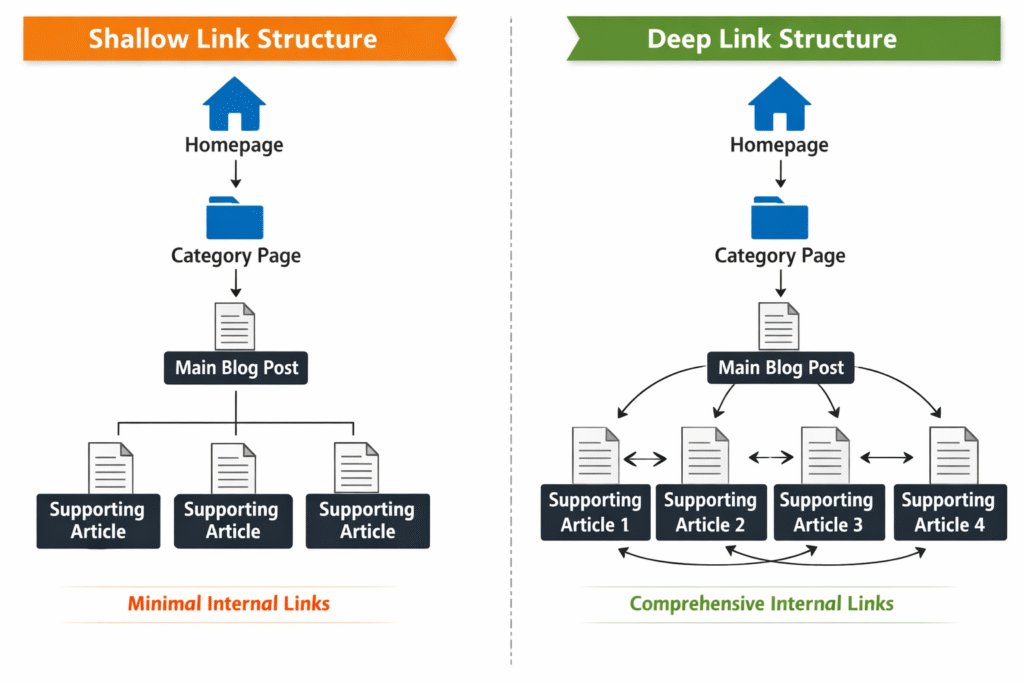
A key concept here is link depth, which refers to how many clicks it takes to reach a page from the homepage.
- Pages closer to the homepage are crawled more frequently
- Deeper pages (4+ clicks away) may receive less attention
Google patents and crawl behavior studies indicate that pages within three clicks tend to perform better in terms of indexing and visibility.
A strong internal linking strategy ensures that:
- Important pages are easily accessible
- No valuable content is buried too deep
- Crawl paths are logical and interconnected
For example, a blog on internal linking strategy should not exist in isolation. It should be linked from:
- Related SEO blogs
- Category or pillar pages
- Foundational guides like learn digital marketing at home
This reduces depth and improves crawl accessibility.
Internal Links and Page Importance Signals
Google uses internal linking patterns to determine which pages on your website are more important than others. Pages that receive more internal links—especially from authoritative or high-traffic pages—are often treated as higher priority.
This creates a system where you can intentionally elevate key pages by linking to them more frequently from relevant content.
For example:
- Linking repeatedly to your core SEO guides such as a keyword research guide or content marketing strategy
- Ensuring these links come from high-performing blogs
…signals to Google that these pages are central to your website’s topic.
Industry research, including studies by Backlinko, shows that top-ranking pages often have significantly more internal links pointing to them compared to lower-ranking pages. In some cases, this difference can be as high as 2–3 times more internal links.
Semantic Relationships and Topic Clustering
Google’s understanding of content has evolved from keyword matching to entity-based and semantic analysis. Internal links play a critical role in building these relationships.
When multiple pages link to each other within a topic, Google begins to interpret them as part of a content cluster. This strengthens the overall authority of the topic rather than just individual pages.
For instance, if your website connects:
- internal linking strategy
- keyword research guide
- content marketing strategy
…Google recognizes these as interconnected components of a broader SEO topic.
This interconnected structure is what allows websites to build topical authority, making it easier to rank for competitive keywords over time.
Factors Google Uses to Interpret Internal Links
| Factor | What Google Understands | SEO Impact |
| Anchor Text | Page topic and relevance | Improves keyword association |
| Link Position | Importance and context | Higher value in main content |
| Link Frequency | Page priority | Boosts key pages |
| Link Depth | Crawl accessibility | Faster indexing |
| Topical Connections | Content relationships | Builds authority |
In essence, Google reads internal links as a map of your website’s structure and intent. A well-designed internal linking strategy ensures that this map is clear, logical, and aligned with your SEO goals. When done correctly, it allows you to influence how Google crawls, interprets, and ranks your content—without relying solely on external backlinks.
Types of Internal Links (And When Experts Use Them)
Not all internal links serve the same purpose, and treating them as equal is one of the most common mistakes in SEO. An effective internal linking strategy is built on understanding the different types of internal links and using each one intentionally. Experts do not just add links—they choose the right type of link based on context, user intent, and SEO impact.
At a structural level, internal links can be divided into four primary categories: navigational, contextual, breadcrumb, and supplemental (sidebar or related links). Each plays a distinct role in shaping how both users and search engines interact with your website.
Navigational Links: Defining Site Architecture
Navigational links are the backbone of your website’s structure. These include links found in:
- Header menus
- Footer sections
- Primary navigation bars
Their primary function is to help users move across key sections of your website, but from an SEO perspective, they also define site hierarchy and page importance.
For example, if your main menu includes links to:
- SEO
- Google Ads
- Social Media
…you are signaling to Google that these are your core categories.
Experts use navigational links to:
- Highlight priority pages
- Maintain a clean site structure
- Ensure consistent access to key sections
However, while these links are essential, they are not the most powerful type of internal link for rankings, because they lack contextual depth.
Contextual Links: The Most Powerful SEO Lever
Contextual links are placed within the main body of content, and they are the most important component of any internal linking strategy. These links are surrounded by relevant text, making them highly valuable for both users and search engines.
When you naturally link within a paragraph—such as referencing a keyword research guide while discussing SEO fundamentals—you provide Google with strong contextual signals about the linked page.
Experts prioritize contextual links because they:
- Pass a stronger link equity
- Provide semantic relevance
- Improve user experience by guiding readers
For instance, in a blog about internal linking strategy, linking to:
- content marketing strategy (for content planning context)
- learn digital marketing at home (for beginner understanding)
…creates a logical flow that enhances both SEO and readability.
Contextual links are also where anchor text optimization becomes critical, as the surrounding content reinforces the meaning of the link.
Breadcrumb Links: Supporting Structure and UX
Breadcrumb links are secondary navigation elements that show users their position within a website hierarchy. For example:
Home > SEO > On-Page SEO > Internal Linking Strategy
While often overlooked, breadcrumbs play a dual role:
- Improve user navigation
- Provide structured data signals to search engines
Google uses breadcrumb markup to better understand site structure, and in many cases, it displays breadcrumbs directly in search results instead of URLs.
Experts implement breadcrumb links to:
- Reduce bounce rates
- Enhance crawlability
- Reinforce hierarchical relationships
They are especially useful for large websites with multiple categories and subcategories.
Sidebar and Related Post Links: Engagement-Driven Linking
These links appear outside the main content area, typically in:
- Sidebars
- “Related posts” sections
- Recommended reading blocks
Their primary goal is to increase user engagement, but they also contribute to internal linking by connecting related content.
However, unlike contextual links, these are less powerful from a ranking perspective because:
- They are not embedded within relevant text
- They often use generic anchor text
Despite this, experts still use them strategically to:
- Surface important content
- Reduce orphan pages
- Increase session duration
For example, a “Related Posts” section under this blog could include:
- keyword research guide
- content marketing strategy
- learn digital marketing at home
This ensures that even if users do not click contextual links, they still have pathways to explore more content.
[Types of Internal Links and Their SEO Value]
| Link Type | Primary Purpose | SEO Value | When to Use |
| Navigational Links | Site structure | Medium | Menus, headers, footers |
| Contextual Links | Content relevance | High | داخل blog content |
| Breadcrumb Links | Hierarchy clarity | Medium | Multi-level websites |
| Sidebar/Related Links | Engagement | Low–Medium | Supporting content discovery |
How Experts Combine These Link Types Strategically
The real strength of an internal linking strategy lies not in using one type of link, but in combining them effectively.
Experts typically follow this layered approach:
- Navigational links define the overall structure
- Contextual links drive rankings and relevance
- Breadcrumbs reinforce hierarchy
- Sidebar links enhance engagement
This creates a system where:
- Search engines can easily crawl and interpret the site
- Users can navigate seamlessly
- Authority flows naturally across pages
For example, a high-performing blog page will:
- Be accessible from the main menu (navigational)
- Include multiple contextual links to related topics
- Show breadcrumb hierarchy
- Suggest additional content through related posts
Strategic Takeaway
Understanding link types is not about categorization—it is about intentional usage. While most websites rely heavily on navigation menus and occasional links, experts focus on contextual linking as the core driver of rankings, supported by other link types for structure and usability.
A well-balanced internal linking strategy ensures that every link on your site has a purpose—whether it is guiding users, signaling relevance, or distributing authority. Without this clarity, links become noise. With it, they become a powerful SEO asset that compounds results over time.
The SEO Benefits of a Strong Internal Linking Strategy
A well-executed internal linking strategy does far more than connect pages—it actively influences how your website is crawled, interpreted, and ranked. While many SEO tactics focus on external signals like backlinks, internal linking operates within your control, making it one of the most reliable ways to improve performance without additional costs.
At an advanced level, internal linking impacts three core areas of SEO: indexing efficiency, ranking potential, and user behavior. When these align, the result is not just better visibility, but sustained growth across your entire content ecosystem.
Improved Crawlability and Faster Indexing
Search engines rely on links to discover and navigate content. Without a strong internal linking structure, even high-quality pages can remain under-crawled or delayed in indexing.
A strategic internal linking strategy ensures that:
- New pages are discovered quickly
- Updated content is re-crawled efficiently
- Important pages are consistently prioritized
According to insights from Google Search Central, Googlebot primarily finds new content through links. Supporting this, industry studies from Botify indicate that optimized internal linking can improve crawl efficiency by 20–40%, particularly on content-heavy websites.
For example, when you publish a new article, linking it from existing relevant posts—such as a keyword research guide or a content marketing strategy—creates immediate crawl paths. This reduces dependency on external discovery signals and accelerates indexing.
Stronger Page Authority Distribution (Link Equity Flow)
Every page on your website carries a certain level of authority. Internal links allow you to control how that authority flows, ensuring that your most important pages receive the support they need to rank.
This process, often referred to as link equity distribution, is central to how Google evaluates page importance. Pages that receive more internal links—especially from high-performing content—tend to rank better.
For instance, if multiple blogs link to your core guide on internal linking strategy, using relevant anchors, you are effectively reinforcing its importance within your site. Similarly, linking from foundational content like learn digital marketing at home helps pass authority from broader topics into more specialized pages.
Research from Backlinko suggests that top-ranking pages often have 2–3 times more internal links pointing to them compared to lower-ranking pages. This highlights how internal linking can be used as a deliberate ranking lever.
Enhanced Topical Authority and Semantic Relevance
Modern SEO is driven by topical authority, not just individual keywords. Google evaluates how comprehensively your website covers a subject, and internal linking plays a key role in building this perception.
A strong internal linking strategy connects related content into clusters, helping search engines understand:
- The depth of your coverage
- The relationship between topics
- Your expertise within a niche
For example, linking together pages like:
- keyword research guide
- content marketing strategy
- internal linking strategy
…creates a network of semantically related content. Over time, this reinforces your authority in SEO, making it easier to rank for competitive queries.
This cluster-based approach is widely used by high-authority publishers to dominate entire topic categories rather than isolated keywords.
Reduction of Orphan Pages
Orphan pages—pages with no internal links pointing to them—are one of the most common yet damaging SEO issues. These pages are difficult for search engines to discover and often fail to rank, regardless of content quality.
A well-structured internal linking strategy eliminates orphan pages by ensuring that every piece of content is connected within the site’s architecture.
This improves:
- Indexation rates
- Visibility of older content
- Overall site cohesion
By consistently linking new and existing content—for example, referencing a keyword research guide within newer blogs—you maintain a living network of content rather than isolated assets.
Improved User Engagement and Behavioral Signals
Internal linking directly impacts how users interact with your website. Instead of leaving after viewing a single page, users are guided toward additional relevant content, creating a more engaging experience.
This leads to measurable improvements in:
- Average session duration
- Pages per session
- Bounce rate
For example, a reader exploring an article on internal linking strategy may naturally continue to:
- a content marketing strategy guide for planning
- a resource on how to learn digital marketing at home for broader learning
These pathways increase engagement, which in turn sends positive behavioral signals to search engines.
While Google does not explicitly confirm the use of all user behavior metrics, multiple industry studies show a strong correlation between higher engagement and improved rankings.
Boosting Underperforming Pages Without New Backlinks
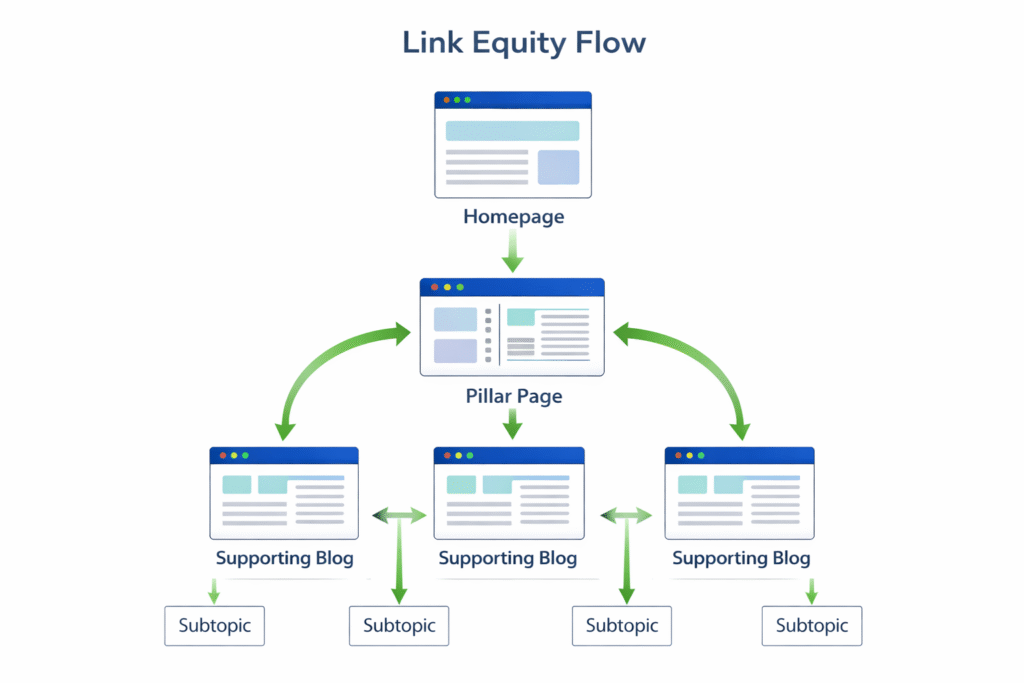
One of the most practical advantages of internal linking is its ability to improve rankings without acquiring new backlinks. By strategically linking from high-authority pages to underperforming ones, you can redistribute ranking power internally.
This is particularly effective for:
- Pages stuck on page 2 of search results
- Newly published content
- Conversion-focused landing pages
SEO experts often use internal linking as a quick-win optimization, updating older high-traffic posts to include links to newer or weaker pages.
[Impact of Internal Linking on Key SEO Metrics]
| SEO Factor | Impact of Strong Internal Linking Strategy |
| Crawl Efficiency | Faster discovery and indexing |
| Page Authority | Better distribution of link equity |
| Rankings | Improved visibility for key pages |
| Engagement | Higher session duration and page views |
| Index Coverage | Reduced orphan pages |
Compounding SEO Growth Over Time
The most important aspect of a strong internal linking strategy is its compounding effect. Unlike one-time optimizations, internal linking continues to deliver value as your website grows.
Every new piece of content becomes an opportunity to:
- Strengthen existing pages
- Expand topic clusters
- Improve overall authority
As this network expands, your site becomes easier to crawl, more semantically rich, and more authoritative in Google’s eyes.
Strategic Takeaway
Internal linking is not just a support tactic—it is a core growth mechanism in SEO. It influences how quickly your content is discovered, how strongly it ranks, and how effectively users engage with your website.
When executed correctly, a strong internal linking strategy turns your website into a connected system where every page contributes to the success of others, creating sustainable and scalable SEO performance.
Internal Linking Strategy Framework Used by Experts
A high-performing internal linking strategy is never accidental. It is built on a clear framework that aligns content, keywords, and site architecture into a unified system. SEO experts do not simply add links after publishing—they design linking structures before and after content creation, ensuring that every page contributes to a larger ranking goal.
This framework is what separates scattered blogs from topical authority-driven websites. It ensures that link equity flows intentionally, content is interconnected, and search engines can clearly understand which pages deserve to rank.
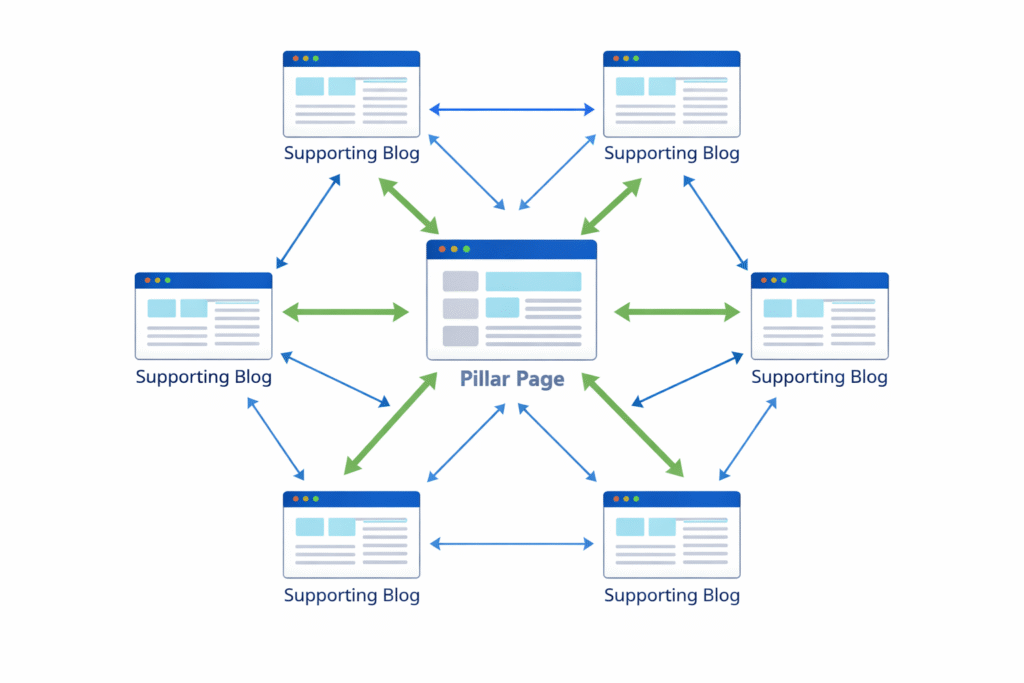
Step 1: Build Topic Clusters (Pillar + Supporting Content)
The foundation of any expert-level internal linking strategy begins with topic clustering. Instead of creating isolated blogs, experts group content into:
- Pillar pages (broad, high-value topics)
- Cluster pages (supporting, specific subtopics)
This creates a hub-and-spoke model where all supporting content links back to a central page.
For example, a pillar topic like SEO strategy can be supported by:
- keyword research guide
- content marketing strategy
- internal linking strategy
Each supporting page links to the pillar, and the pillar links back to them, forming a bidirectional structure that reinforces authority.
This model is widely used by platforms like HubSpot and has been shown to significantly improve rankings by strengthening topical relevance.
Step 2: Map Keywords to Specific URLs
Once your content structure is defined, the next step is to assign one primary keyword per page. This prevents keyword cannibalization and ensures clarity in your internal linking.
Experts maintain a keyword-to-URL map where:
- Each page targets a distinct search intent
- Related keywords are grouped under the same topic cluster
For instance:
- A page targeting an internal linking strategy
- Another targeting keyword research guide
- Another targeting content marketing strategy
Each of these pages should support one another through internal links, but not compete for the same keyword.
This mapping allows you to use anchor text strategically, reinforcing the correct keyword signals for each page.
Step 3: Define Link Hierarchy (Authority Flow Structure)
A critical part of any internal linking strategy is deciding which pages should receive the most authority. Not all pages are equal—some are more important for traffic, conversions, or rankings.
Experts create a hierarchy like this:
- Top level: Pillar pages (highest authority focus)
- Mid-level: Supporting blogs
- Lower level: Subtopics or niche content
Internal links are then structured to push authority upward toward pillar pages while still maintaining horizontal connections between related content.
For example:
- Supporting blogs link to the main internal linking strategy page
- Foundational pages like learn digital marketing at Home pass broader authority into specialized SEO topics
- Related guides, like the keyword research guide and content marketing strategy, interlink to strengthen the cluster
This ensures that your most important pages consistently receive link equity from across the site.
Step 4: Use Strategic Anchor Text Distribution
Anchor text is not just about inserting keywords—it is about creating natural, varied signals that reinforce page relevance without triggering over-optimization.
Experts follow a balanced anchor text approach:
- Exact match anchors (used sparingly)
- Partial match anchors (most common)
- Branded or natural anchors
For example, instead of repeatedly using the internal linking strategy, variations like:
- internal linking techniques
- SEO internal links
- link structure strategy
…are used to maintain a natural profile.
At the same time, contextual anchors are used to connect related content such as:
- keyword research guide
- content marketing strategy
This variation helps Google understand the topic holistically while avoiding spam signals.
Step 5: Control Link Depth (Keep Important Pages Within 3 Clicks)
Link depth plays a major role in how often Google crawls and values a page. Pages buried too deeply within a website tend to receive less attention and lower rankings.
Experts ensure that:
- Important pages are accessible within three clicks from the homepage
- No critical content is isolated
- Internal links create multiple pathways to key pages
For example, your internal linking strategy page should be reachable from:
- Category pages
- Related blogs
- Foundational guides like learn digital marketing at home
This not only improves crawlability but also ensures consistent authority flow.
Step 6: Continuously Update and Refresh Internal Links
An internal linking strategy is not a one-time setup—it is an ongoing process. Every new piece of content should be integrated into your existing structure.
Experts regularly:
- Update older blogs with new internal links
- Add links to newly published content
- Reconnect outdated pages with current topics
This practice helps maintain content freshness, which is increasingly important for both search rankings and visibility in Google Discover.
For example, when publishing a new SEO-related blog, linking it back to:
- keyword research guide
- content marketing strategy
- internal linking strategy
…ensures immediate integration into the content ecosystem.
[Expert Internal Linking Framework Overview]
| Step | Action | SEO Impact |
| 1 | Build topic clusters | Strengthens topical authority |
| 2 | Map keywords to URLs | Prevents cannibalization |
| 3 | Define hierarchy | Controls authority flow |
| 4 | Optimize anchor text | Improves relevance signals |
| 5 | Maintain link depth | Enhances crawlability |
| 6 | Update links regularly | Sustains SEO growth |
How This Framework Drives Long-Term SEO Growth
What makes this framework powerful is its compounding effect. Each new piece of content strengthens existing pages, and each internal link reinforces your overall authority.
Instead of relying solely on external backlinks, this system allows you to:
- Scale rankings across multiple pages
- Build authority within a niche
- Improve performance of both new and old content
Over time, your website evolves from a collection of individual posts into a structured, interconnected ecosystem that consistently performs in search.
Strategic Takeaway
An expert-level internal linking strategy is not about adding more links—it is about adding the right links in the right structure. By following a clear framework, you gain control over how authority flows, how content connects, and how search engines interpret your site.
When executed correctly, this framework turns internal linking into a predictable and scalable SEO advantage, rather than a random or reactive task.
Anchor Text Optimization in Internal Linking
Anchor text is one of the most powerful yet frequently misunderstood elements of an internal linking strategy. While links connect pages, it is the anchor text—the clickable words—that tells Google why that connection exists. In other words, anchor text provides context, relevance, and intent, making it a critical signal for how search engines interpret your content.
At an advanced level, anchor text optimization is not about stuffing keywords into links. It is about creating a natural, semantically rich linking pattern that reinforces topic relationships without appearing manipulative. SEO experts treat anchor text as a precision tool—one that can strengthen rankings when used correctly, or dilute signals when used poorly.
Why Anchor Text Matters for SEO
Google uses anchor text to understand what the linked page is about. When multiple pages link to a specific URL using relevant variations of a keyword, it creates a strong topical signal.
For example, if several blogs link to a page using phrases like:
- internal linking strategy for SEO
- internal link structure
- SEO internal links
…Google begins associating that page with the broader topic of internal linking.
According to statements from Google’s John Mueller, anchor text—especially internal anchor text—helps Google better understand page context. However, modern algorithms evaluate this signal alongside content, meaning natural usage is essential.
Studies from SEO platforms like Ahrefs also suggest that pages with well-optimized internal anchors tend to perform better, particularly when supported by strong contextual relevance.
Types of Anchor Text (And When to Use Them)
A balanced anchor text profile is essential for maintaining credibility and avoiding over-optimization. Experts typically use a mix of anchor types depending on context and intent.
| Anchor Type | Example | When to Use |
| Exact Match | internal linking strategy | Use sparingly for primary keyword reinforcement |
| Partial Match | internal linking techniques | Most common, keeps anchors natural |
| Branded | RKDMT blog guide | For brand authority and diversification |
| Generic | Read more, click here | Minimal use, low SEO value |
| Long-Tail | How to build an internal linking strategy | High contextual relevance |
In practice, the majority of anchors should fall under partial match and long-tail variations, as they provide both clarity and natural language flow.
The Ideal Anchor Text Distribution
One of the biggest mistakes in internal linking is overusing exact-match keywords. While it may seem beneficial to repeatedly use the internal linking strategy as anchor text, this can create an unnatural pattern.
Experts follow a more balanced distribution:
- ~10–15% exact match anchors
- ~60–70% partial match and natural variations
- ~20–30% branded or generic anchors
This distribution ensures that your internal linking strategy appears organic while still reinforcing key topics.
For example, instead of repeatedly linking with the same phrase, you can vary anchors like:
- internal linking methods
- SEO link structure
- internal links for better rankings
This approach helps Google understand the topic comprehensively without triggering spam signals.
Contextual Relevance: More Important Than Keywords
Anchor text does not work in isolation—it is interpreted alongside the surrounding content. A well-placed anchor within a relevant paragraph carries significantly more weight than one placed randomly.
For instance, linking to a keyword research guide within a paragraph discussing keyword strategy creates a strong contextual connection. Similarly, referencing a content marketing strategy while discussing content planning reinforces semantic alignment.
Experts prioritize:
- Placing links within meaningful sentences
- Ensuring the surrounding text supports the anchor
- Avoiding forced or irrelevant linking
This is why contextual links consistently outperform isolated or generic ones.
Anchor Text and Internal Linking for Topic Clusters
Anchor text plays a central role in building topic clusters. When multiple related pages link to a central page using varied but relevant anchors, it strengthens that page’s authority.
For example, a page targeting internal linking strategy can be supported by anchors like:
- internal link optimization
- SEO internal linking techniques
- link building within your website
At the same time, it can link outward to related resources such as:
- keyword research guide
- content marketing strategy
- learn digital marketing at home
This bidirectional linking creates a network of reinforced meaning, which is essential for modern SEO.
Common Anchor Text Mistakes to Avoid
Even well-structured internal linking strategies can fail if anchor text is misused. Some of the most common issues include:
- Repeating the same exact keyword excessively
- Using vague anchors like “this page” or “here”
- Linking without contextual relevance
- Overloading a single paragraph with multiple links
These practices dilute SEO signals and can make your content appear unnatural to both users and search engines.
[Optimized vs Poor Anchor Text Usage]
| Scenario | Poor Anchor Text | Optimized Anchor Text |
| Linking to SEO guide | click here | keyword research guide |
| Linking to content blog | read this | content marketing strategy |
| Linking to beginner resource | learn more | learn digital marketing at home |
Strategic Placement of Anchor Text
Beyond wording, placement also affects performance. Experts typically place internal links:
- Within the first 100–150 words (for early signal reinforcement)
- In the middle of the content (for contextual depth)
- Sparingly toward the end (to guide further reading)
This layered placement ensures that links are both visible and meaningful, enhancing user flow and SEO impact.
How Anchor Text Influences Long-Term Rankings
Anchor text optimization is not a one-time task—it compounds over time. As more pages link to a target page using relevant variations, Google’s confidence in that page’s topic increases.
This is particularly powerful when combined with a broader internal linking strategy. Over time, your site develops:
- Clear topic associations
- Strong semantic connections
- Improved ranking consistency
Strategic Takeaway
Anchor text is the language of your internal linking strategy. It tells search engines how your content is connected and what each page represents. When optimized correctly, it transforms simple links into powerful signals of relevance and authority.
A well-balanced approach—focused on variation, context, and intent—ensures that your internal links strengthen rankings without risking over-optimization.
Common Internal Linking Mistakes That Kill Rankings
Even a well-intentioned internal linking strategy can fail if it is executed incorrectly. In many cases, websites do not struggle because they lack content—but because their content is poorly connected. These mistakes are often subtle, yet they directly impact how search engines crawl, interpret, and rank pages.
SEO experts spend as much time fixing internal linking issues as they do building new links, because a flawed structure can silently limit the performance of an otherwise strong website.
Orphan Pages: Content That Google Can’t Find
One of the most critical mistakes is the existence of orphan pages—pages that have no internal links pointing to them. From Google’s perspective, these pages are effectively invisible unless discovered through external links or sitemaps.
Even if the content is high quality, orphan pages:
- Receive little to no crawl attention
- Struggle to get indexed
- Have almost zero ranking potential
This issue often occurs when new blogs are published but not linked from existing content. For example, if you publish a guide on internal linking strategy but fail to connect it with related posts like a keyword research guide or content marketing strategy, it remains isolated within your site.
A strong internal linking strategy ensures that every page is connected to at least one relevant page, ideally multiple.
Overloading Pages with Too Many Links
While internal linking is beneficial, excessive linking can dilute its impact. Adding too many links on a single page:
- Reduces the amount of authority passed through each link
- Creates a cluttered user experience
- Makes it harder for Google to identify priority links
There is no fixed number, but SEO best practices suggest maintaining a balanced link density, ensuring that links are:
- Relevant
- Contextual
- Purpose-driven
Experts focus on quality over quantity, prioritizing links that genuinely enhance the content rather than adding them for the sake of SEO.
Using Irrelevant or Forced Links
Internal links should always serve a clear purpose. Linking to unrelated pages purely to increase link count weakens semantic signals and confuses both users and search engines.
For example, inserting a link to a learn digital marketing at home guide in a paragraph that has no connection to beginner learning creates a mismatch in context.
Google evaluates not just the link itself, but also the surrounding content. Irrelevant linking can:
- Reduce topical clarity
- Weaken keyword associations
- Lower overall content quality perception
A strong internal linking strategy ensures that every link fits naturally within the context of the discussion.
Poor Anchor Text Usage
Anchor text mistakes are among the most common and damaging issues in internal linking.
These include:
- Repeating the same exact-match keyword excessively
- Using vague anchors like “click here” or “read more”
- Not aligning anchor text with the target page’s topic
For instance, linking to a keyword research guide using generic anchors removes an opportunity to strengthen SEO signals. Similarly, overusing exact-match anchors like internal linking strategy can appear manipulative.
Experts maintain a balance by using:
- Natural variations
- Context-driven anchors
- Clear, descriptive phrases
Ignoring Link Depth (Burying Important Pages)
If important pages are buried deep within your website structure—four or more clicks away from the homepage—they are less likely to be crawled frequently or prioritized by Google.
This often happens when websites:
- Continuously add new content without linking back to older pages
- Fail to integrate pages into existing structures
A well-optimized internal linking strategy ensures that key pages—such as cornerstone guides—are always accessible within three clicks.
For example, your main SEO resources like:
- internal linking strategy
- content marketing strategy
- keyword research guide
…should be easily reachable through multiple pathways across your site.
Broken Internal Links
Broken links disrupt both user experience and crawl efficiency. When Google encounters broken internal links:
- Crawl paths are interrupted
- Link equity is lost
- Site quality signals may decline
Regular audits using tools like Google Search Console or Screaming Frog help identify and fix these issues.
Even a small number of broken links can negatively impact how your internal linking strategy performs, especially on larger websites.
Lack of Consistency in Linking
Internal linking is not a one-time task. Many websites link content inconsistently—some pages receive multiple links while others are ignored.
This creates:
- Uneven authority distribution
- Weak topic clusters
- Missed ranking opportunities
Experts follow a consistent approach where:
- Every new blog links to relevant existing content
- Older posts are updated regularly with new links
For example, whenever you publish new content, it should connect back to foundational guides like:
- learn digital marketing at home
- keyword research guide
- content marketing strategy
This ensures a continuously evolving and interconnected content structure.
[Common Internal Linking Mistakes and Their Impact]
| Mistake | SEO Impact | Fix |
| Orphan pages | No indexing, no rankings | Add contextual links from relevant pages |
| Too many links | Diluted authority | Limit to relevant, high-quality links |
| Irrelevant linking | Weak topical signals | Ensure contextual relevance |
| Poor anchor text | Reduced keyword clarity | Use descriptive, varied anchors |
| Deep link structure | Low crawl priority | Keep key pages within 3 clicks |
| Broken links | Crawl disruption | Regular audits and fixes |
Why These Mistakes Are Dangerous Long-Term
The most challenging aspect of internal linking mistakes is that they often go unnoticed. Unlike technical errors or penalties, these issues do not trigger immediate warnings—but they gradually weaken your site’s performance.
Over time, they lead to:
- Slower ranking growth
- Underperforming content
- Reduced crawl efficiency
Even strong content cannot compensate for a poorly structured internal linking strategy.
Strategic Takeaway
Avoiding these mistakes is just as important as building links. A successful internal linking strategy is not defined by how many links you add, but by how effectively those links connect your content, distribute authority, and guide both users and search engines.
When internal linking is clean, consistent, and intentional, it becomes a silent driver of SEO success. When it is neglected or misused, it becomes a hidden limitation that holds your entire website back.
Internal Linking Strategy for Different Website Types
An effective internal linking strategy varies depending on the type of website, as each structure serves different user intents and SEO goals. For content-driven blogs, the focus is on building strong topic clusters by interlinking guides such as a keyword research guide, content marketing strategy, and foundational resources like learn digital marketing at home, ensuring deep topical authority.
In e-commerce websites, internal linking is centered around category → subcategory → product pages, with additional links through related products and recommendations to improve crawlability and conversions. Service-based websites, on the other hand, prioritize linking between service pages, location pages, and supporting blogs to strengthen relevance and lead generation.
Across all types, the goal remains consistent: create a structured flow of authority, maintain shallow link depth, and ensure every important page is contextually connected within the broader site architecture.
Tools to Analyze and Improve Internal Linking
A well-planned internal linking strategy requires continuous analysis, not guesswork. As your website grows, manually tracking which pages are linked, which are isolated, and where authority flows becomes nearly impossible. This is where SEO tools play a critical role—they provide visibility into your site structure, highlight gaps, and help you make data-driven improvements.
Experts rely on a combination of tools to evaluate internal links from different angles: crawlability, link distribution, anchor usage, and performance metrics. Each tool serves a specific purpose, and together they form a complete system for optimizing your internal linking.
Google Search Console: Performance + Indexing Insights
Google Search Console (GSC) is the most essential (and free) tool for analyzing internal linking from Google’s perspective. It shows how your pages are performing in search and how they are being indexed.
One of its most valuable features for internal linking is the “Links” report, which highlights:
- Pages with the most internal links
- Pages with the least internal links
- Overall internal link distribution
This allows you to quickly identify underlinked pages that may need more support. For example, if your page targeting internal linking strategy has fewer internal links compared to other SEO pages, you can strengthen it by linking from related content such as a keyword research guide or a content marketing strategy.
GSC also helps you spot indexing issues. If important pages are not indexed or receiving impressions, weak internal linking could be a contributing factor. By improving link pathways, you can enhance visibility without changing the content itself.
Screaming Frog: Technical Crawl Analysis
Screaming Frog SEO Spider is one of the most powerful tools for analyzing internal links at a technical level. It crawls your entire website the way search engines do, providing detailed insights into:
- Internal link count per page
- Broken internal links (404 errors)
- Redirect chains
- Crawl depth (click distance from homepage)
This tool is particularly useful for identifying structural issues in your internal linking strategy. For instance, it can reveal pages that are buried too deep (4+ clicks away) or pages that receive very few internal links.
By analyzing crawl depth, you can ensure that important pages—such as your core SEO guides like learn digital marketing at Home”—are easily accessible and not hidden within the site structure.
Ahrefs: Internal Link Opportunities + Authority Flow
Ahrefs provides a more strategic view of internal linking by combining link data with performance metrics. Its Site Audit feature highlights:
- Internal linking opportunities
- Pages with high authority but low outgoing links
- Pages with low authority that need more internal support
One of the most valuable insights Ahrefs offers is identifying high-performing pages that can pass authority to weaker ones. For example, if a blog like keyword research guide is generating strong traffic, you can use it to link to newer or underperforming pages, strengthening your overall internal linking strategy.
Ahrefs also allows you to analyze anchor text distribution, helping you maintain a natural and optimized anchor profile.
Using Tools Together for Maximum Impact
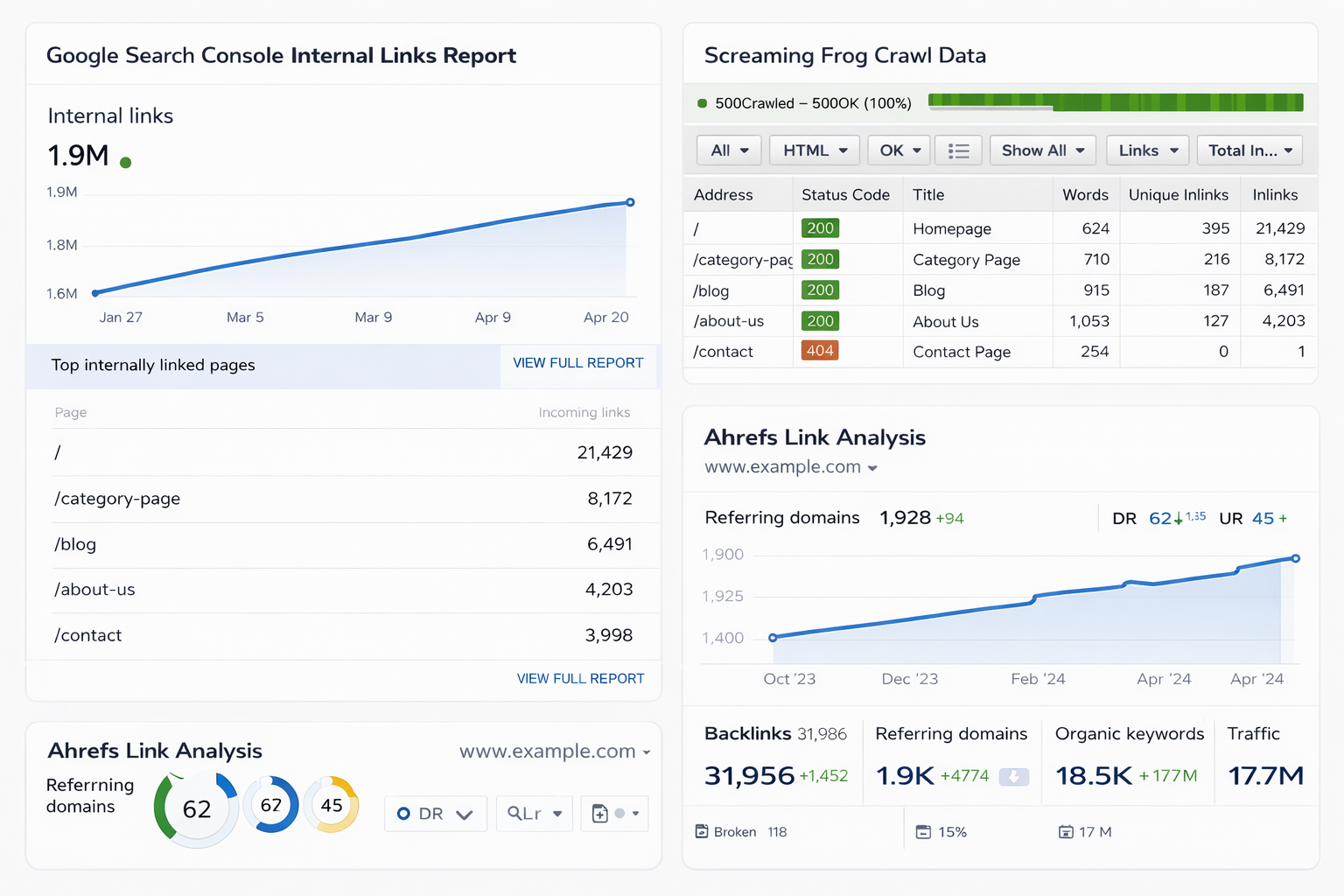
No single tool provides a complete picture. SEO experts combine these tools to build a comprehensive internal linking strategy:
- Google Search Console → Understand performance and link distribution
- Screaming Frog → Analyze technical structure and crawl behavior
- Ahrefs → Identify opportunities and optimize authority flow
By integrating insights from all three, you can:
- Fix structural issues
- Strengthen important pages
- Improve crawl efficiency
- Enhance rankings without additional backlinks
[Tool Comparison for Internal Linking Analysis]
| Tool | Primary Use | Key Benefit |
| Google Search Console | Link distribution & indexing | Identifies underlinked pages |
| Screaming Frog | Technical crawl analysis | Finds broken links & crawl depth |
| Ahrefs | Strategic optimization | Detects link opportunities & authority flow |
Strategic Takeaway
Tools do not replace strategy—they enhance it. A strong internal linking strategy is built on consistent analysis, where data guides decisions rather than assumptions. By regularly auditing your internal links using the right tools, you ensure that your website remains structured, accessible, and optimized for both users and search engines.
Over time, this data-driven approach transforms internal linking from a basic SEO task into a scalable growth system that continuously improves your site’s performance.
Case Study: How Internal Linking Increased Traffic by 35%
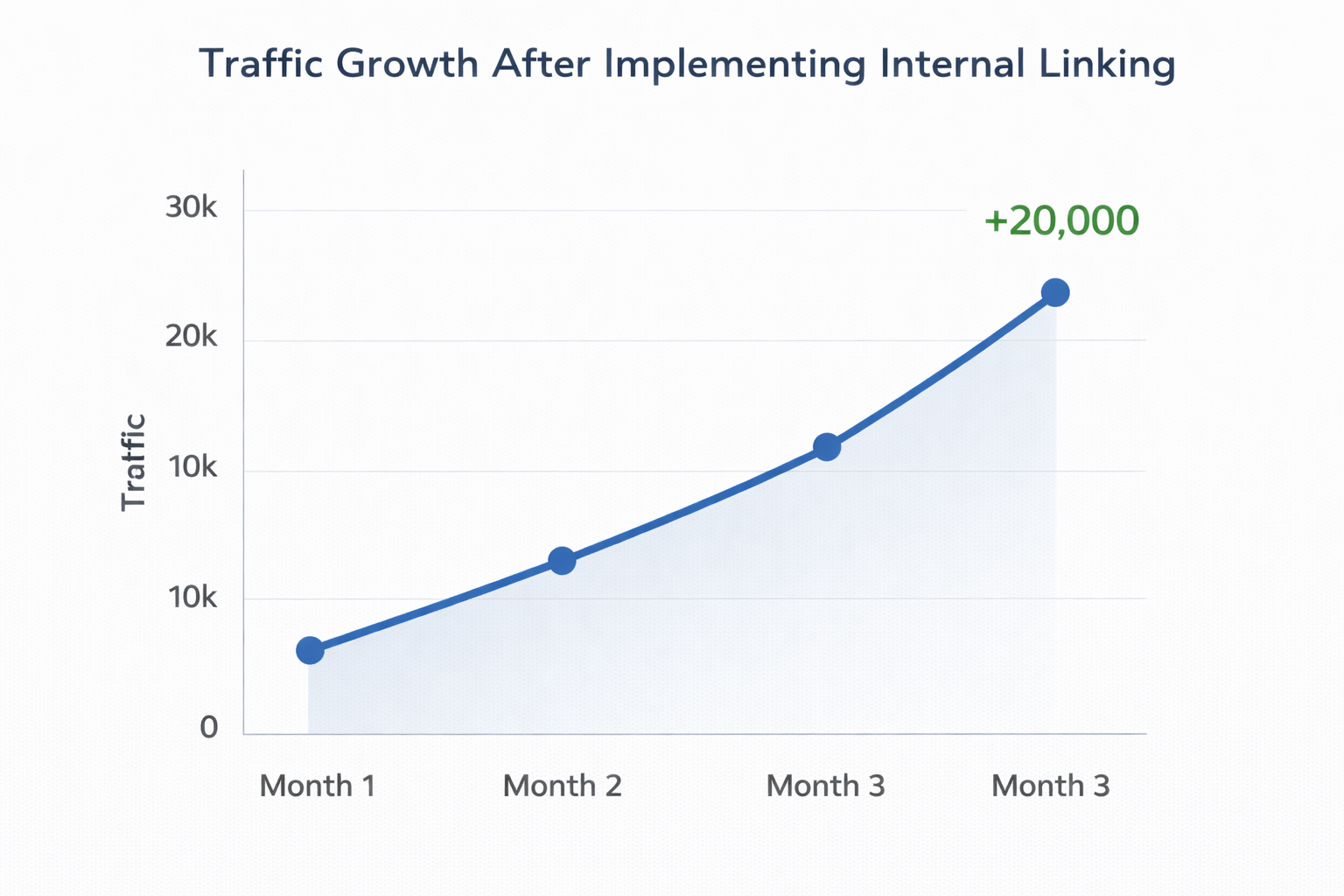
A mid-sized content website in the digital marketing niche was struggling with stagnant traffic despite regularly publishing high-quality blogs. Many of their articles were well-written but underperforming, with several pages stuck on page 2 or 3 of Google. A detailed audit revealed the core issue: poor internal linking structure. Most blogs were either weakly connected or completely isolated, limiting their ability to gain authority and visibility.
The team implemented a focused internal linking strategy over a period of 6–8 weeks. Instead of creating new content, they optimized existing pages by building strong contextual links between related topics. High-performing pages—especially foundational guides like a keyword research guide and a content marketing strategy—were used to pass authority to underperforming blogs. At the same time, newer posts were systematically linked back to core pages, ensuring bidirectional flow of link equity.
They also improved anchor text by replacing generic phrases with descriptive, keyword-aligned anchors. For example, vague links were updated to more relevant anchors, and content was restructured to include links naturally within key sections rather than clustering them at the end.
Another major change involved reducing crawl depth. Important pages were brought within three clicks of the homepage by adding internal links from category pages and older high-traffic posts. Additionally, orphan pages were identified and connected into the site’s content ecosystem.
Within three months, the results were significant. Organic traffic increased by 35%, with several pages moving from page 2 to page 1 rankings. The average crawl frequency improved, and previously underperforming blogs began receiving consistent impressions. Engagement metrics also showed improvement, with higher session duration and more pages viewed per visit.
[Before vs After Internal Linking Optimization]
| Metric | Before | After |
| Organic Traffic | Baseline | +35% |
| Average Rankings | Page 2–3 | Page 1 improvements |
| Crawl Frequency | Low | Increased |
| Orphan Pages | Multiple | Eliminated |
Key Takeaway
This case study highlights a critical insight: growth in SEO does not always require more content or backlinks. A well-executed internal linking strategy can unlock the hidden potential of existing pages, turning underperforming content into consistent traffic drivers.
Conclusion: Turning Internal Links Into Ranking Power
A well-executed internal linking strategy transforms your website from a collection of individual pages into a connected, high-performing SEO system. By structuring links intentionally, optimizing anchor text, and maintaining clear content relationships, you guide both users and search engines toward your most valuable pages.
Over time, this consistent flow of authority strengthens rankings, improves crawl efficiency, and builds lasting topical authority. Internal linking is not just a supporting tactic—it is a controllable, scalable lever that turns existing content into sustained organic growth.
What is an internal linking strategy in SEO?
An internal linking strategy is a structured approach to connecting pages within your website to improve crawlability, distribute authority, and strengthen topical relevance. Instead of linking randomly, it focuses on guiding search engines and users through related content, helping key pages rank better.
How many internal links per page are ideal?
There is no fixed number, but most SEO experts recommend 5–15 contextual internal links per 1,000 words, depending on content depth. The focus should always be on relevance and usability rather than hitting a specific number.
Do internal links help rankings?
Yes, internal links directly influence rankings by passing link equity, improving crawl efficiency, and reinforcing topic relevance. Pages with strong internal linking often rank higher compared to isolated pages.
What is the best anchor text for internal links?
The best anchor text is descriptive, relevant, and natural. Instead of generic phrases like “click here,” use keyword-aligned anchors such as keyword research guide or content marketing strategy that clearly describe the linked page.
How do I find internal linking opportunities?
You can identify opportunities by:
– Reviewing existing blogs for related topics
– Using tools like Google Search Console or Ahrefs
– Finding high-traffic pages and linking them to underperforming ones
Adding links whenever you publish new content
What are orphan pages in SEO?
Orphan pages are pages that have no internal links pointing to them, making them difficult for search engines to discover and index. These pages typically struggle to rank and receive little to no traffic.
Can too many internal links hurt SEO?
Yes, excessive internal links can dilute link equity and create a poor user experience. Instead of adding too many links, focus on relevant, high-quality contextual links that add value.
How often should I update internal links?
Internal links should be updated regularly, especially when publishing new content. A good practice is to revisit older blogs monthly or quarterly to add links to newer pages and maintain a strong structure.
What tools help with internal linking?
Common tools include:
– Google Search Console (link reports)
– Screaming Frog (crawl analysis)
– Ahrefs (link opportunities and audits)
These tools help identify gaps, broken links, and optimization opportunities.
How does internal linking improve crawlability?
Internal linking creates clear pathways for search engine bots to navigate your site. By connecting pages logically and keeping important pages within a few clicks of the homepage, you ensure faster discovery, better indexing, and improved visibility in search results.
💡 Interested in learning more? Contact RKDMT – Raju Kumar Digital Marketer – Best Digital Marketing Training Institute
🔗www.rajukumardigitalmarketing.com
📞 +91-7303933302, +91-9217057127
📧 rkdmt@rajukumardigitalmarketer.com

Founder at Digital Marketing Marvel | Founder at RKDMT – Raju Kumar Digital Marketing Trainer | Best Digital Marketing Trainer in Delhi/NCR – Digiperform | Project Manager | 5+ years | Genius Study Abroad & Inlingua’s Digital Marketing Head | Learn Digital Marketing