


Instagram vs LinkedIn Marketing: Where to Start?
In 2026, social media marketing is no longer about being present everywhere — it is about being strategic with where you show up. With platforms evolving rapidly and algorithms becoming more intent-driven, beginners often find themselves confused between where to start and how to invest their time effectively. This is where the debate around Instagram vs. LinkedIn marketing becomes highly relevant.
Both platforms are powerful, but they operate in completely different ecosystems. Instagram is built around visual storytelling, entertainment, and fast-paced engagement, while LinkedIn focuses on professional networking, trust-building, and high-intent interactions. Choosing the wrong platform at the beginning can lead to wasted effort, slow growth, and poor results.
According to recent data from Meta, Instagram has over 2.4 billion monthly active users, making it one of the most influential platforms for content discovery. On the other hand, LinkedIn has crossed 1 billion users globally, with a strong focus on professionals, businesses, and decision-makers. This difference in audience intent is crucial in determining which platform aligns better with your goals.
For beginners entering the world of digital marketing, the biggest challenge is not learning tools — it is understanding where their efforts will generate the highest return. Many start posting randomly without a clear platform strategy, which often leads to burnout and inconsistency. If you are just starting, it is essential first to understand the social media marketing basics before diving deep into platform-specific tactics.
Another important factor to consider is how algorithms have evolved. Instagram’s algorithm is heavily based on user behavior, content interaction, and interest signals, making it easier for content to go viral but harder to maintain consistency. In contrast, LinkedIn’s algorithm prioritizes relevance, network connections, and meaningful engagement, which may result in slower growth but often leads to higher-quality interactions.
For a deeper understanding of how platform algorithms influence visibility, you can refer to how social media algorithms work or explore insights shared by Google Search Central, which emphasize the importance of user intent and content relevance across digital platforms.
Why This Comparison Matters in 2026
The discussion around Instagram vs. LinkedIn marketing is no longer just about preference — it is about strategy alignment. Beginners today have access to more tools, resources, and opportunities than ever before, but attention spans are shorter, and competition is significantly higher.
- Posting on Instagram without understanding content hooks can result in low reach
- Posting on LinkedIn without providing value can lead to zero engagement
- Trying to manage both platforms without clarity can dilute your efforts
This is why choosing the right starting point becomes critical.
What You Will Learn in This Guide
This guide is designed to help you make a clear, data-driven decision. By the end, you will understand:
- The core differences between Instagram and LinkedIn marketing
- How audience intent shapes content performance
- Which platform is better suited for your specific goals
- How to avoid common beginner mistakes
- A step-by-step roadmap to get started
If you are completely new, you may also want to explore digital marketing for beginners to build a strong foundation before choosing your platform.
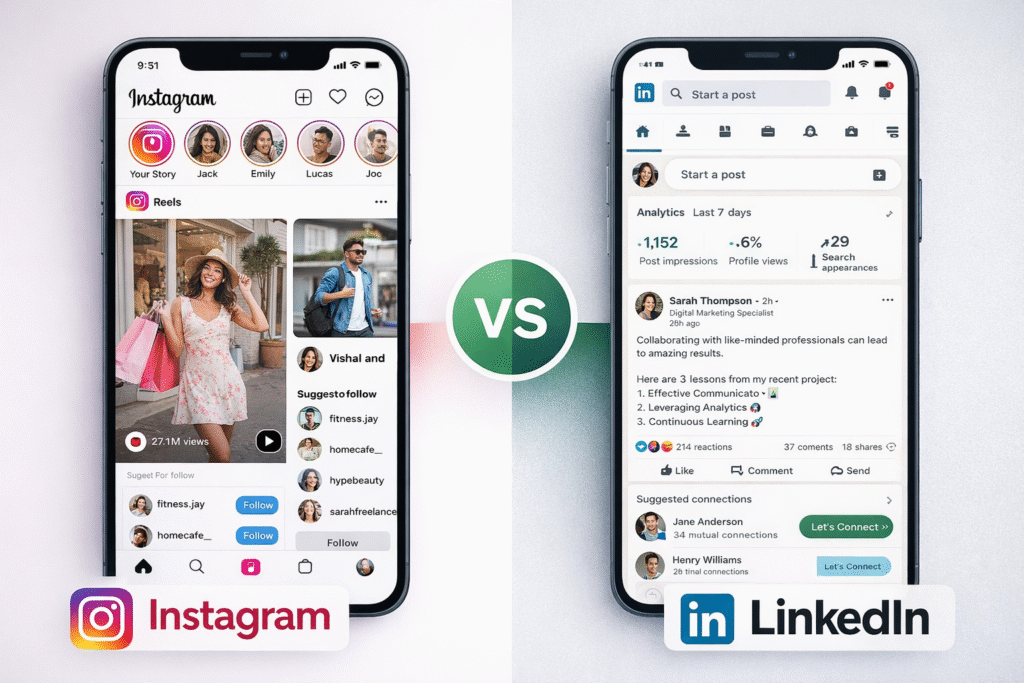
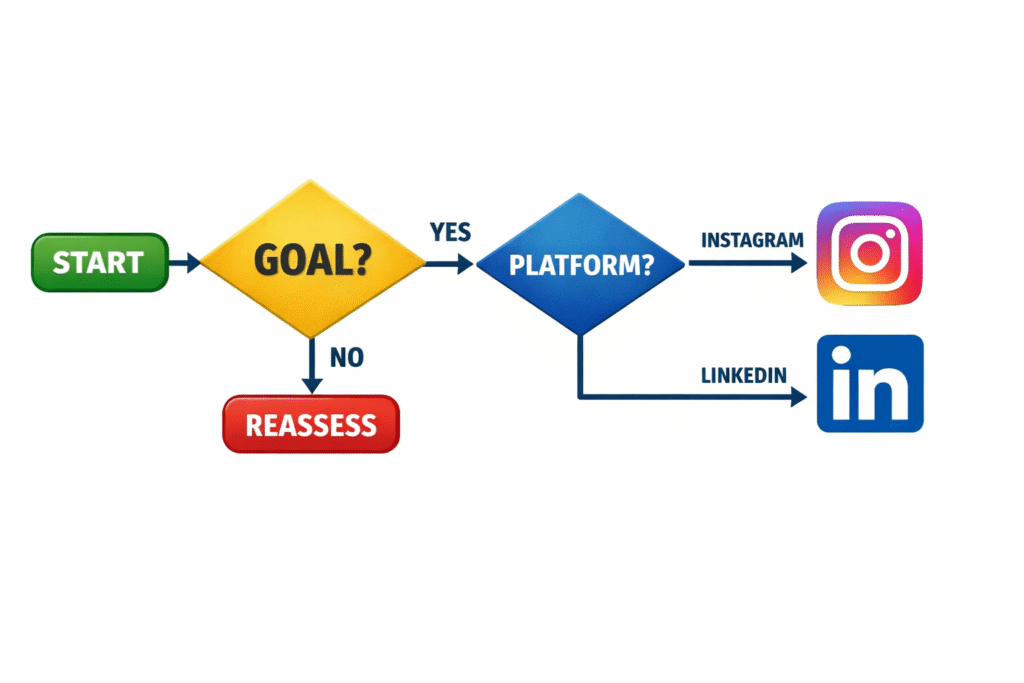
At its core, the decision between Instagram vs. LinkedIn marketing comes down to one thing: your goal. Whether you want rapid growth, brand visibility, or high-quality leads, each platform offers a unique path. The key is not choosing the “best” platform, but choosing the right one for where you are starting from.
Understanding Instagram Marketing
Instagram has evolved from a simple photo-sharing app into one of the most powerful marketing platforms in the digital ecosystem. When discussing Instagram vs. LinkedIn marketing, Instagram stands out as a platform driven by visual appeal, fast consumption, and algorithm-led discovery. For beginners, it offers a unique advantage — the ability to reach a large audience quickly, even without an existing network.
Unlike traditional platforms where reach depends heavily on connections, Instagram allows content to be discovered by strangers through features like the Explore page, Reels feed, and hashtag-based discovery. This makes it especially attractive for those who want visibility, audience growth, and brand awareness in a short period.
If you are new to the platform, it is important to first understand how Instagram marketing works step-by-step before focusing on growth strategies.
What Makes Instagram a Marketing Powerhouse
Instagram’s strength lies in its ability to combine content, creativity, and algorithmic reach. It is designed to keep users engaged through highly visual and interactive formats.
- The platform prioritizes short-form video content (Reels), which is currently the highest-performing format
- Content is distributed based on user behavior, interests, and engagement patterns, not just followers
- Even accounts with zero followers can achieve viral reach if content performs well
According to Meta insights, Reels generate up to 2x more engagement compared to static posts. This shift has made Instagram a key platform for creators, freelancers, and businesses looking to scale quickly.
To understand how engagement metrics impact performance, you can explore what is engagement rate in social media, which explains how likes, saves, and shares influence reach.
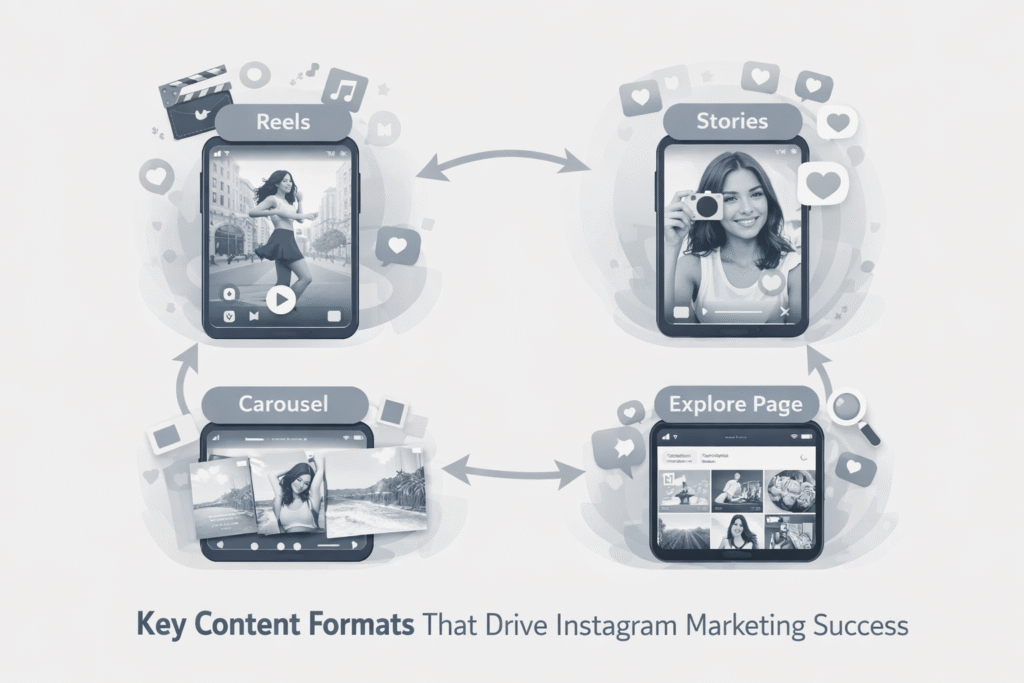
Types of Content That Work Best on Instagram
Success on Instagram depends heavily on the type of content you create. Unlike LinkedIn, where ideas and insights dominate, Instagram rewards visual storytelling and quick value delivery.
The most effective content formats include:
- Reels (Short-form videos): Ideal for reach and discoverability
- Carousel posts: Useful for educational or step-by-step content
- Stories: Best for daily engagement and audience interaction
- Static posts: Good for branding, but lower reach compared to video
To maintain consistency in posting, many marketers rely on content planning strategies for social media, which help organize ideas and maintain quality.
Instagram Content Performance Comparison
| Content Type | Average Engagement Rate | Effort Level | Best Use Case |
| Reels | High (2–5%+) | Medium | Reach & viral growth |
| Carousel Posts | Medium (1.5–3%) | High | Education & value delivery |
| Stories | Variable | Low | Daily engagement & retention |
| Static Posts | Low (1–2%) | Low | Branding & aesthetics |
Note: Engagement rates vary based on niche and audience behavior.
Audience Behavior on Instagram
Understanding user behavior is critical when analyzing Instagram vs. LinkedIn marketing, because the intent of users directly impacts content performance.
Instagram users typically:
- Consume content quickly (attention span: ~3–5 seconds)
- Prefer entertaining, relatable, or visually appealing content
- Engage more with content that evokes emotion or curiosity
- Scroll passively unless a strong hook captures attention
This is why the first few seconds of a Reel or the first slide of a carousel are extremely important. If the hook fails, the content is likely to be ignored.
For deeper insights into audience psychology, you can refer to consumer behavior in digital marketing, which explains how users interact with online content.
Pros and Limitations of Instagram Marketing
Instagram offers significant advantages, but it also comes with certain limitations that beginners must understand.
Advantages
- High potential for organic reach and virality
- Ideal for building personal brands and creative portfolios
- Strong visual storytelling capabilities
- Wide and diverse audience base
Limitations
- Inconsistent reach due to algorithm changes
- High competition across most niches
- Requires continuous content creation
- Lower conversion intent compared to professional platforms
For example, while Instagram can help you gain thousands of followers, converting those followers into clients often requires additional strategies. You can learn more about this in ” How to generate leads from social media.
Strategic Takeaway
When evaluating Instagram vs. LinkedIn marketing, Instagram is best suited for those who want fast growth, high visibility, and creative expression. However, success on this platform requires consistency, adaptability, and a strong understanding of content trends.
It is not just about posting — it is about creating content that aligns with how users consume information. Beginners who take the time to understand this dynamic are more likely to see sustainable results.
Understanding LinkedIn Marketing
While Instagram thrives on creativity and fast-paced content, LinkedIn operates in a completely different environment — one built on professional intent, credibility, and meaningful engagement. In the discussion of instagram vs linkedin marketing, LinkedIn stands out as a platform where quality often matters more than quantity, and where content is consumed with a purpose.
LinkedIn is no longer just a job-search platform. Over the past few years, it has transformed into a powerful content-driven ecosystem where individuals, businesses, and creators share insights, build authority, and generate high-quality leads. For beginners, this means you do not need millions of followers to see results — you need relevance and value.
If you are just starting, it is useful to first understand how LinkedIn marketing works for beginners, especially how content visibility and engagement function differently compared to other platforms.
Why LinkedIn is Growing as a Marketing Platform
LinkedIn’s growth in marketing is driven by a shift in user behavior. Professionals are no longer using the platform only for networking — they are actively consuming and engaging with content.
- The platform has over 1 billion users globally, with a strong concentration of professionals and decision-makers
- LinkedIn reports that video content consumption has grown by over 36% year-over-year
- Posts with images receive up to 2x higher engagement compared to text-only posts
Unlike Instagram, where content is often consumed for entertainment, LinkedIn users are actively looking for knowledge, opportunities, and solutions. This makes it a highly valuable platform for marketers focused on lead generation and authority building.
For additional insights into platform trends, you can refer to LinkedIn user statistics and growth trends or explore the latest digital marketing trends to understand how LinkedIn fits into the broader landscape.
Content That Performs on LinkedIn
Content on LinkedIn is driven by insight, experience, and storytelling rather than visual appeal alone. The platform rewards posts that provide value and encourage discussion.
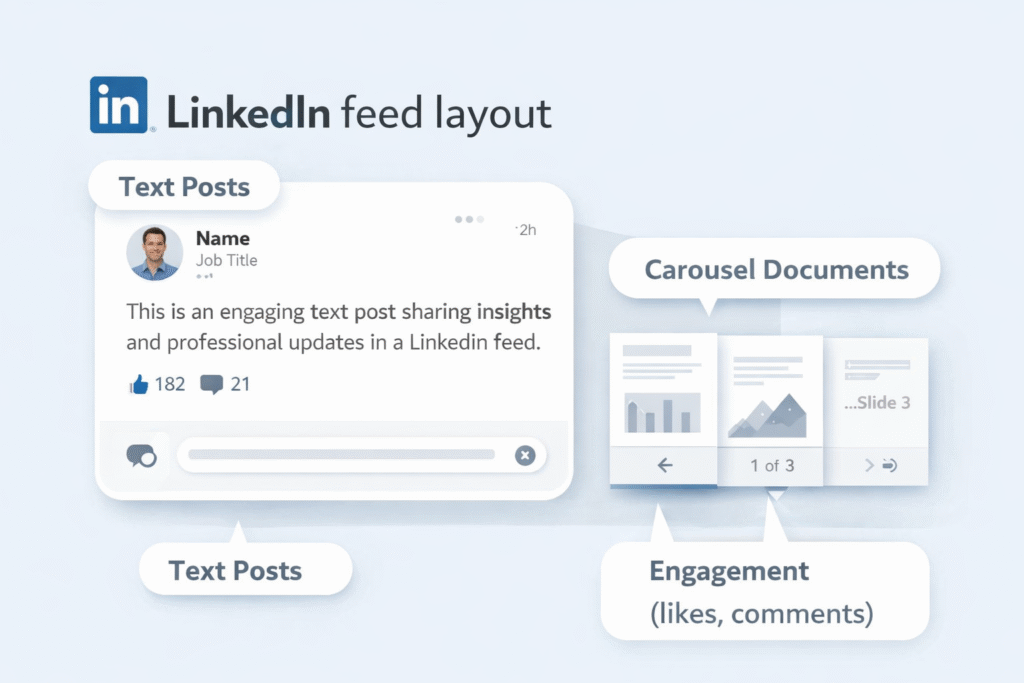
High-performing content formats include:
- Text-based posts with strong hooks and storytelling
- Carousel documents (PDF-style posts) for educational content
- Short-form videos explaining concepts or sharing experiences
- Case studies and real-world insights
Unlike Instagram, where aesthetics dominate, LinkedIn focuses on clarity and substance. Even simple posts can perform well if they deliver genuine value.
To improve content quality, you can explore content writing strategies for digital marketing, which explains how to structure posts that engage professional audiences.
Audience Behavior on LinkedIn
Understanding user intent is crucial when comparing Instagram vs. LinkedIn marketing, because LinkedIn users behave very differently.
LinkedIn users typically:
- Spend more time reading and analyzing content
- Engage with posts that offer practical insights or lessons
- Value authenticity, expertise, and personal experiences
- Are more likely to convert into leads or clients
This high-intent behavior is what makes LinkedIn especially effective for B2B marketing, freelancing, and personal branding.
For a deeper understanding of how audiences interact with professional content, refer to target audience analysis in digital marketing, which helps in creating content tailored to user intent.
Pros and Limitations of LinkedIn Marketing
LinkedIn offers a different set of advantages compared to Instagram, particularly when it comes to long-term growth and conversions.
Advantages
- High-quality audience with strong purchasing or decision-making power
- Better organic reach for valuable content compared to many platforms
- Ideal for lead generation and networking
- Builds authority and trust over time
Limitations
- Slower growth compared to Instagram
- Requires strong communication and content clarity
- Limited appeal for purely entertainment-based content
- Niche audience depending on the industry
For those aiming to convert content into actual business opportunities, it is helpful to explore how to generate clients through LinkedIn marketing, which focuses on practical strategies.
LinkedIn Content Performance Overview
| Content Type | Average Engagement Rate | Effort Level | Best Use Case |
| Text Posts | Medium–High (2–5%) | Low | Storytelling & insights |
| Carousel Documents | High (3–6%) | Medium | Educational content |
| Video Content | Growing (2–4%) | Medium | Personal branding & explanation |
| Image Posts | Medium (2–4%) | Low | Visual support for ideas |
Note: Engagement varies based on niche, network, and content quality.
In the comparison of Instagram vs. LinkedIn marketing, LinkedIn is best suited for those who prioritize credibility, meaningful engagement, and long-term results over instant visibility. It is not about going viral — it is about being valuable enough to be remembered.
For beginners, this platform offers a strong opportunity to build authority, connect with the right audience, and generate real outcomes, even with a smaller following. The key is consistency, clarity, and a focus on delivering insights that truly matter.
Instagram vs LinkedIn Marketing — Core Differences
When it comes to choosing between platforms, understanding the core differences is what truly simplifies the decision. The debate around Instagram vs. LinkedIn marketing is not about which platform is better overall, but about which platform aligns better with your goals, content style, and audience intent.
At a surface level, both platforms allow you to publish content, grow an audience, and promote services. However, the way content is consumed, distributed, and converted is fundamentally different. Ignoring these differences is one of the biggest reasons why beginners struggle to see results.
Before diving deeper, it is helpful to understand digital marketing platform comparison strategies , which explain how different platforms serve different purposes in a marketing funnel.
Platform Philosophy — Entertainment vs Intent
The most important distinction in Instagram vs. LinkedIn marketing lies in why people use the platform.
- Instagram is built for entertainment, inspiration, and quick consumption
- LinkedIn is built for learning, networking, and professional growth
This directly affects how your content performs. On Instagram, a visually appealing Reel can gain massive reach even without depth. On LinkedIn, a simple text post can outperform everything if it provides real insight.
Content Style and Format Differences
Content expectations vary significantly across both platforms.
- Instagram favors visual-first content such as videos, images, and creative storytelling
- LinkedIn favors idea-first content, where the message matters more than design
Creators who simply repost the same content across both platforms often fail because they ignore this difference. To avoid this mistake, you can explore how to repurpose content for different platforms, which explains how to adapt content effectively.
Audience Intent and Behavior
User intent is the backbone of any marketing strategy.
- Instagram users scroll casually and engage based on interest and emotion
- LinkedIn users engage intentionally, looking for value and relevance
This is why conversion rates tend to be higher on LinkedIn, even though reach may be lower. Understanding this difference is critical when planning your content strategy.
For deeper insights, you can refer to understanding audience intent in marketing, which explains how user behavior impacts performance.
Growth Speed vs Quality of Results
One of the most noticeable contrasts in instagram vs linkedin marketing is the trade-off between speed and quality.
- Instagram offers faster growth, especially through Reels and trending content
- LinkedIn offers slower but more stable growth, with stronger relationships
A post on Instagram can go viral overnight, while LinkedIn growth typically compounds over time through consistent value-driven content.
Lead Generation and Conversion Potential
Marketing is not just about visibility — it is about results.
- Instagram is effective for brand awareness and audience building
- LinkedIn is more effective for lead generation and client acquisition
Businesses and freelancers often use Instagram to attract attention and LinkedIn to convert that attention into opportunities. To understand this better, you can explore lead generation strategies in digital marketing.
Algorithm Differences
Algorithms play a major role in determining content reach.
- Instagram’s algorithm is based on engagement signals, user interests, and content performance
- LinkedIn’s algorithm focuses on relevance, connections, and meaningful interactions
For a technical breakdown, refer to how social media algorithms work , which explains visibility
Instagram vs LinkedIn Marketing Comparison
| Factor | ||
| Audience Intent | Entertainment, inspiration | Professional growth, networking |
| Content Style | Visual-heavy (Reels, images, Stories) | Text-driven, insight-based |
| Growth Speed | Fast (viral potential) | Moderate (consistent growth) |
| Engagement Type | Likes, shares, quick reactions | Comments, discussions, meaningful engagement |
| Lead Quality | Medium | High |
| Algorithm Type | Interest-based | Network + relevance-based |
| Best For | Creators, influencers, and brand awareness | Professionals, B2B, personal branding |
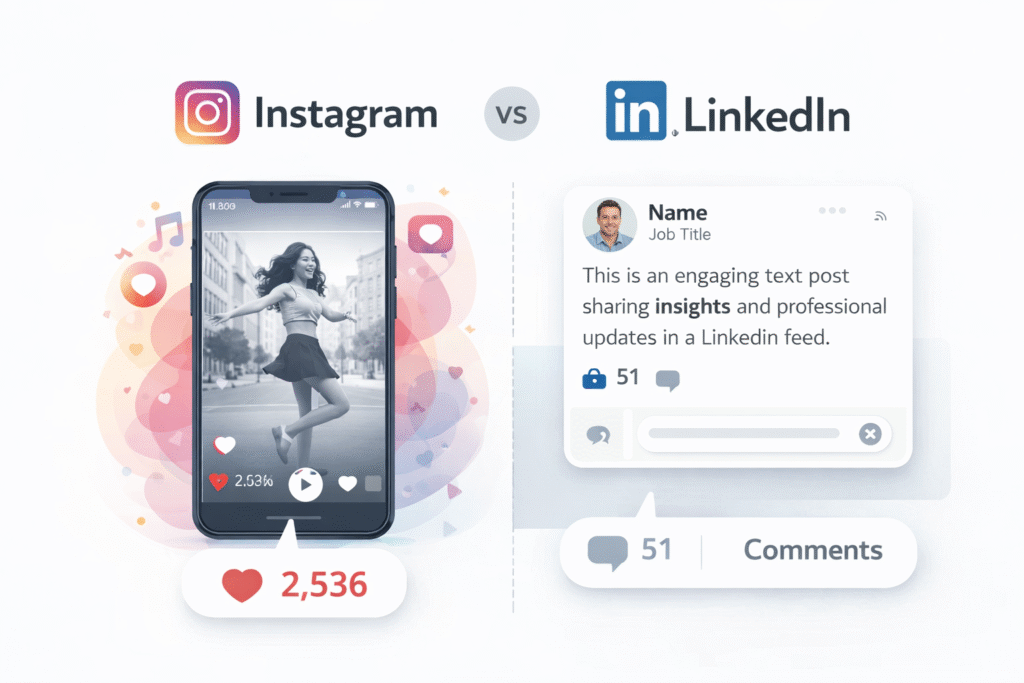
The real takeaway from Instagram vs. LinkedIn marketing is that both platforms serve different roles within a marketing ecosystem. Instagram helps you get discovered, while LinkedIn helps you get trusted.
Instead of choosing based on trends, beginners should focus on what outcome they want — visibility or credibility, speed or sustainability, audience size or audience quality.
If you are still unsure, you can revisit social media marketing basics to build a clearer understanding before making your decision.
Real-World Use Cases & Scenarios
Understanding theory is important, but real clarity comes from seeing how strategies work in practical situations. When comparing Instagram vs. LinkedIn marketing, the difference becomes much more obvious when applied to real-world scenarios. Each platform serves a different purpose depending on the individual’s goal, industry, and content style.
Instead of viewing both platforms as competitors, it is more effective to understand how they function in different stages of the marketing journey. If you are still unclear about strategic positioning, you can explore how to build a digital marketing strategy from scratch , which explains how platforms fit into a larger plan.
Case 1 — Freelancer Starting From Scratch
A beginner freelancer often faces two main challenges: getting visibility and getting clients. This is where the distinction in Instagram vs. LinkedIn marketing becomes highly practical.
Instagram Approach (Visibility Stage):
- Create Reels showcasing skills (editing, design, content creation)
- Post carousel content explaining services or tips
- Build a portfolio through highlights and pinned posts
LinkedIn Approach (Conversion Stage):
- Share personal journey and learning experiences
- Post case studies or results (even small wins)
- Engage with professionals and potential clients
For example, a freelancer might gain attention through Instagram but close their first client through LinkedIn conversations. To strengthen this process, you can refer to how to get freelance clients as a beginner .
Case 2 — Small Business Owner
For small businesses, the goal is usually a mix of brand awareness and lead generation. Choosing between Instagram vs. LinkedIn marketing depends on the nature of the business.
Instagram Strategy:
- Showcase products visually
- Use Reels for product demonstrations
- Leverage trends for reach
LinkedIn Strategy:
- Share business insights and industry knowledge
- Build partnerships and collaborations
- Target decision-makers directly
A local business might rely heavily on Instagram for visibility, while a service-based business (like digital marketing or consulting) will benefit more from LinkedIn.
To understand this better, you can explore social media marketing strategies for small businesses, which explains platform selection based on business type.
Case 3 — Personal Brand Builder
Personal branding has become one of the most powerful assets in digital marketing. In the context of Instagram vs. LinkedIn marketing, both platforms can contribute, but in different ways.
Instagram Role:
- Show personality, lifestyle, and behind-the-scenes content
- Build relatability and emotional connection
- Use visual storytelling to stand out
LinkedIn Role:
- Share knowledge, opinions, and experiences
- Build authority and credibility
- Position yourself as an expert in your niche
A strong personal brand often uses Instagram to attract attention and LinkedIn to establish trust. To build this effectively, you can explore how to build a strong personal brand online.
Case 4 — Job Seeker or Career-Focused Individual
For individuals focused on career growth, the comparison of instagram vs linkedin marketing becomes more straightforward.
LinkedIn as Primary Platform:
- Optimize profile for visibility
- Share achievements, projects, and learnings
- Engage with industry professionals
Instagram as Secondary Platform:
- Showcase creativity or side skills
- Share informal insights or experiences
- Build a broader online presence
LinkedIn provides direct access to recruiters and hiring managers, making it a more effective platform for career opportunities. You can also explore how to optimize your LinkedIn profile for jobs to improve visibility.
Platform Usage Based on Scenario
| Scenario | Instagram Role | LinkedIn Role |
| Freelancer | Portfolio & visibility | Client acquisition & networking |
| Small Business | Brand awareness | Partnerships & lead generation |
| Personal Branding | Relatability & reach | Authority & credibility |
| Job Seeker | Creative showcase | Career growth & opportunities |
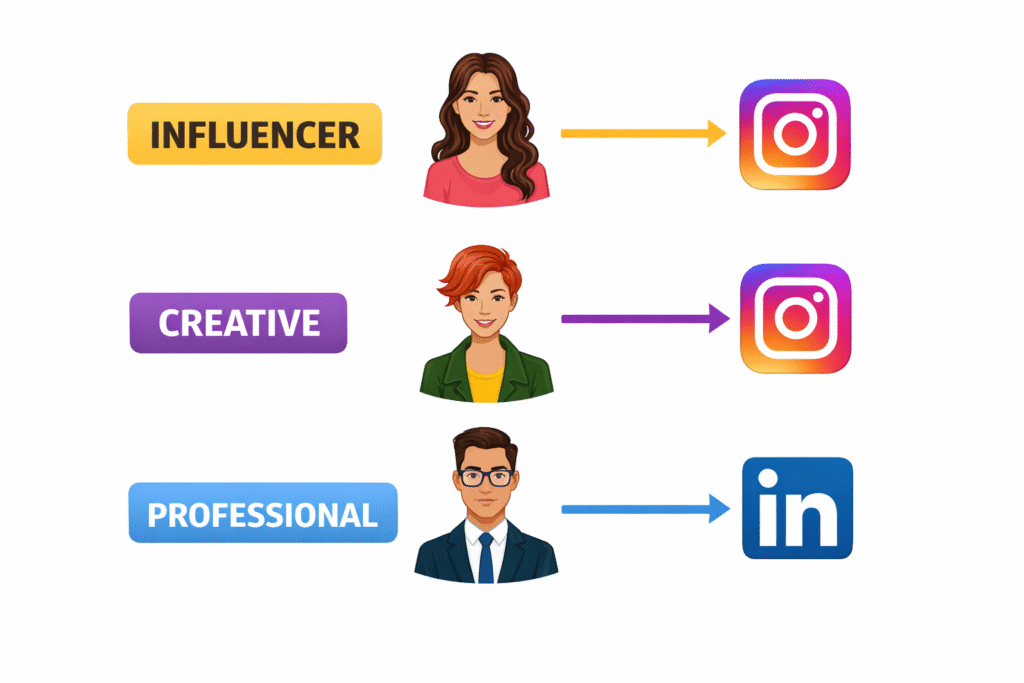
Strategic Insight
The real takeaway from these scenarios is that Instagram vs. LinkedIn marketing is not a one-size-fits-all decision. The effectiveness of each platform depends entirely on how well it aligns with your specific objective.
Beginners who understand this early can avoid one of the most common mistakes — blindly following trends without considering their own goals. Instead of asking “which platform is better,” focus on how each platform fits into your journey.
For a more structured approach, you can revisit digital marketing strategy planning for beginners to align your platform choice with long-term growth.
Common Beginner Mistakes to Avoid
Starting your journey without clarity is one of the biggest reasons why most beginners fail to see results. When comparing Instagram vs. LinkedIn marketing, many people assume that success depends only on posting consistently. In reality, it depends on strategy, platform understanding, and audience alignment.
Avoiding common mistakes early can save months of wasted effort and help you grow faster with the right approach. If you are just getting started, it is recommended that you first understand the digital marketing mistakes beginners should avoid to build a strong foundation.
Posting Without a Clear Strategy
One of the most common mistakes is posting content without knowing the purpose behind it. Beginners often create content randomly without aligning it with their goals.
- Posting just to stay active instead of delivering value
- Not defining whether the goal is reach, engagement, or leads
- Switching content style frequently without consistency
In the context of Instagram vs. LinkedIn marketing, this mistake becomes even more critical because each platform requires a different approach. Without a strategy, even consistent posting will not generate meaningful results.
To fix this, you can explore how to create a social media content strategy, which helps in planning content with intent.
Ignoring Audience Intent
Many beginners fail to understand why people are using a platform in the first place.
- Instagram users expect entertainment and visual appeal
- LinkedIn users expect value, insights, and professional relevance
Posting the wrong type of content on the wrong platform leads to low engagement. For example, highly casual or entertainment-heavy content may not perform well on LinkedIn, while overly formal content may not attract attention on Instagram.
To understand this better, refer to how to identify your target audience in digital marketing, which explains how to align content with user intent.
Copy-Pasting Content Across Platforms
Another major mistake in Instagram vs. LinkedIn marketing is using the same content without adapting it.
- Posting Instagram Reels captions directly on LinkedIn
- Sharing LinkedIn text-heavy posts on Instagram without visuals
- Ignoring platform-specific formats and expectations
Each platform has its own content style. What works on one may fail on the other. Instead of copying content, focus on repurposing it effectively.
You can learn this through content repurposing strategies for social media, which helps maintain consistency while adapting content.
Inconsistent Posting and Lack of Discipline
Consistency is a key growth factor, but many beginners struggle to maintain it.
- Posting frequently for a few days and then disappearing
- Lack of content planning
- Losing motivation due to slow initial results
Both Instagram and LinkedIn reward consistency, but in different ways. Instagram requires frequent posting for visibility, while LinkedIn rewards consistent value-driven content.
To stay consistent, you can follow how to create a content calendar for social media, which helps in organizing posts in advance.
Focusing Only on Followers Instead of Value
A common misconception is that more followers automatically mean success. In reality, engagement and conversions matter more than numbers.
- Instagram followers may not always convert into clients
- LinkedIn connections are valuable only if they are relevant
- Vanity metrics can create a false sense of progress
When analyzing Instagram vs. LinkedIn marketing, LinkedIn often provides better conversion opportunities despite having a smaller audience.
To understand this concept, you can explore the difference between reach, engagement, and conversion, which explains key performance metrics.
Not Analyzing Performance Data
Many beginners post content without tracking what works and what doesn’t.
- Ignoring analytics tools
- Not measuring engagement rate or reach
- Repeating ineffective content strategies
Both platforms provide insights that can help improve performance. Instagram offers detailed engagement metrics, while LinkedIn provides data on impressions, profile visits, and audience demographics.
For better optimization, refer to how to analyze social media performance metrics.
Common Mistakes and Their Impact
| Mistake | Impact on Instagram | Impact on LinkedIn |
| No clear strategy | Low reach and inconsistent growth | Low engagement and visibility |
| Ignoring audience intent | Poor engagement | Irrelevant audience interaction |
| Copy-pasting content | Reduced reach | Low credibility |
| Inconsistent posting | Algorithm deprioritization | Loss of audience trust |
| Focusing on followers only | Low conversions | Weak professional network |
| Not analyzing data | Repeated mistakes | Missed optimization opportunities |
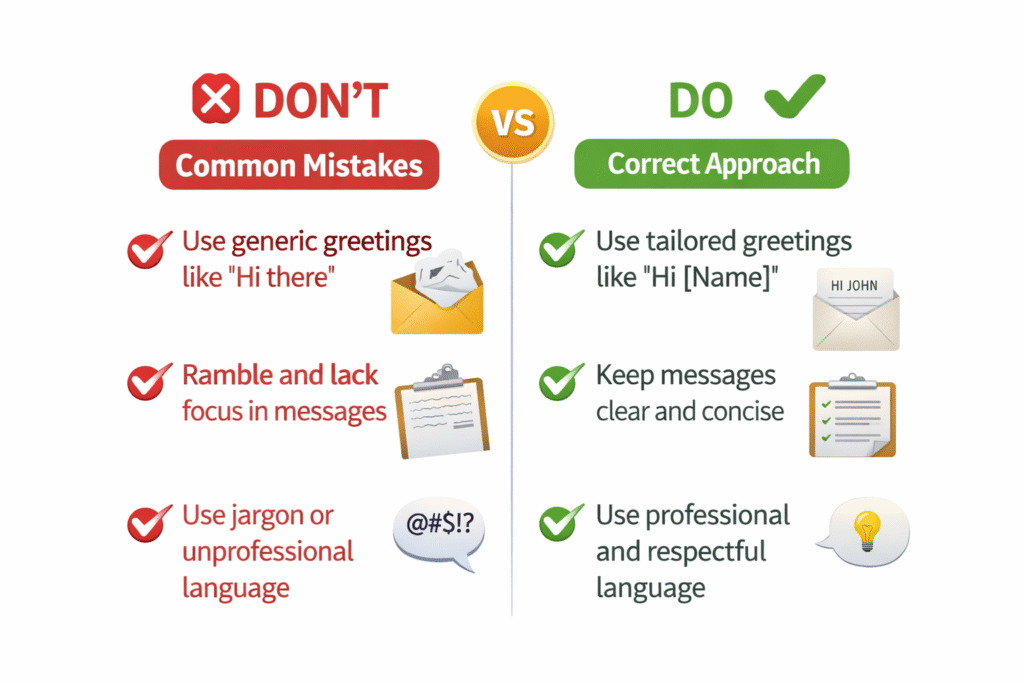
Strategic Insight
The difference between slow growth and consistent progress often comes down to avoiding these mistakes. In the debate of Instagram vs. LinkedIn marketing, success is not determined by the platform alone — it is determined by how well you understand and use it.
Beginners who focus on strategy, audience intent, and consistency are far more likely to achieve results than those who rely on random posting or trends. Instead of chasing quick wins, focus on building a system that delivers long-term growth.
For a structured learning path, you can revisit the complete guide to digital marketing for beginner to strengthen your fundamentals.
Step-by-Step Strategy to Start (Beginner Roadmap)
Starting without a roadmap is one of the biggest reasons beginners feel lost. When approaching Instagram vs. LinkedIn marketing, the key is not just choosing a platform, but following a structured system that leads to consistent growth and measurable results.
This roadmap is designed to help you move from confusion to clarity by breaking down the process into actionable steps. If you want a broader foundation, you can also explore how to start digital marketing step-by-step before implementing platform-specific strategies.
Step 1 — Define Your Goal Clearly
Before creating content, you need to decide why you are using the platform. Without a clear goal, your efforts will lack direction.
Ask yourself:
- Do you want followers, clients, or brand awareness?
- Are you building a personal brand or promoting a service/business?
- Is your focus on short-term growth or long-term authority?
In the context of Instagram vs. LinkedIn marketing:
- Instagram is more suitable for visibility and audience growth
- LinkedIn is more effective for lead generation and credibility
To align your goals properly, you can refer to goal setting in digital marketing strategy, which helps in defining clear objectives.
Step 2 — Choose One Platform to Start
A common mistake beginners make is trying to grow on multiple platforms at once. This often leads to burnout and inconsistent results.
Instead:
- Focus on one platform initially
- Learn its algorithm, content style, and audience behavior
- Build momentum before expanding
When evaluating Instagram vs. LinkedIn marketing, choose based on your strengths:
- Visual and creative → Instagram
- Analytical and idea-driven → LinkedIn
For better clarity, revisit the digital marketing platform comparison guide, which explains how to select the right platform.
Step 3 — Build a Simple Content Strategy
Content is the foundation of growth, but it needs structure to perform well. A basic framework can help beginners stay consistent and effective.
A proven content structure:
- Hook — Capture attention in the first few seconds
- Value — Deliver useful or engaging information
- Call-to-Action (CTA) — Encourage interaction (comment, share, follow)
For example:
- Instagram: Hook through visuals → Deliver quick tips → CTA for engagement
- LinkedIn: Hook through a strong opening line → Share insights → CTA for discussion
To improve your content quality, you can explore content writing frameworks for social media.
Step 4 — Maintain Consistency With a System
Consistency is one of the most important factors in both Instagram and LinkedIn growth. However, consistency does not mean posting randomly — it means following a structured plan.
Recommended approach:
- Post 3–5 times per week
- Plan content in advance
- Batch-create content to save time
For effective planning, refer to how to create a content calendar for social media , which helps maintain discipline and consistency.
Step 5 — Analyze Performance and Optimize
Growth does not come from posting alone — it comes from learning what works and improving continuously.
Key metrics to track:
- Engagement rate (likes, comments, shares)
- Reach and impressions
- Click-through rate (CTR)
- Follower growth
Data Insights:
- Average Instagram engagement rate: ~1–3%
- LinkedIn engagement rate: ~2–5% (often higher due to intent-driven audience)
By analyzing these metrics, you can refine your content strategy and improve results over time.
To understand analytics better, you can explore how to track and measure social media performance.
Beginner Roadmap Summary
| Step | Action | Outcome |
| Define Goal | Set a clear objective | Direction and focus |
| Choose Platform | Select Instagram or LinkedIn | Better consistency |
| Content Strategy | Use the Hook–Value–CTA framework | Improved engagement |
| Consistency System | Follow the posting schedule | Steady growth |
| Analyze & Optimize | Track performance metrics | Continuous improvement |
Image Placement Suggestion
[Insert Image Here]
- Visual Concept: Step-by-step flowchart
- Goal → Platform → Content → Consistency → Optimization
- Caption: Beginner Roadmap for Instagram vs LinkedIn Marketing
Strategic Insight
The key to succeeding in Instagram vs. LinkedIn marketing is not complexity — it is consistency and clarity. Beginners who follow a structured roadmap are more likely to see results compared to those who rely on random posting or trends.
Instead of trying to master everything at once, focus on executing one step at a time. As you gain experience, you can refine your strategy and expand to other platforms.
For long-term success, you can revisit the complete digital marketing roadmap for beginners to strengthen your overall strategy.
Step-by-Step Strategy to Start (Beginner Roadmap)
Starting without a roadmap is one of the biggest reasons beginners feel lost. When approaching Instagram vs. LinkedIn marketing, the key is not just choosing a platform, but following a structured system that leads to consistent growth and measurable results.
This roadmap is designed to help you move from confusion to clarity by breaking down the process into actionable steps. If you want a broader foundation, you can also explore how to start digital marketing step-by-step before implementing platform-specific strategies.
Step 1 — Define Your Goal Clearly
Before creating content, you need to decide why you are using the platform. Without a clear goal, your efforts will lack direction.
Ask yourself:
- Do you want followers, clients, or brand awareness?
- Are you building a personal brand or promoting a service/business?
- Is your focus on short-term growth or long-term authority?
In the context of Instagram vs. LinkedIn marketing:
- Instagram is more suitable for visibility and audience growth
- LinkedIn is more effective for lead generation and credibility
To align your goals properly, you can refer to goal setting in digital marketing strategy, which helps in defining clear objectives.
Step 2 — Choose One Platform to Start
A common mistake beginners make is trying to grow on multiple platforms at once. This often leads to burnout and inconsistent results.
Instead:
- Focus on one platform initially
- Learn its algorithm, content style, and audience behavior
- Build momentum before expanding
When evaluating Instagram vs. LinkedIn marketing, choose based on your strengths:
- Visual and creative → Instagram
- Analytical and idea-driven → LinkedIn
For better clarity, revisit the digital marketing platform comparison guide, which explains how to select the right platform.
Step 3 — Build a Simple Content Strategy
Content is the foundation of growth, but it needs structure to perform well. A basic framework can help beginners stay consistent and effective.
A proven content structure:
- Hook — Capture attention in the first few seconds
- Value — Deliver useful or engaging information
- Call-to-Action (CTA) — Encourage interaction (comment, share, follow)
For example:
- Instagram: Hook through visuals → Deliver quick tips → CTA for engagement
- LinkedIn: Hook through a strong opening line → Share insights → CTA for discussion
To improve your content quality, you can explore content writing frameworks for social media.
: Step 4 — Maintain Consistency With a System
Consistency is one of the most important factors in both Instagram and LinkedIn growth. However, consistency does not mean posting randomly — it means following a structured plan.
Recommended approach:
- Post 3–5 times per week
- Plan content in advance
- Batch-create content to save time
For effective planning, refer to how to create a content calendar for social media , which helps maintain discipline and consistency.
Step 5 — Analyze Performance and Optimize
Growth does not come from posting alone — it comes from learning what works and improving continuously.
Key metrics to track:
- Engagement rate (likes, comments, shares)
- Reach and impressions
- Click-through rate (CTR)
- Follower growth
Data Insights:
- Average Instagram engagement rate: ~1–3%
- LinkedIn engagement rate: ~2–5% (often higher due to intent-driven audience)
By analyzing these metrics, you can refine your content strategy and improve results over time.
To understand analytics better, you can explore how to track and measure social media performance.
Beginner Roadmap Summary
| Step | Action | Outcome |
| Define Goal | Set a clear objective | Direction and focus |
| Choose Platform | Select Instagram or LinkedIn | Better consistency |
| Content Strategy | Use the Hook–Value–CTA framework | Improved engagement |
| Consistency System | Follow the posting schedule | Steady growth |
| Analyze & Optimize | Track performance metrics | Continuous improvement |
Image Placement Suggestion
[Insert Image Here]
- Visual Concept: Step-by-step flowchart
- Goal → Platform → Content → Consistency → Optimization
- Caption: Beginner Roadmap for Instagram vs LinkedIn Marketing
Strategic Insight
The key to succeeding in Instagram vs. LinkedIn marketing is not complexity — it is consistency and clarity. Beginners who follow a structured roadmap are more likely to see results compared to those who rely on random posting or trends.
Instead of trying to master everything at once, focus on executing one step at a time. As you gain experience, you can refine your strategy and expand to other platforms.
For long-term success, you can revisit the complete digital marketing roadmap for beginners to strengthen your overall strategy.
Tools to Manage Instagram vs LinkedIn Marketing
Managing content across platforms can quickly become overwhelming, especially for beginners. When working with Instagram vs. LinkedIn marketing, the challenge is not just creating content — it is planning, designing, scheduling, and analyzing performance efficiently.
Using the right tools can simplify your workflow, save time, and improve consistency. Instead of handling everything manually, marketers rely on a combination of tools for content creation, scheduling, analytics, and optimization.
If you are new to tools and workflows, you can start by understanding digital marketing tools for beginners , which gives a broader overview before diving into platform-specific tools.
Content Creation Tools
Content is the backbone of both Instagram and LinkedIn. However, the type of content differs — Instagram requires visual-heavy content, while LinkedIn focuses more on clean, informative layouts.
Some of the most commonly used tools include:
- Canva — for designing posts, carousels, and LinkedIn documents
- Adobe Express — for quick visual edits and branding
- CapCut — for editing short-form videos (Reels)
- InShot — for mobile-friendly video editing
These tools help beginners create professional-looking content without advanced design skills. To improve your design quality, you can explore how to create engaging social media posts.
Scheduling and Automation Tools
Consistency is critical in Instagram vs. LinkedIn marketing, and scheduling tools help maintain a regular posting routine without manual effort.
Popular scheduling tools:
- Buffer — supports both Instagram and LinkedIn scheduling
- Hootsuite — advanced scheduling and multi-platform management
- Later — ideal for Instagram visual planning
- Meta Business Suite — a free tool for scheduling Instagram content
These tools allow you to:
- Plan content in advance
- Maintain posting consistency
- Manage multiple platforms from one dashboard
For better planning, you can refer to how to create a content calendar for social media, which works well with scheduling tools.
Analytics and Performance Tracking Tools
Tracking performance is essential to understand what works and what doesn’t. In the comparison of Instagram vs. LinkedIn marketing, analytics help identify which platform is delivering better results.
Built-in analytics tools:
- Instagram Insights — tracks reach, engagement, and audience behavior
- LinkedIn Analytics — provides data on impressions, engagement, and profile visits
Third-party tools:
- Google Analytics — tracks website traffic from social media
- Sprout Social — advanced analytics and reporting
Key Metrics to Track:
- Engagement rate
- Reach and impressions
- Click-through rate (CTR)
- Follower growth
To understand these metrics in detail, you can explore how to measure social media performance effectively.
Content Ideation and Research Tools
One of the biggest challenges beginners face is running out of content ideas. Research tools help identify trends, topics, and audience interests.
Useful tools include:
- Google Trends — identifies trending topics
- AnswerThePublic — shows common user queries
- LinkedIn Feed & Instagram Explore — real-time content inspiration
These tools help you stay relevant and create content that aligns with audience interests. For a deeper understanding, refer to how to find content ideas for social media marketing.
Tools for Instagram vs LinkedIn Marketing
| Tool Type | Instagram Usage | LinkedIn Usage |
| Content Creation | Canva, CapCut, InShot | Canva, Adobe Express |
| Scheduling | Buffer, Later, Meta Business Suite | Buffer, Hootsuite |
| Analytics | Instagram Insights | LinkedIn Analytics |
| Research & Ideation | Instagram Explore, Google Trends | LinkedIn Feed, AnswerThePublic |
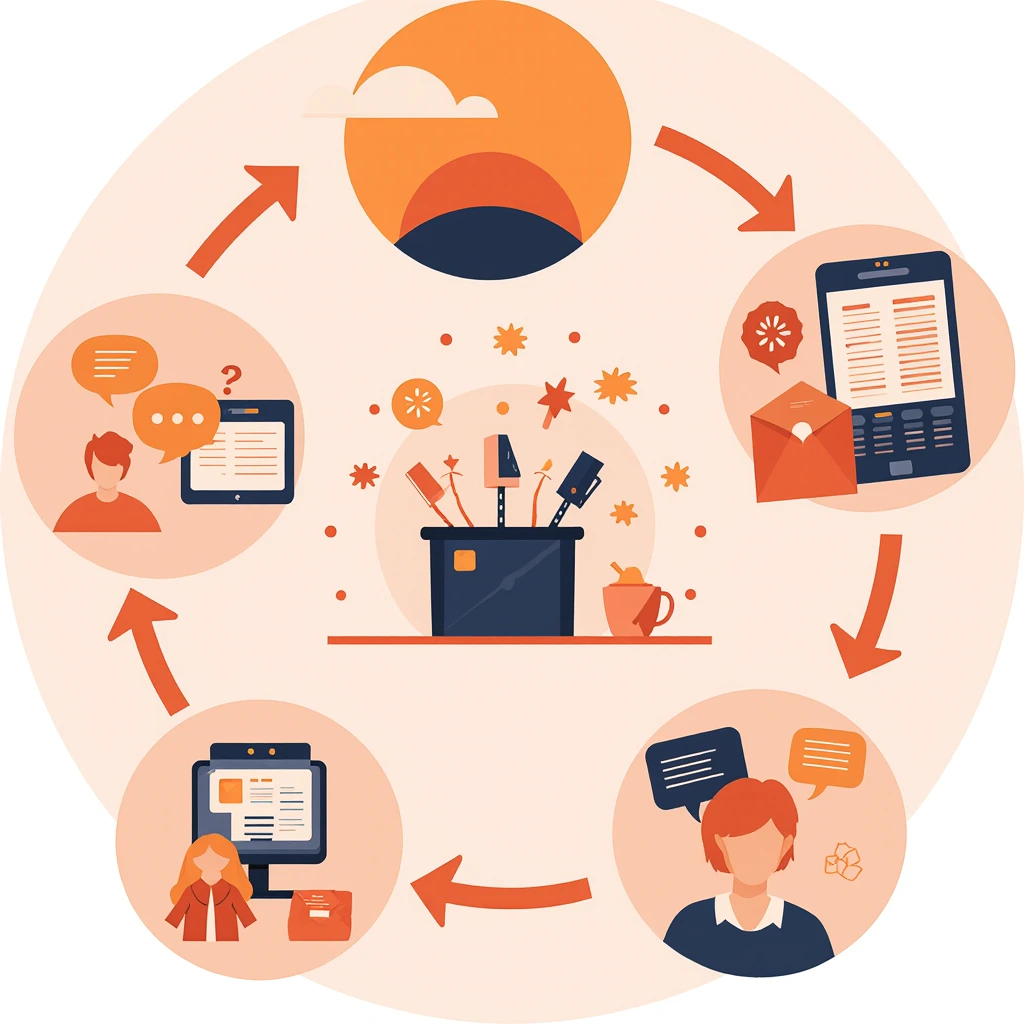
The difference between struggling and scaling in Instagram vs. LinkedIn marketing often comes down to how efficiently you manage your workflow. Tools are not just optional — they are essential for maintaining consistency, improving quality, and saving time.
Beginners should avoid using too many tools at once. Instead, start with a simple stack:
- One design tool
- One scheduling tool
- One analytics tool
As your strategy grows, you can expand your toolkit. For a complete setup, you can revisit the best tools for digital marketing beginners and build a system that supports long-term growth.
Future Trends — Instagram vs LinkedIn Marketing in 2026
Social media marketing is evolving faster than ever, and understanding future trends is essential for staying competitive. When analyzing Instagram vs. LinkedIn marketing, the difference is no longer just about platform features — it is about how technology, user behavior, and content consumption patterns are reshaping both ecosystems.
In 2026, the focus has shifted from simply creating content to building systems, communities, and high-intent engagement loops. Platforms are prioritizing retention, on-platform activity, and meaningful interactions, which directly impacts how marketing strategies should be planned.
If you want to align your strategy with future growth, you can also explore the latest digital marketing trends and updates to stay ahead of platform changes.
AI-Powered Content Creation and Personalization
Artificial Intelligence is no longer optional — it is becoming a core part of content creation and distribution.
- AI tools are being used for content ideation, editing, and personalization
- Platforms are increasingly using AI to recommend content based on user behavior
- In 2025, nearly 70% of marketers used AI for efficiency, and in 2026 the focus is shifting toward performance and results (World Federation of Advertisers)
In the context of Instagram vs. LinkedIn marketing:
- Instagram uses AI heavily for content discovery and recommendations
- LinkedIn uses AI to prioritize relevant, high-value professional content
This means content quality and relevance will matter more than ever.
Dominance of Short-Form and Video Content
Video content continues to dominate across platforms, but its role is evolving.
- On Instagram, Reels account for nearly 50% of time spent on the platform (Social Media Today)
- LinkedIn is also rapidly adopting video, with video viewership growing significantly year-over-year (Reuters)
However, the difference lies in execution:
- Instagram → fast, engaging, trend-driven videos
- LinkedIn → informative, insight-driven videos
This indicates that video is no longer optional in instagram vs linkedin marketing — it is a primary content format.
Rise of Social Search and Platform SEO
One of the biggest shifts in 2026 is the rise of social platforms as search engines.
- Users are increasingly searching for answers directly on Instagram and LinkedIn
- Social SEO (keywords in captions, profiles, and posts) is becoming critical
- Platforms are prioritizing content that answers specific user queries
According to industry reports, social search is emerging as an alternative to traditional search engines, especially for younger audiences (Distart Blog)
For beginners, this means optimizing content with relevant keywords, including Instagram vs. LinkedIn marketing, becomes essential for discoverability.
You can explore how SEO works in social media marketing to understand this shift better.
On-Platform Conversions and Reduced External Traffic
A major trend shaping both platforms is the shift toward keeping users within the platform.
- Platforms are reducing the reach of posts that push users to external links
- More tools are being introduced for in-app engagement and conversions
- Marketers are encouraged to capture leads directly on the platform (LinkedIn)
In instagram vs linkedin marketing:
- Instagram is expanding features like shops, DMs, and in-app interactions
- LinkedIn is improving lead forms, messaging, and professional networking tools
This means marketers need to focus on building trust and converting within the platform, rather than relying only on external websites.
Community-Driven and Authentic Content
The era of polished, overly edited content is slowly fading. In 2026, authenticity is becoming the key differentiator.
- Brands are focusing on community building rather than just audience growth
- User-generated content (UGC) is becoming a major trust factor
- Consumers prefer real, relatable content over perfection (Adobe)
Additionally, influencer marketing is shifting toward long-term collaborations and deeper engagement, with brands investing more in creators as strategic partners (Vogue)
In the comparison of Instagram vs. LinkedIn marketing:
- Instagram thrives on relatability and storytelling
- LinkedIn thrives on authenticity and expertise
LinkedIn Becoming a Creator Platform
LinkedIn is undergoing a major transformation.
- It is no longer just a professional network — it is becoming a content and creator platform
- Video, personal storytelling, and creator-led content are increasing rapidly
- LinkedIn is integrating more features similar to traditional social platforms
Recent insights show LinkedIn evolving into a more interactive and content-driven space, blending professional and social interactions (El País)
This shift makes LinkedIn more accessible for beginners who want to build a personal brand without needing a large audience.
Quality Over Quantity in Content Strategy
Another major trend in Instagram vs. LinkedIn marketing is the shift toward high-quality, intentional content.
- Posting frequently without value is becoming less effective
- Platforms are rewarding content that drives engagement and retention
- Fewer, better posts outperform frequent low-quality content
Industry trends highlight that quality-focused content and niche targeting are becoming more effective than mass posting strategies (Distart Blog)
Key Trends Comparison (Instagram vs LinkedIn)
| Trend | ||
| AI Usage | Content recommendations & discovery | Content relevance & professional insights |
| Video Growth | Reels dominate engagement | Video adoption growing rapidly |
| Social Search | Strong (hashtags + captions) | Emerging (keyword-driven posts) |
| Conversion Strategy | DMs, in-app actions | Lead forms, networking |
| Content Style | Creative, relatable | Insightful, authority-driven |
| Platform Evolution | Entertainment + commerce | Professional + creator ecosystem |
Image Placement Suggestion
[Insert Image Here]
- Visual Concept: Future trends infographic
- AI → Video → Social Search → Community → Conversion
- Caption: Key Social Media Marketing Trends Shaping 2026
Strategic Insight
The future of Instagram vs. LinkedIn marketing is not about choosing one platform over the other — it is about adapting to how both platforms are evolving.
- Instagram is becoming smarter, faster, and more AI-driven
- LinkedIn is becoming more creative, personal, and content-focused
Beginners who understand these shifts early can position themselves ahead of the competition. Instead of reacting to trends, focus on building skills that align with where the platforms are heading.
Conclusion — Where Should You Start?
After exploring every aspect of Instagram vs. LinkedIn marketing, one thing becomes clear — there is no universal “best” platform. The right choice depends entirely on your goals, content style, and long-term vision.
Many beginners get stuck trying to find the perfect platform before taking action. In reality, growth does not come from overthinking — it comes from starting, experimenting, and improving consistently. Both Instagram and LinkedIn offer powerful opportunities, but they reward different types of effort.
If your goal is fast visibility, audience growth, and creative expression, Instagram provides the ideal starting point. Its algorithm allows content to reach beyond your network, giving beginners a chance to grow quickly. However, this growth often requires consistent content creation and adaptability to trends.
On the other hand, if your focus is building credibility, generating leads, and creating meaningful professional connections, LinkedIn is the stronger choice. While growth may be slower, the quality of engagement and opportunities is significantly higher.
For those who want the best of both worlds, combining both platforms strategically can deliver powerful results. You can use Instagram to attract attention and build awareness, and LinkedIn to convert that attention into trust and opportunities. To implement this effectively, you can revisit how to create a multi-platform social media strategy, which explains how to align different platforms within a single system.
Key Takeaways
- There is no one-size-fits-all answer in Instagram vs. LinkedIn marketing
- Instagram is best for reach, visibility, and creative content
- LinkedIn is best for credibility, networking, and conversions
- Beginners should focus on one platform first, then expand
- Consistency and strategy matter more than the platform itself
Final Recommendation
If you are still unsure where to begin, start with the platform that aligns with your natural strengths:
- If you enjoy visuals, videos, and storytelling → start with Instagram
- If you prefer writing, sharing ideas, and professional growth → start with LinkedIn
The most important step is to start with clarity and stay consistent. Over time, you can expand, experiment, and refine your strategy based on what works best for you.
If you are looking for structured guidance, you can explore beginner-friendly digital marketing training that helps you build the right skills and strategies from the start.
Success in Instagram vs. LinkedIn marketing is not determined by the platform you choose — it is determined by how well you understand it and how consistently you execute your strategy.
Instead of waiting for the perfect moment or perfect plan, start where you are, use the resources available, and build your presence step by step. The sooner you begin, the sooner you learn — and in digital marketing, learning through action is what creates real growth.

Founder at Digital Marketing Marvel | Founder at RKDMT – Raju Kumar Digital Marketing Trainer | Best Digital Marketing Trainer in Delhi/NCR – Digiperform | Project Manager | 5+ years | Genius Study Abroad & Inlingua’s Digital Marketing Head | Learn Digital Marketing