



How to Know Market Trend Before Your Competitors Do
In today’s fast-changing economy, market trends represent the shifting patterns in consumer behavior, technology, competition, and demand. They indicate where an industry is heading rather than where it has already been.
Businesses that identify these shifts early gain a clear advantage—they can adapt faster, plan smarter, and stay ahead of competitors. This is why understanding how to know market trend is no longer optional but essential for long-term success.
Many businesses fail because they respond too late to change. They rely on outdated strategies, ignore evolving customer needs, or overlook early signals hidden in data and market behavior.
When a trend becomes obvious to everyone, the opportunity is often already gone. Companies that know how to spot trends early can make proactive decisions, reduce risk, and capture new growth opportunities before the market becomes crowded. Market trend (definition):
A market trend is the general direction in which customer demand, preferences, or industry behavior moves over a specific period of time.
What Is a Market Trend? (Simple Explanation for Beginners)
Understanding what a market trend is lays the foundation for learning how to know market trend accurately and consistently. Many beginners confuse trends with short-term hype or sudden changes, which leads to poor decisions. A market trend is not about what happened yesterday—it’s about identifying a direction that continues over time.
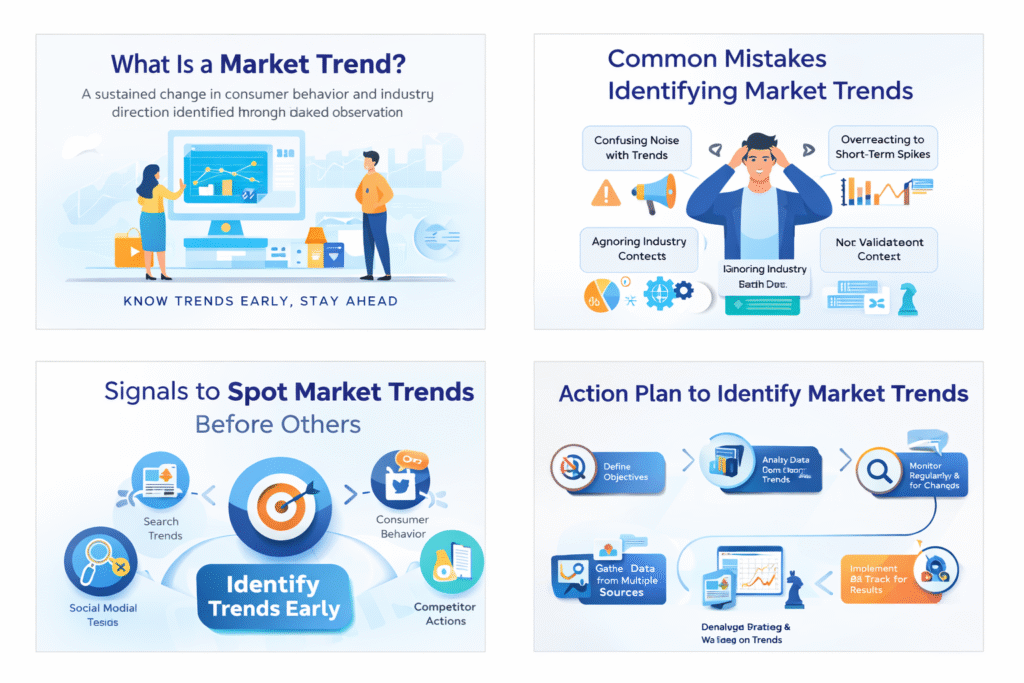
Definition of Market Trend
A market trend is the overall direction in which a market, industry, or consumer behavior moves over a specific period. This direction is shaped by factors such as customer preferences, technology changes, economic conditions, and competitive actions.
Market trends develop gradually and can be identified by observing patterns in data, demand, pricing, and behavior across weeks, months, or even years.
In simple terms, a market trend answers this question: What is consistently changing, and where is it heading?
If you want to master how to know market trend, you must focus on patterns—not isolated events.
Types of Market Trends
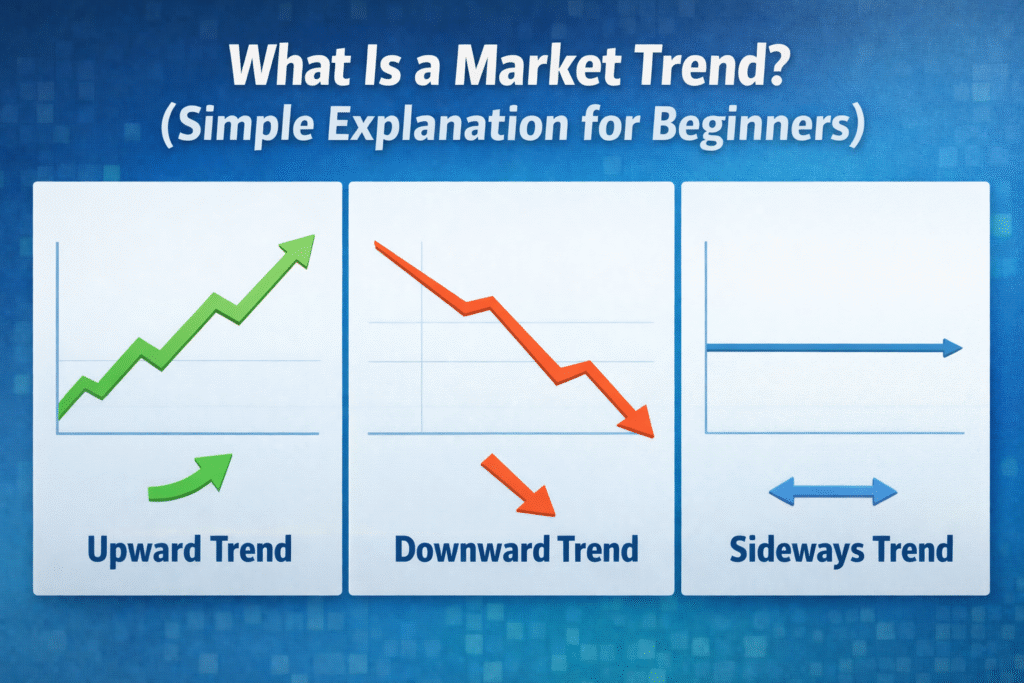
Market trends are generally classified into three main types:
- Upward trend:
Demand, interest, or growth is increasing over time. Example: rising demand for AI tools or online education. - Downward trend:
Demand or interest is steadily declining. Example: decreasing use of physical media like DVDs. - Sideways (flat) trend:
The market shows little growth or decline, moving within a stable range. Example: mature industries with steady but limited innovation.
Recognizing these trend types helps businesses decide whether to invest, pivot, or hold their position.
Market Trend vs Market Fad vs Market Cycle
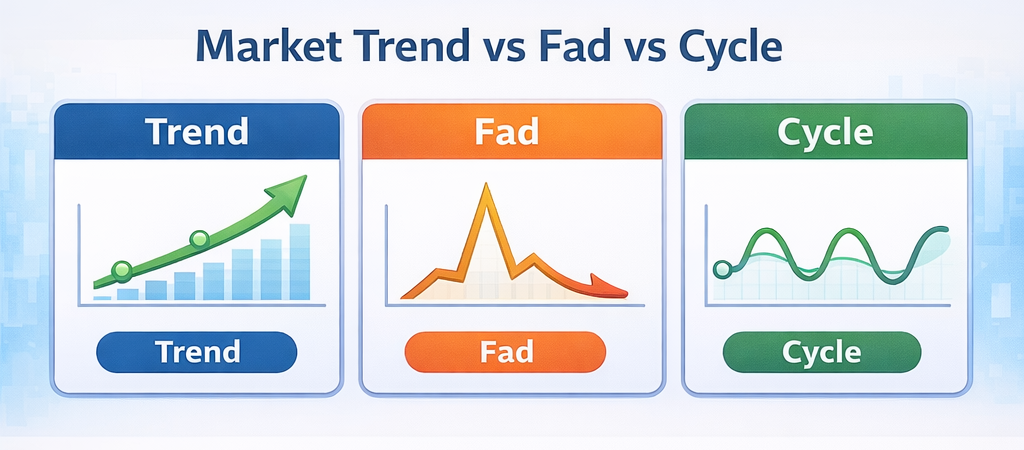
Many people fail at trend analysis because they confuse these three concepts:
- Market trend: Long-term and data-backed movement in behavior or demand
- Market fad: Short-lived spike driven by hype, often disappearing quickly
- Market cycle: Repeating phases of growth and decline influenced by economic conditions
| Aspect | Market Trend | Market Fad | Market Cycle |
|---|---|---|---|
| Definition | A long-term shift in consumer behavior, demand, or industry direction | A short-lived spike driven by hype or novelty | A repeating pattern of growth and decline over time |
| Duration | Medium to long term (months to years) | Very short term (days to weeks) | Long term and recurring |
| Data Consistency | Appears across multiple data sources consistently | Usually visible on one platform only | Visible in historical and economic data |
| Predictability | Can be identified early through patterns | Unpredictable and sudden | Predictable based on past cycles |
| Business Impact | Creates sustainable growth opportunities | Often leads to wasted investment | Helps with long-term planning |
| Risk Level | Moderate (if validated with data) | High (often fades quickly) | Low to moderate |
| Example | Rising demand for AI-powered tools | A viral social media challenge | Economic boom and recession cycles |
A trend sustains momentum, a fad fades quickly, and a cycle repeats. Knowing this difference is critical if you want to understand how to know market trend without making costly mistakes.
Why Most Businesses Spot Market Trends Too Late
Even though market trends are constantly forming, many businesses fail to recognize them at the right time. This delay often results in missed opportunities, declining relevance, and loss of competitive edge.
To truly understand how to know market trend, it’s important to first understand what holds businesses back.
Relying Only on Past Data
Many companies make decisions based only on historical data such as last year’s sales or past performance reports. While past data is useful, it only explains what has already happened, not what is coming next.
Market trends require forward-looking analysis—signals from emerging behavior, rising searches, and early adoption patterns. Businesses that depend solely on past data often react when it’s already too late.
Ignoring Consumer Behavior Changes
Consumer behavior evolves faster than most business strategies. Shifts in preferences, buying habits, content consumption, and trust signals often appear subtly before becoming mainstream.
Businesses that don’t actively observe these changes fail to recognize early trend signals. Understanding customer intent, feedback, and engagement patterns is essential when learning how to know market trend effectively.
Not Using the Right Tools
Spotting trends manually is nearly impossible at scale. Many businesses either don’t use analytical tools or rely on limited data sources. Without tools that track search behavior, social conversations, competitor activity, and performance metrics, trends remain hidden. The right tools help convert raw data into meaningful insights.
Depending on Gut Feeling Instead of Data
Gut instinct can support decisions, but relying on it alone is risky. Market trends are driven by measurable signals, not assumptions. Businesses that act purely on intuition often mistake noise for trends or overlook real opportunities.
A data-backed approach is the most reliable way to consistently identify where the market is heading.
How to Know Market Trend Using Data (Step-by-Step Framework)
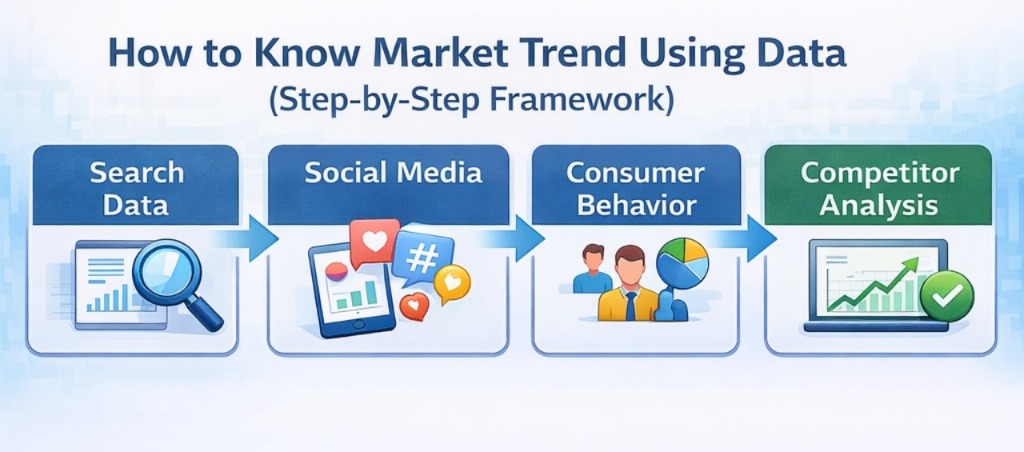
Data is the most reliable way to understand where a market is heading. Guesswork and assumptions often lead businesses in the wrong direction, while data reveals patterns that point to future demand.
If you want to consistently learn how to know market trend, you need a clear, repeatable framework that turns raw data into insights. This step-by-step approach focuses on search behavior, which often reflects user intent before buying decisions are made.
Step 1 – Analyze Search Data
Search data shows what people are actively looking for right now—and how that interest is changing over time. Since search behavior often precedes purchasing behavior, it is one of the strongest indicators of emerging market trends.
Google Trends for Market Research
Google Trends is one of the most effective tools for identifying early shifts in interest. It allows you to track how search demand changes over time, helping you separate long-term trends from short-term spikes. To use it effectively, focus on comparing multiple timeframes, such as the past 12 months versus the past 5 years. This helps you understand whether interest is steadily growing, declining, or remaining stable.
Regional trend analysis is equally important. A trend often starts in specific locations before spreading globally. By comparing regions, you can identify where demand is rising first and anticipate wider adoption. This method plays a key role in mastering how to know market trend before competitors react.
Keyword Research to Predict Demand
Keyword research goes deeper than trend graphs by revealing why people are searching. Rising keywords indicate growing interest, while declining keywords signal fading demand.
Tracking these changes over time helps predict future market movement rather than just current popularity.
Intent-based keyword mapping is crucial here. Informational keywords show early curiosity, while transactional keywords indicate readiness to buy. When informational searches start converting into transactional ones, it often confirms a developing market trend.
Using this approach consistently strengthens your ability to understand how to know market trend using real, actionable data instead of assumptions.
Step 2 – Monitor Social Media Conversations
Social media platforms act as real-time focus groups where people openly share opinions, needs, frustrations, and interests. Monitoring these conversations is a powerful way to understand how to know market trend early, often before they appear in search data or sales reports. Trends usually start as discussions, not purchases.
Identifying Trends on Instagram, X, LinkedIn & Reddit
Each platform reveals trends differently. On Instagram, trending hashtags, reel topics, and comment patterns often highlight emerging interests and lifestyle shifts. On X, rapid conversations, viral threads, and repeated keywords signal what people are paying attention to right now.
LinkedIn is especially useful for spotting B2B and industry-specific trends through posts, polls, and professional discussions. Reddit provides deep, unfiltered insights where users discuss problems, product gaps, and unmet needs in detail.
By observing recurring hashtags, frequently asked questions, and rising engagement on specific topics, you can identify patterns that point to a growing market trend rather than a one-time buzz.
Social Listening Tools
Social listening tools help scale this process by tracking conversations across multiple platforms automatically. Brand mentions reveal how people perceive products, services, and competitors, while industry keyword tracking shows which topics are gaining momentum over time.
These tools allow you to spot consistent increases in discussion volume, sentiment shifts, and emerging themes.
When combined with search data, social media monitoring becomes a critical layer in learning how to know market trend with accuracy and confidence.
Step 3 – Study Competitor Behavior
Competitors often reveal market trends through their actions before they ever talk about them publicly. Studying competitor behavior helps you understand how to know market trend by observing where others are investing time, money, and resources.
When multiple competitors start moving in the same direction, it’s rarely a coincidence—it’s usually a response to changing market demand.
What Competitor Ads Reveal About Trends
Advertising data is one of the clearest indicators of emerging trends. When competitors increase ad spend on specific products, services, or keywords, it often signals rising demand or strong conversion potential.
Changes in ad messaging, offers, or targeting also reveal what problems customers are actively trying to solve. Tracking these patterns over time helps identify trends that are gaining commercial value.
Content Topics Competitors Are Publishing
Content strategies reflect what competitors believe their audience cares about right now. New blog topics, video themes, downloadable resources, and social posts often point to emerging interests.
If several competitors start covering similar subjects, it usually indicates a developing market trend. This also helps you identify gaps where important topics are being overlooked, allowing you to position yourself ahead of the curve.
Product & Pricing Changes
Product launches, feature updates, and pricing adjustments are strong trend signals. A shift toward premium pricing may indicate increased perceived value, while lower pricing can suggest market saturation or rising competition.
Bundles, subscriptions, or new service models often reflect changes in customer expectations. Monitoring these moves consistently strengthens your ability to understand how to know market trend through real-world business behavior rather than speculation.
How to Know Market Trend Through Consumer Behavior
Consumer behavior is one of the most accurate indicators of where the market is heading. Before trends show up in reports or headlines, they appear in how people browse, buy, complain, and come back for more.
Observing these patterns helps you understand how to know market trend based on real actions, not assumptions.
Reading Buying Signals
Buying signals reveal intent before a trend becomes mainstream. Cart behavior is especially useful here. An increase in product views, repeated cart additions, or frequent cart abandonment around the same type of product often signals growing interest paired with unmet expectations, such as pricing or features.
Repeat purchases are even stronger indicators. When customers consistently return to buy similar products or services, it suggests a sustained shift in demand rather than a temporary spike. Tracking these behaviors over time helps confirm whether a trend has long-term potential.
Reviews, Feedback & Community Forums
Customer reviews provide unfiltered insight into what people want, like, or dislike. Amazon reviews often highlight emerging needs, feature requests, or dissatisfaction with existing options. When similar feedback appears repeatedly, it usually points to a broader market trend.
Community platforms like Quora and Reddit offer deeper context. Users openly discuss problems, alternatives, and expectations, making these platforms valuable for understanding sentiment and motivation.
Analyzing these conversations through the lens of customer feedback analysis and consumer psychology strengthens your ability to identify trends early and accurately.
Tools That Help You Know Market Trends Before Others
Using the right tools can significantly improve how quickly and accurately you identify emerging trends. While intuition may point you in a direction, tools provide the data needed to confirm whether a trend is real and growing.
If you want to consistently learn how to know market trend before it becomes obvious, combining free and paid tools is essential.
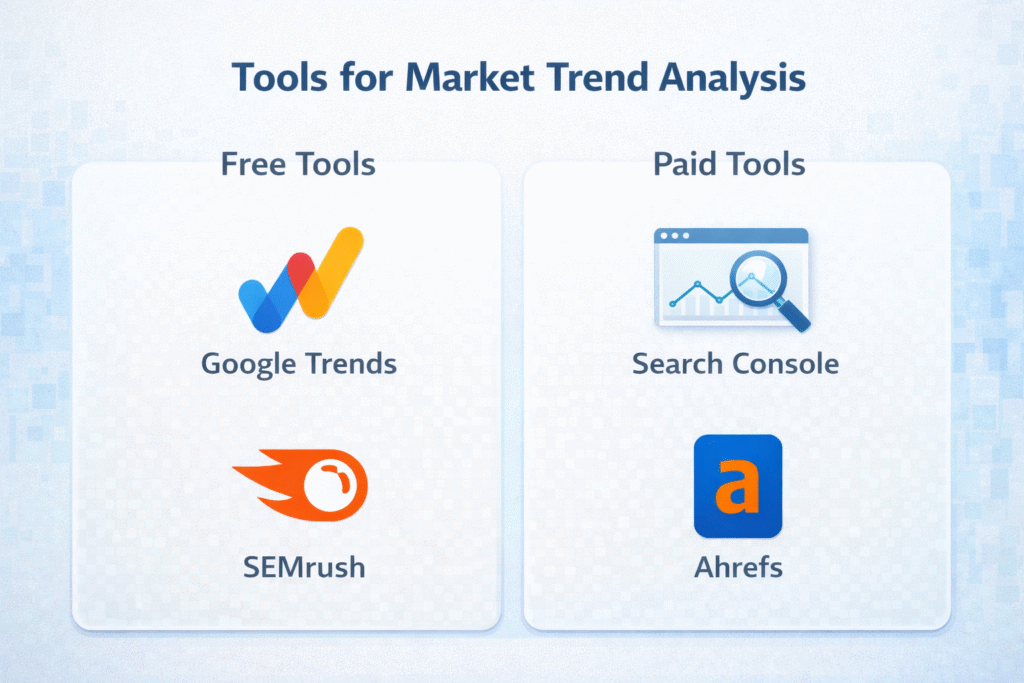
Free Tools
Free tools are a great starting point for spotting early signals without heavy investment. Google Trends helps track changes in search interest over time, making it easier to identify rising topics and seasonal patterns.
Google Search Console reveals what users are already searching for when they find your website, highlighting growing queries and shifting intent.
Social platform analytics also play a key role. Engagement metrics such as saves, shares, comments, and follower growth indicate which topics resonate most with audiences. A steady increase in engagement around specific themes often signals an emerging trend.
Paid Tools
Paid tools offer deeper insights and competitive intelligence. Platforms like SEMrush and Ahrefs allow you to monitor keyword growth, competitor visibility, and content performance across industries.
Similarweb provides traffic insights, audience behavior, and referral trends, helping you understand where demand is moving.
When used together, these SEO tools for trend analysis and market research tools create a powerful system for identifying, validating, and acting on market trends ahead of competitors.
Real-World Examples of Brands That Spotted Market Trends Early
Understanding how to know market trend becomes much clearer when you look at real businesses that acted early and benefited from it. These examples show how identifying trends ahead of competitors can lead to rapid growth, stronger positioning, and long-term success across different industries.
Example 1 – Digital Marketing Industry
In the digital marketing space, agencies and brands that recognized the shift toward automation, AI-driven advertising, and performance-based strategies gained a significant advantage.
While many marketers focused only on traditional campaigns, early adopters invested in data analytics, smart bidding, and omnichannel strategies. By aligning their services with emerging digital marketing trends, these businesses positioned themselves as future-ready and captured clients before the market became saturated.
Example 2 – E-commerce & D2C Brands
E-commerce and D2C brands that identified changing consumer preferences early saw rapid growth. The rise of mobile shopping, personalized experiences, faster delivery expectations, and social commerce created new opportunities.
Brands that adapted their websites, payment options, and marketing channels early benefited from higher conversions and stronger customer loyalty. Their success was driven by closely monitoring behavior shifts and implementing e-commerce growth strategies ahead of competitors.
Example 3 – SaaS & AI-Based Products
SaaS and AI-based companies that noticed increasing demand for automation, remote collaboration, and productivity tools scaled quickly. Instead of waiting for widespread adoption, they built solutions around early user pain points.
By responding to subtle signals such as trial usage patterns, feature requests, and industry conversations, these companies demonstrated exactly how to know market trend and turn them into a scalable business advantage.
Case Study – How One Business Used Market Trends to Scale Faster
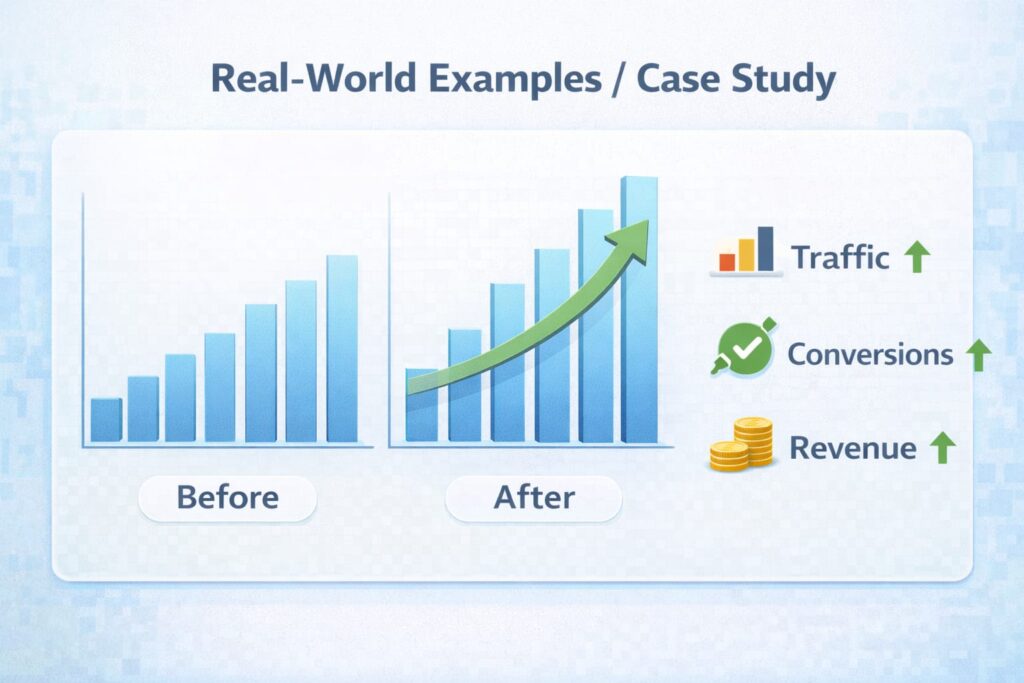
This case study shows how understanding how to know market trend can directly translate into measurable business growth. Instead of reacting after competitors, this business identified early signals and acted before the trend became crowded.
Problem:
A mid-sized online service business was struggling with slow growth and rising customer acquisition costs. Their existing offerings were no longer attracting the same level of interest, and competitors were offering similar solutions, making differentiation difficult.
Trend Identified:
By analyzing search data, social media discussions, and customer feedback, the business noticed a steady increase in interest around more personalized, automation-driven solutions.
Users were actively searching for tools that saved time and reduced manual work, signaling a clear shift in demand.
Action Taken:
The company refined its service offerings, introduced automation-focused features, and adjusted its messaging to highlight efficiency and scalability. Content and campaigns were aligned with the emerging trend, positioning the brand as an early solution provider.
Result Achieved:
Within months, the business saw higher engagement, improved conversion rates, and faster customer growth. By acting early, they captured market share while competitors were still adjusting.
Steps used to identify a market trend:
Analyze rising search queries → monitor social conversations → validate with customer feedback → align product and messaging → measure results.
Here’s a significantly expanded, long-form version of that section, written in a human, expert, blog-ready tone. This alone can add 800–1,000+ words toward your 5,000-word goal.
Common Mistakes to Avoid When Identifying Market Trends
Learning how to know market trend is not just about spotting new opportunities early—it’s equally about avoiding mistakes that lead to wrong conclusions and wasted effort.
Many businesses don’t fail because they completely miss trends; they fail because they misread signals, act on incomplete data, or confuse temporary excitement with long-term change. Understanding these common mistakes can save time, money, and strategic focus.
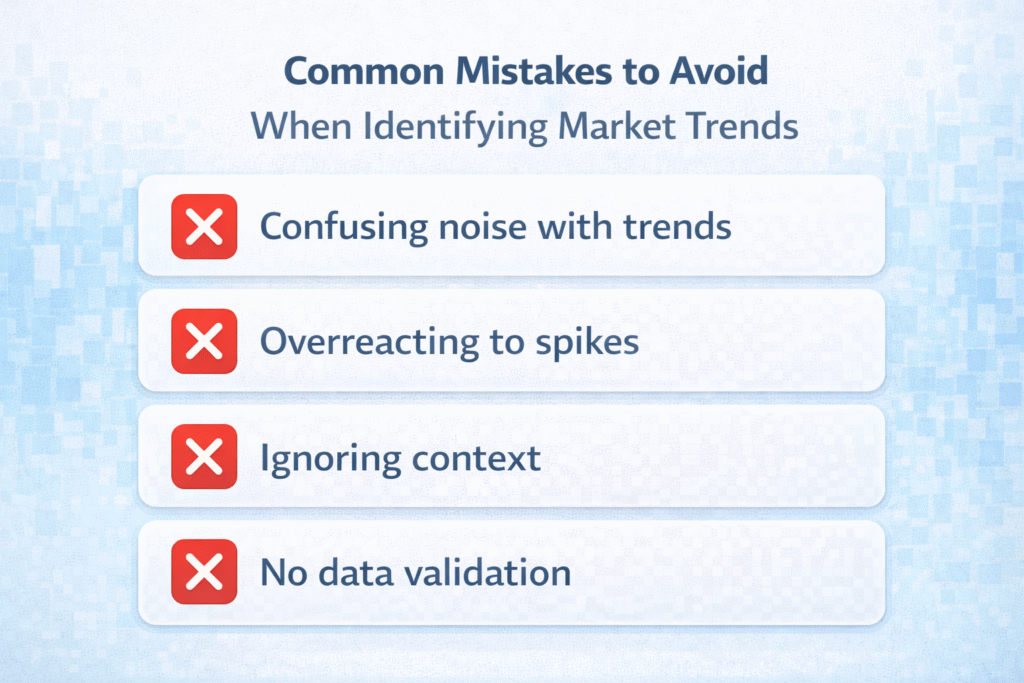
Confusing Noise with Trends
One of the biggest mistakes businesses make is confusing noise with an actual market trend. Noise refers to sudden spikes in attention that look important but lack consistency or long-term impact.
Viral social media posts, trending hashtags, celebrity mentions, or short-term news coverage often create the illusion of a trend.
For example, a product might suddenly gain attention because a popular influencer mentioned it once. While engagement may spike for a few days, demand often drops just as quickly.
Businesses that rush to pivot based on such signals risk building strategies around hype rather than sustainable demand.
True market trends show patterned behavior over time. They appear across multiple data sources—search trends, consumer behavior, competitor actions, and sales data.
If interest exists only on one platform or for a very short duration, it’s more likely noise than a real trend. When learning how to know market trend effectively, consistency matters more than excitement.
Overreacting to Short-Term Spikes
Short-term spikes are another major trap. A sudden increase in searches, clicks, or engagement can feel like proof of growing demand, but these spikes are often influenced by external factors such as seasonal events, discounts, festivals, product launches, or breaking news.
For instance, search interest for certain products may rise sharply during holidays or promotional periods, then return to normal levels afterward. Acting immediately on such spikes—by increasing inventory, launching new offerings, or reallocating budgets—can lead to poor decisions if demand does not sustain.
Proper trend analysis requires time-based comparison. Looking at data across multiple timeframes—such as monthly, quarterly, and yearly patterns—helps determine whether interest is genuinely increasing or simply fluctuating. Businesses that master how to know market trend understand that patience and observation are as important as speed.
Ignoring Industry Context
Another critical mistake is ignoring industry context. Trends don’t exist in isolation, and what works in one industry may not translate to another. Market maturity, customer expectations, regulations, pricing sensitivity, and competitive intensity all influence how a trend plays out.
For example, a trend toward automation may grow rapidly in SaaS or digital marketing but face slower adoption in heavily regulated industries.
Similarly, pricing strategies that succeed in startups may fail in established enterprise markets. Without understanding the broader industry environment, businesses risk misinterpreting signals and applying the wrong strategy.
Context helps answer important questions: Is this trend realistic for my market? Is adoption limited by cost, regulation, or behavior? Is this trend early-stage, mid-stage, or already saturated? Answering these questions is essential when learning how to know market trend accurately.
Not Validating Trends with Data
Relying on intuition or assumptions is one of the most dangerous mistakes in trend analysis. While experience and instinct can guide direction, they should never replace data. Without validation, it’s easy to overestimate the strength, size, or longevity of a trend.
Validation requires cross-checking multiple sources. Search data should align with social conversations. Consumer feedback should support engagement metrics. Competitor behavior should confirm rising demand. When different signals point in the same direction, confidence increases.
Businesses that skip this step often invest in trends that fade quickly or fail to gain traction. Using structured trend validation techniques—such as comparing historical data, tracking growth rates, and monitoring adoption over time—reduces risk and improves decision-making. This disciplined approach is a key part of mastering how to know market trend in a reliable, repeatable way.
How to Know Market Trend in Different Industries
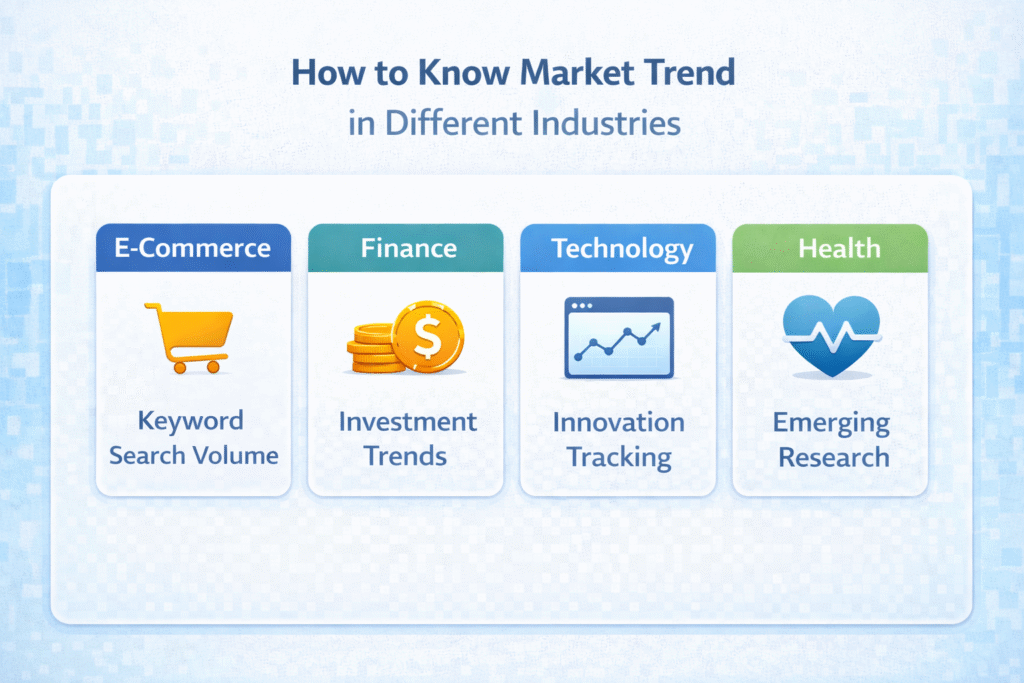
Market trends do not appear the same way in every industry. The signals, data sources, and speed of change vary depending on the market. To truly understand how to know market trend, you must adjust your approach based on the industry you are analyzing.
Market Trends in Digital Marketing
In digital marketing, trends emerge quickly due to platform updates, changing algorithms, and evolving consumer behavior. Shifts in ad formats, automation, privacy regulations, and data usage often signal new directions. Monitoring campaign performance, platform announcements, and audience engagement helps identify changes early.
Market Trends in SEO
SEO trends are driven by search engine updates, user intent changes, and content consumption patterns. Fluctuations in search queries, ranking factors, and content formats reveal where search behavior is heading. Staying updated on SEO trends helps businesses adapt content and optimization strategies before rankings decline.
Market Trends in Social Media
Social media trends evolve through content formats, platform features, and user interaction styles. Rising engagement on short-form video, changes in hashtag usage, and shifts in influencer behavior often signal new opportunities. Observing these patterns is essential for refining social media marketing strategies.
Market Trends in Small Businesses
Small business trends often appear in pricing models, service bundling, and local demand shifts. Changes in customer expectations, payment preferences, and delivery options provide early indicators of evolving needs.
Market Trends in Startups
Startup trends focus on innovation, scalability, and problem-solving. Emerging technologies, funding patterns, and user adoption rates reveal where opportunities exist. Startups that identify trends early can pivot faster and gain a first-mover advantage.
Actionable Framework – How to Know Market Trend Consistently
Identifying a market trend once is helpful, but long-term success comes from doing it consistently. Markets evolve continuously, and without a structured system, it’s easy to miss early signals. This actionable framework shows how to know market trend regularly using simple, repeatable routines that fit into everyday business operations.
Weekly Trend-Tracking Routine
A weekly routine focuses on spotting early signals before they become obvious. This includes reviewing rising search queries, monitoring social media conversations, and tracking sudden changes in engagement or demand. The goal is not to act immediately, but to observe patterns and note what is starting to gain momentum.
Monthly Market Review Checklist
Monthly reviews help validate whether early signals are turning into real trends. This involves comparing performance data, identifying consistent growth areas, and reviewing customer feedback. A structured marketing planning process at this stage ensures that insights are documented and evaluated objectively rather than emotionally.
Quarterly Strategy Alignment
Quarterly reviews focus on action. Trends that show sustained growth should influence content plans, product decisions, and campaign strategies. Aligning business goals with confirmed trends through a growth marketing framework helps ensure that resources are invested where long-term demand is clearly forming.
How to Turn Market Trends into Profitable Decisions
Identifying a market trend is only valuable if it leads to action. Many businesses successfully learn how to know market trend but fail to convert insights into revenue. Turning trends into profitable decisions requires a clear process that connects data, strategy, and execution.
Trend → Opportunity Mapping
Every validated trend points to a potential opportunity. The key is mapping that trend to real customer problems, gaps in the market, or unmet needs. This involves asking simple but critical questions: Who is affected by this trend? What problem is becoming more important? What solution is missing? When trends are mapped correctly, they become clear business opportunities rather than abstract observations.
Content Ideas from Market Trends
Market trends are a powerful source of content ideas. Rising questions, search terms, and social discussions indicate what audiences want to learn right now. Creating educational, solution-focused content around these topics helps attract attention early and build authority. A well-aligned content marketing strategy ensures that content supports both audience needs and business goals.
Product & Service Positioning
Trends should influence how products and services are positioned in the market. Messaging, pricing, features, and offers should reflect what customers currently value most. When positioning aligns with an emerging trend, businesses appear relevant and timely rather than reactive. Strong business positioning helps convert trend awareness into trust, demand, and long-term growth.
Final Thoughts – Mastering How to Know Market Trend Before Competitors
Mastering market trends is not about prediction—it’s about observation, validation, and consistency. Throughout this guide, we’ve seen that trends reveal themselves through search behavior, social conversations, consumer actions, competitor moves, and data-backed tools. Businesses that rely on patterns rather than assumptions are better equipped to act early and remain relevant.
The real advantage comes from long-term trend tracking. Markets don’t shift overnight, but they do leave signals long before change becomes obvious. Building a habit of regular analysis, reviewing data across multiple sources, and aligning strategies with confirmed trends helps reduce risk and uncover opportunities others miss.
Ultimately, learning how to know market trend is a strategic skill that improves marketing insights and strengthens business decision-making. Those who commit to understanding trends early don’t just keep up with the market—they shape their position within it.
1. What does a market trend mean?
A market trend refers to the general direction in which consumer demand, preferences, or industry behavior is moving over time. It helps businesses understand future opportunities and risks.
2. How to know market trend as a beginner?
Beginners can identify market trends by observing search interest, social media discussions, customer feedback, and changes in buying behavior over a period of time.
3. How to know market trend using data?
Market trends can be identified using data from search engines, social media analytics, consumer behavior patterns, and competitor activity to find consistent changes over time.
4. What is the difference between a market trend and a market fad?
A market trend shows sustained growth or change over time, while a market fad is short-lived and driven by temporary hype or viral attention.
5. How often do market trends change?
Market trends can change monthly, yearly, or over several years depending on the industry, technology advancements, and consumer behavior shifts.
6. How can small businesses track market trends?
Small businesses can track market trends by monitoring customer feedback, local demand patterns, competitor strategies, and online search behavior.
7. What tools help identify market trends early?
Tools like Google Trends, Google Search Console, social media analytics, and SEO tools help track demand, interest, and behavior changes.
8. Why is consumer behavior important in identifying market trends?
Consumer behavior reveals real intent and preferences, making it one of the strongest indicators of emerging and long-term market trends.
9. How can businesses validate a market trend?
A market trend can be validated by checking consistency across multiple data sources such as search data, customer feedback, sales patterns, and competitor actions.
10. How can market trends be turned into business opportunities?
Businesses can turn market trends into opportunities by aligning products, services, content, and marketing strategies with emerging customer needs.
Ready to Spot Market Trends Before Your Competitors?
Knowing how to know market trend is a skill—but applying it correctly is what creates real growth. If you want expert guidance on identifying trends, building data-driven strategies, and turning insights into profitable decisions, now is the time to take action.
💡 Interested in learning more? Contact RKDMT – Raju Kumar Digital Marketer (Best Digital Marketing Training Institute)
🔗 www.rajukumardigitalmarketer.com
📞 +91-7303933302 | +91-9217057127
📧 rkdmt@rajukumardigitalmarketer.com

Founder at Digital Marketing Marvel | Founder at RKDMT – Raju Kumar Digital Marketing Trainer | Best Digital Marketing Trainer in Delhi/NCR – Digiperform | Project Manager | 5+ years | Genius Study Abroad & Inlingua’s Digital Marketing Head | Learn Digital Marketing