


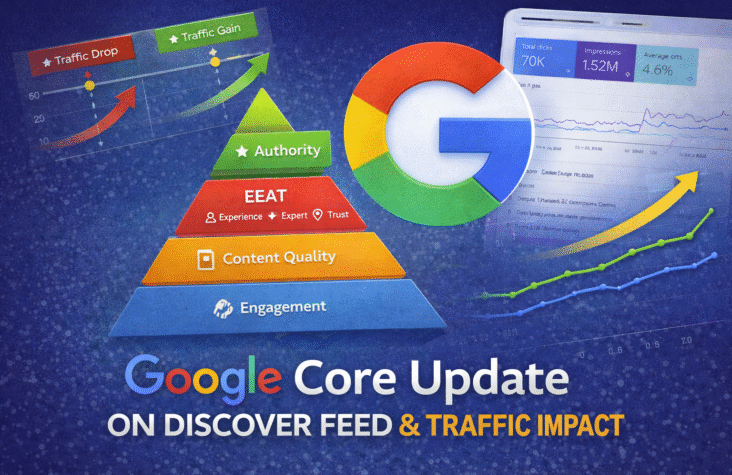
Google Core Update on Discover Feed & Traffic Impact
The Google core update on discover feed has become one of the most critical factors affecting website traffic, especially for publishers, bloggers, and digital marketers who rely on Google Discover for visibility. Unlike traditional search rankings, Discover traffic is highly dynamic and sensitive to Google’s core algorithm changes. When a Core Update rolls out, Google reassesses content quality, authority, trustworthiness, and relevance across the web, which directly impacts which content appears in the Discover feed.
Many websites experience sudden Discover traffic drops or spikes immediately after a Core Update. In some cases, publishers have reported traffic fluctuations ranging from 30% to 70% within days of an update rollout.
This happens because Discover prioritizes high-quality, engaging, and authoritative content, and Core Updates refine how Google evaluates these signals. As a result, websites with strong expertise, consistent publishing, and trustworthy content often gain visibility, while sites with outdated, thin, or low-authority content may lose Discover exposure.
Understanding the impact of Google Core Updates on Discover is essential for maintaining stable traffic and long-term growth. These updates do not target specific websites but instead improve Google’s ability to identify valuable content for users. This means websites must focus on building authority, improving content quality, enhancing user engagement, and maintaining technical performance to remain competitive.
This guide explains how Core Updates affect Discover traffic, why traffic drops happen, how to diagnose the impact, and most importantly, how to recover and protect your website from future Discover traffic losses.
Why the Google Core Update on Discover Feed Matters More Than Ever
Google Discover has become one of the most powerful traffic sources for publishers, but it is also the most volatile. Unlike Google Search, which ranks content based on user queries, Discover is a predictive system. It shows content based on user interests, browsing behavior, engagement patterns, and content quality signals. This means websites do not rank for keywords in Discover. Instead, Google decides which content deserves visibility based on its perceived value and relevance to individual users.
This is why the google core update on discover feed has such a dramatic impact. Core Updates adjust how Google evaluates content quality, authority, expertise, and trust. When these evaluation systems change, Discover visibility can increase or decrease immediately. Websites that previously met Google’s quality thresholds may lose visibility, while others with stronger authority and engagement signals gain more exposure.
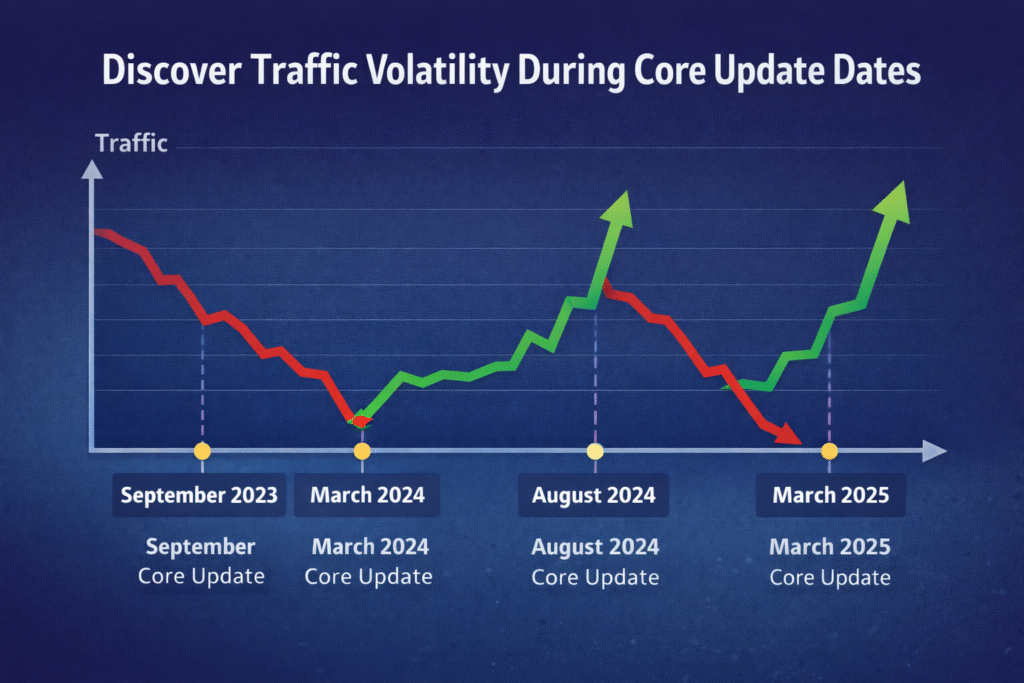
Discover traffic volatility is significantly higher compared to traditional search traffic. Industry studies and publisher reports show that Discover can contribute between 10% and 60% of total website traffic, especially for news sites, blogs, and content-heavy platforms. However, during major Core Updates, some publishers have reported Discover traffic losses ranging from 40% to 80% within days. These fluctuations occur because Discover continuously recalibrates which websites deserve user attention based on updated ranking systems.
Websites heavily dependent on Discover are the most vulnerable to these changes. Since Discover prioritizes content freshness, authority, and engagement, even small changes in Google’s quality evaluation systems can significantly alter traffic patterns. Unlike Search, where rankings may fluctuate gradually, Discover traffic can drop or spike almost instantly after a Core Update rollout.
This makes it essential for publishers to understand how Core Updates influence Discover performance. Websites that focus on high-quality content, strong authority signals, consistent publishing, and positive user engagement are far more likely to maintain stable Discover visibility, while sites with weaker signals face higher volatility during algorithm updates.
Understanding this relationship is the first step in developing a reliable Google Core Update recovery strategy and aligning your content with how Google evaluates content quality for Discover visibility and long-term traffic growth.
Understanding Google Discover: How It Works and How It Differs from Search
To understand the impact of the Google core update on discover feed, it is essential to first understand how Google Discover works and why its ranking system behaves differently from traditional search. Unlike Google Search, which responds to user queries, Discover proactively recommends content based on user interests, behavior, and predictive algorithms. This makes Discover far more sensitive to Core Updates because Google continuously reevaluates which content deserves visibility based on quality, authority, and engagement signals rather than keyword rankings alone.
Discover operates as a content recommendation engine powered by machine learning and user data. It analyzes browsing history, search activity, location signals, device usage, and engagement patterns to predict what users are likely to find useful or interesting. Because of this predictive nature, Discover traffic depends heavily on content quality and trust signals, which are directly influenced by Core Updates.
What is Google Discover
Google Discover is a personalized content feed that appears in the Google mobile app and on the Chrome mobile browser homepage. It shows articles, news, videos, and other content tailored to individual users based on their interests and online behavior. Users do not need to search for anything. Google automatically recommends content it believes will be relevant and valuable to them.
Discover is available in more than 100 countries and is used by over 800 million users every month. This makes it one of the largest content distribution platforms in the world. For many publishers, Discover has become a major source of traffic, often driving more visitors than traditional search for certain types of content such as news, trending topics, and informational articles.
Unlike Search, where rankings are relatively stable and keyword-driven, Discover visibility can change rapidly. Content may receive large traffic spikes if Google identifies it as highly relevant, and visibility can disappear just as quickly if quality signals decline.
How Discover Ranking Differs from Search Ranking
The biggest difference between Google Search and Google Discover is how content is selected and ranked. Google Search responds to explicit user intent, meaning users type queries and Google returns results based on relevance and authority. Discover, on the other hand, predicts user intent without requiring a search query.
Discover places much greater emphasis on personalization, engagement, and content freshness. It prioritizes content that aligns closely with a user’s demonstrated interests and behavior patterns. This makes Discover more dynamic and less predictable compared to Search rankings.
Content freshness is especially important in Discover. New or recently updated content is more likely to appear in the feed, particularly if it is relevant to trending topics or ongoing user interests. Additionally, Discover relies heavily on user engagement signals such as click-through rate, dwell time, and interaction patterns to determine which content continues to be shown.
Because Discover relies more heavily on predictive relevance and engagement signals, Core Updates can significantly alter which websites qualify for Discover visibility.
Discover Ranking Signals Influenced by Core Updates
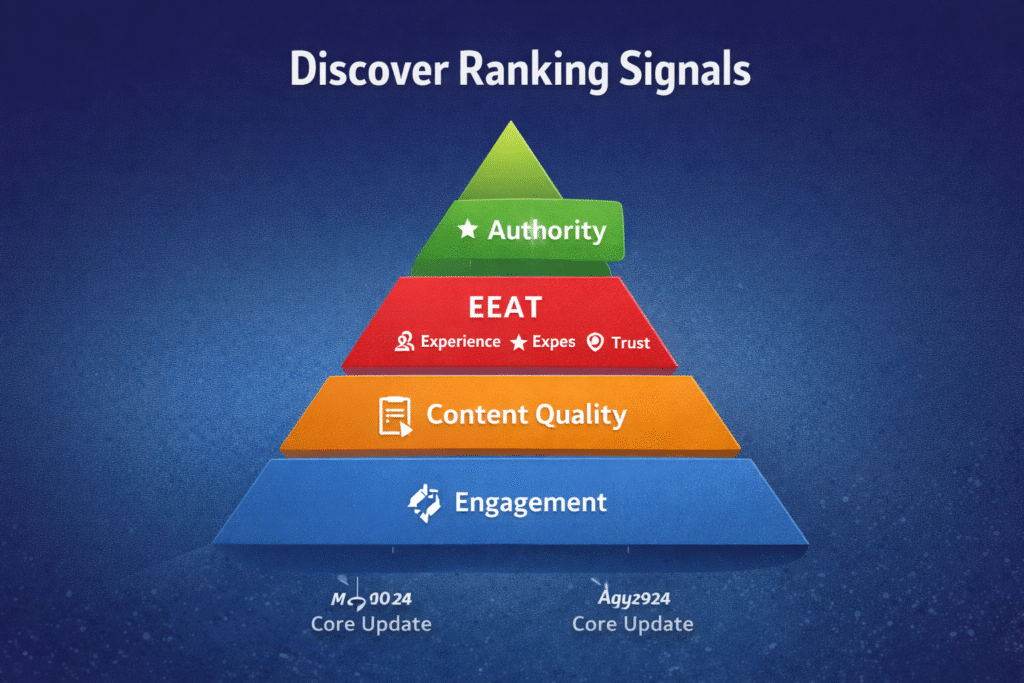
Google Core Updates directly affect the ranking systems that determine Discover visibility. These updates refine how Google evaluates content quality, authority, and trustworthiness, which are critical factors for Discover inclusion.
Content quality is one of the most important signals. Google prioritizes original, well-researched, and valuable content that demonstrates expertise and provides meaningful insights. Thin, duplicate, or low-value content is less likely to appear in Discover after Core Updates.
Entity authority also plays a major role. Google evaluates the overall credibility of the website, brand, and author. Websites with strong authority in their niche are more likely to maintain Discover visibility during Core Updates.
User engagement metrics are another critical factor. Content that attracts higher click-through rates, longer reading time, and stronger engagement signals is more likely to continue appearing in Discover. These signals help Google determine whether users find the content useful.
Content freshness is especially important in Discover. Updated and recently published content has a higher chance of being recommended, particularly if it aligns with current trends or user interests.
Publisher authority and trust signals also influence Discover rankings. Websites with strong reputations, consistent publishing history, and high-quality editorial standards are more resilient to traffic drops during Core Updates.
Together, these signals form the foundation of Discover rankings. When Google releases a Core Update, it recalibrates how these signals are evaluated, which explains why Discover traffic can change dramatically even if search rankings remain stable.
What is a Google Core Update and How Does It Affect Discover
Google Core Updates are major algorithm changes that refine how Google evaluates and ranks content across its entire ecosystem, including Search and Discover. These updates are designed to improve Google’s ability to identify high-quality, trustworthy, and useful content for users. While most discussions focus on search rankings, Core Updates also have a direct and often more dramatic impact on Discover visibility because Discover relies heavily on quality, authority, and engagement signals.
The connection between Core Updates and Discover is structural. Discover uses many of the same core ranking systems that Google uses for Search, but applies them in a predictive and personalized environment. When a Core Update changes how quality and authority are evaluated, Discover quickly recalibrates which websites and pages are eligible to appear in user feeds. This is why publishers often see sudden Discover traffic spikes or drops immediately after a Core Update rollout.
Understanding how Core Updates work is essential for diagnosing Discover traffic changes and building a long-term content strategy that remains resilient during algorithm shifts.
Definition of Google Core Updates
Google Core Updates are broad changes to Google’s ranking systems that improve how the algorithm evaluates content relevance, quality, expertise, and authority. These updates do not target specific websites or pages. Instead, they reassess all indexed content to ensure that the most helpful and reliable information is prioritized.
Core Updates are not penalties. They do not punish websites for violations. Instead, they reevaluate content relative to other competing content on the web. This means a website may lose rankings or Discover visibility simply because other websites now demonstrate stronger quality or authority signals.
One of the key aspects of Core Updates is that they affect overall site authority and trust evaluation. Google analyzes signals such as content expertise, website reputation, author credibility, topical authority, and user engagement. If a website’s perceived authority improves, its visibility can increase across both Search and Discover. If its authority signals weaken relative to competitors, visibility may decrease.
According to Google’s core update official explanation, these updates are intended to improve search quality by ensuring that users receive the most relevant and helpful content. This same evaluation process directly influences Discover content selection.
Why Core Updates Directly Impact Discover Feed
Google Discover relies on many of the same ranking systems used in Search, particularly those related to content quality, authority, expertise, and trust. Because Core Updates refine these evaluation systems, they directly influence which content qualifies to appear in Discover.
One of the most important factors affected by Core Updates is authority recalibration. Google continuously reassesses which websites and authors are considered trustworthy and authoritative within specific topics. When authority signals change, Discover adjusts which sources it recommends to users. Websites with strong authority signals often see increased Discover visibility, while websites with weaker signals may lose exposure.
Trust and expertise signals are also reassessed during Core Updates. Google evaluates whether content demonstrates real expertise, provides original value, and aligns with reliable sources. Websites that consistently publish high-quality, expert-level content tend to benefit from Core Updates, while websites with thin, outdated, or low-value content often experience Discover traffic declines.
Industry data and publisher case studies show a clear pattern. Large, well-established publishers frequently see Discover traffic increases after Core Updates because their authority and trust signals are strong. In contrast, smaller or lower-authority websites often experience Discover visibility drops if their content does not meet updated quality thresholds.
This happens because Discover prioritizes content from sources that Google considers reliable and valuable for users. When Core Updates refine how these signals are measured, Discover visibility adjusts accordingly. This explains why Discover traffic changes can be immediate and significant following Core Update rollouts.
In practical terms, Core Updates act as a recalibration of trust and authority. Websites that align closely with Google’s quality standards gain more Discover exposure, while websites with weaker signals must improve content quality, authority, and trustworthiness to regain visibility.
Timeline of Major Google Core Updates and Their Discover Impact
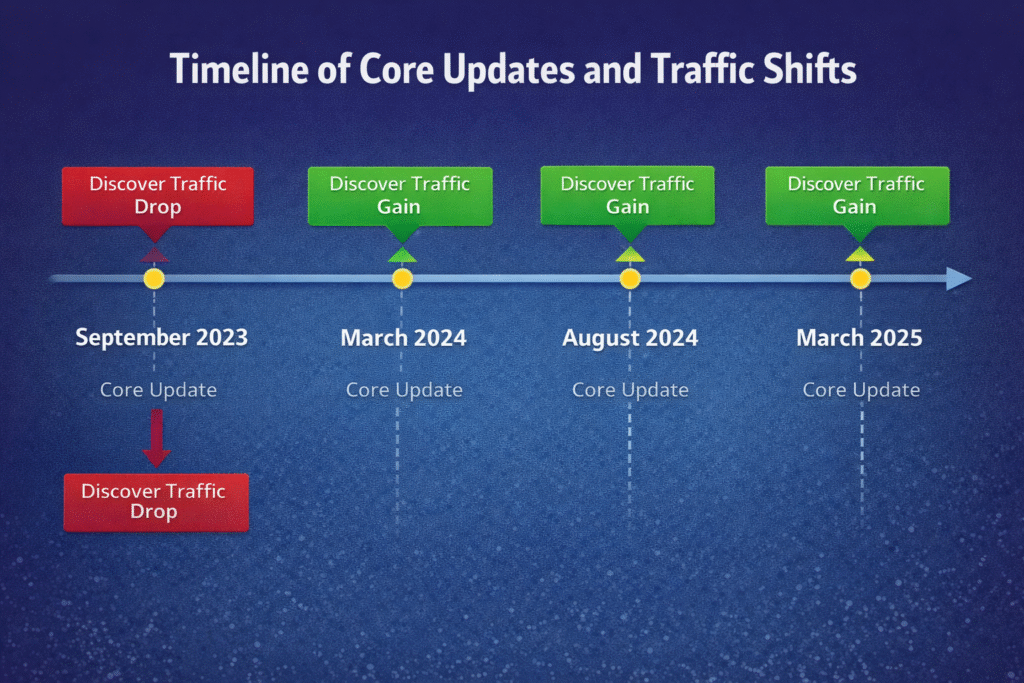
Google Core Updates have consistently influenced Discover traffic patterns, often causing sudden spikes or drops depending on how websites align with Google’s updated quality and authority standards. By analyzing past Core Updates, clear patterns emerge that show Discover is highly sensitive to changes in Google’s content evaluation systems. These updates recalibrate how Google assesses authority, trust, expertise, and user engagement, which directly determines Discover visibility.
Unlike search rankings, which may fluctuate gradually, Discover traffic changes are often immediate. This is because Discover operates as a recommendation system. Once Google
adjusts its quality thresholds during a Core Update, Discover quickly begins promoting different content sources based on the revised evaluation criteria. Industry analysis and publisher reports show Discover traffic swings ranging between 20% and 60% during major Core Updates, making it one of the most volatile traffic sources.
Understanding the timeline of Core Updates helps publishers identify patterns and prepare better content strategies to maintain Discover visibility.
Major Core Updates and Discover Traffic Volatility (2022–2025)
Several major Google Core Updates between 2022 and 2025 significantly impacted Discover traffic across industries. These updates primarily focused on improving content quality evaluation, strengthening authority signals, and prioritizing trustworthy sources.
The September 2023 Core Update was one of the most impactful updates for Discover. Many publishers reported significant Discover traffic drops, particularly websites with weaker authority or inconsistent content quality. Google refined its trust and expertise evaluation systems, resulting in stronger preference for authoritative publishers.
The March 2024 Core Update introduced further authority recalibration. Websites with well-established topical authority and consistent publishing history saw Discover traffic increases, while websites lacking strong expertise signals experienced visibility declines. This update reinforced Google’s focus on rewarding credible, expert-driven content.
The August 2024 Core Update triggered another major Discover reshuffle. Google improved its ability to identify valuable content and filter out low-quality or repetitive content. Publishers who invested in original, in-depth, and high-quality content saw improved Discover performance.
The March 2025 Core Update placed even greater emphasis on content quality, trustworthiness, and user engagement. Google enhanced its systems to prioritize helpful, reliable, and user-focused content. Websites demonstrating strong authority, consistent publishing, and positive engagement metrics were more likely to maintain or gain Discover visibility.
These updates highlight a consistent trend. Google Discover increasingly favors authoritative, trustworthy, and high-quality content sources. Websites that invest in content quality, topical authority, and long-term credibility are more resilient during Core Updates, while websites relying on low-quality or inconsistent content face greater Discover traffic volatility.
Analyzing these historical patterns makes it clear that Discover success depends on aligning with Google’s evolving quality standards rather than relying on short-term optimization tactics.
Signs That a Google Core Update on Discover Feed Affected Your Website
One of the clearest indicators of a google core update on discover feed is a sudden and unexplained change in Discover traffic. These changes often happen immediately after a Core Update rollout and can occur even when your search rankings remain stable. Because Discover uses predictive algorithms and quality evaluation systems, any recalibration in Google’s ranking signals can quickly affect which content is recommended to users.
Unlike technical issues such as indexing errors or website downtime, Core Update impacts are algorithmic. This means your content may still be indexed and ranked in Search, but Discover may stop recommending it if Google’s updated systems determine that other content sources offer stronger authority, trust, or engagement signals. Identifying these signs early allows publishers to take corrective action and improve content quality and authority.
Sudden Discover Traffic Drop or Spike
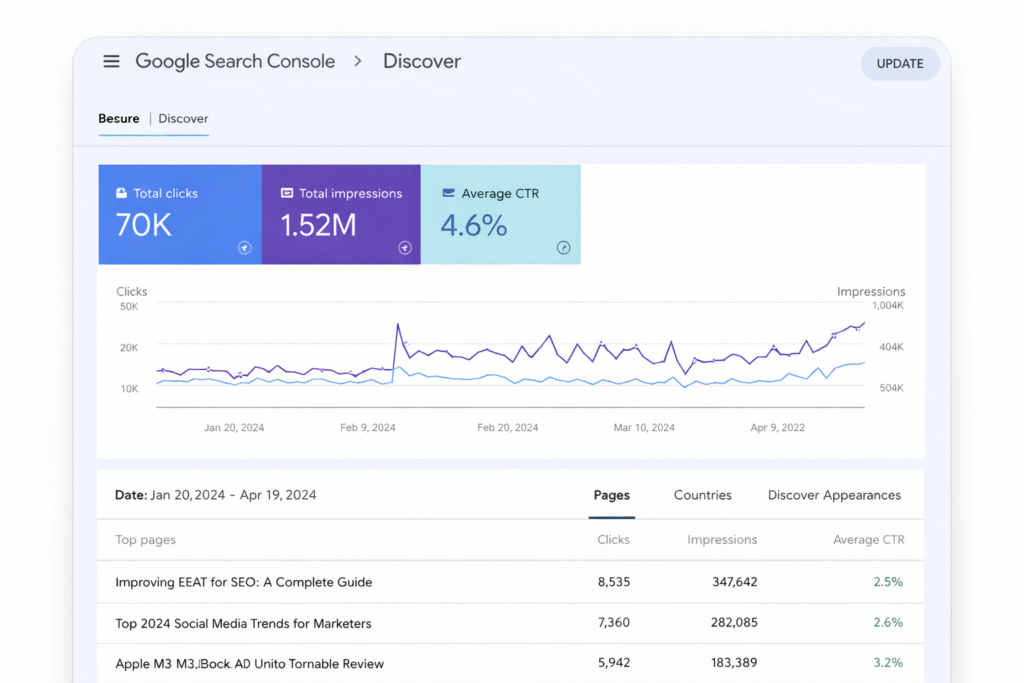
The most obvious sign of a Core Update impact is a sudden drop or spike in Discover traffic. These changes can occur within a few days of the update rollout and may affect individual pages or the entire website. In many cases, publishers notice that Discover clicks and impressions change dramatically without any major changes to their content or technical setup.
One important characteristic of Core Update-related Discover changes is that search rankings often remain stable. Your website may continue ranking normally in Google Search, while Discover traffic declines significantly. This happens because Discover evaluates content eligibility differently and prioritizes predictive relevance and authority rather than keyword rankings.
Google Search Console provides a dedicated Discover performance report where publishers can monitor clicks, impressions, and traffic trends. A sudden drop or spike in Discover impressions during a known Core Update period is a strong indicator that the update affected your Discover visibility.
Drop in Discover Impressions but Stable Search Rankings
Another clear sign of Core Update impact is a decline in Discover impressions while search rankings remain unchanged. This indicates that the Core Update affected Discover eligibility signals rather than overall search rankings.
Discover uses stricter quality and authority thresholds compared to Search. After a Core Update, Google may determine that certain content no longer meets the updated criteria for Discover recommendations. As a result, impressions decline because Google stops showing that content in users’ feeds.
This type of impact confirms that the issue is not technical. Your pages are still indexed, accessible, and ranking in search results. However, Discover’s recommendation system has recalibrated which content it considers valuable enough to recommend.
Content Losing Discover Visibility Without Technical Issues
If your website loses Discover visibility despite having no technical problems, a Core Update likely affected your authority and quality evaluation signals. This is one of the most common Discover traffic loss scenarios.
Core Updates reassess overall website authority, content expertise, and trustworthiness. If Google determines that competing websites now demonstrate stronger expertise, better content quality, or higher trust signals, Discover may prioritize those sources instead.
EEAT signals—Experience, Expertise, Authority, and Trust—play a crucial role in this evaluation. Websites that lack strong author credibility, topical authority, or consistent high-quality content may lose Discover visibility after a Core Update. This does not mean the website is penalized. It simply means Google’s updated ranking systems now favor other content sources.
Authority recalibration is an ongoing process. Websites that improve content quality, strengthen expertise signals, and build trust can regain Discover visibility over time. Identifying these early warning signs allows publishers to respond strategically and protect their Discover traffic from long-term decline.
Root Causes: Why Core Updates Cause Discover Traffic Loss
When a Core Update rolls out, Google recalibrates how it evaluates content quality, authority, trustworthiness, and user engagement across the web. These changes directly influence which content is eligible to appear in Google Discover. Since Discover prioritizes high-quality and trustworthy content, any shift in Google’s evaluation systems can cause certain pages or entire websites to lose visibility.
Discover operates on stricter quality thresholds than traditional search because it proactively recommends content to users. Google must ensure that the content it recommends meets high standards of reliability, usefulness, and engagement. When Core Updates improve how these signals are measured, content that falls below the updated quality threshold may no longer be recommended.
Understanding the root causes behind Discover traffic loss is essential for identifying weaknesses and improving long-term visibility.
Content Quality Reevaluation
One of the primary reasons websites lose Discover traffic after Core Updates is content quality reevaluation. Google continuously refines its ability to identify content that provides genuine value to users. Content that lacks depth, originality, or usefulness is more likely to lose Discover visibility after these updates.
Thin content is especially vulnerable. Articles that provide limited information, surface-level explanations, or generic insights often fail to meet Google’s updated quality standards. Discover prioritizes comprehensive, informative, and well-researched content that demonstrates clear value.
Duplicate or repetitive content also loses priority. If Google identifies similar content across multiple websites, it is more likely to promote the version from the most authoritative and trusted source. Websites publishing copied, rewritten, or low-originality content may see Discover traffic declines as Google prioritizes more original sources.
Core Updates strengthen Google’s ability to differentiate between high-value content and low-value content, which directly affects Discover visibility.
EEAT Signal Reassessment
Core Updates play a major role in reassessing EEAT signals, which stand for Experience, Expertise, Authority, and Trust. These signals help Google determine whether content comes from reliable and credible sources.
Experience refers to whether the content demonstrates real-world knowledge or firsthand insights. Content written by individuals with direct experience in a topic is more likely to maintain Discover visibility.
Expertise evaluates whether the content creator has subject matter knowledge. Articles written by knowledgeable authors or industry professionals are considered more reliable.
Authority refers to the overall credibility of the website and author. Websites with strong reputations, consistent publishing history, and recognition within their niche are more likely to rank well in Discover.
Trust is one of the most critical factors. Google prioritizes content from sources it considers trustworthy and reliable. Websites with transparent authorship, accurate information, and strong editorial standards perform better.
Core Updates refine how Google measures these signals. If a website’s EEAT signals are weaker compared to competitors, Discover visibility may decline.
Authority and Brand Signal Changes
Core Updates often recalibrate how Google evaluates brand authority and reputation. Strong brands with established credibility are more likely to gain Discover visibility, while lesser-known or lower-authority websites may lose exposure.
Google evaluates brand signals such as website reputation, backlink profile, content consistency, and topical authority. Websites that consistently publish high-quality content within a specific niche build stronger authority over time.
Industry observations show that well-known publishers and authoritative websites tend to gain Discover visibility more frequently after Core Updates. This happens because Google has higher confidence in recommending content from trusted sources.
Websites without strong authority signals may struggle to maintain Discover visibility, especially in competitive niches.
Engagement Signal Changes
User engagement signals play a crucial role in determining Discover visibility. Core Updates refine how Google evaluates engagement metrics, which influence whether content continues to be recommended.
Click-through rate (CTR) measures how often users click on content when it appears in Discover. Higher CTR indicates that users find the content relevant and appealing.
Scroll depth measures how far users scroll through the content. Content that keeps users engaged for longer periods signals higher quality and usefulness.
Dwell time refers to how long users stay on a page after clicking. Longer dwell time indicates that users are actively consuming the content and finding it valuable.
If engagement metrics decline or if competing content performs better, Discover may reduce visibility for lower-performing pages. Core Updates improve Google’s ability to identify content that delivers better user engagement, which directly affects Discover traffic.
Improving content quality, strengthening authority, and optimizing engagement signals are essential for maintaining Discover visibility after Core Updates.
Case Studies: Real Discover Traffic Impact from Core Updates
Google Core Updates often produce immediate and measurable changes in Discover traffic, making real-world case studies essential for understanding how algorithm recalibration affects visibility. These examples demonstrate that Discover traffic is highly sensitive to authority, content quality, and trust signals. Websites with weaker signals often experience traffic losses, while authoritative websites benefit from increased Discover exposure.
These case studies also highlight an important principle: Core Updates do not penalize websites. Instead, they re-rank content based on improved quality evaluation systems. As a result, traffic gains and losses occur because Google identifies more reliable and valuable sources to recommend.
Example 1: Publisher Losing 60% Discover Traffic
One mid-sized content publisher experienced a significant Discover traffic drop following a Core Update. Before the update, Discover was a major traffic source driving consistent daily visitors. However, within two weeks of the update rollout, Discover visibility declined sharply.
The Google Search Console Discover report showed a dramatic decrease in both impressions and clicks.
| Metric | Before Core Update | After Core Update |
| Discover Clicks | 120,000 | 45,000 |
| Discover Impressions | 2,000,000 | 800,000 |
This represents a traffic loss of approximately 60%, which is consistent with patterns reported across the industry during major Core Updates.
Despite this Discover traffic decline, the website’s search rankings remained relatively stable. This confirmed that the issue was not caused by technical errors, indexing problems, or penalties. Instead, the Core Update recalibrated Discover eligibility signals.
Further analysis revealed several contributing factors:
- Content lacked depth compared to competing websites
- Articles were not regularly updated
- Author credibility and expertise signals were weak
- Competing websites demonstrated stronger topical authority
As Google reassessed content quality and authority, Discover began prioritizing content from more trusted and authoritative sources.
Example 2: Authority Site Gaining Discover Traffic
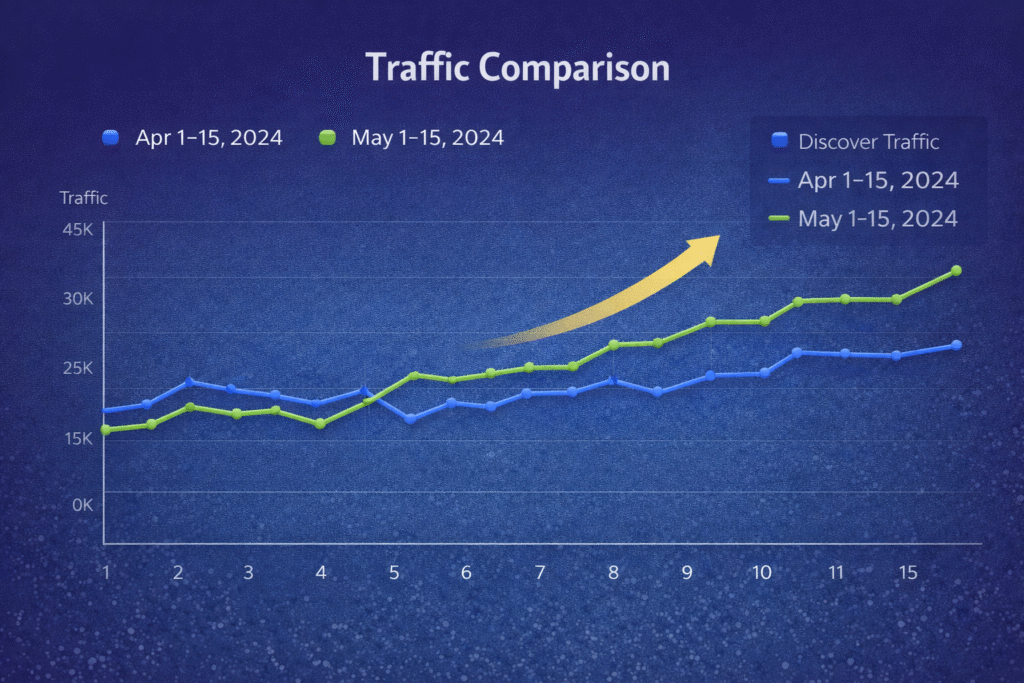
In contrast, an established authority website experienced a significant Discover traffic increase after the same Core Update. This website had strong brand recognition, consistent publishing frequency, and high-quality original content.
Within weeks of the update, Discover impressions and clicks increased substantially. Google began recommending the website’s content more frequently because its authority and trust signals aligned closely with Google’s updated quality evaluation systems.
Several key factors contributed to this growth:
- Strong topical authority within its niche
- Consistent publishing of high-quality, original content
- Recognized brand reputation and credibility
- High user engagement metrics, including strong click-through rates and longer dwell time
This case demonstrates how Core Updates reward websites that demonstrate expertise, authority, and trustworthiness. As Google improves its ability to identify valuable content, authoritative websites gain more Discover visibility.
These contrasting examples illustrate a fundamental truth about Discover traffic. Visibility is directly tied to perceived content quality and authority. Core Updates simply refine Google’s ability to identify and promote the most reliable and useful content sources.
How to Recover from Google Core Update on Discover Feed
Recovering from a google core update on discover feed requires a strategic approach focused on improving content quality, authority, trust signals, and user engagement. Since Core Updates reassess how Google evaluates content value and credibility, recovery is not achieved through quick technical fixes. Instead, it depends on strengthening your website’s overall content quality and demonstrating expertise and trustworthiness over time.
Discover is a recommendation system that prioritizes valuable and engaging content. This means websites that consistently publish high-quality, authoritative, and user-focused content have the highest chance of regaining visibility. Recovery may take weeks or months, but websites that align with Google’s quality standards often see gradual improvements in Discover impressions and traffic.
Improve Content Quality and Depth
Improving content quality is the most important step in recovering Discover traffic. Google prioritizes content that provides original insights, comprehensive information, and genuine value to users. Thin, outdated, or generic content is less likely to regain Discover visibility.
Start by updating existing content to ensure it remains accurate, relevant, and useful. Refresh outdated information, add new data, and expand sections that lack depth. Comprehensive content performs better because it demonstrates expertise and authority.
Adding expert insights also strengthens content credibility. Include real-world examples, expert opinions, case studies, and practical explanations that provide unique value. Content that demonstrates firsthand experience and expertise aligns more closely with how Google evaluates quality.
Improving originality is equally critical. Avoid rewriting existing content from other sources. Instead, focus on creating unique, research-driven content that provides fresh perspectives. Strengthening content quality aligns with best practices outlined in how to improve EEAT for SEO and increases your chances of regaining Discover visibility.
Strengthen Topical Authority
Topical authority refers to how strongly Google associates your website with a specific subject area. Websites that consistently publish high-quality content within a focused niche are more likely to maintain Discover visibility.
Building content clusters is an effective way to strengthen topical authority. This involves creating multiple related articles around a central topic and linking them together. For example, if your website focuses on SEO, publishing related articles on Core Updates, Discover optimization, EEAT, and algorithm changes helps Google recognize your expertise in that field.
Maintaining topic consistency is also important. Websites that publish unrelated or inconsistent content may weaken their authority signals. Focusing on a clearly defined niche helps Google build trust in your website as a reliable source of information.
Over time, strong topical authority increases the likelihood that Google will recommend your content in Discover.
Improve User Engagement Signals
User engagement plays a critical role in Discover visibility. Google evaluates how users interact with your content to determine whether it should continue recommending it.
Click-through rate (CTR) is one of the most important engagement signals. Improving your headlines and featured images can significantly increase CTR. Titles should be clear, compelling, and relevant without being misleading.
Time on page is another key metric. Content that keeps users engaged for longer periods signals higher quality and usefulness. Improving readability, adding visuals, and providing valuable information can increase user engagement.
Content structure also influences engagement. Using clear headings, logical organization, and easy-to-read formatting helps users stay on the page longer. Higher engagement signals increase the likelihood of Discover visibility recovery.
Update Content Regularly
Content freshness is a major ranking factor in Google Discover. Google prioritizes recently published or updated content, especially when it relates to trending topics or evolving subjects.
Regularly updating existing content signals to Google that your website maintains current and relevant information. Even small updates, such as refreshing statistics, improving explanations, or adding new insights, can improve Discover eligibility.
Websites that consistently publish fresh content are more likely to appear in Discover feeds. Frequent publishing also strengthens authority and increases opportunities for Discover recommendations.
Maintaining an active publishing schedule improves your chances of long-term Discover traffic recovery.
Improve Visual Content and CTR Optimization
Visual presentation plays a significant role in Discover performance. Discover is a highly visual platform, and content with strong visual appeal tends to attract more clicks and engagement.
Large, high-quality images significantly improve Discover click-through rates. Google recommends using images that are at least 1200 pixels wide to qualify for large preview cards. Larger images make content more visually prominent in the Discover feed and increase the likelihood of user interaction.
Optimizing featured images to clearly represent the content topic also improves CTR. Images should be relevant, professional, and visually engaging. Avoid generic or low-quality visuals, as they reduce click potential.
Improving headline clarity and image quality together creates stronger Discover cards. Content that combines compelling titles with high-quality visuals performs significantly better in Discover and has a higher chance of recovering traffic after Core Updates.
Recovery from Discover traffic loss requires consistent improvement in content quality, authority, engagement, and freshness. Websites that align closely with Google’s quality standards are far more likely to regain Discover visibility and maintain stable traffic over time.
Technical Factors That Influence Discover Performance
While content quality and authority are the primary drivers of Discover visibility, technical optimization plays a critical supporting role. Google Discover is designed for fast, seamless mobile consumption, and technical issues can reduce your content’s eligibility even if the content itself is high quality. Google’s systems evaluate technical performance to ensure users receive a smooth and reliable experience when interacting with recommended content.
Technical factors such as mobile usability, page speed, and structured data help Google understand, trust, and efficiently deliver your content to users. Websites with strong technical performance are more likely to maintain consistent Discover visibility, especially after Core Updates.
Mobile Optimization
Google Discover is almost entirely mobile-driven, as it appears in the Google mobile app and Chrome mobile browser. This means your website must be fully optimized for mobile devices to remain eligible for Discover traffic.
Mobile-friendly websites provide better readability, faster loading times, and smoother navigation. Content should display properly across different screen sizes without requiring users to zoom or scroll horizontally. Text should be easy to read, images should scale correctly, and buttons should be easy to click.
Google uses mobile-first indexing, which means it primarily evaluates the mobile version of your website when determining rankings and Discover eligibility. Websites with poor mobile usability, broken layouts, or difficult navigation may lose Discover visibility even if the content quality is strong.
Ensuring a responsive design, clean layout, and mobile-friendly user experience is essential for maintaining Discover’s performance.
Page Speed Optimization
Page speed is a critical ranking and a Discover eligibility factor. Users expect Discover content to load instantly, and slow-loading pages create poor user experiences. Google prioritizes fast-loading pages because they improve user satisfaction and engagement.
Studies and performance benchmarks show that pages loading in under 2.5 seconds tend to perform significantly better in Discover. Faster websites reduce bounce rates, increase dwell time, and improve engagement signals, all of which contribute to higher Discover visibility.
Core Web Vitals metrics such as Largest Contentful Paint (LCP), Interaction to Next Paint (INP), and Cumulative Layout Shift (CLS) help Google evaluate page performance. Websites that meet recommended performance thresholds are more likely to maintain Discover eligibility.
Optimizing images, reducing unnecessary scripts, using efficient hosting, and enabling caching can significantly improve page speed and Discover performance.
Structured Data and Technical Trust Signals
Structured data helps Google understand your content more clearly by providing additional context about your pages. It uses schema markup to define elements such as articles, authors, publication dates, and organizations. This improves Google’s ability to evaluate content credibility and relevance.
Article schema is particularly important for Discover. It helps Google identify important content elements such as headlines, featured images, and publication dates. This increases the chances of your content appearing correctly in Discover feed cards.
Technical trust signals also play an important role. Secure websites using HTTPS are more trusted by Google and users. Clear author information, proper site structure, and transparent publishing details strengthen trust signals and improve Discover eligibility.
Structured data does not guarantee Discover inclusion, but it improves Google’s understanding of your content and strengthens the technical foundation required for Discover visibility. Websites that combine strong technical optimization with high-quality content are more likely to achieve stable and consistent Discover traffic.
Future of Discover Feed and Algorithm Evolution
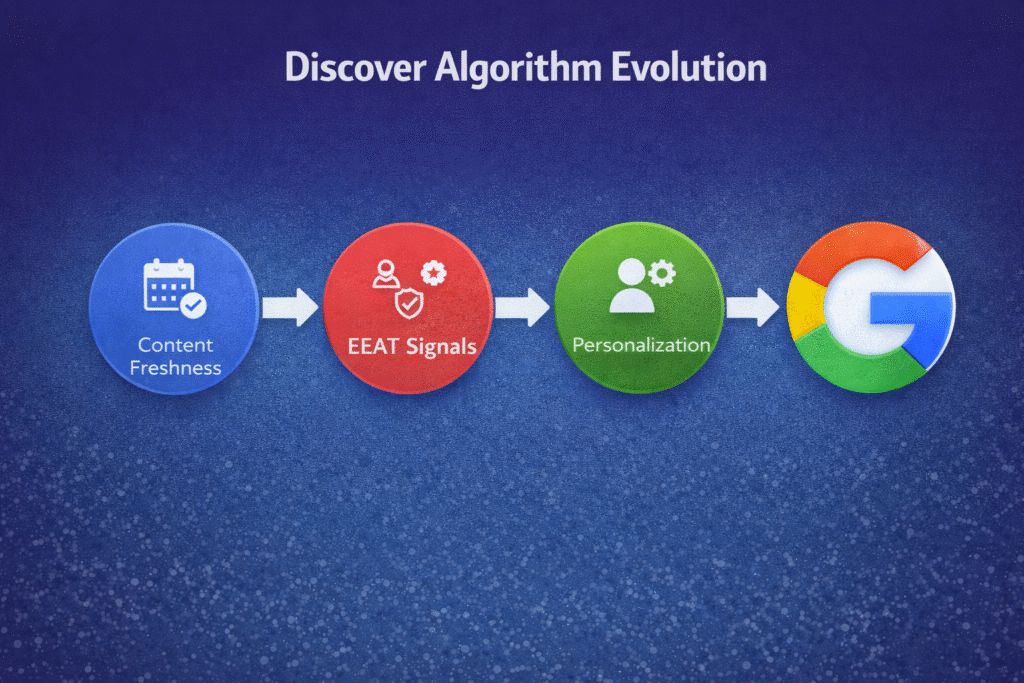
Google Discover is rapidly evolving into a fully AI-driven content recommendation system. As Google integrates more advanced machine learning models into its ranking infrastructure, Discover is becoming more precise in predicting user interests and recommending high-quality content. This evolution means that Discover will rely even more heavily on authority, trust, engagement, and user satisfaction signals in the future.
One of the most significant shifts is the increased use of AI-driven personalization. Google’s systems analyze vast amounts of behavioral data, including browsing patterns, interaction history, location signals, and content engagement. This allows Discover to deliver highly personalized content feeds tailored to individual users. As Google’s AI models become more advanced, Discover will improve its ability to identify which content users are most likely to engage with, making content quality and relevance more important than ever.
Authority prioritization will also become stronger. Google is continuously improving its ability to evaluate brand credibility, topical expertise, and publisher trustworthiness. Websites that demonstrate consistent expertise, publish authoritative content, and build strong reputations within their niche will gain more Discover visibility. Smaller or low-authority websites will need to invest more in building topical authority and trust signals to remain competitive.
Quality standards are expected to increase significantly. Google’s goal is to recommend content that is helpful, reliable, and valuable to users. As a result, low-quality, thin, or generic content will become less likely to appear in Discover. Instead, Google will prioritize original, in-depth, and experience-driven content that provides meaningful value.
Another important trend is the integration of AI-generated summaries and entity-based ranking systems. Google is becoming better at understanding content context, author credibility, and topical relationships. This means Discover will increasingly favor websites with strong entity recognition, clear expertise signals, and consistent content themes.
User engagement will remain a critical factor. Metrics such as click-through rate, dwell time, and content interaction will continue to influence Discover recommendations. Google’s AI systems will use these signals to refine future recommendations and improve feed accuracy.
In the long term, Discover will become more selective and quality-focused. Websites that invest in building authority, maintaining high editorial standards, optimizing technical performance, and consistently publishing valuable content will have the highest chance of achieving stable Discover traffic.
As Google continues to refine its algorithm, Discover will shift further toward rewarding trustworthy, expert-driven, and highly engaging content. Publishers who align with these evolving standards will be better positioned to maintain and grow their Discover visibility in the future.
What is the Google Core Update on Discover Feed?
It is a major Google algorithm update that changes how content quality, authority, and trust are evaluated, directly affecting which content appears in the Discover feed.
Why did my Discover traffic drop after a Core Update?
Your content likely lost visibility because Google reassessed quality, authority, or engagement signals and started prioritizing stronger competing content.
Can Discover traffic recover after a Core Update?
Yes. Improving content quality, authority, and engagement signals can help restore Discover visibility over time.
How long does Discover recovery take?
Recovery can take a few weeks to several months, depending on improvements and future algorithm reevaluations.
Does EEAT affect Discover rankings?
Yes. Strong Experience, Expertise, Authority, and Trust signals increase your chances of appearing in Discover.
How do I optimize content for Discover?
Publish original, high-quality content, use strong images, improve authority, and update content regularly.
Why is Discover traffic unstable?
Discover is personalized and predictive, so traffic changes quickly based on user behavior and algorithm updates.
Does fresh content help Discover visibility?
Yes. Recently published or updated content has a higher chance of appearing in Discover feeds.
How can I check Discover traffic impact?
Use the Discover report in Google Search Console to monitor clicks, impressions, and traffic trends.
Does technical SEO affect Discover performance?
Yes. Mobile optimization, fast page speed, and structured data improve Discover eligibility and visibility.

Founder at Digital Marketing Marvel | Founder at RKDMT – Raju Kumar Digital Marketing Trainer | Best Digital Marketing Trainer in Delhi/NCR – Digiperform | Project Manager | 5+ years | Genius Study Abroad & Inlingua’s Digital Marketing Head | Learn Digital Marketing