


How to Use AI Tools for Keyword Research (Step-by-Step Guide)
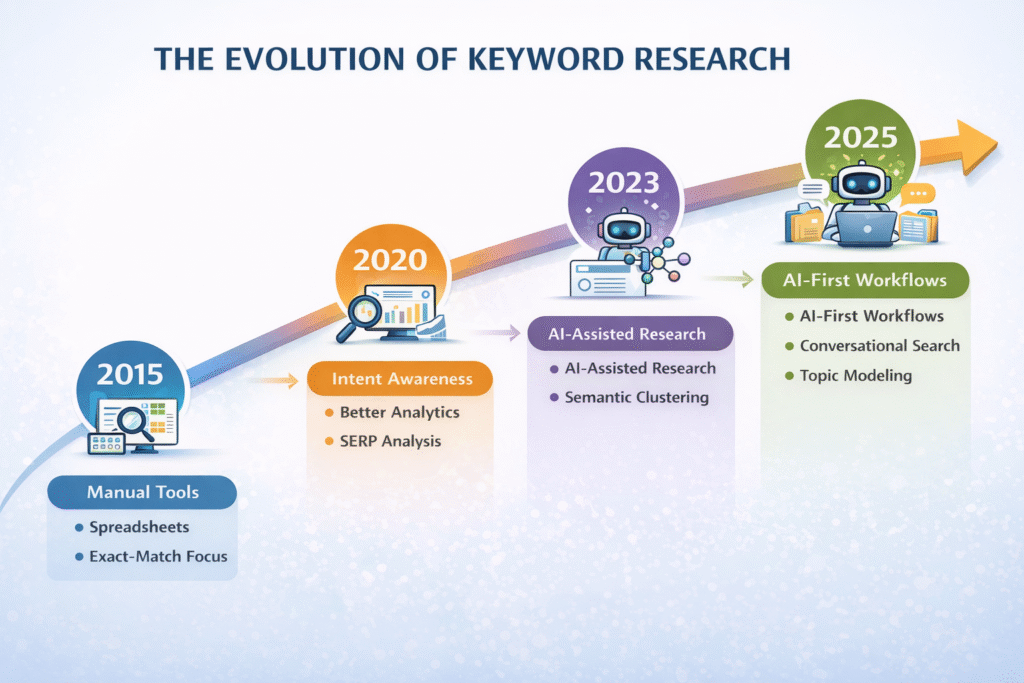
Keyword research has always been the foundation of SEO, but the way we do it has changed dramatically. For years, marketers relied on manual spreadsheets, experience-based intuition, and time-consuming SERP analysis to identify the right keywords.
This “old-school” approach worked, but it was slow, subjective, and often incomplete. Many businesses ended up chasing high-volume keywords, overlooking search intent, or struggling with keyword cannibalization due to poor clustering.
With the rise of artificial intelligence, this process has evolved from manual guesswork to data-augmented decision-making. Today, AI tools for keyword research allow marketers to uncover hidden opportunities, analyze search intent at scale, and organize keywords based on semantic relationships rather than just exact matches.
Instead of spending days gathering and sorting data, beginners and professionals alike can now complete comprehensive keyword research in hours with greater accuracy and clarity.
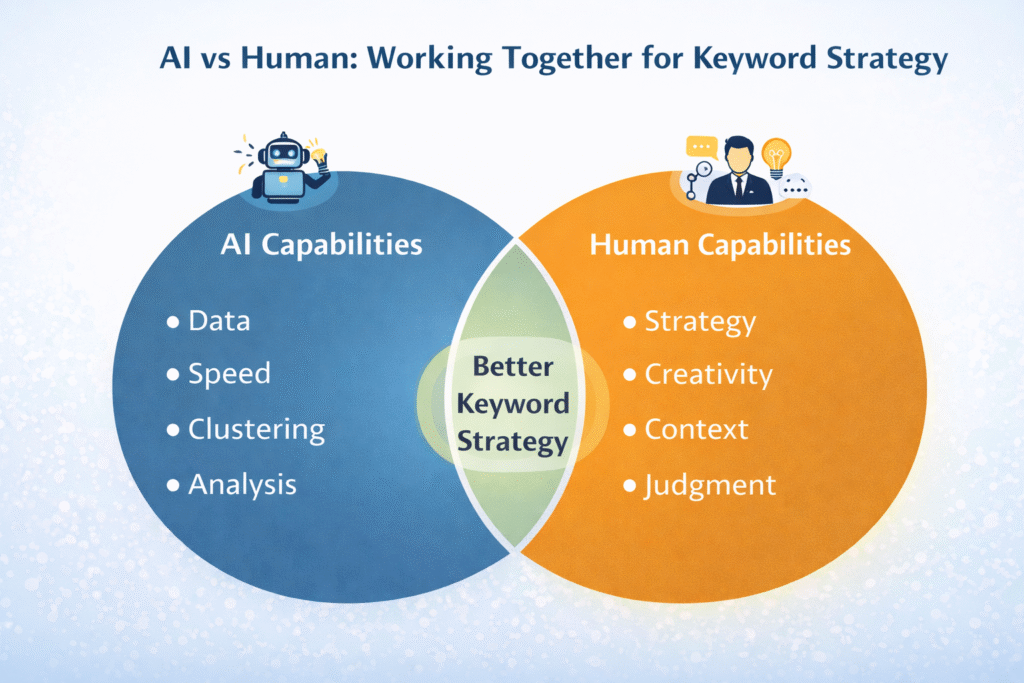
However, it’s important to understand that AI does not replace human strategy—it enhances it. AI can generate ideas, detect patterns, and efficiently structure data, but strategic decisions still require human judgment.
You still need to decide which keywords align with your business goals, which topics deserve investment, and how to interpret search results. In this guide, AI will act as your co-pilot, helping you work smarter while you remain in control of your SEO strategy.
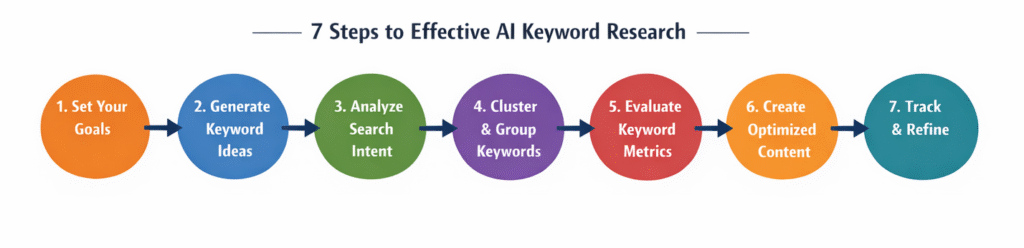
This blog will walk you through a practical, beginner-friendly, step-by-step workflow for using AI in keyword research—from defining your goals to mapping keywords to content. By the end, you’ll not only understand how AI tools work but also how to use them effectively to build a stronger, more organized, and results-driven SEO strategy.
Why AI Is Reshaping Keyword Research (And What Actually Changed)
Keyword research is not changing because of AI — it is changing because search itself has changed, and AI is the best tool we currently have to understand that shift. For beginners, this matters because the methods that worked five years ago no longer guarantee results today. What used to be a largely manual, volume-driven exercise has evolved into an intent-driven, data-assisted discipline.
From “Volume-First” to “Intent-First” Research
In traditional SEO, keyword research often starts with search volume. Marketers prioritized high-volume keywords, assuming that more searches automatically meant more traffic and better results. While volume still matters, this approach frequently led to poor targeting, wasted content effort, and low conversion rates.
AI has helped shift the focus from “How many people search this?” to “Why are people searching this?” Modern AI-powered keyword research emphasizes search intent — understanding whether a query is informational, commercial, or transactional before deciding what content to create. This ensures that content aligns with user expectations and what Google is likely to rank. If you want a deeper breakdown of this concept, see our internal guide on search intent explained.
By analyzing patterns across thousands of queries at once, AI makes it easier to see intent relationships that would be extremely difficult to spot manually in a spreadsheet. This is one of the core reasons keyword research today feels more strategic and less mechanical.
How AI Reduces Bias and Surfaces Hidden Opportunities
Human-led keyword research is naturally influenced by personal experience, industry familiarity, and existing assumptions. Marketers tend to think in familiar terms, which often limits creativity and discovery. AI, on the other hand, analyzes language patterns, related topics, and semantic connections without emotional or cognitive bias.
This allows AI tools to surface non-obvious keyword opportunities, such as:
- Long-tail variations that a human might not think of
- Questions users actually ask in real life
- Emerging topic clusters that are gaining traction
- Alternative phrasing used by different audience segments
For beginners, this is especially powerful because it levels the playing field. You don’t need years of SEO experience to uncover valuable keywords — AI helps you think beyond what you already know.
Why Search Is Becoming More Conversational
Another major reason AI is reshaping keyword research is the changing nature of search behavior. People are no longer typing short, robotic phrases into Google as often as they used to. Instead, search queries are becoming more conversational, detailed, and question-based — especially with the rise of voice search and AI chat interfaces.
Google itself has stated that around 15% of searches every day are completely new, meaning they have never been searched before. This constant evolution makes static, manual keyword lists less reliable over time. AI tools are better suited to adapt to this fluid search landscape by identifying patterns in new and unusual queries.
At the same time, rich SERP features — such as featured snippets, People Also Ask boxes, knowledge panels, and AI-generated answers — have contributed to declining organic click-through rates on traditional blue links. Industry analyses from platforms like SparkToro and Similarweb have shown that users are increasingly finding answers directly on the SERP without clicking through to websites. This makes precise intent targeting more important than ever, because simply ranking is no longer enough — you must rank for the right kind of query.
For context on how Google evaluates relevance and intent in this new environment, you can reference Google’s ranking systems documentation on Google Search Central.
What Actually Changed? (Old vs. AI-Powered Keyword Research)
| Dimension | Traditional Keyword Research | AI-Powered Keyword Research |
| Primary Focus | Search volume | Search intent |
| Speed | Slow (days or weeks) | Fast (hours) |
| Keyword Discovery | Limited to known terms | Broad and exploratory |
| Clustering | Manual and error-prone | Automated and semantic |
| Bias | High (human assumptions) | Lower (data-led patterns) |
| Adaptability | Static lists | Dynamic and evolving |
| Human Role | Execution-heavy | Strategy-heavy |
What AI Tools Can (and Cannot) Do for Keyword Research
AI tools have become powerful assistants in SEO, but they are not magical solutions that automatically guarantee rankings. To use them effectively — especially as a beginner — it is crucial to understand both their strengths and their limitations. This section clarifies what AI truly brings to keyword research and where human judgment remains essential.
The biggest advantage of AI is not just speed, but better pattern recognition. Instead of replacing traditional SEO thinking, AI enhances it by processing large amounts of data, identifying relationships between topics, and organizing information in ways that would take humans far longer to achieve manually. However, strategy, context, and final decision-making still rest with the marketer.
What AI Does Well in Keyword Research
AI tools excel in areas where scale, pattern detection, and automation are required. For beginners, this makes the learning curve much easier and reduces the risk of missing valuable opportunities.
Idea Generation at Scale
One of AI’s greatest strengths is its ability to generate hundreds — sometimes thousands — of keyword ideas within minutes. Instead of brainstorming manually or relying only on traditional tools, AI can suggest:
- Related keywords
- Long-tail variations
- User questions
- Topic expansions
- Alternative phrasings used by different audiences
This helps you explore a much wider keyword landscape than you might reach on your own.
Intent-Based Keyword Clustering
Traditional keyword research often grouped keywords based on similar words or phrases. AI, however, can cluster keywords based on semantic meaning and user intent, even if the words themselves are different. This reduces keyword cannibalization and helps you plan content more logically around topics rather than individual terms.
Identifying Content Gaps and Topical Relationships
AI tools can analyze your existing content (or competitors’ content) and highlight:
- Topics you haven’t covered yet
- Subtopics that are missing depth
- Related themes that could strengthen topical authority
This is particularly useful for building pillar pages and content clusters.
Summarizing SERP Patterns Quickly
Instead of manually reviewing dozens of top-ranking pages, AI can summarize common themes, formats, and intent signals from the search results. This saves time and helps you understand what Google is currently favoring for a given query.
Where AI Still Needs Human Judgment
Despite its capabilities, AI is not flawless — and relying on it blindly can lead to poor SEO decisions. Human expertise remains critical in several areas.
Understanding SERP Nuance
AI may struggle to fully interpret complex SERP signals such as:
- Brand dominance in search results
- Freshness requirements for trending topics
- Local or cultural intent variations
- Google’s preference for certain content formats (e.g., videos, lists, tools, or comparisons)
A human SEO professional must still review the SERP and apply strategic judgment.
Business Relevance vs. Pure Data
AI may recommend keywords that look promising from a data perspective but don’t align with your actual business goals. For example:
- High-volume informational keywords that don’t drive leads
- Broad topics that attract traffic but not conversions
- Queries that don’t match your product or service offerings
You must decide which keywords are worth investing in based on revenue potential, not just search metrics.
Local Intent Misclassification
AI can sometimes misinterpret local search intent, especially in niche or regional markets. For instance, it might suggest generic keywords when users are actually looking for nearby services or location-specific results. Human validation is essential for a local SEO strategy.
Content Quality and Editorial Decisions
AI can help with research and structure, but it cannot replace:
- Original insights
- Industry expertise
- Brand voice
- Storytelling ability
- Depth of analysis
Ultimately, high-ranking content still requires strong human creativity and editorial quality.
AI vs. Human: A Balanced Partnership
Rather than viewing AI as a replacement for SEO professionals, it is more accurate to see it as a powerful co-pilot. AI handles data-heavy, repetitive, and pattern-based tasks, while humans focus on strategy, creativity, and business alignment.
| Aspect | AI Strength | Human Strength |
| Keyword Ideas | Generates at scale | Filters for relevance |
| Intent Analysis | Detects patterns | Interprets context |
| Clustering | Automates grouping | Refines structure |
| SERP Review | Summarizes trends | Applies strategic judgment |
| Content Planning | Suggests topics | Aligns with brand & goals |
| Final Decisions | Data support | Business strategy |
The 7-Step AI Keyword Research Framework (Beginner-Friendly)
Using AI for keyword research is most effective when you follow a structured process rather than jumping randomly between tools. Beginners often feel overwhelmed because they either rely too much on AI or don’t know where to start. This 7-step framework simplifies the process into a logical, repeatable workflow that balances AI assistance with human strategy.
Think of this framework as your roadmap: each step builds on the previous one, taking you from vague ideas to a well-organized, actionable keyword plan. By the end of this process, you won’t just have a list of keywords — you’ll have a clear content strategy backed by data, intent, and relevance.
Step 1 — Define Your Goal (Traffic, Leads, or Conversions?)
Before using any AI tool, you must first clarify your objective. Many beginners make the mistake of doing keyword research without a clear purpose, which leads to scattered content and weak results.
Your goal generally falls into one of three categories:
- Traffic (Awareness):
You want to attract a large audience, educate users, and build brand visibility. This usually involves informational keywords and blog content. - Leads (Consideration):
You want to attract potential customers who are researching options. This includes comparison keywords, best-of lists, and solution-based queries. - Conversions (Sales):
You want users ready to buy or take action. These are transactional keywords such as “buy,” “price,” “best deal,” or “near me.”
Your goal determines the type of keywords you should prioritize and the kind of content you should create.
| Goal | Keyword Type | Example Query | Content Type |
| Traffic | Informational | “what is SEO” | Blog post / guide |
| Leads | Commercial | “best SEO tools” | Comparison article |
| Conversions | Transactional | “SEO agency in Delhi” | Service page |
Step 2 — Start with Seed Topics, Not Keywords
Instead of jumping straight into tools, begin with broad seed topics related to your niche. These are high-level themes that represent what your audience cares about.
For example, if you run a digital marketing website, your seed topics might include:
- SEO
- Google Ads
- Content Marketing
- Social Media Marketing
- Website Optimization
Once you have your core topics, think about your audience’s journey:
- Top of the funnel (TOFU): Beginners seeking basic information
- Middle of the funnel (MOFU): Users comparing options
- Bottom of the funnel (BOFU): Users ready to purchase
This topic-first approach ensures your keyword research remains structured and meaningful rather than random.
Step 3 — Use AI to Expand Topics into Keyword Ideas
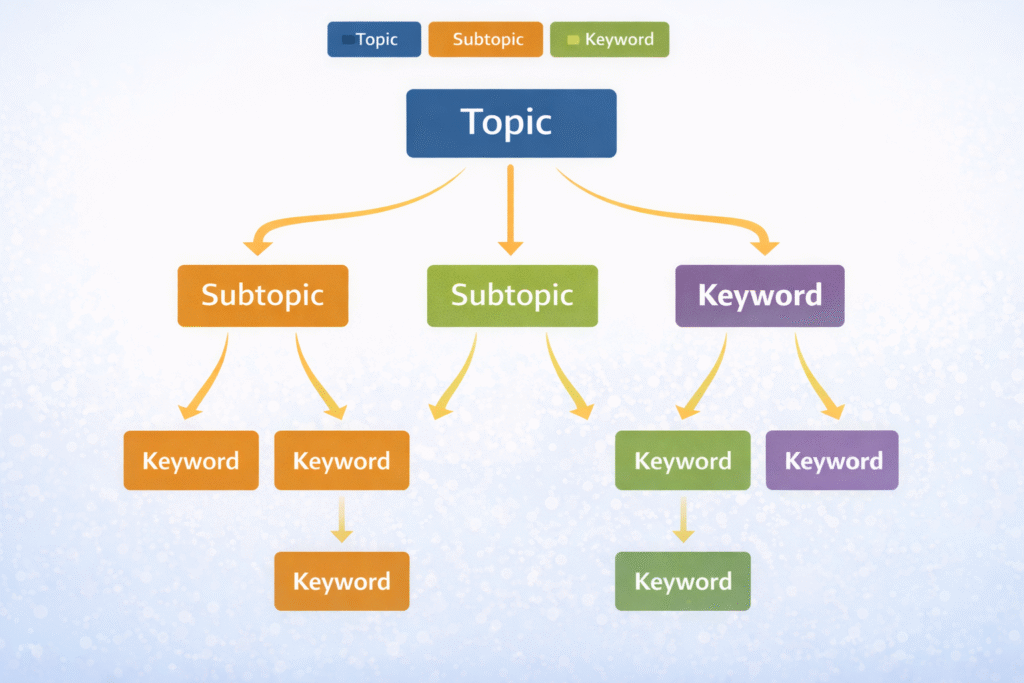
Now is where AI becomes your research assistant. Instead of manually brainstorming dozens of keyword variations, you can use AI tools to expand your seed topics into a rich list of ideas.
AI can help you generate:
- Short-tail keywords (e.g., “keyword research”)
- Long-tail keywords (e.g., “how to do keyword research for beginners”)
- Question-based queries (e.g., “how to find low-competition keywords?”)
- Related terms and synonyms
One major advantage here is that AI often suggests natural, conversational phrases that real users actually search for — especially as search behavior becomes more question-based.
While long-tail keywords may have lower search volume, they often convert better because they match specific user intent more closely.
Step 4 — Analyze Search Intent with AI + SERPs
Generating keywords is not enough — you must understand what users actually want when they search for them.
There are four main types of search intent:
- Informational: Looking for knowledge (e.g., “what is AI?”)
- Navigational: Looking for a specific website (e.g., “OpenAI login”)
- Commercial: Comparing options (e.g., “best AI tools for SEO”)
- Transactional: Ready to buy (e.g., “buy SEO software”)
AI tools can help summarize top-ranking pages and highlight common themes, but you should still manually review the SERP to confirm intent. If your content format does not match what Google already ranks, your chances of success drop significantly.
Step 5 — Cluster Keywords by Topic Using AI
At this stage, instead of treating every keyword separately, you group them into meaningful clusters based on intent and relevance.
For example, keywords like:
- “How to do keyword research.”
- “keyword research for beginners”
- “step-by-step keyword research”
All belong to the same content cluster and can be covered in a single comprehensive guide.
AI tools are particularly strong at semantic clustering, meaning they group keywords based on meaning rather than just matching words. This helps you:
- Avoid keyword cannibalization
- Create stronger pillar content
- Build a logical site structure
| Cluster | Primary Keyword | Supporting Keywords | Content Type |
| Beginner Guide | How to do keyword research | keyword research for beginners | Pillar blog post |
| Tools | Best keyword research tools | AI tools for keyword research | Comparison article |
Step 6 — Prioritize Keywords Using Data
Not all keywords are worth targeting. After clustering, you must decide which ones deserve your time and effort.
Key factors to consider:
- Search Volume: How many people search for it?
- Keyword Difficulty: How competitive is it?
- Search Intent: Does it match your goal?
- Business Value: Will it drive leads or sales?
Sometimes, a lower-volume keyword with strong commercial intent is far more valuable than a high-volume informational keyword.
| Keyword | Volume | Difficulty | Intent | Priority |
| AI keyword research | High | Medium | Informational | Medium |
| Best AI SEO tools | Medium | High | Commercial | High |
| Buy SEO tool | Low | Medium | Transactional | Very High |
Step 7 — Map Keywords to Content (Content Architecture)
The final step is turning your research into a real content plan.
A common and effective structure is the pillar-cluster model:
- Pillar page: A broad, in-depth guide (e.g., “Keyword Research for Beginners”)
- Cluster pages: Supporting articles that link back to the pillar (e.g., “Best AI Keyword Tools,” “How to Find Low-Competition Keywords”)
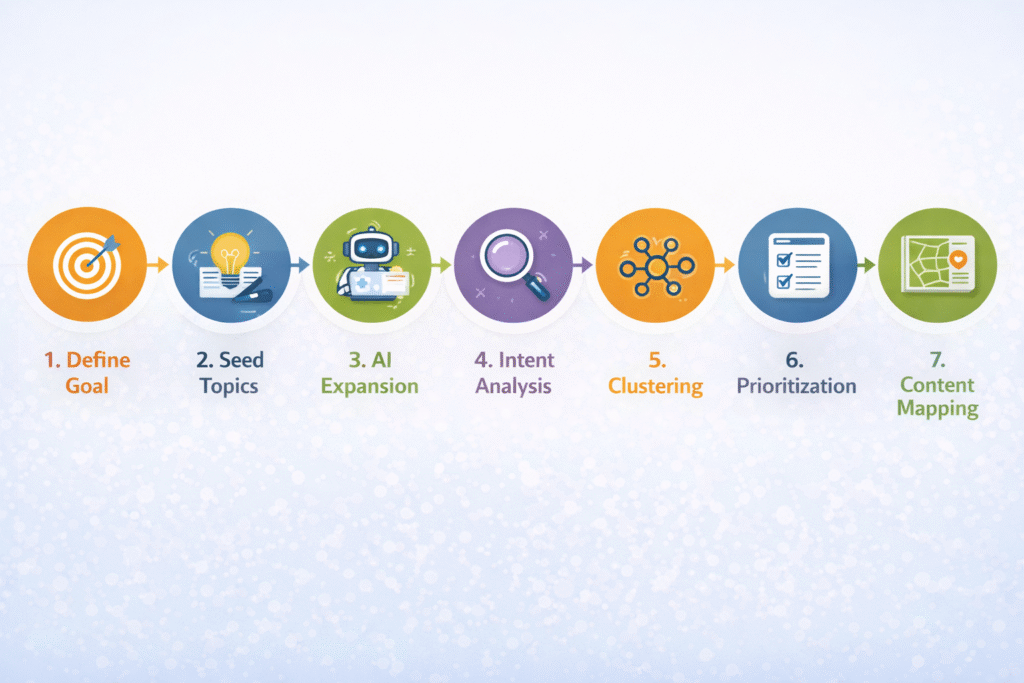
Each keyword cluster should be assigned to a specific type of page:
- Blog posts for informational queries
- Category pages for broad topics
- Product or service pages for transactional queries
- Comparison pages for commercial intent
This ensures your website has a clear, logical structure that both users and search engines can easily understand.
Best AI Tools for Keyword Research (When to Use What)
AI-powered keyword research tools are not all the same. Each tool is built with a different primary purpose — some are best for brainstorming, some for data validation, and others for full SEO workflow management.
For beginners, choosing the right tool can be confusing, which is why it is more useful to think in terms of use cases rather than features.
Instead of asking, “Which tool is the best?”, a better question is:
👉 “Which tool is best for my current stage of keyword research?”
In this section, we break AI tools into three practical categories based on workflow: idea generation, data validation, and hybrid AI + traditional stacks.
Idea Generation Tools (Brainstorming Phase)
At the beginning of your keyword research, your main goal is to discover possibilities, not to finalize decisions. AI tools in this phase are best for creativity, exploration, and expanding your thinking beyond obvious keywords.
These tools are particularly useful for:
- Generating long-tail keywords
- Finding question-based queries
- Expanding seed topics into subtopics
- Identifying conversational phrases that users might search
Strengths of Idea-Generation AI Tools
- Extremely fast brainstorming
- Great at uncovering non-obvious keywords
- Helps beginners think like search users
- Useful for content ideation, not just SEO
Limitations
- They do not always provide accurate search volume or difficulty data
- Suggestions must be validated with proper SEO tools
- May generate broad or vague ideas without prioritization
| Use Case | Best For | Not Ideal For | Beginner Friendliness |
| Brainstorming | Expanding topics quickly | Exact keyword metrics | Very high |
| Content ideas | Blog topics & questions | Competitive analysis | High |
| Conversational queries | Voice-style keywords | Ranking prediction | Medium |
How to use this stage in practice:
Start with 3–5 seed topics, let AI generate 50–100 keyword ideas, then move to the validation phase.
Data-Focused AI SEO Tools (Validation Phase)
Once you have a list of potential keywords, you need real data before making decisions. This is where AI-powered SEO platforms come into play — combining traditional metrics with intelligent analysis.
These tools help you:
- Check search volume
- Evaluate keyword difficulty
- Analyze competitor rankings
- Understand SERP features
- Identify content gaps
What AI Adds Here (Beyond Traditional Tools)
- Automated keyword clustering
- Intent-based grouping
- Competitor content summaries
- SERP pattern recognition
- Smarter prioritization suggestions
Instead of just showing raw numbers, AI helps interpret what the data actually means for your strategy.
| Use Case | Best For | Not Ideal For | Beginner Friendliness |
| Validation | Volume & difficulty | Pure brainstorming | Medium |
| Competitor research | SERP analysis | Creative ideation | Medium–High |
| Clustering | Topic mapping | One-off keyword checks | High |
Best practice:
Never rely on AI ideas alone — always confirm with data-focused SEO tools before publishing content.
AI + Traditional Tool Combo (Best Practice Stack)
The most effective keyword research workflow combines the strengths of both AI and traditional SEO tools. Instead of choosing one over the other, you use them together in a structured way.
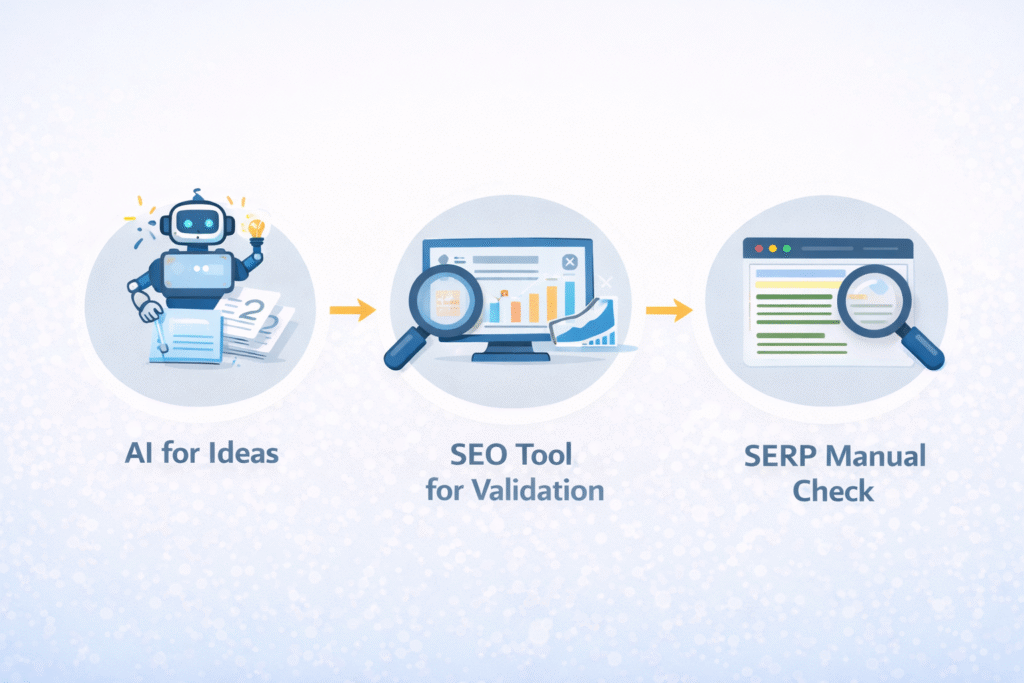
A recommended beginner-friendly workflow:
Step 1 — AI for Ideas (Creativity Stage)
- Use AI to generate broad keyword lists and questions
- Expand seed topics into subtopics
Step 2 — SEO Tool for Validation (Data Stage)
- Check search volume and difficulty
- Analyze SERP competition
- Filter out weak or irrelevant keywords
Step 3 — AI for Clustering (Organization Stage)
- Group keywords into meaningful topics
- Identify pillar pages and supporting content
Step 4 — Manual SERP Check (Final Review)
- Scan top-ranking pages
- Confirm search intent
- Adjust the content angle accordingly
| Stage | Tool Type | Purpose |
| Idea generation | AI brainstorming tools | Discover opportunities |
| Data validation | SEO platforms | Confirm viability |
| Clustering | AI analysis | Organize keywords |
| Final decision | Human review | Strategy & intent check |
This hybrid approach ensures you get the creativity of AI + reliability of data + wisdom of human judgment.
How to Choose the Right Tool as a Beginner
If you are just starting, ask yourself:
- Do I need ideas? → Use AI brainstorming tools first.
- Do I need data? → Use AI-powered SEO platforms.
- Do I need a full workflow? → Use a combination of both.
Over time, as you gain experience, you will naturally develop your own preferred tool stack.
Common Beginner Mistakes (and How AI Helps You Avoid Them)
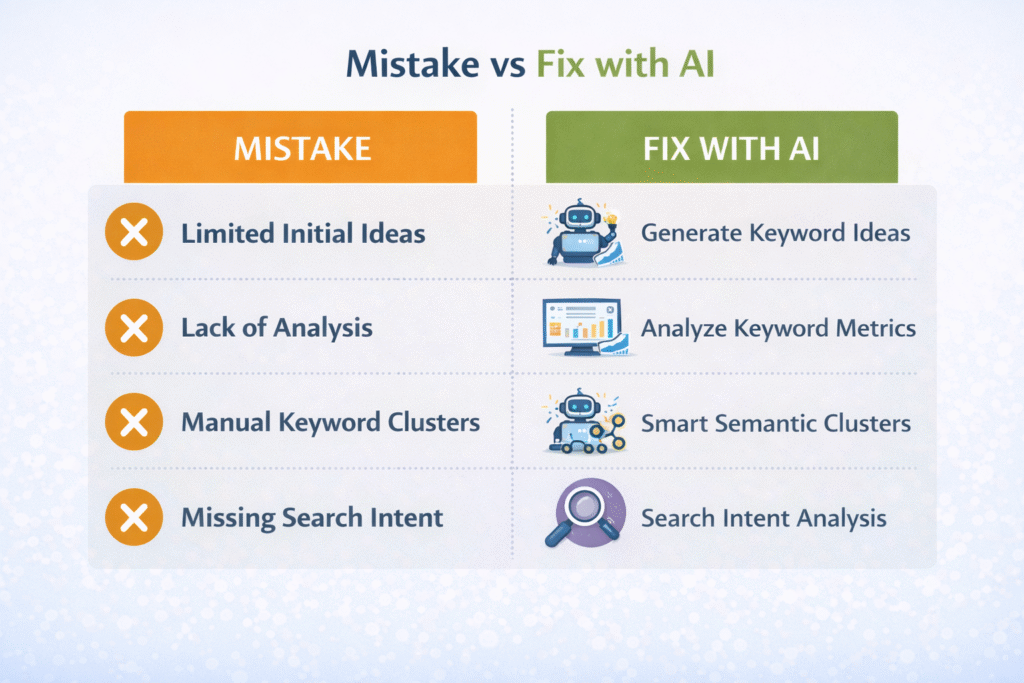
Beginners often struggle with keyword research not because they lack effort, but because they follow the wrong approach.
Many common mistakes come from focusing too much on tools, numbers, or shortcuts rather than strategy and intent. AI does not automatically prevent these errors, but when used correctly, it significantly reduces their likelihood.
This section highlights the most frequent keyword research mistakes beginners make — and how AI tools can help you correct them before they damage your SEO results.
Mistake 1 — Chasing High-Volume Keywords Only
One of the biggest beginner errors is assuming that higher search volume always means better results. Many new marketers target only high-volume keywords, ignoring competition level and user intent.
The problem with this approach is:
- High-volume keywords are usually highly competitive
- They often attract broad, informational traffic that doesn’t convert
- Beginners rarely have enough domain authority to rank for them
How AI helps:
AI tools can analyze thousands of keywords and highlight valuable long-tail opportunities that balance lower volume with stronger intent. Instead of chasing popularity, AI helps you prioritize relevance and business value.
Mistake 2 — Ignoring Search Intent
Another common mistake is choosing keywords without understanding what users actually want. For example, creating a blog post when the SERP clearly favors product pages — or vice versa.
This often leads to:
- Poor rankings
- High bounce rates
- Wasted content effort
How AI helps:
AI can summarize top-ranking pages, detect intent patterns, and group keywords based on user purpose. This makes it easier to align your content format (blog, comparison, product page, guide, etc.) with what Google already rewards.
Mistake 3 — Not Clustering Keywords (Keyword Cannibalization)
Beginners frequently create multiple pages targeting very similar keywords without realizing they are competing with themselves. This leads to keyword cannibalization, where your own pages weaken each other’s rankings.
Common signs of cannibalization include:
- Two or more pages ranking for the same keyword
- Fluctuating rankings
- Confusing content structure for search engines
How AI helps:
AI-powered clustering tools group semantically similar keywords into clear topics, helping you build one strong pillar page instead of multiple weak, overlapping ones. This improves internal linking, topical authority, and overall rankings.
Mistake 4 — Skipping SERP Analysis
Many beginners rely only on tools and skip manual SERP review, assuming that volume and difficulty metrics tell the full story. However, the SERP often reveals crucial insights such as:
- Preferred content format (listicles, videos, comparisons, guides)
- Dominant brands or websites
- Featured snippets and People Also Ask patterns
How AI helps:
AI can quickly summarize SERP results, identify common themes, and highlight what top-ranking pages are doing well — saving you time while still encouraging strategic review.
Mistake 5 — Overtrusting AI Outputs
AI is powerful, but it is not always correct. Beginners sometimes treat AI-generated keywords as final decisions without validation, which can lead to:
- Targeting irrelevant keywords
- Missing local or niche intent
- Publishing content that doesn’t match real user behavior
How AI helps (when used properly):
AI should be treated as a research assistant, not a decision-maker. Use it for brainstorming, clustering, and analysis — but always validate with real data and human judgment before publishing.
Mistake 6 — Focusing on Keywords Instead of Topics
Many beginners create content around individual keywords instead of broader topics, resulting in fragmented and shallow content.
This approach often leads to:
- Thin blog posts
- Weak topical authority
- Poor internal linking structure
How AI helps:
AI encourages topic-based thinking by identifying relationships between keywords and grouping them into clusters. This helps you create comprehensive pillar content that ranks for multiple related terms instead of just one keyword.
Mistake 7 — Not Aligning Keywords with Business Goals
Some beginners successfully generate traffic — but it doesn’t lead to leads or sales. This happens when keywords are not aligned with business objectives.
For example:
- A service business ranking for purely informational queries
- An eCommerce site targeting educational content instead of product keywords
How AI helps:
AI tools can help categorize keywords by intent (informational, commercial, transactional) so you can prioritize those that actually support your revenue or lead-generation goals.
From Mistakes to Smarter Keyword Research
Beginners often fail not because they lack tools, but because they lack the right approach. AI does not eliminate mistakes automatically — but it makes it much easier to avoid them when used strategically.
By using AI for:
- Intent analysis
- Keyword clustering
- SERP summarization
- Opportunity discovery
You can move from trial-and-error SEO to a more structured, data-backed, and results-driven keyword research process.
How to Measure the Success of AI-Based Keyword Research
Using AI for keyword research is only valuable if it leads to real, measurable SEO outcomes. Many beginners focus too much on the research process itself and fail to track whether their keyword strategy is actually working. Success is not about how many keywords you found — it is about how those keywords perform over time.
This section helps you understand what “success” looks like, which metrics truly matter, and how to evaluate whether your AI-assisted keyword research is delivering results.
What Success Really Means in Keyword Research
Before looking at metrics, it is important to define success clearly. Effective AI-based keyword research should lead to:
- More targeted organic traffic
- Better rankings for relevant keyword clusters
- Improved user engagement (lower bounce rate, higher time on page)
- Higher conversions from organic search
- Stronger content structure with fewer internal conflicts
If your keyword research is working, you should see steady, predictable improvements rather than random ranking spikes.
Key Metrics to Track (What Actually Matters)
1. Keyword Rankings (Cluster-Level, Not Single Keywords)
Instead of tracking individual keywords, measure performance at the topic or cluster level. This gives a more accurate picture of your progress.
Look for:
- More keywords from each cluster ranking in the top 10
- Growth in the top 3 rankings over time
- Reduced volatility in rankings
A well-structured AI-based keyword strategy should gradually increase your visibility across entire topics, not just isolated terms.
2. Organic Traffic Growth
One of the clearest indicators of success is an increase in organic traffic to your targeted pages.
Track:
- Overall organic traffic trend
- Traffic growth for newly optimized or published pages
- Traffic distribution across content clusters
If AI helped you identify better keywords, your pages should attract more relevant visitors over time.
3. Click-Through Rate (CTR) from SERPs
Ranking is important, but clicks matter even more. If your content matches search intent well, users are more likely to click your result.
Industry studies consistently show that pages in the top 3 positions capture roughly 55–60% of total clicks on a typical SERP. If your AI-driven keyword targeting is accurate, you should see:
- Higher CTR for your top-ranking pages
- Better performance for queries with strong intent
If your rankings are good but CTR is low, it may indicate a mismatch between keyword intent and your content or meta tags.
4. Conversions from Organic Search
Traffic alone does not equal success — especially for businesses. The real test of keyword research quality is whether it drives leads or sales.
Measure:
- Leads generated from organic pages
- Product purchases attributed to organic search
- Conversion rate improvements after keyword optimization
AI-based research should help you prioritize high-intent keywords that bring users closer to taking action.
5. Reduction in Keyword Cannibalization
One hidden benefit of AI-powered keyword clustering is improved site structure. Over time, you should notice:
- Fewer pages competing for the same keywords
- More stable rankings
- Clearer internal linking patterns
- Stronger performance for pillar pages
If your AI workflow included clustering, you should see fewer conflicts in Search Console over time.
Before vs. After: How to Compare Results
| KPI | Baseline (Before AI) | After 90 Days | Improvement |
| Top 10 Keywords | 25 | 60 | +140% |
| Organic Traffic | 10,000 | 16,500 | +65% |
| Avg. CTR | 2.8% | 4.1% | +1.3 pts |
| Leads from SEO | 40 | 85 | +112% |
| Cannibalization Issues | 12 pages | 3 pages | -75% |
How Long Does It Take to See Results?
SEO is not instant, even with AI. A realistic timeline is:
- 0–30 days: Content publishing, indexing, early ranking movement
- 30–60 days: Noticeable ranking improvements for some keywords
- 60–90 days: Clear traffic and performance impact
If you do not see any progress after 90 days, it usually indicates issues with content quality, intent alignment, or competition level — not the keyword research itself.
Common Reasons AI-Based Research Fails (And How to Fix Them)
- Problem: Great keywords, weak content
Fix: Improve the depth, structure, and usefulness of your pages - Problem: Good content, wrong intent
Fix: Revisit SERP analysis and adjust format - Problem: Too much competition
Fix: Shift focus to long-tail or niche keywords - Problem: Poor internal linking
Fix: Strengthen pillar-cluster connections
Measuring What Matters
AI makes keyword research faster and smarter, but success ultimately depends on execution. The best way to evaluate your strategy is not by how many keywords you generated, but by how those keywords perform in the real world.
If your rankings, traffic, CTR, and conversions are improving, your AI-based keyword research is working.
AI Keyword Research Workflow (Beginner Template)
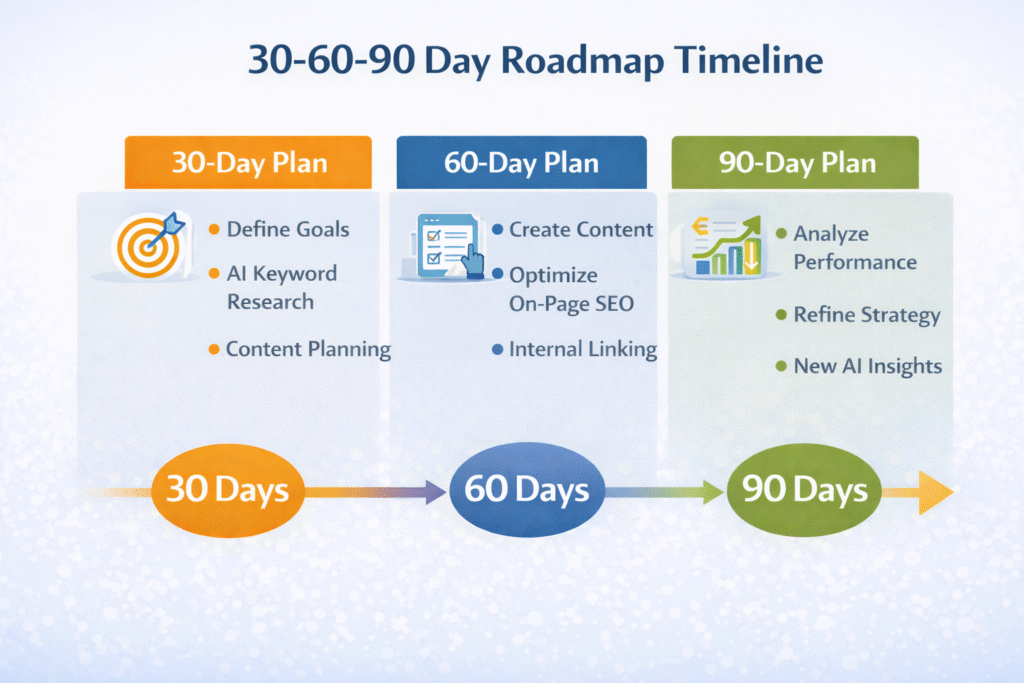
Having a clear workflow is what separates random keyword research from a structured, results-driven SEO strategy. Beginners often jump between tools, collect endless keyword lists, and still struggle to turn their research into actual content. This template gives you a simple, repeatable process that you can follow every time you plan new content — whether you are working on a blog, a website, or a client project.
Think of this as a practical 30–60–90-day roadmap that blends AI assistance with strategic decision-making. It is designed to be realistic, manageable, and effective for beginners.
Week 1: Topic Research + AI Brainstorming (Foundation Phase)
The first week is all about understanding your niche and generating possibilities — not making final decisions.
Your goals in Week 1:
- Identify 5–8 core seed topics related to your business
- Understand your audience’s main problems and questions
- Use AI to expand each topic into a broad list of keyword ideas
What to do step-by-step:
- List your main topics (e.g., SEO, Google Ads, Content Marketing, etc.)
- Use AI tools to generate:
- Long-tail keywords
- Question-based queries
- Related subtopics
- Long-tail keywords
- Collect all ideas in one document or spreadsheet — don’t filter yet
At this stage, your focus should be creativity and exploration, not accuracy or prioritization.
Week 2: Clustering + Prioritization (Organization Phase)
Now you move from ideas to structure. This is where AI becomes especially useful for beginners.
Your goals in Week 2:
- Group related keywords into clear clusters
- Identify your main pillar topics
- Decide which keywords deserve priority
What to do step-by-step:
- Use AI or SEO tools to cluster keywords based on intent and meaning
- Label each cluster with a clear topic name
- Evaluate each cluster based on:
- Search volume
- Keyword difficulty
- Business relevance
- Search volume
- Select your top 3–5 clusters to focus on first
By the end of Week 2, you should have a well-organized keyword map instead of a messy list.
Week 3: Content Mapping (Planning Phase)
This is where keyword research turns into a real content strategy.
Your goals in Week 3:
- Assign keywords to specific pages
- Decide your content architecture
- Plan internal linking structure
What to do step-by-step:
- Choose one main keyword for each cluster as your pillar topic
- Map supporting keywords to:
- Blog posts
- Comparison articles
- Service pages
- Product pages
- Blog posts
- Design a pillar-cluster model:
- One comprehensive pillar page
- Multiple supporting cluster pages linking back to it
- One comprehensive pillar page
At the end of this phase, you should have a clear content plan with titles and target keywords for each page.
Weeks 4–6: Publishing + Tracking (Execution Phase)
Research is useless if you don’t execute. The final phase focuses on content creation and performance monitoring.
Your goals in Weeks 4–6:
- Publish high-quality, intent-aligned content
- Monitor rankings and traffic
- Refine your strategy based on data
What to do step-by-step:
- Create content for your top-priority clusters first
- Optimize on-page SEO (title, headings, meta description, internal links)
- Track performance using:
- Google Search Console
- Analytics tools
- Rank tracking software
- Google Search Console
- Adjust your approach if:
- Rankings are not improving
- CTR is low
- Traffic is not growing
- Rankings are not improving
SEO is iterative — use AI again to refine keywords, improve content, or discover new opportunities as you learn from results.
Simple Workflow Recap (Beginner Checklist)
| Phase | What You Do | Role of AI |
| Week 1 | Generate ideas | Expands topics & keywords |
| Week 2 | Cluster & prioritize | Organizes by intent |
| Week 3 | Map to content | Suggests structure |
| Weeks 4–6 | Publish & track | Helps refine strategy |
How to Use This Template in Real Life
If you are a beginner, follow this exactly for your first project. Once you gain confidence, you can:
- Shorten timelines
- Use more advanced tools
- Add competitor analysis
- Create larger content clusters
The core principle remains the same: research → organize → execute → measure → improve.
Ethical & Practical Considerations When Using AI for SEO
AI has made keyword research faster, smarter, and more accessible — but with this power comes responsibility. Beginners often focus only on results and overlook the ethical and practical implications of using AI in SEO. However, how you use AI matters just as much as what you achieve with it.
This section is not about limiting your use of AI, but about using it responsibly, transparently, and effectively so your SEO strategy remains sustainable, credible, and compliant with best practices.
Transparency in AI-Assisted Workflows
One of the biggest ethical questions in modern content marketing is transparency. While you don’t need to publicly announce every AI tool you use, it is important to be honest — at least internally — about how much of your research and content is AI-assisted.
From an SEO perspective, transparency matters because:
- It keeps your process accountable
- It prevents over-reliance on automation
- It encourages human review and quality control
A good rule of thumb is:
Use AI for research, structure, and analysis — but let humans own strategy, interpretation, and final decisions.
Avoiding AI Hallucinations and Misinformation
AI tools are powerful, but they are not always accurate. They can sometimes:
- Invent keyword metrics
- Misinterpret search intent
- Suggest irrelevant or outdated terms
- Make confident but incorrect assumptions
For this reason, you should always validate AI-generated keyword ideas using real SEO data and SERP analysis. Treat AI as a smart assistant — not a source of truth.
Practical safeguards:
- Cross-check AI suggestions with SEO tools
- Manually review SERPs for high-priority keywords
- Avoid blindly accepting AI clustering without review
Data Privacy and Tool Usage
Many AI tools process large amounts of data, and some may require you to input website content, competitor URLs, or keyword lists. Beginners should be mindful of:
- What data they are sharing with AI platforms
- Whether tools store or reuse submitted data
- Company policies around third-party tools (for agencies or businesses)
If you are working with clients or sensitive business data, always:
- Use reputable, well-known AI tools
- Read privacy policies before uploading data
- Avoid sharing confidential or proprietary information unnecessarily
Balancing Automation with Human Creativity
A common mistake is letting AI take over too much of the process. While AI can generate ideas and structure data efficiently, it cannot replace:
- Original insights
- Industry expertise
- Brand voice
- Storytelling and editorial judgment
Over-automation can lead to:
- Generic content
- Weak differentiation from competitors
- Lack of depth or originality
The best approach is a hybrid one:
- Let AI handle heavy data work
- Let humans handle creativity, strategy, and quality
Avoiding Manipulative or Spammy Practices
AI makes it easier than ever to generate large volumes of keywords and content — but that does not mean you should flood your site with low-quality pages.
Unethical or risky practices to avoid:
- Creating thin, AI-generated pages purely for rankings
- Keyword stuffing based on AI suggestions
- Publishing content without human editing
- Spamming search engines with low-value posts
Google’s systems are increasingly good at detecting low-quality, mass-produced content. Sustainable SEO still requires useful, well-researched, and genuinely helpful pages.
Responsible Use of AI in Competitive Analysis
AI can analyze competitors’ content and identify gaps — but this should be used for inspiration, not imitation.
Ethical approach:
- Learn from competitor strengths
- Identify what they missed
- Create better, more original content
Unethical approach to avoid:
- Copying structure too closely
- Replicating content ideas without adding value
- Using AI to rewrite competitors’ work superficially
Your goal should always be to improve the user experience, not just outrank others.
Keeping Humans in the Loop (Final Decision-Making)
No matter how advanced AI becomes, the final responsibility for SEO decisions should always rest with a human.
A healthy AI + human workflow looks like this:
- AI generates ideas and analysis
- Human reviews, questions, and refines
- AI helps organize and structure
- Human makes final strategic choices
This ensures your keyword research remains both efficient and thoughtful.
Ethical AI = Better SEO
When used responsibly, AI makes keyword research smarter, faster, and more accessible — especially for beginners. But the most successful marketers are not those who use AI the most, but those who use it wisely.
If you:
- Validate AI outputs
- Protect your data
- Maintain human oversight
- Prioritize quality over shortcuts
You will build an SEO strategy that is not only effective today but also sustainable for the future.
What are the best AI tools for keyword research for beginners?
For beginners, the best AI tools are those that balance ease of use with actionable insights. Ideal options include AI-powered SEO platforms that offer keyword ideas, intent analysis, and clustering in simple dashboards. Beginners should start with tools that provide guided workflows rather than complex data tables. Over time, they can graduate to more advanced tools with deeper analytics and competitor tracking.
Can AI replace traditional keyword research?
No — AI cannot completely replace traditional keyword research. It is best used as an intelligent assistant that enhances speed, accuracy, and idea generation. Traditional elements like manual SERP analysis, business judgment, and strategic decision-making are still essential for successful SEO.
How accurate are AI keyword suggestions?
AI keyword suggestions are generally good for brainstorming and discovering new ideas, but they are not always 100% accurate in terms of search volume, competition, or intent. They should always be validated using reliable SEO tools and real SERP analysis before finalizing your strategy.
Is AI keyword research good for local SEO?
Yes, AI can be very helpful for local SEO, especially for generating location-based long-tail keywords and understanding user intent. However, local intent must still be manually verified using local SERPs, Google Business Profile insights, and region-specific search trends.
How do I find low-competition keywords with AI?
AI can help generate long-tail and niche keyword variations that typically have lower competition. You should then filter these suggestions using keyword difficulty metrics from SEO tools and analyze SERPs to confirm that smaller or newer websites are ranking.
Can AI help with search intent analysis?
Yes, AI is particularly strong at identifying search intent patterns. It can summarize top-ranking pages, categorize queries by intent (informational, commercial, transactional), and highlight common content formats that Google favors for specific keywords.
How long does AI keyword research take?
Using AI, initial keyword research typically takes 2–4 hours, compared to several days using purely manual methods. However, final validation, clustering, and content planning may take additional time depending on project complexity.
Does AI keyword research work for niche industries?
Yes, AI can be highly effective in niche industries, especially for discovering long-tail queries and user questions that traditional tools might miss. However, domain expertise is still required to filter and interpret AI-generated ideas correctly.
Should I trust AI keyword volume estimates?
AI-generated volume estimates should be treated as directional, not definitive. Always cross-check them with reliable SEO tools like Google Search Console, keyword planners, or professional SEO platforms before making decisions.
How often should I redo keyword research with AI?
A good practice is to revisit your keyword research every 3–6 months, or sooner if there is a major Google update, a shift in your business focus, or noticeable changes in rankings and traffic.

Founder at Digital Marketing Marvel | Founder at RKDMT – Raju Kumar Digital Marketing Trainer | Best Digital Marketing Trainer in Delhi/NCR – Digiperform | Project Manager | 5+ years | Genius Study Abroad & Inlingua’s Digital Marketing Head | Learn Digital Marketing