


AI Tools for Google Ads Copy Every Beginner Needs
Digital advertising has entered a phase where speed, scale, and efficiency are no longer advantages—they are requirements. As competition in paid search intensifies and cost per click continues to rise across industries, marketers are under pressure to produce more ad variations, test faster, and improve performance without proportionally increasing workload or budget. This is where AI tools for Google Ads copy are rapidly moving from experimental to essential.
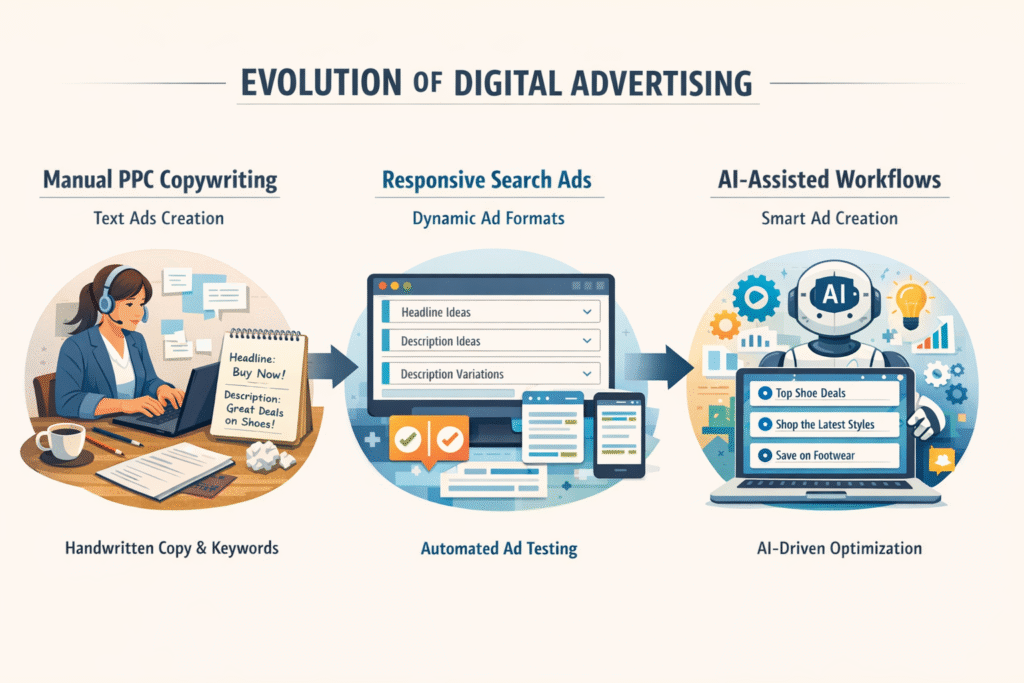
The urgency is driven largely by economics. In many sectors, paid acquisition costs have steadily increased over the past few years, forcing advertisers to extract more performance from every impression. At the same time, Google’s own ad ecosystem has evolved toward automation-first formats like Responsive Search Ads (RSAs), which reward advertisers who can supply a large pool of high-quality copy variations. According to Google, responsive search ads can deliver up to a 10% increase in clicks compared to legacy expanded text ads when properly implemented. That performance delta is significant in competitive auctions.
Parallel to this shift, generative AI has exploded across marketing workflows. McKinsey’s 2023 analysis estimates that generative AI could contribute between $2.6 trillion and $4.4 trillion annually to the global economy, with marketing and sales among the most immediately impacted functions. Adoption data reinforces the momentum: Statista projects the global AI market will surpass $300 billion by 2026, reflecting aggressive enterprise and SMB uptake.
Google Ads copy is particularly well-suited for AI assistance because of its structured nature. Search ads operate within tight character limits, repeatable formats, and clear intent signals derived from keywords. Unlike long-form brand storytelling, PPC copywriting often involves generating and testing many concise variations that follow proven persuasive patterns. This makes it an ideal environment for machine-assisted drafting and iteration.
However, the strategic reality must be clear from the outset. AI is not a replacement for marketing judgment, positioning strategy, or compliance oversight. It is a performance lever that amplifies execution speed and testing capacity.
If you’re new to automation tools, understanding how AI in digital marketing works can help you see how platforms analyze user behavior and optimize campaigns automatically.
Advertisers who treat AI as a blind automation layer often produce generic or policy-risky ads. Those who integrate it into a disciplined workflow—combining structured prompts, human editing, and ongoing optimization—tend to see the strongest gains.
What Are AI Tools for Google Ads Copy?
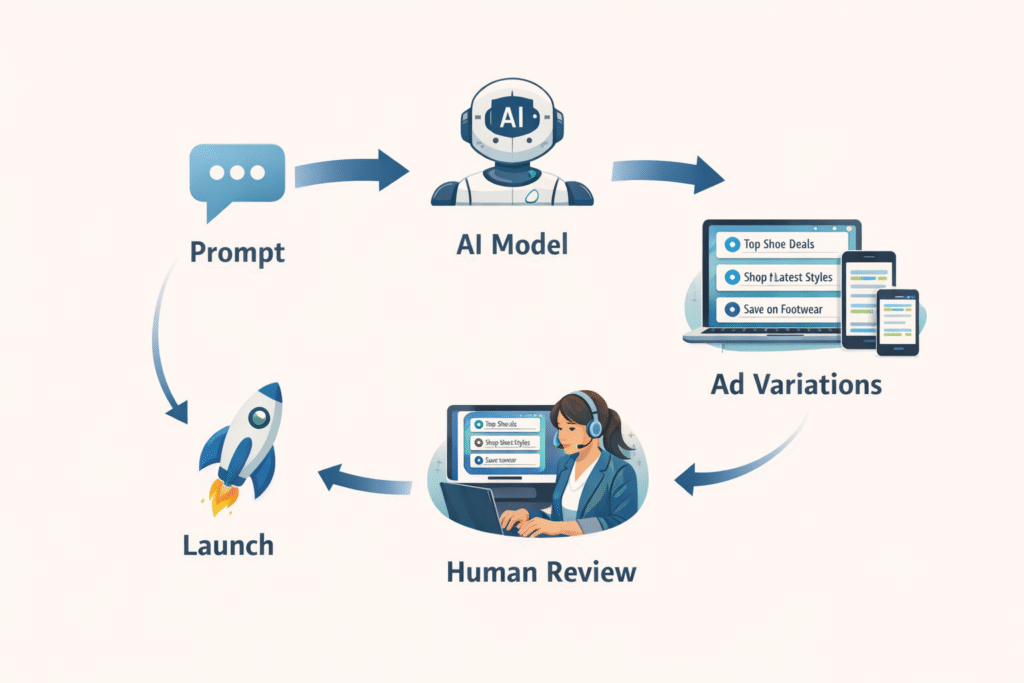
AI tools for google ads copy are software applications that use artificial intelligence to generate, improve, and scale advertising text specifically for Google Ads campaigns. Instead of writing every headline and description manually, advertisers provide inputs such as keywords, audience details, and campaign goals, and the AI produces multiple ad variations in seconds.
In the PPC (pay-per-click) context, these tools are designed to support performance marketing workflows. Their purpose is not just to “write nicely,” but to help marketers create relevant, testable, and policy-compliant ad copy that aligns with search intent and campaign objectives. Before generating ad copy with AI, you must first choose the right keyword for Google Ads campaigns, because keywords determine who sees your ads and why they click.
It is important to distinguish between general AI writing tools and PPC-specialized AI platforms. General AI writers are built for broad content creation, such as blogs, emails, or social posts. They can generate ad copy, but they often lack built-in structures for Google Ads formats, character limits, and keyword logic. PPC-focused tools, on the other hand, are optimized for ad platforms. They typically include features like responsive search ad formatting, bulk variant generation, keyword alignment, and sometimes performance insights tailored to paid advertising.
Modern AI tools for Google Ads copy typically offer several core capabilities. The most basic function is headline generation, where the system produces multiple headline options aligned with your keyword and offer. Closely related is description variant creation, which helps advertisers quickly build multiple combinations for responsive search ads.
Many tools also support keyword insertion, allowing dynamic or manual placement of target search terms to improve ad relevance. Tone adaptation is another common feature, enabling marketers to adjust the voice of the ad—whether professional, urgent, friendly, or premium—so it matches brand positioning.
More advanced platforms include early forms of performance prediction, where the system estimates which variations may perform better based on historical patterns, though these predictions should always be treated as directional, not definitive.
How AI Generates High-Converting Ad Copy
AI systems generate ad copy using natural language processing (NLP) and large language models (LLMs). NLP is the field of AI that enables machines to understand and produce human language. Large language models are trained on massive text datasets so they can recognize patterns in wording, structure, and persuasion techniques.
During training, these models analyze enormous volumes of text from across the web and licensed datasets. Through this process, they learn which phrasing patterns tend to be associated with clarity, relevance, and engagement. When you provide a prompt—such as a keyword, audience, and offer—the AI predicts the most statistically appropriate next words to form coherent ad variations.
For Google Ads specifically, AI tools identify structural patterns commonly found in high-performing ads. These include benefit-driven headlines, urgency cues, keyword alignment, and clear calls to action. The model recombines these learned patterns to generate new variations at scale.
However, the technology has real limitations. AI can sometimes produce hallucinations, meaning it may generate claims, features, or details that are not factually accurate. This creates compliance risk in regulated industries or when strict Google Ads policies apply. AI also lacks true business context and brand judgment, which means human review remains essential before launching any campaign.
Why Advertisers Are Rapidly Adopting AI for Google Ads
AI tools for Google Ads copy are being adopted quickly because they directly address the biggest pain points in paid search: speed, scale, testing velocity, and resource efficiency. As ad platforms reward advertisers who can supply more relevant variations and iterate faster, manual copy workflows are increasingly becoming a bottleneck.
The performance case is supported by industry data. WordStream studies have shown that active A/B testing can lift click-through rate (CTR) by 20–30%, but maintaining that testing cadence manually is resource-intensive. Google has also indicated that advertisers who lean into automation features often see improved conversion efficiency. Meanwhile, HubSpot reports that 64% of marketers are already using AI in some form, signaling that adoption is moving into the mainstream rather than remaining experimental.
Below is a production-focused comparison that highlights why AI-assisted workflows are gaining momentum.
Manual vs AI-Assisted Copy Production Time Comparison
| Production Factor | Manual Copywriting Workflow | AI-Assisted Workflow | Strategic Impact |
| Time to produce 10 headlines | 25–40 minutes | 2–5 minutes | Faster iteration cycles |
| Time to produce 50 ad variants | 3–5 hours | 10–20 minutes | Enables large-scale testing |
| Ability to support RSAs fully | Often limited by time | Easily generates full asset sets | Improves ad strength potential |
| A/B testing frequency | Weekly or less | Daily or on-demand | Higher CTR improvement potential |
| Scaling across multiple ad groups | Labor-intensive | Highly scalable | Supports account growth |
| Consistency of messaging | Depends on writer bandwidth | More standardized baseline | Easier brand control (with review) |
| Cost efficiency for small teams | Requires more human hours | Reduces production workload | Better ROI on lean teams |
| Speed of optimization cycles | Slow feedback loop | Rapid refresh capability | Faster performance gains |
Where AI Delivers the Biggest Performance Gains
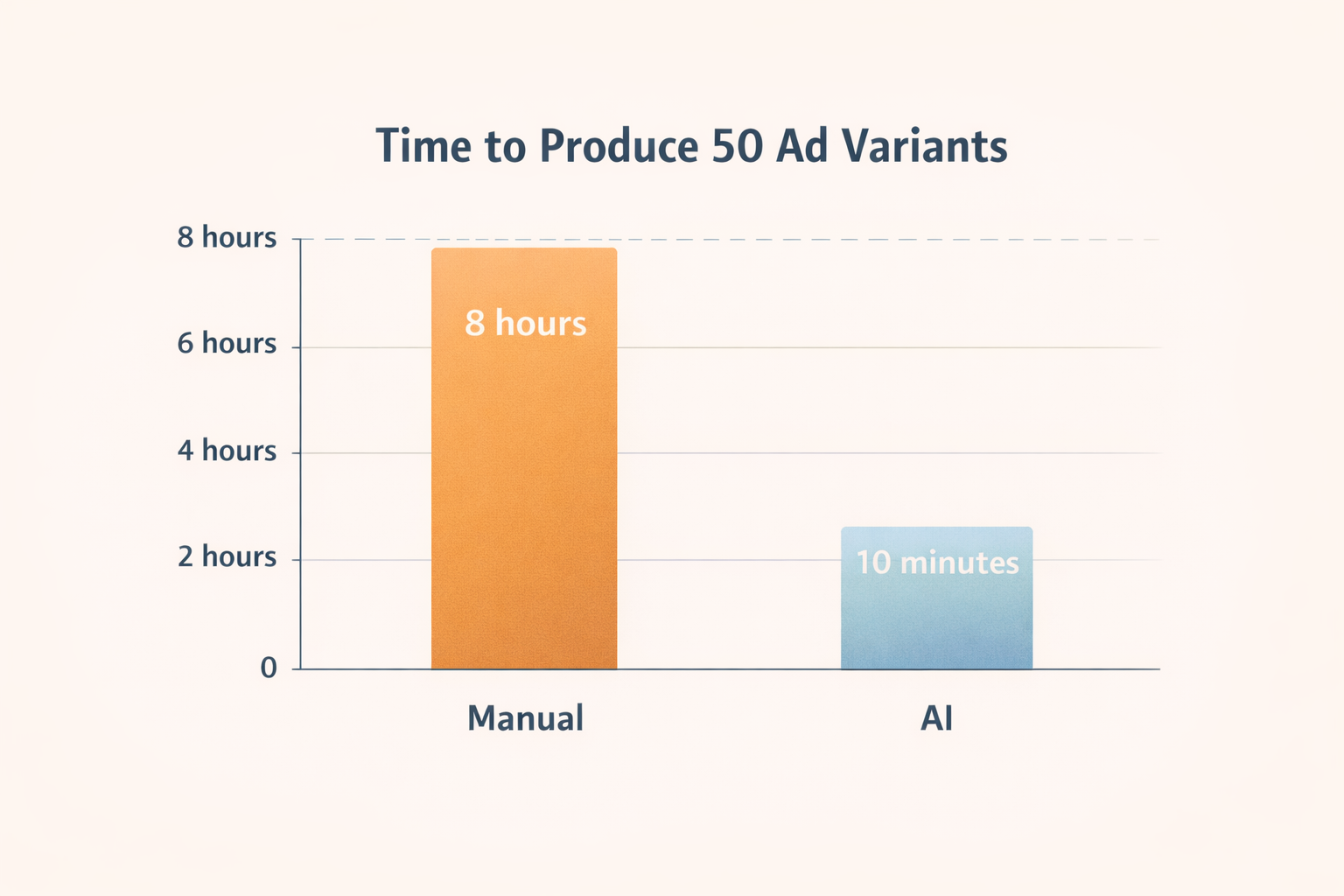
AI impact is not uniform across all campaign types. Performance improvements tend to be strongest in environments that reward high variation volume and rapid testing.
Responsive Search Ads (RSAs)
RSAs benefit heavily because Google’s system mixes and matches multiple headlines and descriptions. AI makes it practical to generate the recommended volume of assets, increasing the likelihood of stronger combinations and improved CTR.
Performance Max campaigns
These campaigns rely on diverse creative inputs across placements. AI helps marketers quickly produce multiple text variations that feed Google’s automation engine, improving coverage and learning speed.
High-volume ecommerce accounts
Retail advertisers managing hundreds or thousands of products gain outsized efficiency benefits. AI enables rapid generation of product-focused headlines and descriptions at scale, something that is difficult to sustain manually.
Lead generation funnels
Service businesses and B2B advertisers see gains when AI is used to produce and test multiple value propositions. Faster iteration helps identify which messaging angles convert best at different funnel stages.
Keyword placement note for writers:
Ensure the primary keyword appears naturally in the opening paragraph of this section and is not forced elsewhere.
Best AI Tools for Google Ads Copy in 2025
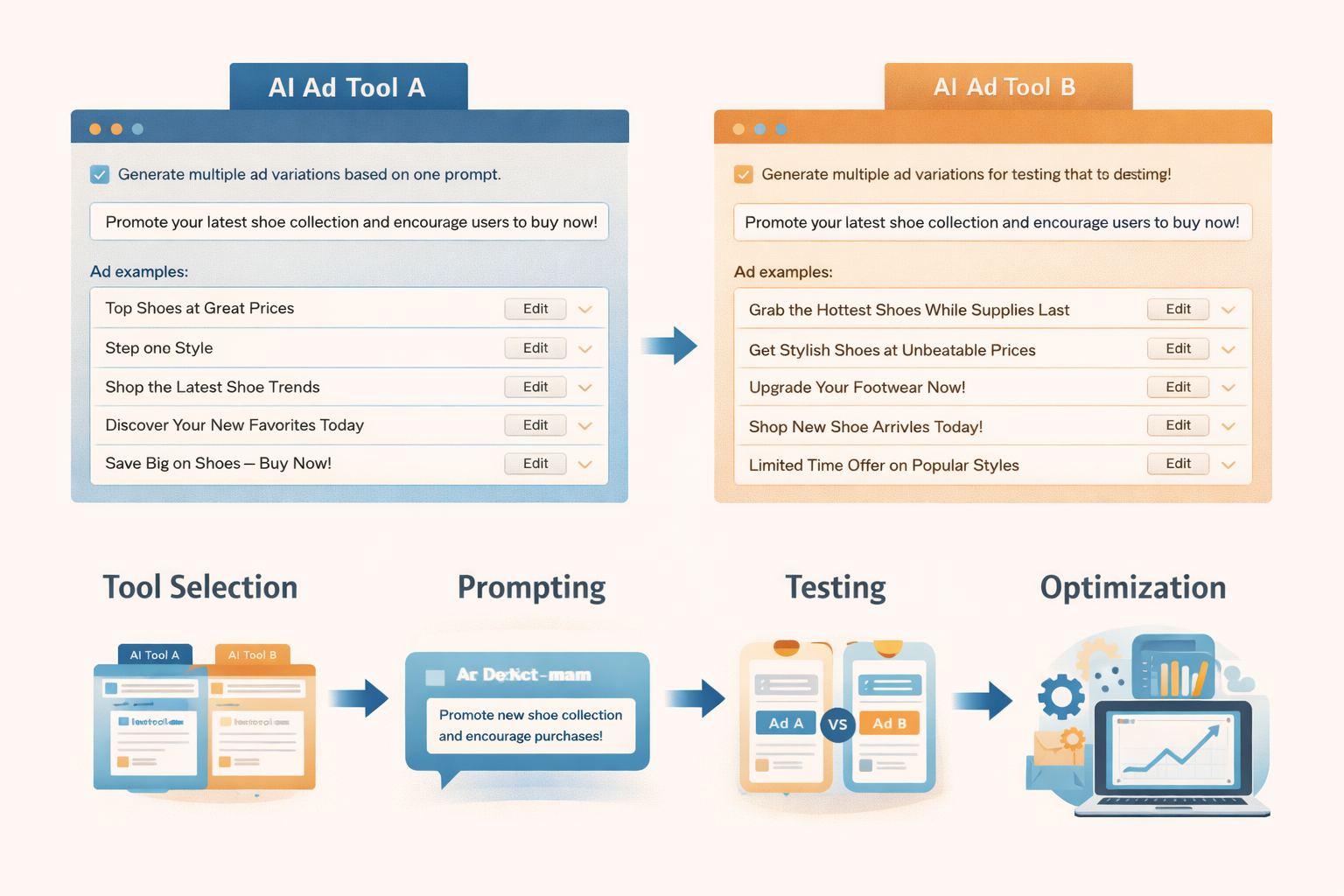
Today’s advertisers are not adopting AI because it is trendy—they are adopting it because the math of paid search demands more speed, more testing, and more variation than manual workflows can realistically sustain. The best AI tools for google ads copy help marketers generate structured ad variations quickly while still allowing human control over strategy and compliance.
Not all AI writers are equally useful for PPC. Some are general-purpose text generators, while others are more marketing-aware. Choosing the right tool depends less on hype and more on how well the platform fits your workflow, budget, and campaign complexity.
Evaluation Criteria
Before comparing tools, readers should understand what actually matters in a Google Ads environment.
Google Ads specificity refers to whether the tool understands ad structure, including headline limits, description length, and responsive search ad formatting. Tools that ignore these constraints create extra editing work.
Output quality and relevance matters more than sheer creativity. High-performing ads are clear, intent-matched, and benefit-driven. The tool should consistently produce usable first drafts, not just clever wording.
Customization depth determines how well you can control tone, audience targeting, keyword placement, and offer framing. Advanced users benefit from tools that allow detailed prompt control.
Compliance and safety controls become critical in regulated industries such as finance, healthcare, and education. Some platforms provide guardrails or brand memory features that reduce risk.
Pricing versus production needs should be evaluated realistically. A cheaper tool that requires heavy manual cleanup can become more expensive in labor than a premium tool that produces cleaner outputs.
Top AI Tools Overview
The following tools are widely used by marketers. Each serves a slightly different type of user.
ChatGPT is best suited for marketers who want maximum flexibility. It works extremely well when the user knows how to write structured prompts. Its major strength is adaptability—you can generate headlines, descriptions, testing angles, and even full testing frameworks. The trade-off is that it does not automatically format outputs for Google Ads, so users must guide it carefully. It is ideal for performance marketers and agencies comfortable with hands-on prompting.
Jasper maintains consistency across campaigns. Teams managing multiple clients often appreciate these controls. However, the outputs may still need tightening to fit strict PPC character limits, and the pricing can be high for solo advertisers. It fits best in agency or mid-sized marketing teams.
Copy.ai is generally the most beginner-friendly option. Its interface is simple and fast, making it attractive for small businesses that need quick ad drafts. The trade-off is depth. Without strong input guidance, the copy can become generic. It works well for early-stage advertisers but may feel limiting for advanced PPC teams.
Feature Comparison Table
| Feature | ChatGPT | Jasper | Copy.ai |
| Google Ads format awareness | Medium (depends on prompt) | Medium | Basic |
| Customization flexibility | Very high | High | Medium |
| Brand voice controls | Limited/manual | Strong | Moderate |
| Bulk variant generation | Manual but flexible | Moderate | Moderate |
| Beginner ease of use | Medium | Medium | High |
| Best fit | Advanced marketers | Agencies | Small businesses |
| Cost efficiency at scale | High | Moderate | Moderate |
Step-by-Step: How to Use AI to Write Google Ads Copy
This section should walk beginners through a safe, repeatable workflow. The goal is not just speed, but controlled performance. When used correctly, AI tools for google ads copy can dramatically increase testing velocity without sacrificing ad quality—but only if the inputs and review process are disciplined.
Step 1 — Define Campaign Goal and Audience
Every strong AI output starts with strong inputs. If the campaign objective and audience are vague, the generated ad copy will also be vague. Before opening any AI tool, clearly define what the campaign is trying to achieve and who the message is for.
Writers should emphasize the importance of mapping the funnel stage. A top-of-funnel awareness campaign requires curiosity-driven messaging, while bottom-of-funnel search campaigns need direct, intent-matching language. Misalignment here is one of the most common beginner mistakes.
Search intent must also be identified early. Is the user researching, comparing, or ready to buy? AI performs significantly better when the prompt includes intent signals such as “high-intent buyers,” “local service seekers,” or “price-sensitive shoppers.” This context helps the model produce copy that mirrors real query behavior.
Step 2 — Craft High-Quality Prompts
Prompt quality is the single biggest performance lever when using AI for PPC. The tool is only as effective as the instructions it receives.
The outline should guide writers to include a clear prompt structure framework. At minimum, strong prompts typically contain:
- Target keyword
- Audience description
- Offer or value proposition
- Desired tone
- Any compliance constraints
- Required format (e.g., RSA headlines)
The section should also contrast good vs. bad prompts. For example, a weak prompt like “write Google ad for gym” produces generic output, while a structured prompt specifying audience, location, offer, and tone produces far more usable copy.
Tone and compliance instructions are especially important in regulated industries. Writers should stress adding guardrails such as “avoid unrealistic claims” or “follow Google Ads policies.”
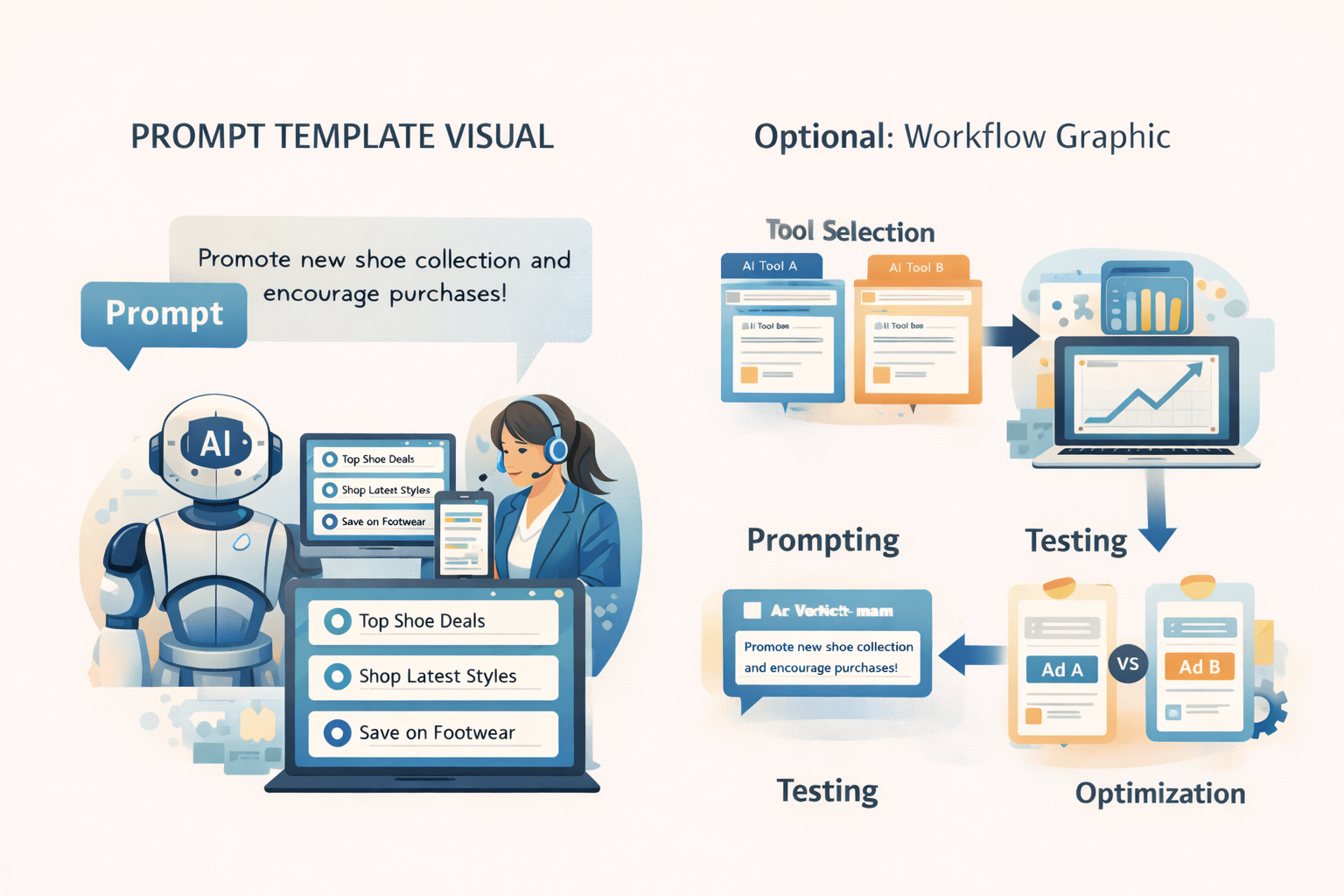
Step 3 — Generate Multiple Variations
Google Ads performance improves when the system has more high-quality assets to test. AI’s biggest advantage is its ability to produce variation at scale.
Explain clearly why volume matters for Responsive Search Ads. Google’s machine learning system mixes and matches headlines and descriptions to find the best-performing combinations. Advertisers who provide too few variations limit the algorithm’s optimization ability.
Include Google’s recommendation: Responsive Search Ads should ideally include up to 15 headlines and 4 descriptions. AI makes reaching this volume practical in minutes rather than hours.
Writers should also note that variation quality matters more than raw quantity. Slight wording changes, different value propositions, and multiple emotional angles typically outperform repetitive phrasing.
Step 4 — Human Editing and Compliance Check
This is the critical safety layer. AI-generated copy should never be launched without human review.
The section should instruct writers to emphasize three review passes:
Policy review
Ensure the copy complies with Google Ads policies. Watch for prohibited claims, misleading language, or restricted category issues.
Brand voice alignment
AI drafts often sound generic. Editors should tighten language to match the brand’s tone, positioning, and differentiation.
Avoiding exaggerated claims
AI sometimes over-promises (“best,” “#1,” “guaranteed results”). These can create both compliance and credibility risks. Human editors must moderate these statements.
The tone of this section should reinforce that human oversight is a performance advantage, not a bottleneck.
Step 5 — Launch, Test, and Optimize
Once ads are live, the workflow shifts from creation to measurement. This step should reinforce that AI accelerates testing, but data determines winners.
Writers should explain a practical A/B testing cadence. For most accounts, reviewing performance every 1–2 weeks provides enough data to make informed adjustments without reacting to noise.
Key performance metrics to monitor:
- Click-through rate (CTR): Measures message relevance
- Conversion rate: Measures landing page and offer alignment
- Quality Score: Indicates expected ad relevance and efficiency
Encourage readers to continuously refresh underperforming assets using AI rather than waiting for full campaign rewrites.
AI Draft vs Human-Optimized Version
| Element | Raw AI Output | Human-Optimized Version | Why It Performs Better |
| Headline clarity | Generic benefit | Specific, intent-matched benefit | Improves CTR |
| Keyword usage | Present but awkward | Naturally integrated | Improves relevance |
| Tone | Neutral/generic | Brand-aligned | Builds trust |
| Compliance | Risk of overclaim | Policy-safe wording | Reduces disapprovals |
| Call to action | Basic | Urgency-driven | Improves conversions |
Prompt Templates That Actually Work for Google Ads
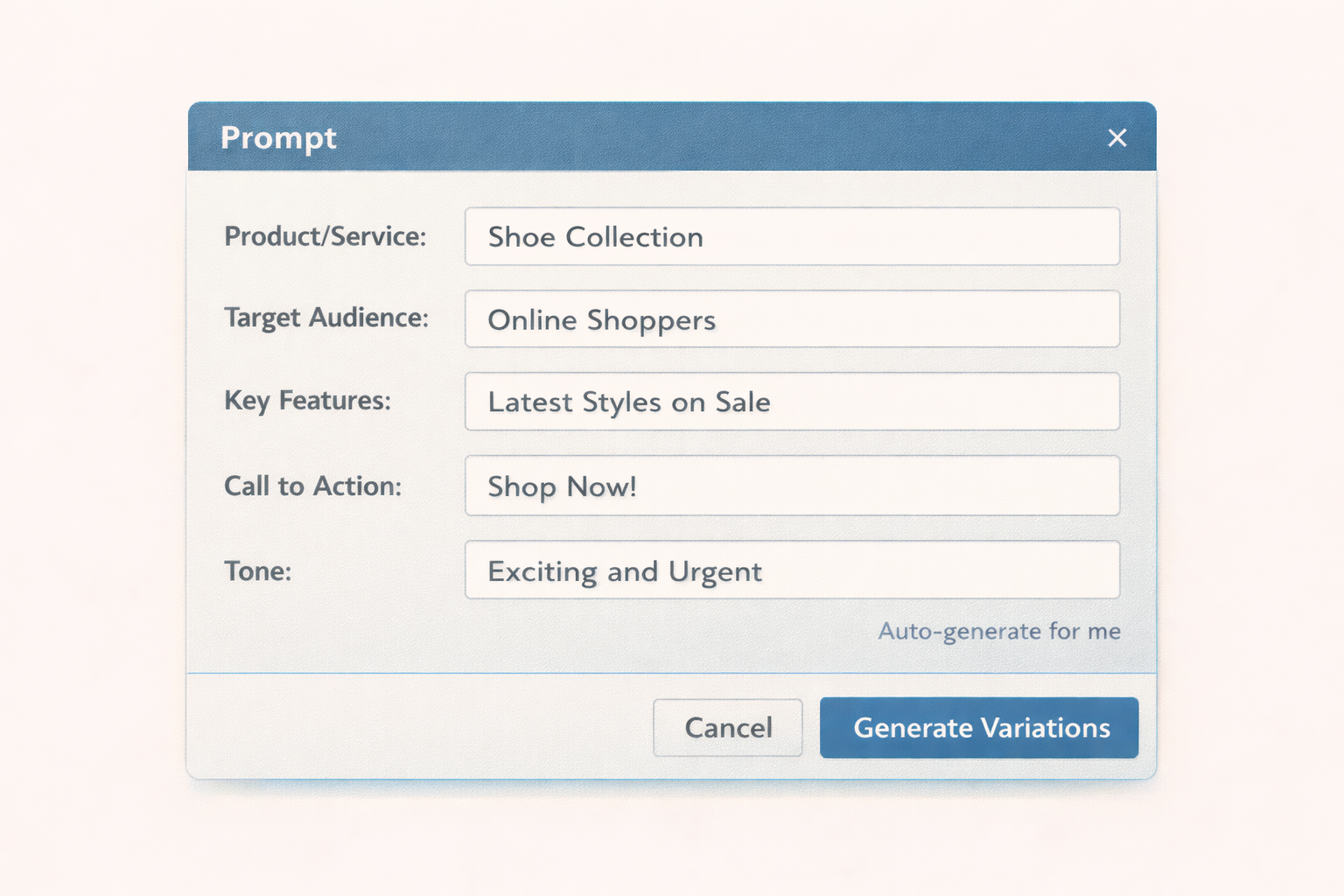
This section should give readers ready-to-use frameworks they can copy, customize, and deploy immediately. The goal is practical execution. When structured correctly, AI tools for google ads copy can produce highly relevant variations—but only when prompts contain the right inputs and constraints.
Each template below includes a fill-in-the-blank framework, when to use it, and common mistakes to avoid. Place the internal anchor Google Ads copywriting tips naturally in the intro or closing paragraph of this section.
High-CTR Headline Prompt Template
Fill-in-the-blank prompt
Write 15 high-CTR Google Ads headlines for the keyword “[PRIMARY KEYWORD]”.
Target audience: [AUDIENCE].
Core benefit: [MAIN BENEFIT].
Include urgency where appropriate.
Keep each headline under 30 characters.
Tone: [PROFESSIONAL / FRIENDLY / PREMIUM].
Avoid exaggerated claims.
When to use
- Responsive Search Ads headline generation
- Early-stage A/B testing
- High-competition keywords where CTR matters most
- Scaling new ad groups quickly
Common mistakes
- Not specifying character limits
- Using vague benefits (“best quality”)
- Forgetting audience context
- Generating too few headline variations
- Allowing AI to repeat the same angle
Conversion-Focused Description Template
Fill-in-the-blank prompt
Write 4 Google Ads descriptions for “[PRIMARY KEYWORD]”.
Audience: [AUDIENCE].
Offer: [DISCOUNT / FREE TRIAL / USP].
Include a strong call to action.
Focus on conversion intent.
Keep each description under 90 characters.
Tone: clear and trustworthy.
Avoid unrealistic promises.
When to use
- Bottom-of-funnel campaigns
- Lead capture campaigns
- High-intent search terms
- When improving the conversion rate is the priority
Common mistakes
- Overstuffing keywords
- Weak or missing CTA
- Too much brand fluff
- Ignoring character limits
- Not aligning with the landing page offer
Local Business Ad Template
Fill-in-the-blank prompt
Create Google Ads headlines and descriptions for a local business.
Business type: [SERVICE TYPE].
Location: [CITY/AREA].
Target customer: [LOCAL AUDIENCE].
Key trust factor: [YEARS / REVIEWS / CERTIFICATION].
Include location relevance and a strong call to action.
Follow Google Ads policies.
When to use
- Local service businesses
- “Near me” keyword campaigns
- Google Ads with location extensions
- High-intent local searches
Common mistakes
- Forgetting location insertion
- Generic national messaging
- Missing trust signals
- No local urgency
- Overly broad audience targeting
E-commerce Product Ad Template
Fill-in-the-blank prompt
Generate Google Ads copy for an e-commerce product.
Product: [PRODUCT NAME].
Category keyword: [PRIMARY KEYWORD].
Key benefit: [TOP FEATURE].
Price or promo: [OPTIONAL].
Target shopper: [AUDIENCE].
Emphasize purchase intent and product value.
Avoid hype language.
When to use
- Shopping-support search campaigns
- High-volume product catalogs
- Promotional sales periods
- Competitive retail niches
Common mistakes
- Feature dumping instead of benefits
- Missing price or offer cues
- Not matching search intent
- Repetitive headlines
- Ignoring differentiation
Lead Generation Template
Fill-in-the-blank prompt
Write Google Ads copy for lead generation.
Service: [SERVICE NAME].
Audience pain point: [PROBLEM].
Primary benefit: [OUTCOME].
Offer: [FREE CONSULTATION / DEMO / QUOTE].
Include strong action language.
Keep messaging compliant and realistic.
Tone: professional and trustworthy.
When to use
- B2B campaigns
- Education and training programs
- High-ticket services
- Form-fill focused funnels
Common mistakes
- Weak problem-solution framing
- Generic benefits
- Missing offer clarity
- Overpromising results
- No urgency in CTA
Common Mistakes Beginners Make With AI Ad Copy
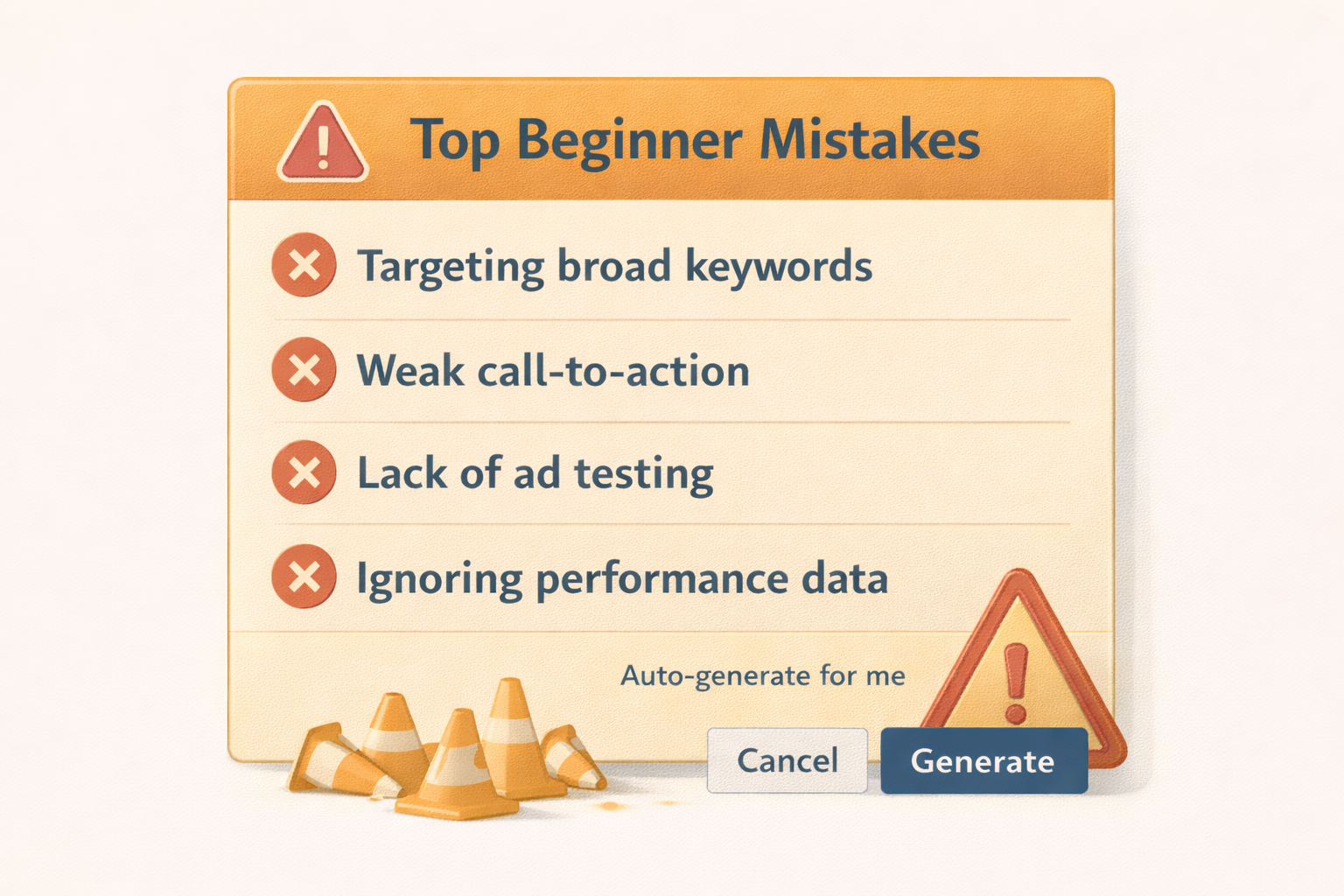
AI has lowered the barrier to producing Google Ads at scale. It has not lowered the bar for strategic thinking. Most underperforming campaigns fail for predictable, preventable reasons—usually because beginners treat AI output as finished work instead of raw material.
Google has long warned that poor ad relevance can depress Quality Score and increase cost per click. When AI is used carelessly, it can accelerate that problem by multiplying weak messaging across dozens of assets. The advertisers who win with AI are the ones who combine automation with disciplined review.
Below are the mistakes that most often sabotage performance.
Mistake → Impact → Fix
| Mistake | Impact on Campaign Performance | How to Fix |
| Over-reliance on raw AI output | Ads feel generic, weak differentiation, lower CTR | Treat AI output as a first draft. Always apply human editing for specificity and brand tone. |
| Ignoring Google Ads policies | Disapprovals, limited reach, potential account risk | Add compliance instructions in prompts and run a manual policy check before launch. |
| Keyword stuffing | Reduced readability and weaker relevance signals | Integrate keywords naturally. Prioritize intent match over repetition. |
| Weak or vague prompts | AI produces bland, unfocused copy | Include audience, offer, tone, and search intent in every prompt. |
| No testing framework | Inability to identify winning messages | Use structured RSA testing and review performance on a fixed schedule. |
| Too few ad variations | Limits Google’s machine learning optimization | Generate full asset sets (up to 15 headlines and 4 descriptions). |
| Blind trust in AI claims | Risk of exaggerated or non-compliant messaging | Edit superlatives (“best,” “#1,” “guaranteed”) and verify facts. |
| Funnel mismatch | High impressions but poor conversion rate | Align messaging with user intent and funnel stage. |
| Inconsistent brand voice | Ads feel fragmented across campaigns | Build brand tone rules directly into prompts. |
| Set-and-forget mindset | Performance plateaus over time | Refresh underperforming assets regularly using new variations. |
The pattern is straightforward. AI multiplies whatever inputs and discipline you bring to the system. Feed it a vague strategy, and you get scalable mediocrity. Pair it with clear intent, structured prompts, and ongoing testing, and it becomes a serious performance engine.
AI vs Human Copywriters — What Still Requires Human Judgment
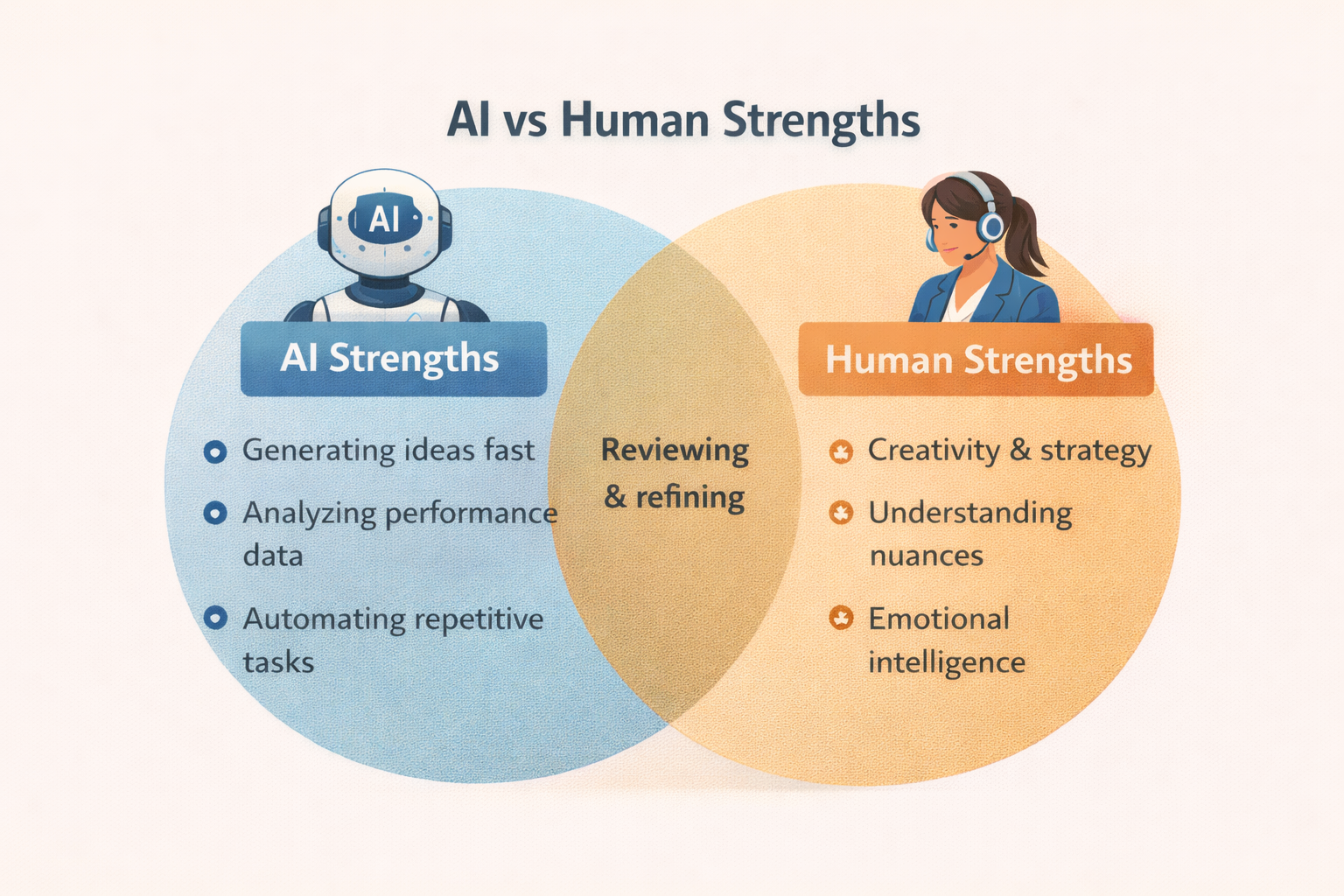
The arrival of AI has transformed how advertising copy is produced, but it has not eliminated the need for human judgment. In practice, the most effective campaigns combine machine efficiency with human strategic thinking. Many marketing teams now use AI tools for Google Ads copy to accelerate production, while relying on experienced marketers to guide positioning, messaging, and optimization decisions.
Industry research increasingly shows that hybrid workflows outperform fully automated ones. Surveys across marketing teams indicate that organizations using AI-assisted content creation paired with human editing often see stronger engagement and higher-quality outputs than those relying entirely on automation.
The reason is simple: AI is excellent at pattern generation, but it does not understand business context, competitive positioning, or brand identity in the way humans do.
One area where human judgment remains critical is strategic positioning. AI can generate dozens of headline variations, but it cannot decide which value proposition should lead the campaign. Choosing between price leadership, premium quality, convenience, or expertise requires understanding the market landscape and customer psychology.
Also Read: Comparison of AI-Generated vs. Human-Written Content
Another key advantage humans bring is emotional nuance. Advertising often succeeds when it resonates with real human motivations—aspiration, urgency, trust, or relief from a specific problem. AI can mimic persuasive language patterns, but experienced copywriters recognize subtle emotional triggers that connect with a specific audience.
Compliance interpretation is another area where human oversight remains essential. Advertising platforms such as Google Ads enforce strict policies around claims, regulated industries, and misleading messaging. AI can sometimes generate exaggerated or ambiguous statements that appear persuasive but violate platform rules. Human reviewers must interpret policies correctly and ensure every asset meets compliance standards.
Brand differentiation also depends heavily on human insight. AI tends to generate safe, commonly used phrases unless directed otherwise. A skilled copywriter understands what makes a brand unique and can shape messaging to emphasize those distinctions rather than blending into industry clichés.
One major risk of poorly written AI ads is policy violations that can lead to Google Ads disapproved ads, preventing your campaign from showing until the issue is fixed.
Finally, the offer strategy is a human-led decision. AI can phrase an offer attractively, but it cannot decide whether the campaign should highlight a limited-time discount, free consultation, product bundle, or premium positioning. That choice depends on pricing strategy, margins, customer lifetime value, and competitive pressure.
The reality is that AI excels at speed and variation, while humans excel at judgment and strategy. When these strengths are combined, advertisers gain the ability to generate ideas quickly while maintaining the strategic clarity that drives real campaign performance.
Future of AI in Google Ads (2025 and Beyond)
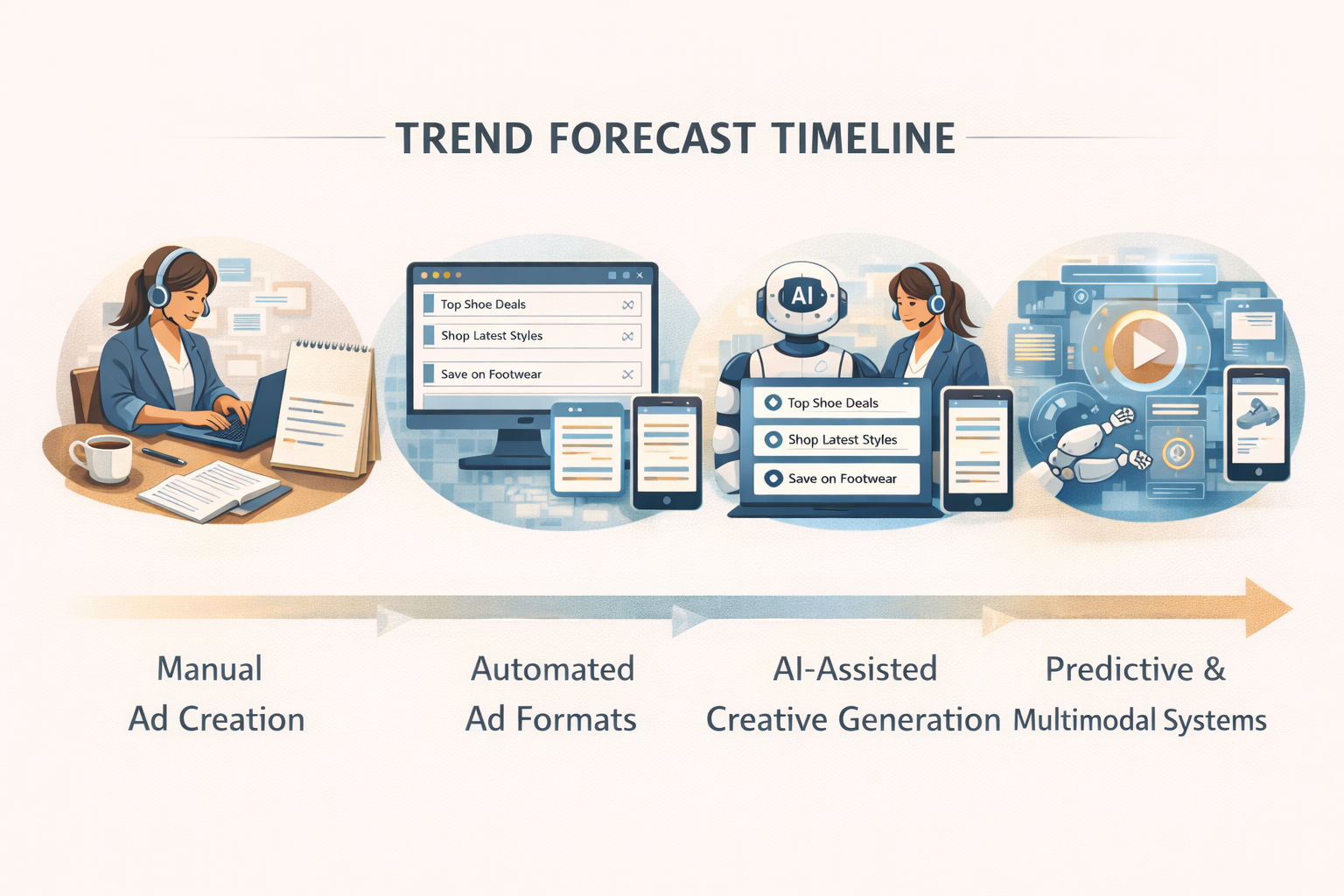
Artificial intelligence is no longer an experimental layer inside advertising platforms—it is becoming the infrastructure. Over the next few years, Google’s advertising ecosystem will continue moving toward deeper automation, where AI assists not only with copy generation but also with creative testing, audience prediction, and campaign optimization.
For advertisers already using AI tools for Google Ads copy, the next phase will be less about producing text and more about integrating AI into the entire campaign lifecycle.
One major trend shaping the future is Google’s increasing push toward automation. Over the past few years, Google has gradually shifted advertisers toward automated formats such as Responsive Search Ads and Performance Max campaigns. This shift reflects Google’s broader strategy: advertisers provide creative inputs and business goals, while Google’s machine learning systems optimize delivery. Statements from Google earnings calls frequently highlight automation and AI as central to the company’s advertising roadmap, signaling that manual campaign management will continue to decrease over time.
Another emerging capability is predictive creative optimization. Instead of simply generating ad variations, advanced AI systems will begin predicting which messaging themes are most likely to perform before campaigns even launch. By analyzing historical account data, search intent patterns, and industry benchmarks, AI may recommend the most promising value propositions, headlines, and calls to action. This reduces the time required to discover winning messages through trial and error.
The industry is also moving toward multimodal ad generation. Today, AI tools primarily generate text-based ads. In the near future, AI systems will be capable of producing coordinated ad assets across formats—headlines, descriptions, images, short videos, and landing page elements—based on the same campaign brief. This integrated creative production could dramatically accelerate campaign launches, especially for e-commerce and performance marketing teams.
Another important shift will involve first-party data integration. As privacy regulations and cookie restrictions reshape digital advertising, advertisers are relying more heavily on their own customer data. AI systems will increasingly analyze first-party data to tailor messaging for different audience segments. Instead of generic ad variations, future AI-driven campaigns may automatically generate copy designed for specific user groups based on behavior, purchase history, or lifecycle stage.
Despite these advancements, the growing reliance on automation introduces real risks. One of the most discussed concerns is the commoditization of ad copy. When thousands of advertisers rely on similar AI systems, messaging can begin to sound uniform. Without strong brand positioning and strategic differentiation, ads risk blending into a sea of similar claims and offers. This reinforces the ongoing importance of human strategy in shaping the message behind the machine.
Adoption trends suggest that AI will continue expanding rapidly across marketing teams. Industry forecasts show strong growth in AI adoption within advertising and marketing technology, reflecting both cost efficiency and competitive pressure. As more advertisers adopt AI-assisted workflows, the competitive advantage will shift from simply using AI to using it intelligently.
Conclusion — Building a Sustainable AI-Assisted Ads Workflow
Artificial intelligence is changing how advertisers produce and test search ads, but its real value lies in acceleration rather than replacement. AI can generate variations quickly, suggest new messaging angles, and reduce production time dramatically. However, successful campaigns still depend on human strategy, clear positioning, and disciplined optimization.
In practical terms, AI works best when it becomes part of a structured workflow rather than a shortcut. Treat it as a creative assistant that expands your testing capacity. When used correctly, AI tools for Google Ads copy allow marketers to produce large sets of ad variations, explore multiple value propositions, and respond faster to performance insights without increasing workload.
A sustainable workflow usually follows a consistent cycle. Start with clear campaign goals and audience definition. Use AI to generate multiple headlines and description variations aligned with search intent. Review the output carefully to ensure brand alignment and policy compliance. Launch the ads, monitor performance data, and identify the combinations that drive the best click-through rate and conversions. From there, repeat the process—refining prompts, introducing new messaging angles, and continuously replacing underperforming assets.
Equally important is building a strong testing culture. Google Ads rewards advertisers who consistently experiment with new creative assets and allows the system to identify winning combinations. AI makes this level of experimentation practical even for small teams, but the discipline of reviewing results and iterating remains a human responsibility.
For beginners, the key takeaway is simple: start small, test frequently, and improve gradually. The advertisers who benefit most from AI are not those who automate everything overnight, but those who integrate it thoughtfully into their existing marketing process. Many beginners now learn digital marketing faster using ChatGPT and AI, because these tools allow marketers to generate ideas, analyze campaigns, and improve ad copy much faster.
Over time, this combination of machine efficiency and human judgment creates a workflow that is faster, smarter, and far more scalable.
Can AI write effective Google Ads copy?
Yes, AI can generate effective Google Ads copy by producing multiple variations quickly and aligning messaging with keywords and search intent. However, human review is still necessary to refine tone, ensure brand alignment, and check policy compliance.
What is the best AI tool for Google Ads copy?
There is no single “best” tool. The right option depends on your workflow. Tools like ChatGPT offer flexibility for custom prompts, while platforms like Jasper or Copy.ai provide structured marketing templates for faster ad creation.
Is AI-generated ad copy allowed by Google Ads policies?
Yes, Google Ads allows AI-generated content. However, advertisers remain responsible for ensuring the ads follow Google Ads policies, including rules around misleading claims, restricted products, and compliance requirements.
How many headlines should responsive search ads have?
Google recommends using up to 15 headlines and 4 descriptions in Responsive Search Ads. Providing more variations helps Google’s system test combinations and identify the best-performing assets.
Does AI improve Google Ads CTR?
AI can improve CTR by generating multiple messaging variations for testing. However, improvements depend on proper optimization and A/B testing rather than relying on AI output alone.
How do I prompt AI for better ad copy?
Use clear and specific prompts. Include the target keyword, audience, main benefit, offer, tone, and required format. The more context you provide, the more relevant and usable the generated ad copy will be.
Can AI replace PPC copywriters?
AI can assist with drafting and scaling ad variations, but it cannot replace human strategy. PPC professionals are still needed for positioning, messaging strategy, compliance review, and performance optimization.
Are free AI tools good enough for beginners?
Yes, free AI tools can work well for beginners learning ad copy generation. However, paid tools often provide better customization, workflow automation, and collaboration features for larger campaigns.
How do I avoid generic AI ad copy?
Provide detailed prompts that include audience insights, brand voice, and unique value propositions. Always edit the output to add specificity and ensure it reflects your brand’s positioning.
What metrics should I track after using AI ad copy?
Monitor key Google Ads metrics such as click-through rate (CTR), conversion rate (CVR), Quality Score, and cost per acquisition (CPA) to evaluate how the new ad variations perform.
If you’re just starting your journey, you can also learn digital marketing at home for free using structured guides and practical tutorials.
💡 Interested in learning more? Contact RKDMT – Raju Kumar Digital Marketer (Best Digital Marketing Training Institute)
🔗 www.rajukumardigitalmarketer.com
📞 +91-7303933302 | +91-9217057127
📧 rkdmt@rajukumardigitalmarketer.com

Founder at Digital Marketing Marvel | Founder at RKDMT – Raju Kumar Digital Marketing Trainer | Best Digital Marketing Trainer in Delhi/NCR – Digiperform | Project Manager | 5+ years | Genius Study Abroad & Inlingua’s Digital Marketing Head | Learn Digital Marketing