


How to Use AI Tools for Content Planning and Research
Content marketing has become one of the most important strategies for businesses that want to grow online. Brands today need to publish blogs, social media posts, videos, and guides regularly to stay visible in search results and maintain audience engagement.
However, creating consistent and valuable content requires strong planning and deep topic research. This is where AI tools for content planning and research are becoming extremely useful for marketers, bloggers, and businesses.
Traditionally, content planning involved manual brainstorming, competitor analysis, and hours of keyword research. Marketers had to rely on spreadsheets, search engine results, and multiple tools just to identify the right topics.
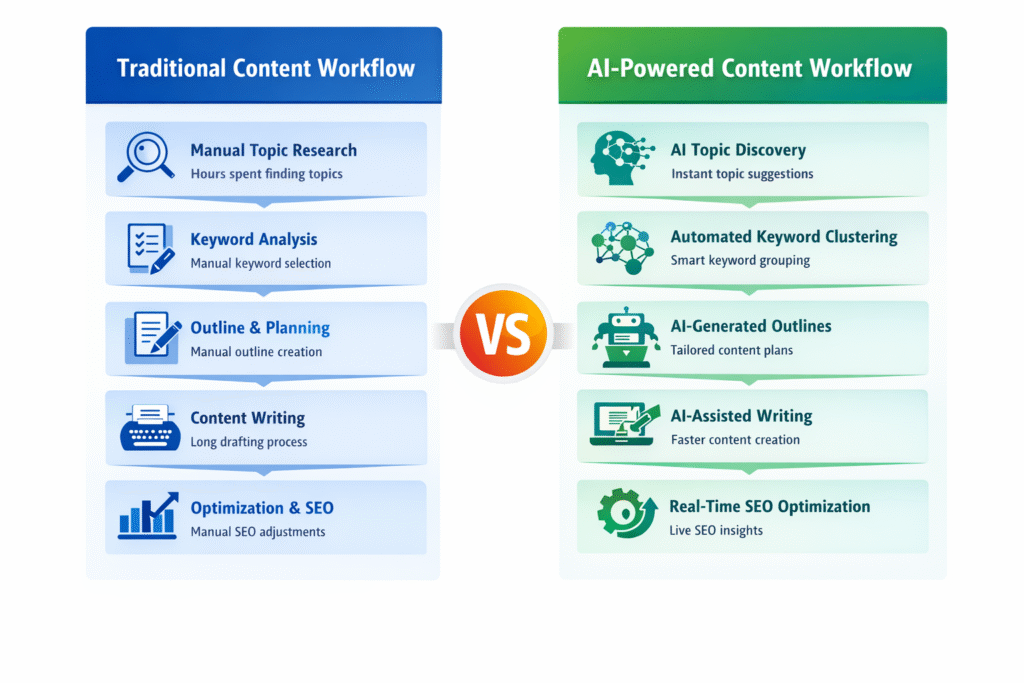
This process was not only slow but also limited because it depended heavily on human guesswork. As the digital space became more competitive, businesses started looking for smarter ways to discover content opportunities and analyze audience interests.
Artificial intelligence has significantly changed how content strategies are created. AI-powered tools can analyze large amounts of data, identify trending topics, suggest keywords, and even predict what type of content audiences are likely to search for. Instead of spending hours researching ideas, marketers can now generate data-driven content plans within minutes. These tools also help identify content gaps, analyze competitors, and organize topics into structured publishing calendars.
Another major advantage of AI is faster decision-making. With real-time insights and automated analysis, marketers can quickly understand what topics are gaining popularity and what their audience is searching for. This allows businesses to create content that aligns with user intent and current market trends, which ultimately improves search visibility and engagement.
Artificial intelligence is rapidly transforming marketing workflows. From automation to data analysis, AI in digital marketing is helping businesses create smarter strategies and better content planning.
As competition in digital marketing continues to grow, relying only on manual research is no longer efficient. Businesses that use AI tools for content planning and research can streamline their workflow, discover better topic ideas, and build more effective content strategies that drive long-term results.
Understanding the Content Planning Challenge
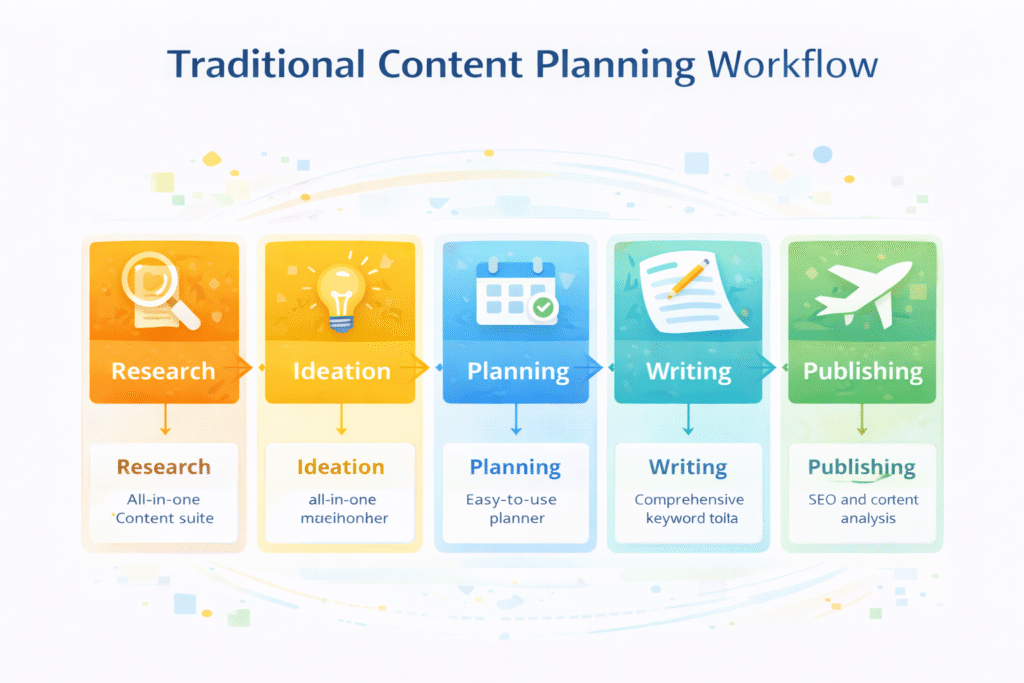
Creating a strong content strategy sounds simple in theory, but in practice, it can be surprisingly complicated. Content planning requires constant research, topic discovery, keyword analysis, and scheduling. Without the support of modern technology, marketers often spend a large amount of time trying to identify what their audience wants to read and which topics can actually bring traffic.
One of the biggest challenges is identifying trending topics. The internet changes quickly, and audience interests shift constantly. When content planning is done manually, marketers usually rely on guesswork, basic Google searches, or competitor observation. This approach often leads to outdated or less relevant topics because it does not use real-time data.
Another major issue is limited keyword insights. Keyword research tools provide valuable information such as search volume, competition level, and user intent. Without these insights, marketers may create content that people are not actively searching for. As a result, even high-quality content may struggle to gain visibility in search engines.
Manual brainstorming is also time-consuming. Teams often spend hours generating ideas, analyzing competitors, and validating topics before even starting to write. This process slows down content production and makes it difficult to maintain an efficient workflow.
Consistency is another common problem. Successful content marketing requires a steady publishing schedule, but managing multiple topics and deadlines manually can become overwhelming. Many businesses start strong but eventually struggle to maintain regular content updates.
These challenges are the reason many marketers are now turning to AI tools for content planning and research. Artificial intelligence can analyze large datasets, detect trending topics, and generate data-driven insights much faster than manual methods. By reducing research time and improving topic accuracy, AI helps marketers build more consistent and effective content strategies.
A content planner without structured data is like navigating a city with no map. Tables act as a cognitive shortcut—they compress complexity into something the brain can scan in seconds. Here is a clean comparison table you can place under the section discussing manual planning challenges.
| Content Planning Challenge | What Happens Without AI | Impact on Content Strategy |
| Identifying trending topics | Marketers rely on guesswork, social media browsing, or competitor posts to find ideas | Topics may already be outdated or oversaturated by the time content is published |
| Limited keyword data | Search volume, competition, and user intent are difficult to estimate manually | Content may target keywords that bring little or no organic traffic |
| Time-consuming brainstorming | Teams spend hours researching ideas and validating topics | Slower content production and delayed publishing schedules |
| Competitor analysis difficulty | Manual checking of multiple competitor websites and blogs | Important content gaps and opportunities may be missed |
| Maintaining publishing consistency | Content calendars are often managed in spreadsheets with manual updates | Irregular posting reduces audience engagement and SEO growth |
| Lack of data-driven insights | Decisions are based on assumptions rather than analytics | Content strategy becomes less effective and harder to scale |
This table visually reinforces the core problem: manual planning is slow, uncertain, and difficult to scale. In the next sections of the article, you can naturally transition into how AI tools for content planning and research solve these exact issues by automating data analysis, identifying trends, and organizing content strategies more efficiently. To succeed today, marketers must master digital marketing skills like SEO and content research, which are essential for building effective strategies.
The Role of Data in Modern Content Strategy
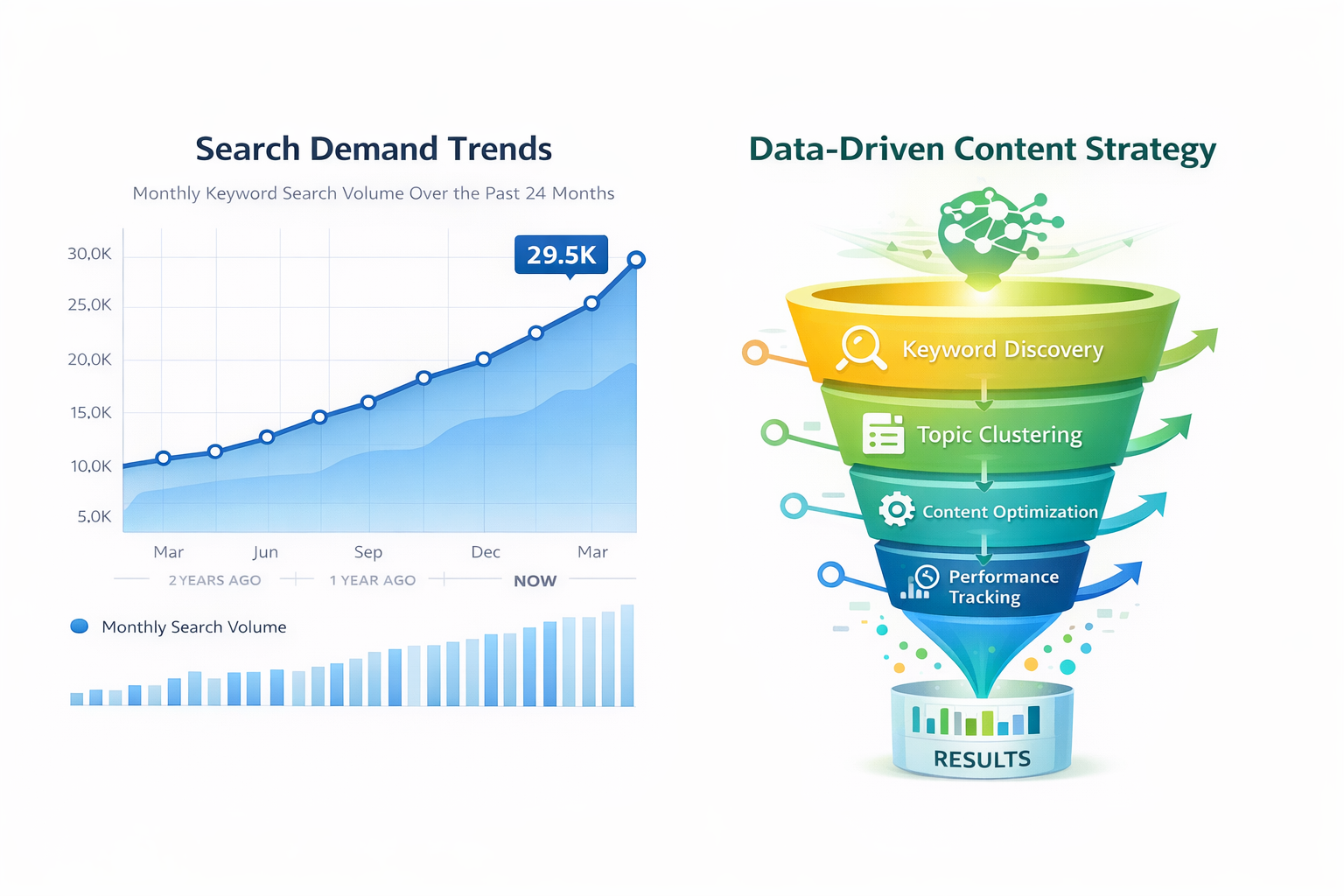
In modern digital marketing, successful content strategies are built on data rather than assumptions. Businesses can no longer rely only on creativity or guesswork when deciding what topics to publish. Instead, marketers use real insights such as search trends, audience behavior, and competitor activity to create content that people are actively looking for.
One of the most important sources of data is search trends. Search engines process billions of queries every day, and those queries reveal what people want to learn, buy, or explore. By analyzing this information, marketers can identify which topics are gaining popularity and which ones are declining. Creating content around high-demand topics increases the chances of ranking in search results and attracting organic traffic.
If you want to learn digital marketing at home for free, understanding how to analyze search data and audience behavior is one of the first skills you should develop.
Another key factor is keyword search intent. Search intent refers to the reason behind a user’s search. For example, some users are looking for information, while others may be comparing products or are ready to make a purchase. Understanding this intent helps marketers create content that matches what users expect to find. When content aligns with search intent, it performs better in both rankings and engagement.
Data also reveals valuable audience interest signals. These signals can come from social media interactions, website analytics, or search behavior. By studying what users click, share, or spend time reading, marketers can understand what topics truly resonate with their audience. This allows them to plan future content more effectively.
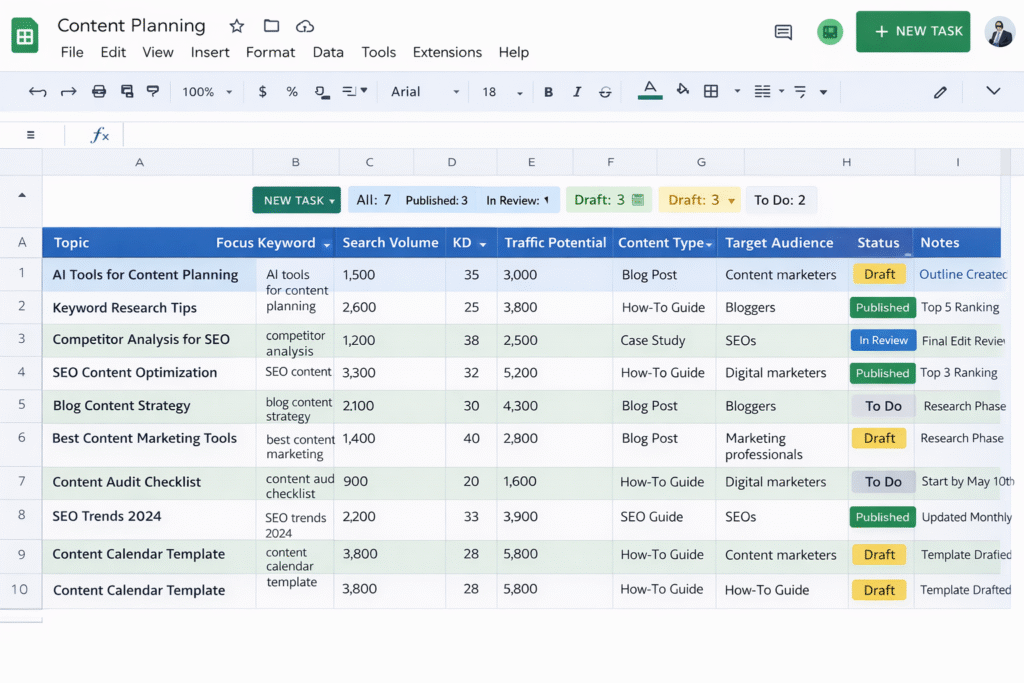
Another important aspect of data-driven content strategy is competitor analysis. Studying competitor websites and blogs helps marketers discover which topics are performing well in their industry. It also highlights content gaps—topics that competitors may have missed but audiences are still searching for.
Analyzing such large volumes of information manually can be extremely difficult. This is where AI tools for content planning and research play a powerful role. These tools can process huge datasets, identify patterns in search behavior, and generate insights that help marketers choose the right topics and keywords more efficiently.
Types of Data Used in Content Research
| Data Type | What It Shows | How It Helps Content Strategy |
| Search Data | Search volume, keyword trends, and popular queries | Helps identify high-demand topics and keywords |
| Competitor Analysis Data | Competitor rankings, popular articles, and keyword strategies | Reveals content gaps and competitive opportunities |
| Social Media Insights | Likes, shares, comments, and engagement trends | Shows what topics audiences find interesting |
| Website Analytics | Page views, time on page, and user behavior | Helps understand which content performs best |
| Audience Demographics | Age, location, and user interests | Allows marketers to create targeted and relevant content |
By combining these different types of data, marketers can create a content strategy that is both strategic and audience-focused. Data-driven planning not only improves search visibility but also ensures that the content created truly addresses what users want to learn or solve.
What Are AI Tools for Content Planning and Research
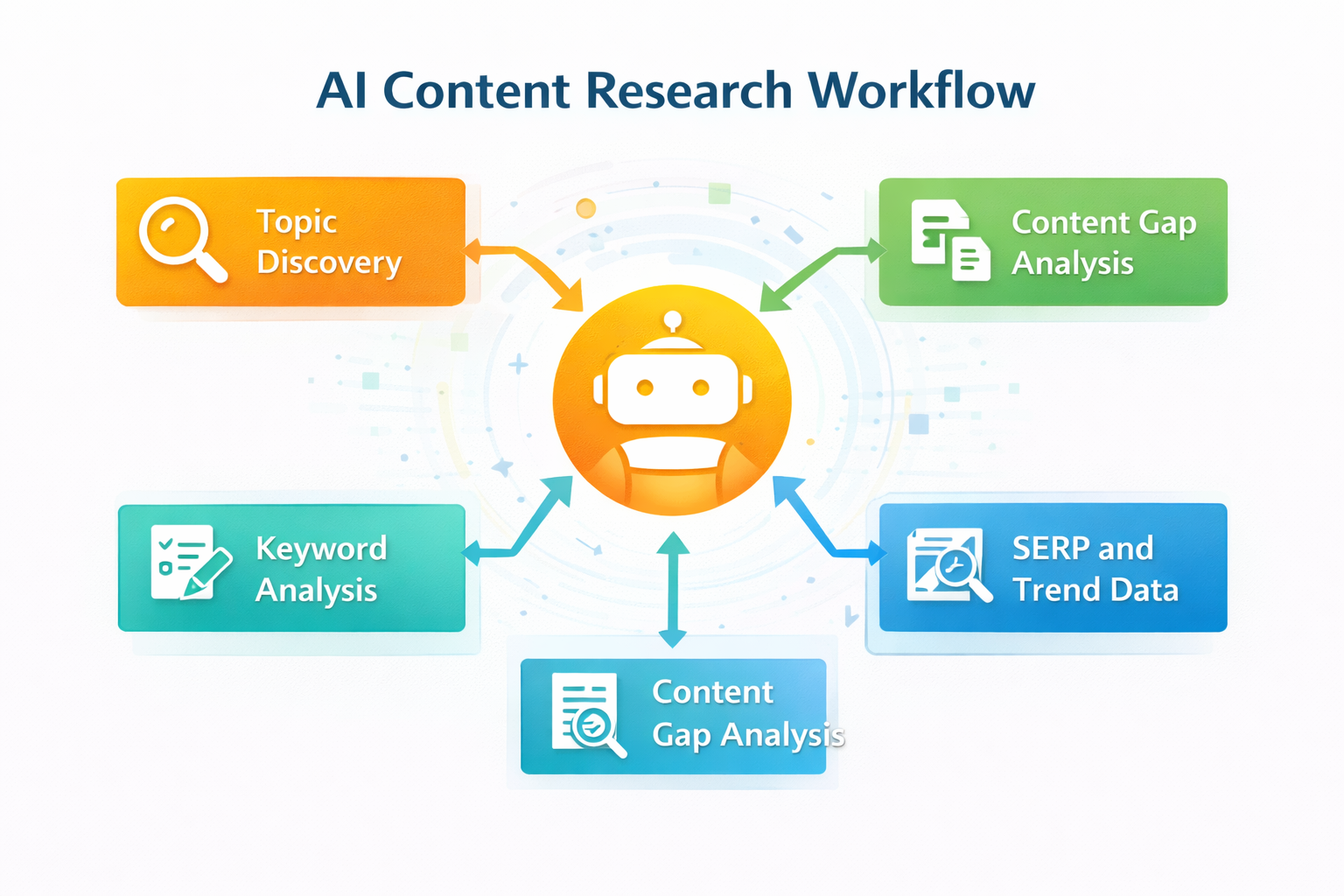
In digital marketing, planning content used to rely heavily on manual research, brainstorming sessions, and trial-and-error strategies. Today, technology has changed that process significantly. AI tools for content planning and research use artificial intelligence to analyze large amounts of data, discover topic opportunities, and help marketers create more effective content strategies. Many modern tools used in digital marketing now include AI features that help marketers automate research, generate topic ideas, and build content calendars.
Artificial intelligence works by processing massive datasets such as search engine queries, social media discussions, competitor content, and user behavior. Instead of spending hours analyzing information manually, marketers can use AI tools to quickly identify popular topics, relevant keywords, and emerging trends. These insights make it easier to plan content that aligns with audience interests and search engine demand.
One of the key capabilities of AI tools is topic discovery. AI systems can scan thousands of articles, forums, and search queries to identify what people are talking about online. This helps marketers generate relevant new content ideas, trending, and likely to attract traffic.
Another major capability is automated keyword research. AI-powered platforms can analyze search data to suggest keywords, evaluate search volume, estimate competition, and determine search intent. This helps marketers choose keywords that have strong ranking potential and align with what users are actively searching for.
AI tools also assist with content gap analysis. These tools compare your website with competitor websites to identify topics that competitors rank for but you do not. By discovering these gaps, marketers can create new content that fills missing opportunities and improves search visibility.
Another valuable feature is trend forecasting. AI systems can analyze patterns in search behavior and predict which topics may grow in popularity in the future. This allows businesses to create content before a topic becomes highly competitive, giving them a strategic advantage in search rankings.
AI Capabilities vs Traditional Research Methods
| Research Capability | Traditional Method | AI-Powered Method |
| Topic discovery | Manual brainstorming and competitor browsing | AI analyzes search trends and online discussions to generate topic ideas |
| Keyword research | Manual keyword tools and spreadsheet analysis | AI automatically suggests keywords based on search data and intent |
| Competitor analysis | Checking competitor blogs individually | AI scans multiple competitors and identifies ranking gaps |
| Trend identification | Observing market trends manually | AI detects emerging search patterns and predicts topic growth |
| Content planning | Manual content calendars and topic lists | AI organizes topics into structured content strategies |
Overall, AI is transforming how marketers approach content strategy. By automating research and providing data-driven insights, AI tools for content planning and research help marketers discover better topics, improve SEO performance, and plan content more efficiently.
Best AI Tools for Content Planning and Research
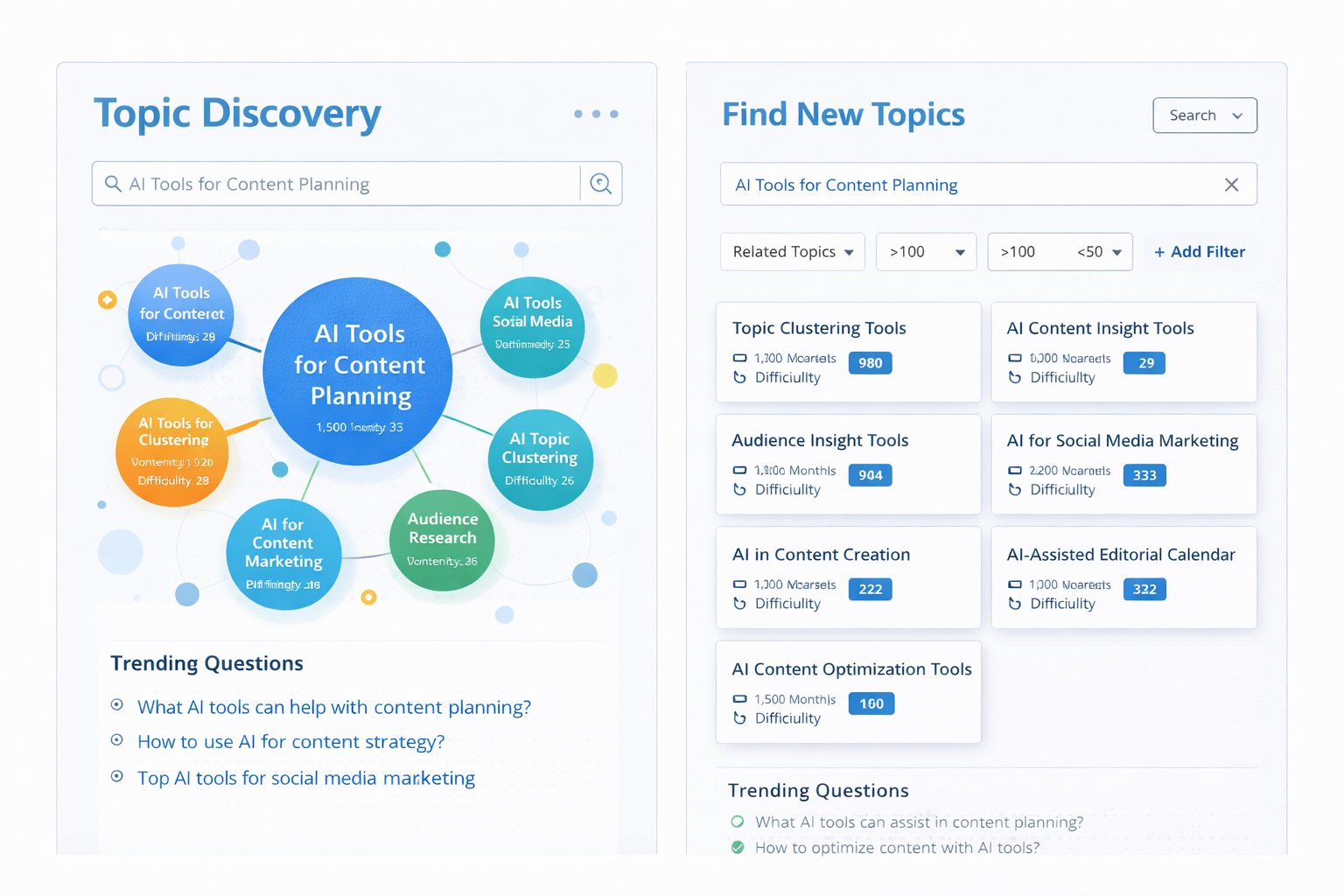
Finding the right content topic is one of the most important steps in building a successful content strategy. Even the best-written article will struggle to perform if the topic does not match what people are currently searching for or discussing online. This is where AI tools for content planning and research become extremely valuable. These tools analyze large amounts of online data—from search engines, social platforms, and competitor websites—to identify trending topics and new content opportunities.
AI-powered topic discovery tools help marketers move beyond random brainstorming. Instead of guessing what might work, marketers can use data-driven insights to find topics that audiences are already interested in. These tools analyze search queries, trending keywords, and user behavior to generate topic ideas that have a higher chance of attracting traffic and engagement.
One important category of topic discovery tools focuses on trend analysis. These tools track how search interest changes over time and highlight emerging topics before they become highly competitive. By identifying these trends early, marketers can create content that captures traffic before the topic becomes saturated.
Another useful category includes AI-powered brainstorming platforms. These tools generate topic suggestions based on keywords, industry themes, or audience interests. By analyzing large content datasets, they can suggest blog titles, content clusters, and related subtopics. This helps content creators quickly develop multiple article ideas from a single concept.
A third category involves social listening tools. These tools monitor conversations across social media platforms, forums, and online communities. By analyzing discussions and engagement patterns, they help marketers understand what questions people are asking and what problems they want solved. This insight allows brands to create content that directly addresses audience needs.
Using these AI-powered discovery tools allows marketers to build stronger content strategies. Instead of relying only on creativity or intuition, content planning becomes a data-informed process that identifies topics with real demand and audience interest. If you want to learn digital marketing professionally, understanding how these AI tools work can dramatically improve your content strategy and planning skills.
Comparison of AI Topic Research Tools
| Tool Type | Key Features | Strengths | Best Use Case |
| AI Topic Discovery Platforms | Generates topic ideas from search trends and keyword data | Helps identify high-demand content topics quickly | Bloggers and SEO professionals looking for article ideas |
| AI Brainstorming Tools | Suggests blog titles, topic clusters, and related subtopics | Speeds up the ideation process for content teams | Content creators planning multiple blog posts |
| Trend Analysis Tools | Tracks rising search trends and keyword popularity | Helps marketers identify emerging topics early | Businesses targeting trending content opportunities |
| Social Listening Tools | Monitors online discussions and audience conversations | Provides insight into audience interests and problems | Brands creating audience-focused content strategies |
By combining these different tools, marketers can discover relevant content ideas faster and build topic strategies that align with real audience demand. This approach allows businesses to stay ahead of industry trends while improving the effectiveness of their overall content marketing strategy.
AI Tools for Keyword Research
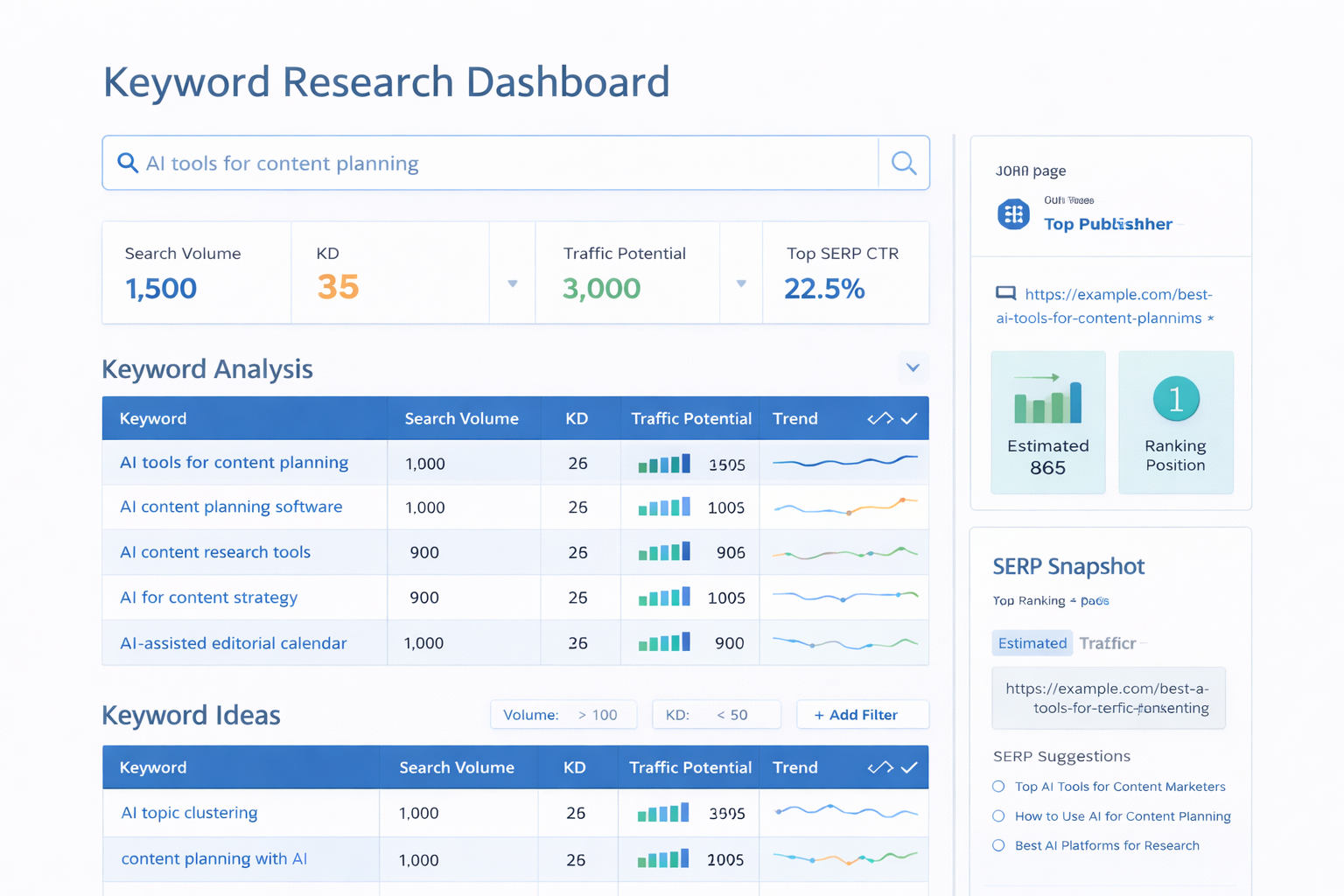
Keyword research sits at the heart of search-driven content. Every query typed into a search engine is a signal—millions of tiny clues about what people want to learn, buy, or solve. AI-powered keyword research tools transform those signals into actionable insights. Instead of manually digging through search results and spreadsheets, marketers can use AI systems that scan massive search datasets and surface keywords with strong traffic potential.
AI makes keyword research faster and more precise. These tools analyze search volume patterns, related queries, user behavior, and ranking pages to suggest keywords that match real audience demand. Rather than producing a single keyword, AI tools typically generate keyword clusters—groups of related phrases that revolve around a core topic. This approach helps marketers build comprehensive articles that target multiple search variations at once.
Another powerful capability is search intent analysis. Not every search query means the same thing. Some users want information, others are comparing options, and some are ready to make a purchase. AI tools study search results and user patterns to determine the intent behind keywords. When content aligns with that intent, it has a much higher chance of ranking well and satisfying readers.
AI keyword tools also provide competitor keyword insights. These tools analyze competitor websites to discover which keywords they rank for and which pages generate the most traffic. By examining these patterns, marketers can uncover keyword opportunities that competitors are already benefiting from—or find gaps where competitors are not creating enough content.
This data-driven approach helps marketers prioritize keywords that offer the best balance between search demand and ranking difficulty. Instead of guessing which topics might perform well, content planners can rely on measurable signals from search engines and user behavior.
| Tool Category | Key Features | Strengths | Best Use Case |
| AI Keyword Discovery Tools | Generate keyword ideas based on search patterns | Quickly finds high-volume and related keywords | Bloggers and SEO specialists planning new articles |
| Search Intent Analysis Tools | Identifies informational, navigational, or transactional intent | Helps create content that matches user expectations | Businesses targeting specific audience needs |
| Competitor Keyword Analysis Tools | Analyzes keywords competitors rank for | Reveals ranking opportunities and content gaps | Marketers improving competitive SEO strategies |
| Keyword Clustering Tools | Groups related keywords into topic clusters | Helps build structured SEO content strategies | Content teams planning long-form guides |
AI-driven keyword research shifts content planning from intuition to evidence. With clearer insight into search behavior, marketers can target keywords that attract traffic, match audience intent, and strengthen overall search visibility.
AI Tools for Content Calendar Planning
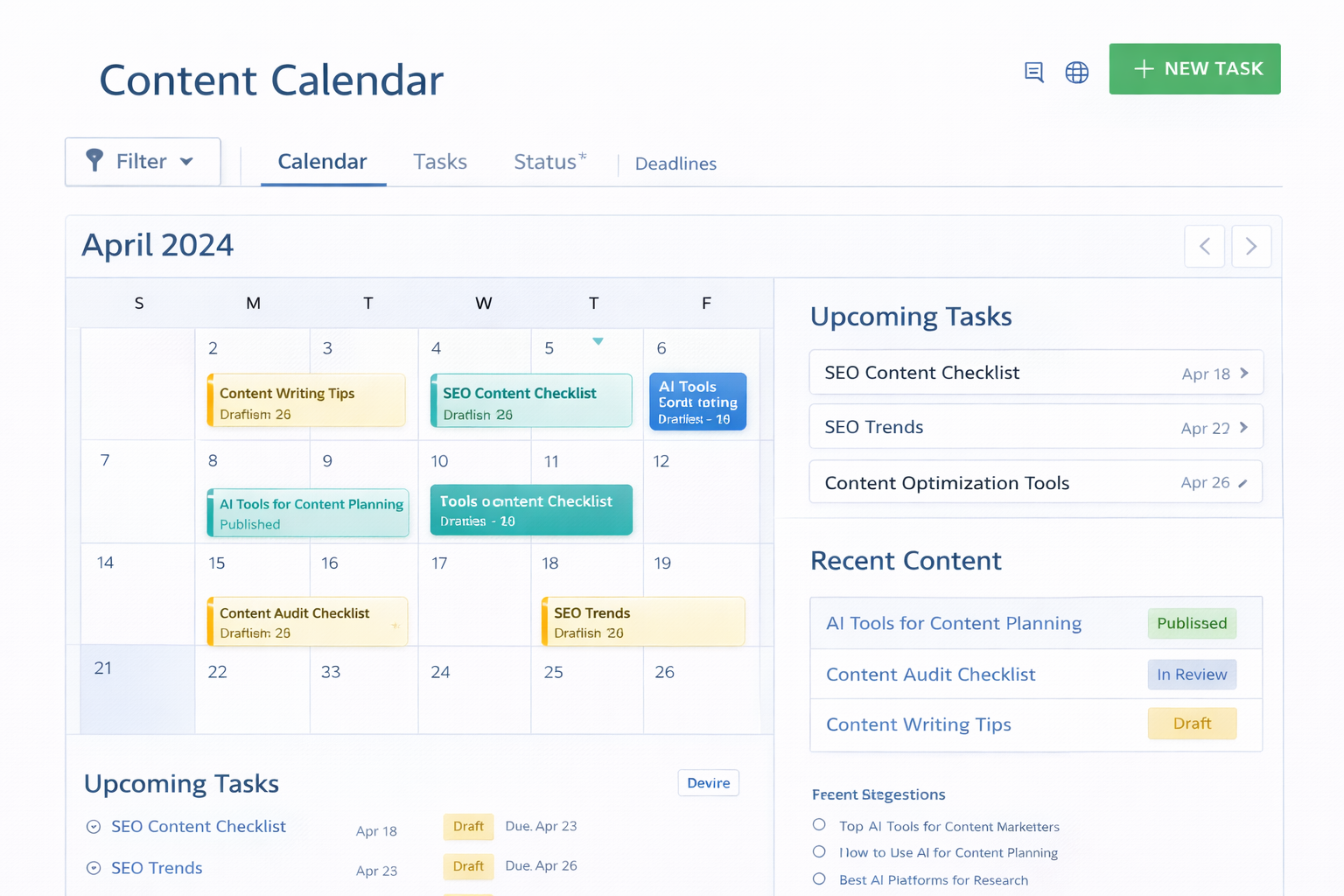
Planning content is not only about finding good topics. Marketers also need to organize those topics into a structured publishing schedule. Without a clear system, even strong content ideas can become disorganized, delayed, or forgotten. AI-powered tools solve this challenge by helping marketers build structured publishing calendars that align with audience demand and marketing goals.
AI tools analyze keyword data, trending topics, and existing content to automatically generate organized content plans. Instead of manually deciding what to publish each week, marketers can use AI systems that recommend topics and schedule them based on priority, seasonal trends, and audience interest. This allows teams to maintain a consistent publishing rhythm without spending hours managing spreadsheets.
One important capability of these tools is automated content calendar generation. AI platforms can take a list of target keywords or topics and convert them into a complete publishing schedule. For example, if a business wants to publish two blog posts per week, the system can automatically distribute topics across a monthly or quarterly calendar. This structured planning helps teams stay organized and ensures that content production remains consistent.
Another powerful feature is topic clustering. Instead of planning isolated articles, AI tools group related topics into clusters around a central theme. This structure helps create stronger SEO strategies because search engines favor websites that cover topics in depth. A single core topic may be supported by multiple related articles, each targeting a different keyword variation.
AI tools also help with content gap detection. By analyzing competitor websites and existing blog content, these tools can identify missing topics that audiences are searching for but your website has not yet covered. Once identified, those topics can automatically be added to the content calendar, ensuring the strategy remains comprehensive and competitive.
Using AI-driven planning systems also improves collaboration for marketing teams. Many tools include shared dashboards where team members can track deadlines, assign tasks, and monitor content progress. This makes it easier to manage large-scale content strategies involving multiple writers, editors, and marketers.
| Tool Category | Key Features | Strengths | Best Use Case |
| AI Content Calendar Tools | Automatically generate structured publishing schedules | Keeps content planning organized and consistent | Marketing teams managing regular blog publishing |
| Topic Clustering Tools | Groups related keywords and topics into clusters | Improves SEO by creating comprehensive topic coverage | SEO-focused content strategies |
| Content Gap Analysis Tools | Identifies topics competitors rank for but your site does not | Reveals new content opportunities | Businesses expanding their blog authority |
| Workflow Management Tools | Assign tasks, track deadlines, and manage team collaboration | Improves team productivity and content organization | Agencies and large marketing teams |
By combining automated scheduling, topic clustering, and content gap detection, AI-powered planning tools help marketers transform scattered ideas into a structured and scalable content strategy. Instead of reacting to trends randomly, businesses can follow a clear publishing roadmap that supports long-term growth.
Step 1: Identify Audience and Goals
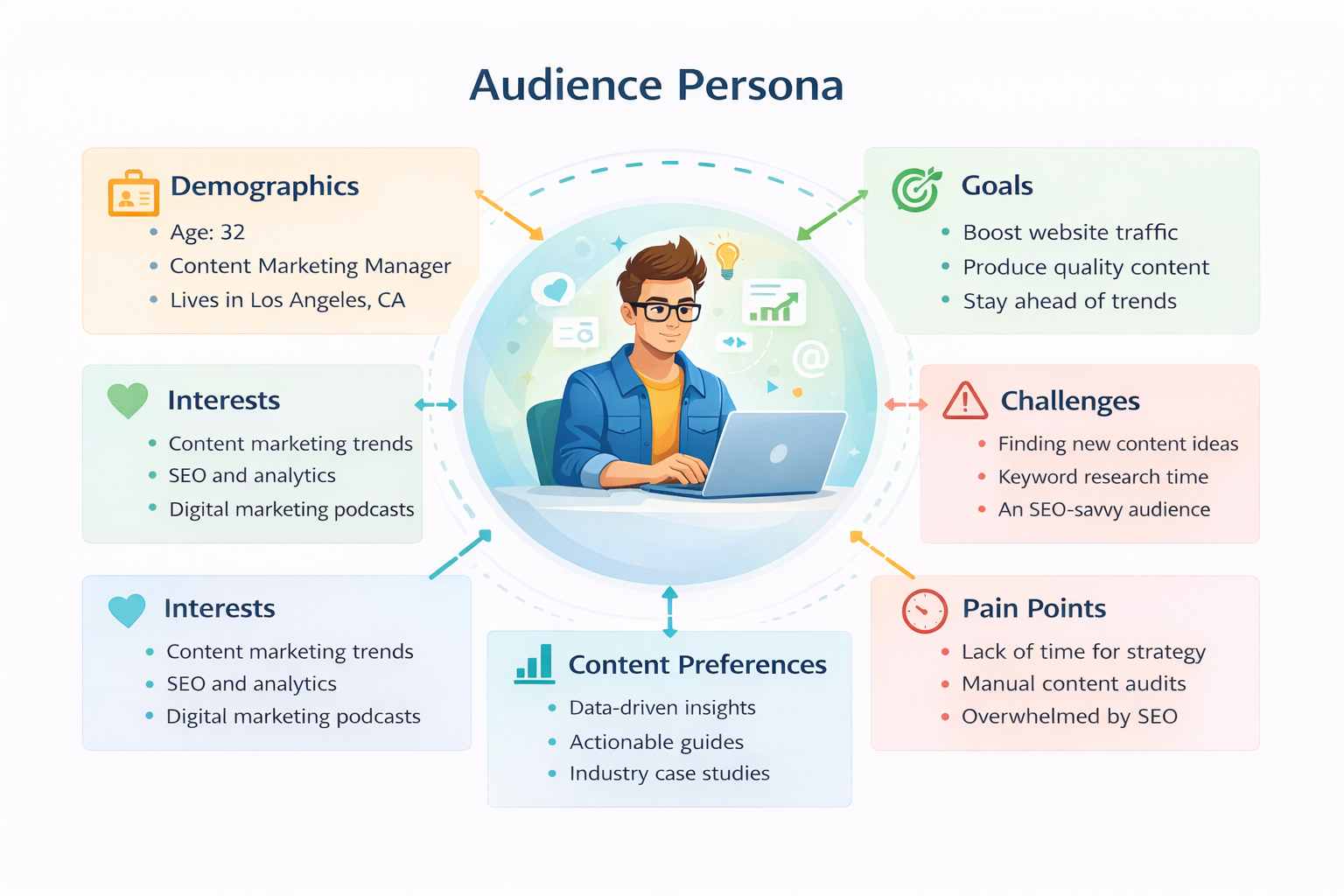
Before using any AI platform for research or planning, the first step is understanding who the content is for and what the business wants to achieve. AI tools are powerful, but they are only as effective as the strategy behind them. If marketers start generating topics or keywords without defining their audience and goals, the result is usually scattered content that attracts the wrong visitors or fails to support business objectives.
The foundation of a successful content strategy begins with target audience analysis. This involves understanding who the audience is, what problems they face, what type of information they search for, and how they consume content online. Marketers often build audience personas to represent their ideal reader or customer. These personas include details such as age group, interests, profession, common challenges, and preferred platforms. When AI tools are used after defining these characteristics, the generated topic ideas and keywords become far more relevant.
The second step is identifying business objectives. Content should not exist only to fill a website with articles. It should support measurable goals such as increasing website traffic, generating leads, improving brand awareness, or educating potential customers. For example, a company focused on lead generation may prioritize educational guides and solution-based articles, while a brand awareness strategy may emphasize trend-based or shareable content.
Once the audience and business objectives are clear, marketers can define specific content goals. These goals help guide how AI tools will be used during the research and planning process. For instance, AI platforms may be used to identify informational keywords, discover trending topics, or analyze competitors depending on the strategy.
When these three elements—audience, objectives, and content goals—are clearly defined, AI tools can generate insights that align with the overall marketing strategy. Instead of producing random ideas, the technology becomes a structured support system that helps marketers build content that attracts the right audience and supports business growth.
| Content Goal | AI Insight or Data Used | Example Outcome |
| Increase website traffic | AI analyzes high-search-volume keywords | Blog topics targeting popular search queries |
| Generate leads | AI identifies problem-solving keywords and industry questions | Educational guides that encourage newsletter signups |
| Build brand authority | AI analyzes trending industry topics | Thought leadership articles and expert content |
| Improve search rankings | AI evaluates keyword difficulty and competitor rankings | SEO-optimized articles targeting achievable keywords |
| Understand audience interests | AI analyzes social discussions and search behavior | Content topics aligned with real audience questions |
Defining the audience and goals first ensures that the rest of the AI-driven workflow remains focused, strategic, and aligned with long-term marketing objectives.
Step 2: Use AI to Discover Content Topics
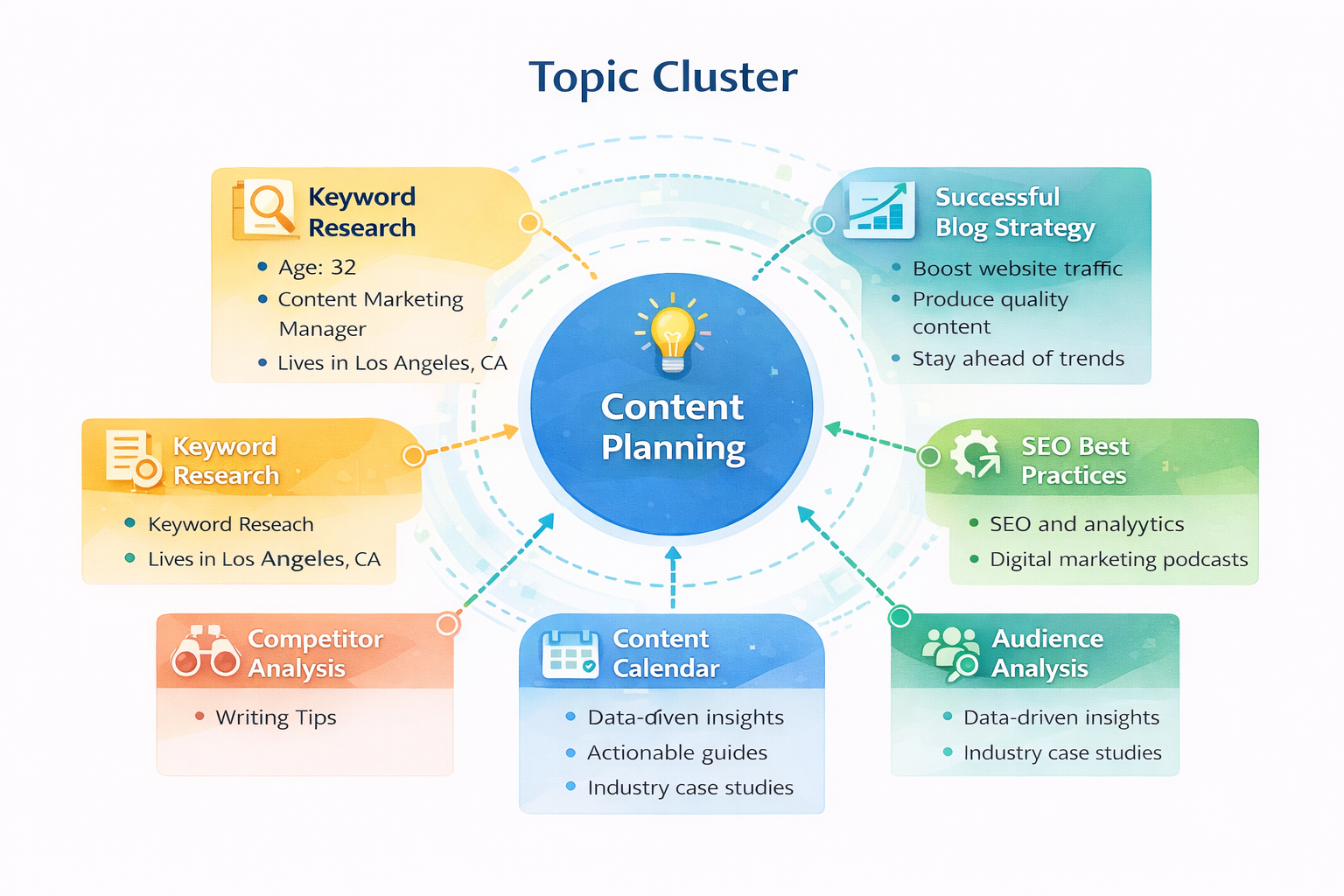
Once the audience and content goals are clearly defined, the next step is discovering relevant topics. This is where artificial intelligence becomes extremely useful. Instead of manually searching through blogs, forums, and competitor websites, AI tools can analyze large datasets to generate topic ideas based on search trends, keywords, and user behavior.
AI-powered systems scan search engines, online discussions, and content databases to identify what people are currently searching for. By analyzing this information, the tools suggest topics that match real audience demand. This approach reduces guesswork and ensures that content ideas are supported by actual search data rather than assumptions.
One of the most effective techniques used by AI tools is topic clustering. Instead of focusing on a single keyword, AI groups related keywords and ideas into clusters around a central theme. For example, if the main topic is content marketing, the AI tool may generate related subtopics such as content planning strategies, SEO content research, and content calendar management. This clustering approach helps marketers create multiple pieces of content that support a broader topic, which strengthens search engine visibility.
AI tools also improve the content ideation process. Traditionally, brainstorming sessions require teams to manually generate ideas and validate them through research. AI simplifies this process by automatically suggesting article titles, blog topics, and content angles based on existing search queries. Marketers can start with a single keyword and quickly receive dozens of topic suggestions that can be developed into blog posts, guides, or videos.
Another powerful feature is trend monitoring. AI platforms continuously track how search interest changes over time. This allows marketers to identify rising topics before they become highly competitive. Creating content around emerging trends gives businesses an advantage because they can capture search traffic early, before the topic becomes saturated with competing articles.
Using AI for topic discovery helps marketers build a stronger content pipeline. Instead of struggling to find new ideas every week, they can rely on data-driven insights that reveal what audiences actually want to read.
| AI Topic Discovery Method | How It Works | Benefit for Content Planning |
| Topic Clustering | Groups related keywords into a central topic and supporting subtopics | Helps create structured content strategies and topic authority |
| Keyword-Based Ideation | Generates topic ideas from search queries and keyword data | Provides multiple blog post ideas quickly |
| Trend Monitoring | Tracks changes in search demand and emerging topics | Allows marketers to create content before competition increases |
| Audience Question Analysis | Analyzes questions asked in search engines and forums | Helps create content that answers real user problems |
By using AI-powered topic discovery, marketers can move from random brainstorming to a systematic content planning approach that is guided by real audience demand and search trends.
Step 3: Perform AI-Powered Keyword Research
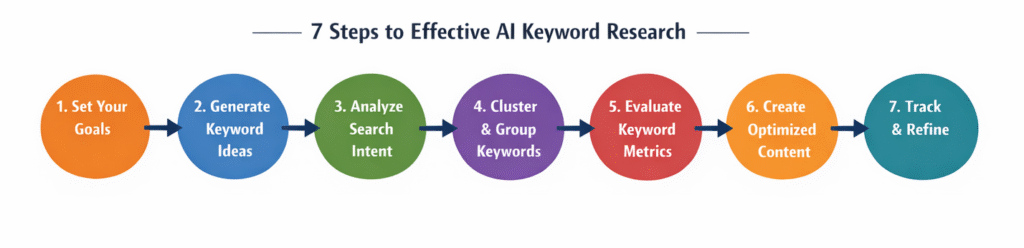
After discovering potential content topics, the next step is validating those ideas through keyword research. Topic ideas may sound promising, but without understanding how people actually search for information, it is difficult to know whether the content will attract traffic. AI-powered keyword research tools help marketers evaluate topics using real search data and identify the keywords most likely to generate visibility in search engines.
One of the most important metrics in keyword research is search volume. Search volume indicates how many times a particular keyword or phrase is searched for within a specific period, usually per month. AI tools analyze large search datasets and provide accurate estimates of keyword demand. By identifying keywords with strong search volume, marketers can prioritize topics that have a higher chance of bringing organic traffic.
Another important factor is keyword difficulty. This metric estimates how challenging it may be to rank for a particular keyword based on competition in search results. Highly competitive keywords often have many established websites already ranking for them. AI tools analyze competitor pages, domain authority, backlinks, and content quality to estimate how difficult it would be to compete for that keyword. This allows marketers to focus on keywords that provide a realistic opportunity to rank.
AI tools also help marketers understand search intent, which refers to the purpose behind a user’s search query. For example, someone searching for “what is content marketing” is likely looking for information, while a user searching for “best content marketing tools” may be comparing solutions. AI-powered tools analyze search results and keyword patterns to determine whether a query is informational, commercial, or transactional. Matching content to the correct intent increases the chances of ranking well and satisfying user expectations.
In addition to these insights, AI keyword tools often generate related keyword suggestions and long-tail keyword variations. Long-tail keywords are more specific phrases that usually have lower competition but still attract highly targeted traffic. Including these keywords in content helps articles rank for multiple related searches.
Using AI-powered keyword research ensures that topic ideas are supported by real search demand. Instead of publishing content based on assumptions, marketers can build articles around keywords that audiences are actively searching for.
| Keyword Metric | What It Measures | Why It Matters |
| Search Volume | Number of monthly searches for a keyword | Helps identify topics with strong traffic potential |
| Keyword Difficulty | Level of competition in search engine results | Helps determine whether a keyword is realistic to rank for |
| Search Intent | The purpose behind a user’s search query | Ensures content matches what users expect to find |
| Keyword Variations | Related keywords and long-tail phrases | Expands ranking opportunities across multiple searches |
By combining these metrics, marketers can select keywords that balance search demand, competition, and relevance, making their content strategy more effective and data-driven.
Step 4: Build a Data-Driven Content Calendar
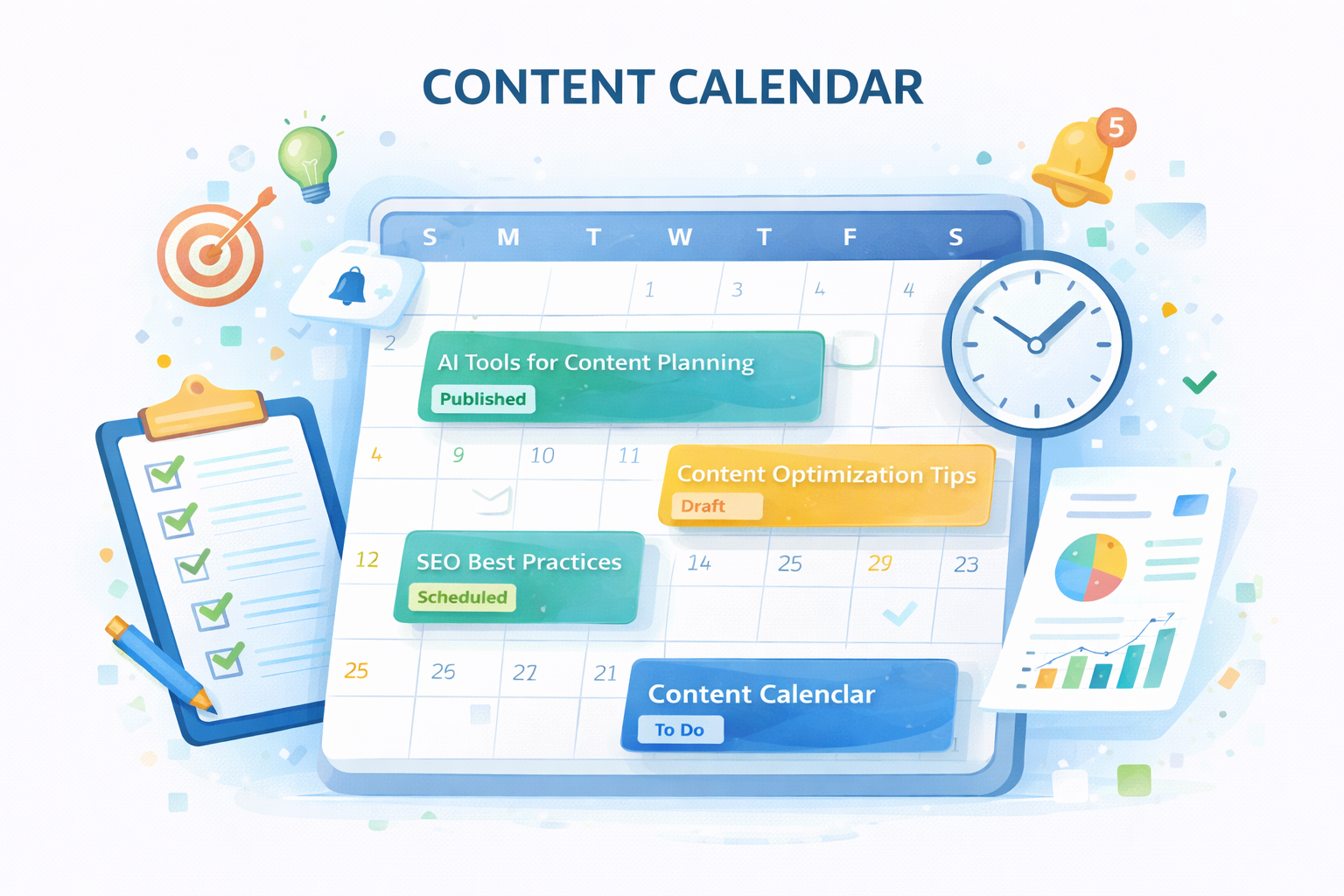
After identifying topics and validating them with keyword research, the next step is organizing those ideas into a structured publishing schedule. A content calendar helps marketers plan when each piece of content will be created and published. Without a clear schedule, content production often becomes inconsistent, which can negatively affect both audience engagement and search engine performance.
A data-driven content calendar uses insights from keyword research, audience behavior, and trend analysis to determine which topics should be published and when. Instead of randomly choosing topics each week, marketers can prioritize content based on search demand, business goals, and audience interests. AI tools help simplify this process by organizing topics automatically and suggesting an optimal publishing timeline.
One important aspect of this step is monthly content planning. Marketers often plan content several weeks or months in advance to maintain consistency. AI tools can analyze keyword data and suggest how frequently topics should be published, helping businesses maintain a steady flow of content. For example, a company may schedule two blog posts per week along with supporting social media content.
Another key element is topic prioritization. Not all topics have the same value or urgency. Some keywords may have high search demand or align closely with business objectives, while others may serve as supporting content. AI tools analyze keyword difficulty, search volume, and competitor rankings to help marketers decide which topics should be published first.
AI tools are also useful for seasonal trend planning. Certain topics become more popular during specific times of the year. For example, digital marketing searches often increase around the beginning of the year when businesses plan new strategies. AI systems can detect seasonal search patterns and recommend publishing content before peak demand occurs. This ensures that articles are already indexed and ranking when search traffic increases.
By combining these insights, marketers can build a structured content calendar that supports long-term strategy while maintaining consistent publishing. This approach not only improves organization but also ensures that content creation aligns with real audience demand and search behavior.
| Week | Content Topic | Target Keyword | Content Type | Objective |
| Week 1 | Introduction to AI Content Planning | AI tools for content planning | Blog article | Educate audience and attract informational traffic |
| Week 1 | Benefits of AI in Content Marketing | AI content marketing tools | Blog article | Increase search visibility |
| Week 2 | How to Perform AI Keyword Research | AI keyword research tools | Guide article | Provide educational value |
| Week 3 | Building an AI Content Calendar | AI content calendar planning | Blog article | Support content strategy learning |
| Week 4 | Best AI Tools for Content Strategy | AI tools for content planning and research | Comparison article | Capture high-intent search traffic |
A well-structured content calendar transforms scattered ideas into a clear publishing roadmap. With AI insights guiding topic selection and scheduling, marketers can maintain consistency, respond to search trends, and build a stronger long-term content strategy. Many digital marketing training programs now include AI-based content planning as a core part of their curriculum.
Comparing AI Tools for Content Planning and Research
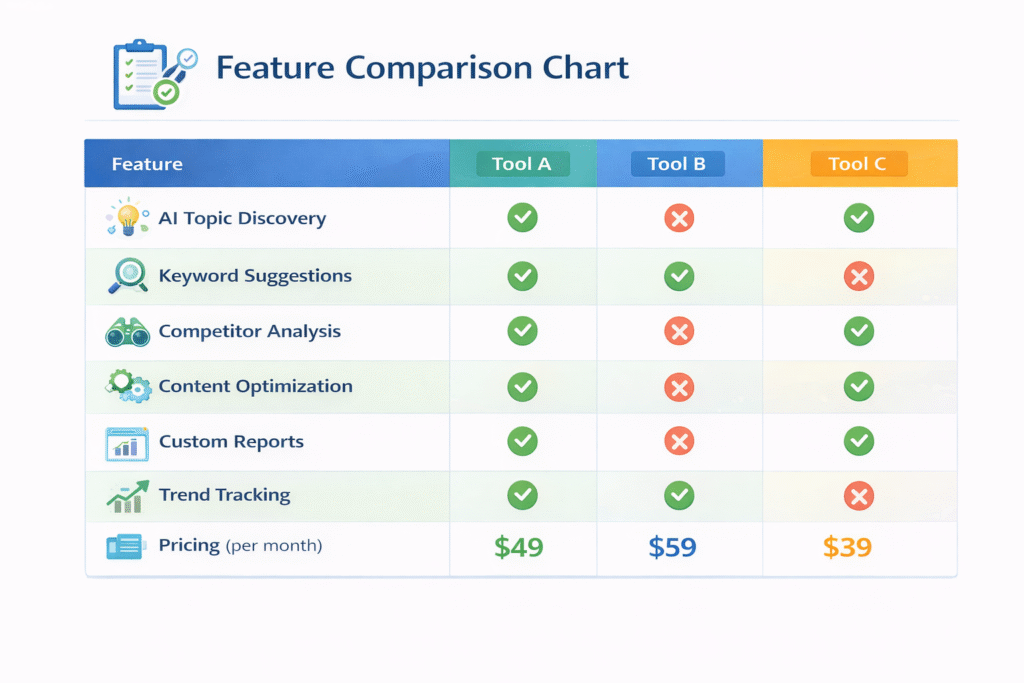
Choosing the right AI platform can significantly improve the efficiency of a content strategy. Different AI tools focus on different aspects of the workflow, such as topic discovery, keyword research, content optimization, and automated writing assistance. A clear comparison helps marketers understand which tool fits their needs, budget, and level of expertise.
Several AI platforms have become widely used in digital marketing because they combine data analysis, automation, and content generation features. Tools like ChatGPT, Jasper, Surfer SEO, Semrush, and Frase are commonly used for content planning and SEO-driven research. Each platform provides different capabilities depending on whether the goal is brainstorming ideas, analyzing competitors, or optimizing articles for search engines. (Semrush)
For example, conversational AI assistants are useful for brainstorming content ideas, generating outlines, and analyzing data. Platforms such as ChatGPT are often used by marketers for research, ideation, and strategy development. (Dataslayer) Meanwhile, SEO-focused platforms like Surfer SEO analyze top-ranking pages and recommend keyword usage, headings, and content structure to help articles rank higher in search results. (Altos Edu Hub)
Some platforms focus on full marketing workflows. Tools such as Jasper provide automated content pipelines and marketing workflows designed for teams that produce large volumes of content across multiple channels. (Jasper) Other solutions like Frase combine research, optimization, and AI writing in one platform to help create search-optimized articles. (Frase)
Because every tool emphasizes different strengths, marketers often combine multiple tools to create a complete content planning system. For instance, one tool might be used for topic discovery, another for keyword research, and another for content optimization.
Detailed Tool Comparison Table
| AI Tool | Key Features | Ease of Use | Pricing Model | Best Use Case |
| ChatGPT | AI marketing automation, brand voice control, and large-scale content production | Very beginner-friendly | Free plan + paid subscription tiers | Bloggers and marketers brainstorming content ideas |
| Jasper | Keyword research, competitor analysis, content templates, and visibility tracking | Moderate learning curve | Subscription-based plans | Marketing teams producing high-volume content |
| Surfer SEO | SEO optimization, keyword suggestions, content scoring, competitor analysis | Moderate | Monthly subscription | SEO professionals optimizing blog content |
| Semrush AI Toolkit | Keyword research, competitor analysis, content templates, visibility tracking | Moderate to advanced | Tiered subscription plans | Agencies and businesses managing SEO campaigns |
| Frase | AI content briefs, SERP analysis, content optimization, AI writing assistant | Beginner to intermediate | Subscription starting around monthly plans | Content strategists creating SEO-focused articles |
A feature comparison chart like this helps marketers quickly evaluate tools based on functionality, usability, and cost. Instead of choosing tools randomly, businesses can select platforms that align with their content strategy and workflow needs.
In practice, the most effective approach is often a combination of tools. For example, marketers may use one platform for topic discovery, another for keyword research, and another for optimizing content performance. By combining these technologies, businesses can build a more efficient system for planning and producing high-quality content.
Choosing the Right AI Tool for Your Needs
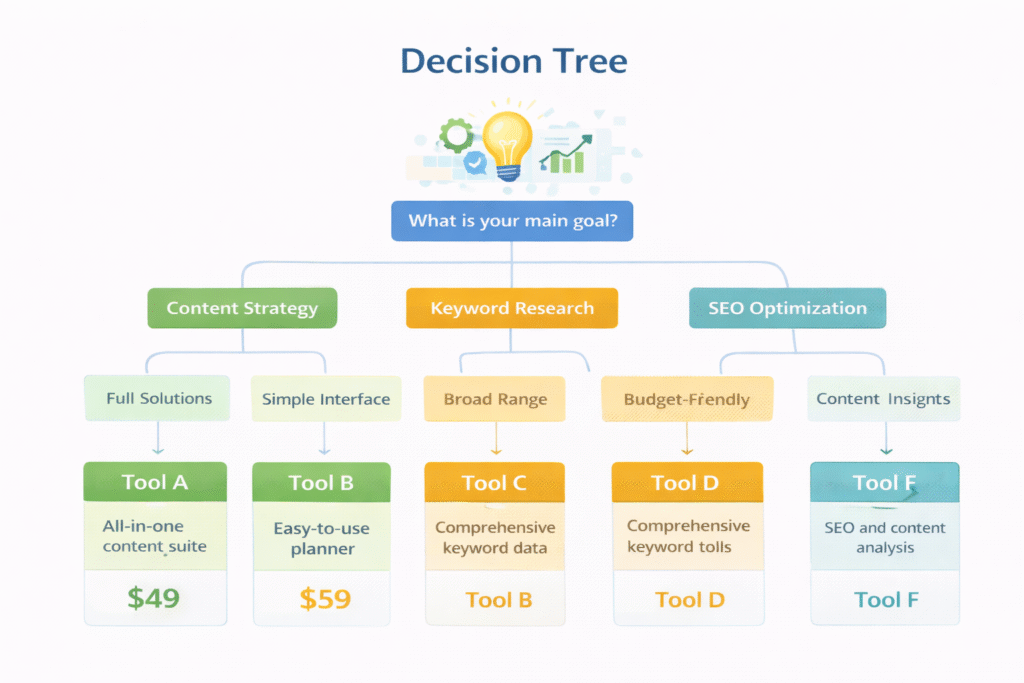
With so many AI platforms available, selecting the right tool can feel overwhelming. Each tool offers different capabilities, pricing models, and levels of complexity. The best choice depends on several factors, including your budget, team size, content production goals, and SEO requirements. Instead of choosing a tool simply because it is popular, marketers should evaluate how well it fits their overall content strategy.
One of the first considerations is budget. AI tools range from free platforms to advanced enterprise solutions with monthly subscriptions. Freelancers and small businesses may prefer cost-effective tools that provide essential features such as topic generation, keyword suggestions, and content outlines. Larger organizations, on the other hand, often invest in premium platforms that combine SEO research, competitor analysis, and workflow management in one system.
Another important factor is team size. Individual content creators usually need tools that are simple and easy to use without complex setup. In contrast, marketing teams often require collaborative features such as shared dashboards, project tracking, and team workflows. Some AI platforms are designed specifically for teams and include features that allow multiple users to manage content planning and publishing together.
The scale of content production also influences tool selection. A blogger publishing a few articles each month may only need basic research and ideation tools. However, companies producing large volumes of content across blogs, social media, and marketing campaigns may require advanced AI systems that automate planning, optimization, and scheduling.
Finally, marketers should consider their SEO requirements. If search engine visibility is the main goal, tools that focus on keyword research, competitor analysis, and content optimization will be more valuable. These platforms help identify ranking opportunities and guide the creation of SEO-friendly articles that match user search intent.
When these factors are evaluated together, it becomes easier to select the AI tool that supports both short-term content creation and long-term strategy.
| Business Need | Recommended Tool Type | Reason |
| Small budget or beginner creators | AI ideation and research tools | Provide topic ideas and keyword suggestions without high costs |
| Freelancers and solo bloggers | AI writing and research assistants | Help generate outlines, research topics, and draft content efficiently |
| Small marketing teams | AI content planning and calendar tools | Organize topics, schedules, and team workflows |
| SEO-focused content strategies | AI SEO and keyword research platforms | Provide detailed keyword data and competitor insights |
| Large businesses and agencies | All-in-one AI marketing platforms | Manage large-scale content production and advanced analytics |
Choosing the right AI tool is less about finding the “best” platform and more about finding the right fit for your workflow. When the tool aligns with your goals, team structure, and content strategy, it becomes a powerful system that helps streamline research, planning, and content production.
Future of AI in Content Planning and Research
Artificial intelligence is already transforming how marketers plan and research content, but its role is expected to grow even further in the coming years. As machine learning models become more advanced and access to data continues to expand, AI will play a central role in shaping how businesses identify topics, create strategies, and optimize content performance. The next generation of marketing technology will not only assist with research but will actively guide strategic decisions.
One emerging trend is predictive topic analysis. Instead of only analyzing current search data, AI systems are beginning to forecast future trends by studying historical patterns and user behavior. These predictive models can identify topics that are likely to gain popularity in the near future. By publishing content early, businesses can position themselves as authoritative sources before competition increases.
Another development is the rise of AI-generated content strategies. Future AI platforms may be capable of analyzing an entire website, identifying weaknesses in its content structure, and generating a complete strategic roadmap. This could include suggested blog topics, keyword clusters, publishing schedules, and internal linking recommendations. Such systems would allow marketers to build comprehensive content strategies with minimal manual research.
Automated content optimization is also becoming more advanced. Current tools already provide recommendations for keyword placement, headings, and readability improvements. In the future, AI systems may automatically update existing articles by analyzing new search trends and adjusting content accordingly. This type of continuous optimization could help websites maintain strong search rankings without constant manual revisions.
Another major shift will be the integration of AI tools with broader marketing platforms. Content planning tools are increasingly being connected with analytics platforms, social media management systems, and customer relationship management (CRM) tools. This integration allows marketers to track how content performs across different channels and adjust strategies based on real performance data.
As these technologies continue to evolve, AI tools for content planning and research will likely become more intelligent, predictive, and interconnected. Instead of functioning as separate research tools, they will operate as comprehensive systems that guide the entire content marketing process—from idea generation to performance analysis.
| Current AI Capabilities | Future AI Possibilities |
| Generates topic ideas based on keyword data | Predicts emerging topics before they trend |
| Suggests keywords and search intent insights | Automatically builds full content strategies |
| Provides SEO recommendations for articles | Continuously optimizes content using real-time data |
| Analyzes competitor content | Identifies strategic opportunities across entire industries |
| Supports content planning workflows | Fully integrates with marketing, analytics, and CRM platforms |
The future of content marketing will likely be shaped by systems that combine data analysis, automation, and predictive intelligence. Marketers who learn to use these technologies effectively will gain a significant advantage in identifying opportunities, planning content strategies, and staying ahead of industry trends.
Conclusion
Content planning and topic research are essential parts of any successful digital marketing strategy. However, traditional methods of brainstorming ideas, researching keywords, and analyzing competitors can be time-consuming and inefficient. This is where AI technology is transforming the way marketers approach content creation. By analyzing large datasets, identifying search trends, and suggesting relevant topics, AI tools simplify the entire research and planning process.
Throughout this guide, we explored how AI can assist with multiple stages of content strategy. From discovering trending topics and performing keyword research to organizing a structured content calendar, AI tools provide valuable insights that help marketers make smarter decisions. These tools allow businesses to move away from guesswork and rely on real data when planning their content strategies.
One of the biggest advantages of AI-driven planning is efficiency. Marketers can identify content opportunities faster, analyze competitor strategies more effectively, and develop structured publishing schedules with minimal manual effort. This allows content teams to focus more on creativity, storytelling, and delivering value to their audience.
However, it is important to remember that AI should support human creativity rather than replace it. The most effective content strategies combine the analytical power of AI with human insight, industry expertise, and unique perspectives. While AI can reveal what audiences are searching for, marketers still play a critical role in crafting meaningful and engaging content that resonates with readers.
As digital marketing continues to evolve, businesses that adopt AI-driven content planning strategies will have a competitive advantage. By using data-backed insights and intelligent tools, marketers can create content that aligns with audience needs, improves search visibility, and drives long-term growth. If you want to build a career in content marketing and AI strategy, joining a practical digital marketing training institute can help you gain real-world skills faster.
What are AI tools for content planning and research?
AI tools for content planning and research are software platforms that use artificial intelligence to help marketers discover topics, analyze keywords, study audience trends, and plan content strategies. These tools simplify the research process and help create data-driven content plans.
How do AI tools help with content topic research?
AI tools analyze search trends, competitor content, and keyword data to generate topic ideas. They help marketers identify trending subjects and understand what audiences are actively searching for online.
Why should marketers use AI for content planning?
Using AI improves efficiency and accuracy. It allows marketers to analyze large amounts of data quickly, identify high-performing topics, and create structured content calendars that align with audience interests.
Can beginners use AI tools for content planning and research?
Yes. Most AI tools are designed with simple dashboards and automated suggestions, making them easy for beginners to use. Even people with limited marketing experience can generate topic ideas and plan content effectively.
What are some popular AI tools for content planning and research?
Some widely used AI tools include ChatGPT, Jasper AI, Surfer SEO, SEMrush, and Ahrefs. These platforms help with keyword research, topic discovery, content optimization, and strategic planning.
Are AI tools better than manual content research?
AI tools are faster and provide more data insights than manual research. However, the best results come from combining AI analysis with human creativity and strategic thinking.
How do AI tools help with keyword research?
AI tools analyze search engine data to identify keywords with high search volume and manageable competition. They also suggest related keywords and help marketers understand search intent.
Can AI tools create a content calendar automatically?
Yes. Many AI tools can generate content calendars by organizing topics based on trends, keywords, and publishing frequency. This helps marketers maintain a consistent content schedule.
Do AI tools improve SEO performance?
AI tools can significantly improve SEO performance by identifying relevant keywords, optimizing content structure, and analyzing competitors. This helps content rank higher in search engine results.
What is the future of AI in content planning and research?
The future of AI in content marketing includes predictive topic research, automated content strategies, and deeper integration with marketing platforms. AI will continue to make content planning faster, smarter, and more data-driven.

Founder at Digital Marketing Marvel | Founder at RKDMT – Raju Kumar Digital Marketing Trainer | Best Digital Marketing Trainer in Delhi/NCR – Digiperform | Project Manager | 5+ years | Genius Study Abroad & Inlingua’s Digital Marketing Head | Learn Digital Marketing