


How AI Roles in Marketing Changing Modern Marketing Ecosystem
As a digital marketing trainer with over 10 years of experience, I’ve seen how fast the industry has changed, and nothing has reshaped it more than artificial intelligence.
The AI Roles in Marketing have grown massively in the last few years. In fact, a 2024 Deloitte survey found that 76% of marketing teams now use AI tools in their daily activities, from content creation to customer targeting.
Brands are rapidly adopting AI because it helps them save time, reduce costs, and improve accuracy. For example, AI can analyze huge amounts of customer data in seconds—something that used to take teams hours or even days.
This data-driven approach helps brands make smarter decisions, run better ad campaigns, and personalize their content at scale.
The shift toward AI-powered strategies is also happening because AI improves results. A HubSpot study showed that businesses using AI for marketing saw a 28% increase in campaign performance on average.
With such clear benefits, it’s no surprise that companies of all sizes are now exploring new AI Roles in Marketing to stay ahead in this competitive landscape.
Also Read: Google Tests Audio AI Overviews in Latest Search Labs Update
Understanding the Core AI Roles in Marketing
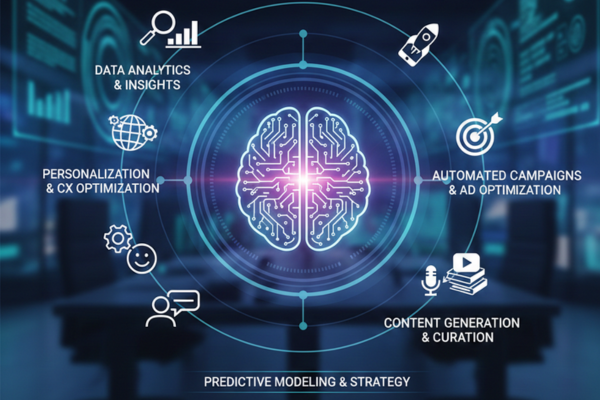
From my 10+ years in digital marketing, I’ve learned one clear thing: the brands that win are the ones that understand their data and take fast action. This is exactly where the AI Roles in Marketing create the biggest impact.
Data Processing and Automation
Earlier, marketers spent hours collecting data from Google Analytics, CRM tools, and ad dashboards. Now, AI does this in real time. According to IBM, AI can process data up to 100 times faster than humans, which means marketers get insights instantly instead of waiting for manual reports.
For example, an e-commerce store can use AI to track customer behavior, abandoned carts, and buying patterns automatically. This saves time, reduces errors, and helps teams focus more on strategy instead of routine tasks.
Predictive Analytics and Customer Insights
Predictive analytics is one of the most powerful AI Roles in Marketing. It uses past data to guess future behavior—what people might buy, when they might buy, and what message will push them to take action.
A Salesforce study revealed that 57% of marketers rely on AI to predict customer needs, helping them target users more accurately.
For example, AI can predict which leads are most likely to convert, so businesses can focus their budget and efforts on high-value audiences.
Personalization at Scale
Customers today expect personalized experiences. AI makes this easy by showing the right message to the right person at the right time.
Brands using AI-powered personalization reported a 20% increase in sales according to McKinsey.
Think of platforms like Netflix or Amazon—every recommendation is driven by AI based on your past behavior. This same approach is now used in email marketing, ads, websites, and even chatbots.
This is another strong example of how AI Roles in Marketing help brands deliver meaningful, tailored experiences without increasing workload.
Also Read: Google Rolls Out Verified Badge for Local Services Ads
Key AI Roles in Marketing for Customer Targeting
I can say that targeting the right audience is one of the most important skills in digital marketing. Today, AI makes this process smarter and more accurate than ever before.
The AI Roles in Marketing for customer targeting help businesses reach people who are truly interested—without wasting budget.
AI-Driven Audience Segmentation
Earlier, audience segmentation was based on guesswork or basic demographics. Now AI studies real user behavior, interests, past actions, and engagement patterns to build highly accurate segments.
In a recent Statista report, over 60% of marketers said AI improved their audience segmentation quality.
For example, an online clothing store can use AI to group customers based on browsing history, purchase frequency, price range preference, and even color choices. This helps brands send the right message to the right customer group every time.
Behavioral Predictions
One of the strongest AI Roles in Marketing is predicting what a user will do next. AI models study how people interact with websites, ads, emails, and apps, and use that data to forecast behavior.
A good example is predicting churn—AI can identify customers who are likely to stop using a service, so businesses can run retention campaigns before losing them.
Adobe found that companies using AI for behavioral predictions improved conversions by 25%, simply because they acted before the customer made a final decision.
Lookalike Audience Creation for Ads
Lookalike audiences used to be created manually with limited data. Today, AI automatically analyzes your best-performing customers and finds new users who behave just like them.
Meta and Google both use AI-driven lookalike modeling, helping advertisers lower costs and increase ROI.
In fact, Meta reported that advertisers saw up to 40% better results when they used AI-based lookalike audiences.
This is one of the most effective AI Roles in Marketing, especially for scaling ads without increasing risk.
AI Roles in Marketing for Content Creation & Optimization
I’ve seen how content used to take days to plan, write, and optimize. Today, AI has changed that completely. The AI Roles in Marketing for content creation and optimization are helping brands save time, improve quality, and increase visibility on search engines.
Automated Content Writing and Editing
AI-powered writing tools can now create blogs, social media posts, ad copies, and video scripts in minutes. According to HubSpot, nearly 80% of marketers use AI for content creation, which shows how fast the industry is adopting it.
AI also helps in editing—checking grammar, tone, readability, and structure. This ensures the final content is clean and professional. For example, if a business needs 10 product descriptions in a day, AI can generate them within minutes while maintaining quality.
AI for Keyword Research and SEO Optimization
One of the strongest AI Roles in Marketing is improving SEO. AI tools analyze thousands of keywords, search trends, and competitor pages much faster than manual research.
A SEMrush study showed that AI-powered SEO tools improved ranking performance by up to 30% for many businesses.
AI also helps identify search intent, content gaps, and optimization opportunities like:
- High-ranking title ideas
- Keyword difficulty analysis
- Internal link suggestions
- SEO-friendly structure
This ensures every piece of content has a better chance of ranking on Google.
Personalized Content Recommendations
Personalization is no longer optional. Customers expect content that matches their needs. AI studies user behavior—like pages visited, products viewed, and past purchases—to recommend content that feels relevant.
This approach is why Netflix’s recommendation engine drives 80% of its total watch time. The same logic works in marketing.
For example:
- E-commerce sites show products based on browsing history
- Blogs show articles related to previous reads
- Email campaigns deliver personalized offers
This is another strong example of how AI Roles in Marketing help boost engagement and conversions.
The Expanding AI Roles in Marketing Automation
I’ve seen marketers struggle with managing emails, leads, and customer communication. Today, AI has taken over most of these repetitive tasks, helping businesses work faster and smarter. The AI Roles in Marketing within automation are growing rapidly and delivering better results with less effort.
Email Automation and Campaign Flows
Email marketing used to be a manual job—writing separate emails, scheduling them, and hoping they worked. Now AI builds complete automated flows based on user behavior.
A recent Campaign Monitor report showed that AI-powered email automation increases open rates by 41% and click-through rates by 35%.
For example:
- If a user abandons a cart, AI sends a reminder email automatically
- If someone downloads a guide, AI triggers a follow-up email
- If a customer hasn’t interacted, AI sends re-engagement content
This makes email campaigns more personalized, timely, and effective.
Lead Scoring and Nurturing
One of the most powerful AI Roles in Marketing is scoring leads based on their chance of converting. Earlier, marketers followed gut feeling, but now AI uses data—like page visits, interactions, timing, device behavior, and purchase patterns—to score leads accurately.
According to Salesforce, AI-driven lead scoring increases sales productivity by 30% because teams focus only on high-quality leads.
AI also nurtures leads by sending them the right content at the right stage, helping move them smoothly through the funnel.
Chatbots and Virtual Assistants
AI chatbots have become a must-have for businesses today. They handle FAQs, product queries, bookings, complaints, and even sales conversations.
Gartner reported that AI chatbots now handle 70% of customer conversations without human support.
For example:
- E-commerce chatbots help with order tracking and product suggestions
- Service-based businesses use bots to schedule calls or demos
- Real estate websites use AI to pre-qualify buyers
These bots work 24/7, offer instant replies, and improve customer experience at almost zero extra cost.
Overall, the expanding AI Roles in Marketing are making automation smarter, faster, and more impactful, helping brands scale without increasing workload.
AI Roles in Marketing Analytics & Performance Tracking
One thing has always been clear: the brands that track their numbers closely always perform better. Today, AI is making analytics faster, clearer, and much more accurate.
The AI Roles in Marketing for analytics and performance tracking help marketers take the guesswork out of decision-making.
Real-Time Data Visualization
Earlier, marketers had to export data from different tools and build dashboards manually. Now, AI platforms visualize data in real time.
According to PwC, over 60% of marketers say AI-based dashboards help them make quicker decisions.
AI tools automatically pull data from Google Ads, social media, CRM systems, and websites, then display it in easy-to-understand charts and reports.
This helps marketers:
- Track performance instantly
- Spot issues or trends earlier
- Adjust campaigns without delay
For example, if an ad campaign suddenly drops in performance, AI highlights it immediately so you can fix it before losing more budget.
Campaign Performance Forecasting
One of the most impactful AI Roles in Marketing is forecasting. AI studies past campaigns, user behavior, seasonal trends, and industry benchmarks to predict future results.
A Google study found that AI-based forecasting can improve media planning accuracy by up to 50%.
Marketers use this to answer questions like:
- How much budget is needed next month?
- Which audience will perform best?
- What ROI can we expect from a new campaign?
This helps businesses plan smarter instead of relying on guesswork.
Measuring ROI With Machine Learning Models
ROI has always been one of the hardest metrics to measure, especially when users interact with multiple channels. Machine learning now solves this problem by analyzing complete user journeys.
For example, ML models can show which channels—Google Ads, Meta Ads, email, or SEO—actually contributed to a sale.
A Gartner report shared that ML-driven attribution improves ROI accuracy by 35%.
This helps marketers understand:
- Which campaigns are profitable
- Which keywords drive real revenue
- Where to reduce or increase budget
This is another powerful way the AI Roles in Marketing are helping businesses maximize returns with clear, data-backed decisions.
Emerging AI Roles in Marketing Across Social Media
In the last few years, social media has changed faster than any other marketing channel. With new features, formats, and consumer behavior shifts, it has become harder for brands to keep up.
This is where the AI Roles in Marketing on social platforms have become extremely valuable. AI helps marketers stay updated, spot trends early, and create content that truly connects with the audience.
Trend Prediction
Social media trends move quickly—sometimes within hours. AI tools scan millions of posts, hashtags, keywords, and engagement patterns to identify what’s gaining traction.
A Sprout Social report revealed that 72% of marketers rely on AI to spot social trends before they peak.
For example:
- AI can predict which reels or short-form video topics will go viral
- It can identify rising influencers in a niche
- It highlights trending sounds, captions, and formats
This helps brands join trends early and get higher reach with minimal effort.
AI-Enhanced Ad Creatives
One of the strongest AI Roles in Marketing today is improving ad creatives. AI studies high-performing ads and automatically suggests better headlines, visuals, color combinations, and call-to-action options.
Meta shared that AI-enhanced ad creatives can improve performance by 30% to 50% because they are optimized for engagement.
For example:
- AI generates multiple versions of an ad to test
- It identifies which creative element boosts conversion
- It helps create personalized ads for different audience segments
This allows marketers to scale their ads quickly with better results and lower costs.
Sentiment Analysis for Brand Monitoring
A big part of social media marketing is understanding how people feel about your brand. AI-powered sentiment analysis checks comments, reviews, tags, and mentions to determine whether the overall sentiment is positive, negative, or neutral.
According to Hootsuite, brands using AI for sentiment tracking resolve issues 2X faster than those using manual monitoring.
For example:
- AI alerts brands when negative comments start increasing
- It identifies common complaints or praise
- It helps in managing brand reputation proactively
This is one more example of how the AI Roles in Marketing are helping businesses protect their image and improve customer satisfaction.
Challenges & Ethical Concerns Related to AI Roles in Marketing
Even though AI has created massive opportunities for businesses, it also comes with a few challenges that marketers must handle responsibly. As someone who has worked in digital marketing for more than a decade, I always remind my students that the AI Roles in Marketing must be used carefully to protect customer trust and brand reputation.
Data Privacy Issues
One of the biggest concerns with AI is how customer data is collected and used. AI systems depend on huge amounts of data—browsing behavior, purchase history, location, device usage, and more.
A Cisco study found that 86% of consumers are worried about how companies use their personal data.
If brands are not transparent, it can create legal risks and harm customer trust.
Marketers must:
- Follow data protection laws
- Use only essential customer information
- Clearly communicate how data is stored and processed
Responsible data usage is key to maintaining long-term trust.
Bias in AI Models
Another challenge in the AI Roles in Marketing is bias. AI learns from past data, and if that data is unbalanced, the output becomes biased.
For example, an ad platform might show job ads to one gender more than the other simply because the algorithm learned from historical patterns.
A Harvard study reported that AI bias appears in over 40% of automated decisions if not monitored.
To avoid this, marketers must:
- Regularly review AI suggestions
- Train AI models with diverse data
- Avoid full reliance on automated decisions
Human oversight is extremely important to keep AI fair and accurate.
Transparency and Trust Concerns
Customers want to know when AI is interacting with them. When brands hide the use of AI tools—like chatbots or automated emails—it can reduce trust.
In fact, a Deloitte survey showed that 62% of customers feel uncomfortable when AI is not clearly disclosed.
Brands must be open about how AI is used in communication, targeting, and customer service.
This includes:
- Informing users when they are chatting with an AI bot
- Being clear about automated content
- Explaining how recommendations or decisions are made
Transparency helps customers feel safer and more connected to the brand.
Overall, while the AI Roles in Marketing are powerful, they must be handled with responsibility, fairness, and honesty to build a trustworthy digital ecosystem.
Future AI Roles in Marketing: What to Expect Next
I can confidently say that the next phase of AI will be even more transformative. The AI Roles in Marketing are expanding fast, and the future will bring smarter automation, deeper personalization, and a clearer understanding of consumer behavior.
Hyper-Personalization
Today’s personalization is good, but the future will make it even sharper. Hyper-personalization means AI will deliver content, offers, and recommendations that match each user’s exact needs in real time.
A McKinsey report predicts that brands using deep personalization could increase revenue by up to 40%.
For example:
- Websites will change layout based on user interest
- Emails will adjust tone, product suggestions, and timing automatically
- Ads will become fully dynamic for every single viewer
This level of accuracy will make marketing more relevant and impactful than ever.
Autonomous Ad Management
One of the most advanced AI Roles in Marketing we’ll see is complete automated ad management.
Platforms like Google, Meta, and LinkedIn are already testing AI that can run full campaigns with minimal human input.
According to Google, AI-managed campaigns already reduce acquisition costs by 20–30%.
In the future, AI will:
- Set budgets
- Select audience segments
- Create and test ad creatives
- Optimize bids
- Pause or scale campaigns automatically
This will allow marketers to focus more on strategy and creative direction while AI handles day-to-day optimization.
AI-Driven Consumer Behavior Mapping
Understanding customer behavior is the foundation of successful marketing. AI will soon map complete customer journeys with extreme accuracy—showing what motivates people, what stops them, and what triggers conversion.
A Gartner study predicts that over 70% of enterprise brands will use AI behavior models by 2027.
AI will help marketers understand:
- Why customers choose certain brands
- What emotional triggers influence buying decisions
- How users behave across devices and channels
- What future actions they are likely to take
This deep behavior mapping will help brands deliver better experiences and build stronger customer relationships.
The future is exciting, and the AI Roles in Marketing will continue to grow, helping businesses run smarter, faster, and more efficiently than ever before.
Final Thought
I’ve seen how technologies come and go — but nothing has transformed the industry the way AI has. The AI Roles in Marketing have turned complex, time-consuming tasks into quick, data-backed processes that deliver better results with less effort. From customer targeting and content creation to automation and analytics, AI is now involved in almost every part of a marketing strategy.
The biggest advantage of AI is that it helps marketers make smarter decisions. Studies show that businesses using AI in marketing see 20% to 40% higher performance across campaigns. Whether it’s predicting user behavior, optimizing ads, personalizing content, or tracking ROI more accurately, AI significantly improves both efficiency and output. It removes guesswork and replaces it with clear insights.
This is exactly why marketers must adopt AI if they want to stay competitive. Today’s customers expect fast responses, personalized experiences, and relevant content — and AI makes all of that possible at scale. Brands that ignore AI risk falling behind, while those who embrace it gain a major edge in visibility, engagement, and revenue.
In short, the future of marketing will be built on AI. And the marketers who start adapting today will be the ones leading tomorrow’s digital landscape.

Founder at Digital Marketing Marvel | Founder at RKDMT – Raju Kumar Digital Marketing Trainer | Best Digital Marketing Trainer in Delhi/NCR – Digiperform | Project Manager | 5+ years | Genius Study Abroad & Inlingua’s Digital Marketing Head | Learn Digital Marketing