


AI in Digital Marketing: How It Works (Complete Guide)
AI in Digital Marketing is no longer a futuristic concept—it is now a core part of how modern marketing operates. Businesses today generate massive amounts of customer data every second, from website visits and search behavior to purchase patterns and engagement metrics. Traditional marketing methods cannot analyze this volume of data efficiently.
Artificial intelligence solves this problem by processing data instantly, identifying patterns, and making intelligent decisions that improve marketing performance. This shift has fundamentally changed how marketers target audiences, optimize campaigns, and drive conversions.
One of the biggest reasons AI adoption has accelerated is its ability to automate complex tasks that previously required manual effort. Audience targeting, for example, used to rely on assumptions and limited demographic information. Marketers would manually create audience segments and test campaigns through trial and error.
Today, AI analyzes user behavior, predicts intent, and automatically identifies high-converting audiences. This automation improves accuracy and eliminates guesswork. Also, AI is transforming modern digital marketing strategies by helping marketers automate tasks, analyze data, and improve campaign performance.
Content creation and optimization have also evolved. Previously, marketers had to manually analyze performance data to determine which content worked best. AI now analyzes engagement patterns, predicts which topics will perform well, and even assists in content creation. This allows marketers to produce more effective content faster while maintaining quality and relevance.
Campaign optimization is another area where AI has had a major impact. Traditional campaign management required continuous monitoring and manual adjustments. AI systems now optimize campaigns automatically in real time. They adjust bids, targeting, and ad placements based on performance data. This ensures that campaigns continuously improve without constant human intervention.
The rapid adoption of AI is supported by clear data. According to the HubSpot State of Marketing Report, over 80% of marketers now use AI tools in some form. This includes advertising automation, content creation, analytics, and customer engagement.
McKinsey research shows that AI adoption in marketing has increased by more than 250% since 2018, highlighting how quickly businesses are integrating AI into their operations. The same research indicates that AI can increase marketing productivity by 20–30%, allowing teams to achieve better results with less manual effort.
AI also improves marketing precision. Instead of targeting broad audiences, AI enables hyper-personalized marketing. It analyzes individual user behavior, preferences, and intent to deliver relevant content. This increases engagement, improves customer experience, and drives higher conversion rates. Personalization at this scale was impossible before AI.
Another major advantage is predictive capability. AI does not just analyze past data—it predicts future behavior. It can identify which users are most likely to convert, when they are most likely to engage, and what type of content will influence their decisions. This predictive ability allows businesses to make proactive marketing decisions instead of reactive ones.
AI is also transforming marketing efficiency. Tasks that previously required hours of manual analysis can now be completed instantly. Marketers can focus on strategy, creativity, and growth instead of repetitive tasks. This improves overall efficiency and enables businesses to scale their marketing efforts more effectively.
The transformation caused by AI is not temporary—it represents a permanent shift in how marketing works. Businesses that adopt AI gain significant competitive advantages, including better targeting, higher efficiency, and improved return on investment. Those who fail to adapt risk falling behind competitors who use AI to optimize performance.
Understanding how AI works and how it impacts marketing is essential for modern marketers. As technology continues to evolve, AI will become even more integrated into marketing systems, shaping the future of how businesses attract, engage, and convert customers.
What Is AI in Digital Marketing?
AI in Digital Marketing refers to the use of artificial intelligence technologies to analyze data, automate marketing tasks, predict customer behavior, and optimize marketing performance without constant human intervention. Instead of relying on manual analysis and assumptions, AI uses algorithms and machine learning to process large volumes of data and make intelligent decisions. This allows marketers to deliver more relevant content, target the right audiences, and improve overall campaign efficiency.
At its core, AI enables marketing systems to learn from user behavior and continuously improve performance. It can analyze patterns in customer interactions, identify trends, and predict future actions. This allows businesses to automate complex processes such as audience targeting, content personalization, and campaign optimization. AI transforms marketing from a reactive process into a predictive and automated system that improves results over time.
AI is already integrated into many marketing platforms. When Google Ads automatically adjusts bids, when email platforms personalize subject lines, or when websites recommend products based on browsing history, AI is working behind the scenes. These systems analyze user data and make decisions instantly, improving marketing accuracy and efficiency.
Definition of AI in Digital Marketing
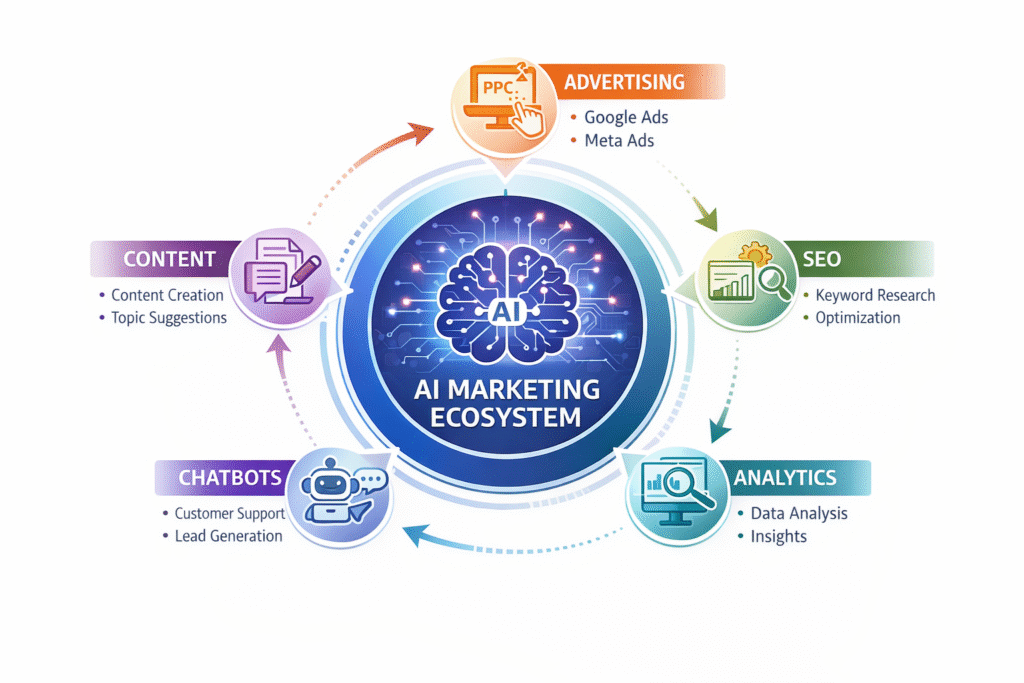
AI in Digital Marketing uses machine learning, data analysis, and automation to improve marketing performance and decision-making. It allows marketing systems to analyze customer data, identify patterns, and automatically adjust campaigns based on performance and predicted outcomes. This reduces manual effort while increasing precision and effectiveness.
One of the primary functions of AI is predicting user behavior. By analyzing browsing patterns, engagement data, and past interactions, AI can determine which users are most likely to convert. This allows marketers to focus their efforts on high-potential audiences, improving efficiency and return on investment.
AI also enables marketing automation. Instead of manually managing campaigns, AI systems can automatically adjust targeting, budgets, and content based on performance data. This ensures campaigns remain optimized without constant monitoring.
Personalization is another major benefit. AI analyzes individual user preferences and delivers tailored content, recommendations, and advertisements. This improves user experience and increases engagement.
Common examples of AI in Digital Marketing include:
- Google Ads automation, where AI adjusts bids and targeting automatically
- Email marketing automation, where AI personalizes content and optimizes send times
- Content recommendation systems are used by platforms like YouTube, Netflix, and e-commerce websites
These applications demonstrate how AI enhances marketing efficiency and improves performance.
Also Read : How to Use AI Tools for Keyword Research (Step-by-Step Guide)
Core Technologies Behind AI Marketing
AI in Digital Marketing relies on several core technologies that enable it to analyze data, understand content, and make intelligent decisions. Each technology plays a specific role in improving marketing effectiveness.
Machine Learning (ML) is one of the most important technologies behind AI marketing. It allows systems to learn from data and improve over time without being explicitly programmed. Machine learning analyzes patterns in user behavior, identifies trends, and predicts future actions. This enables accurate audience targeting and campaign optimization.
Natural Language Processing (NLP) allows AI to understand and process human language. It enables chatbots to interact with users, helps AI generate content, and allows systems to analyze customer feedback. NLP improves communication between businesses and customers by enabling automated and intelligent interactions.
Predictive analytics uses historical data to predict future outcomes. It helps marketers identify which users are most likely to convert, which campaigns will perform best, and which strategies will deliver the highest return on investment. This allows businesses to make proactive decisions instead of reacting after campaigns fail.
Computer vision enables AI to analyze images and visual content. It is used in platforms that automatically recognize objects, faces, and visual patterns. In marketing, computer vision helps analyze visual engagement and optimize image-based content.
Core AI Technologies in Marketing
| Technology | Function | Marketing Use |
| Machine Learning | Pattern recognition | Predict user behavior and optimize campaigns |
| Natural Language Processing | Understand human language | Chatbots, content creation, customer interaction |
| Predictive Analytics | Predict future actions | Lead scoring, campaign optimization |
| Computer Vision | Analyze images | Visual content analysis and optimization |
These technologies work together to create intelligent marketing systems that analyze data, predict outcomes, and automate decisions. By leveraging these capabilities, AI enables marketers to deliver more efficient, personalized, and effective marketing strategies.
How AI in Digital Marketing Actually Works
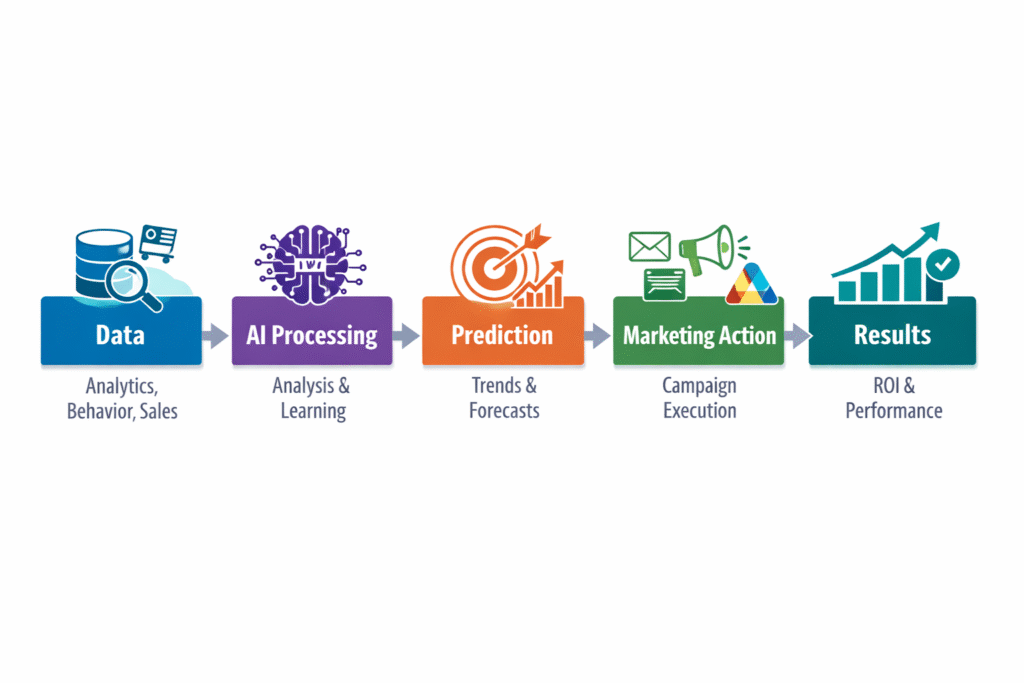
AI in Digital Marketing works through a structured process that involves collecting data, analyzing patterns, predicting user behavior, automating marketing actions, and continuously improving performance. Unlike traditional marketing systems that rely on manual analysis and static rules, AI systems use machine learning to process massive amounts of data in real time and make intelligent decisions. This allows businesses to deliver personalized experiences, optimize campaigns automatically, and improve marketing efficiency at scale.
At its core, AI functions as a closed-loop system. It collects data from multiple sources, analyzes that data to identify patterns, predicts outcomes, executes marketing actions, and then learns from the results. This continuous cycle enables AI to improve accuracy and performance over time.
Step 1: Data Collection
The first step in how AI works is collecting data. AI systems rely on large volumes of data to understand user behavior and make accurate predictions. Every interaction a user has with a website, app, or advertisement generates valuable data that AI can analyze.
Common data sources include:
- Website analytics, such as page views, time spent on pages, and click behavior
- User behavior data, including browsing patterns and interaction history
- Search data, such as keywords users search for and their intent
- Purchase history, including products viewed, added to cart, or purchased
This data provides insight into what users want, how they behave, and how they interact with digital platforms. According to IBM, companies collect over 2.5 quintillion bytes of data every day. This massive volume of data is impossible to analyze manually, which is why AI is essential.
AI systems collect this data continuously and prepare it for analysis. The more data AI receives, the more accurate its predictions become.
Step 2: Data Analysis Using Machine Learning
Once data is collected, AI uses machine learning algorithms to analyze it. Machine learning allows AI to identify patterns, trends, and relationships within the data. Instead of relying on predefined rules, machine learning systems learn from data automatically.
For example, AI can analyze which users are most likely to click on ads, which content generates the highest engagement, and which audiences convert most frequently. It identifies correlations between user behavior and marketing outcomes.
This analysis helps marketers understand:
- Which audiences are most valuable
- Which marketing strategies are most effective
- Which content drives the highest engagement
Machine learning enables AI to process millions of data points instantly, providing insights that would be impossible to obtain manually.
Step 3: Prediction and Decision Making
After analyzing data, AI uses predictive analytics to forecast future user behavior. This is one of the most powerful capabilities of AI in Digital Marketing. Instead of reacting to past performance, AI predicts what users are likely to do next.
AI can predict:
- Which users are most likely to convert?
- Which products are users most likely to purchase?
- When are users most likely to engage with content?
- Which advertisements will perform best?
For example, AI can identify users who have a high probability of making a purchase and target them with personalized ads. It can also determine the best time to display advertisements to maximize engagement. It can also identify performance issues and suggest improvements in Google Ads optimization to reduce wasted ad spend.
These predictions allow marketers to focus on high-value opportunities and improve overall campaign performance.
Step 4: Automated Marketing Execution
Once AI makes predictions, it automatically executes marketing actions. This is where automation plays a critical role. Instead of requiring manual adjustments, AI systems optimize campaigns automatically.
For example, Google Ads Smart Bidding uses AI to adjust bids in real time based on user behavior, device type, location, and other factors. This ensures that ads are shown to users who are most likely to convert.
AI can automatically:
- Adjust ad bids
- Change audience targeting
- Personalize content
- Optimize email send times
- Recommend products to users
This automation improves efficiency and ensures campaigns are always optimized for maximum performance.
Step 5: Continuous Learning and Improvement
One of the most important aspects of AI is its ability to learn continuously. AI systems do not remain static—they improve over time as they receive new data.
After executing marketing actions, AI analyzes the results. It evaluates which strategies worked and which did not. This feedback is used to refine future predictions and decisions.
This process creates a continuous improvement cycle:
Data → Analysis → Prediction → Action → Learning → Improvement
Over time, AI becomes more accurate and effective. Campaign performance improves automatically without requiring manual intervention.
This continuous learning capability makes AI far more powerful than traditional marketing systems. It enables businesses to adapt to changing customer behavior and market conditions instantly.
This structured workflow explains how AI in Digital Marketing transforms raw data into intelligent marketing decisions. By automating analysis, prediction, and execution, AI allows businesses to deliver more efficient, personalized, and effective marketing strategies.
Real Examples of AI in Digital Marketing
AI in Digital Marketing is not just a theoretical concept—it is actively used by businesses every day to automate tasks, improve targeting, and increase marketing performance. Many of the platforms marketers already use, such as Google Ads, email marketing tools, SEO platforms, and chatbots, rely heavily on AI to function efficiently. These systems analyze user behavior, predict outcomes, and automatically adjust strategies to deliver better results.
Understanding real-world applications helps marketers see how AI improves efficiency, accuracy, and scalability across different marketing channels.
AI in Google Ads
One of the most powerful examples of AI in Digital Marketing is Google Ads. Google uses artificial intelligence to automate bidding, optimize targeting, and improve ad performance. This system is designed to show ads to users who are most likely to convert.
Smart Bidding is one of the most advanced AI features in Google Ads. It uses machine learning to analyze signals such as user location, device, search intent, browsing behavior, and time of day. Based on this data, AI automatically adjusts bids to maximize conversions or return on investment. Instead of manually adjusting bids, marketers can rely on AI to make data-driven decisions in real time.
AI also enables automated targeting. Google Ads analyzes user behavior and identifies audiences that are most likely to engage with advertisements. It continuously refines targeting based on performance data, improving campaign accuracy over time.
This automation reduces manual effort while improving campaign performance, making Google Ads one of the best examples of AI-powered advertising.
AI in Content Marketing
AI has significantly transformed content marketing by helping marketers create, optimize, and distribute content more efficiently. AI-powered tools can analyze user behavior, identify trending topics, and recommend content strategies based on data.
Content generation is one of the most popular applications. AI tools can assist in writing blog posts, social media captions, and marketing copy. These tools analyze language patterns and generate content that aligns with audience preferences. This helps marketers create content faster while maintaining quality and relevance.
AI also provides topic recommendations. It analyzes search trends, user engagement, and competitor content to suggest topics that are likely to perform well. This ensures that marketers focus on content that attracts traffic and engagement.
AI improves content performance by identifying what works and what does not. It helps marketers optimize headlines, structure, and messaging based on performance data.
AI in Email Marketing
Email marketing has become far more effective with the use of AI. AI analyzes user behavior, engagement patterns, and preferences to deliver personalized email experiences.
Automated personalization is one of the key benefits. AI can customize email content based on user behavior, past interactions, and interests. This increases engagement and improves conversion rates.
Send time optimization is another powerful feature. AI analyzes when users are most likely to open emails and automatically sends messages at the optimal time. This improves open rates and ensures emails reach users when they are most engaged.
AI also helps segment audiences automatically. It identifies different user groups based on behavior and delivers relevant content to each group. This improves targeting and enhances overall campaign effectiveness.
AI in SEO
AI plays a critical role in search engine optimization by helping marketers identify opportunities, optimize content, and improve rankings. AI-powered SEO tools analyze search data, competitor strategies, and user behavior to provide actionable insights.
Keyword research has become more advanced with AI. AI tools analyze search trends, identify valuable keywords, and predict which keywords will drive traffic. This allows marketers to focus on high-impact opportunities.
Content optimization is another important application. AI analyzes existing content and recommends improvements based on ranking factors, user engagement, and search intent. This helps marketers create content that aligns with search engine algorithms.
AI also helps analyze competitor strategies, identify content gaps, and recommend improvements to improve search performance.
AI in Chatbots and Customer Support
Chatbots are one of the most visible examples of AI in Digital Marketing. They use natural language processing to interact with users, answer questions, and provide assistance automatically.
AI chatbots can handle customer inquiries instantly, improving response times and customer experience. They can answer common questions, recommend products, and guide users through purchasing processes.
Chatbots also help with lead qualification. They can collect information from users, identify potential customers, and pass qualified leads to sales teams. This improves efficiency and ensures businesses focus on high-value prospects.
AI chatbots operate 24/7, providing continuous support without human intervention. This improves customer satisfaction and reduces operational costs.
These real-world examples demonstrate how AI in Digital Marketing improves efficiency, accuracy, and scalability. By automating analysis, targeting, and communication, AI enables businesses to deliver better marketing results while reducing manual effort.
Benefits of AI in Digital Marketing
AI in Digital Marketing provides measurable advantages that improve efficiency, accuracy, and overall marketing performance. By analyzing massive volumes of data and automating decision-making, AI enables marketers to achieve better results with less manual effort. Instead of relying on guesswork, AI uses real-time insights and predictive analysis to optimize campaigns, personalize experiences, and increase return on investment. These capabilities allow businesses to scale their marketing efforts while maintaining precision and efficiency.
One of the biggest strengths of AI is its ability to continuously learn and improve. As AI analyzes more data, it becomes more accurate and effective. This leads to smarter targeting, higher conversion rates, and improved customer engagement.
Improved Targeting Accuracy
AI significantly improves audience targeting precision by analyzing user behavior, interests, and engagement patterns. Traditional marketing relied on broad demographic targeting, which often resulted in wasted budget and low conversion rates. AI eliminates this inefficiency by identifying users who are most likely to engage or convert.
AI analyzes multiple data points, including browsing behavior, search intent, purchase history, and engagement patterns. It uses this information to create highly accurate audience segments. This ensures that marketing messages reach the right users at the right time.
According to Salesforce research, AI can improve targeting accuracy by up to 50%. This improved precision increases campaign effectiveness and reduces wasted advertising spend. Businesses can focus their resources on high-value audiences, improving overall performance.
Higher Conversion Rates
AI improves conversion rates by delivering personalized marketing experiences. Instead of showing the same message to all users, AI customizes content based on individual preferences and behavior. Personalized marketing increases relevance, which improves engagement and conversion probability.
AI can recommend products based on browsing history, display personalized advertisements, and tailor email content to individual users. This level of personalization makes marketing more effective and increases customer engagement.
Predictive analytics also helps identify users who are most likely to convert. AI prioritizes these users, ensuring marketing efforts focus on high-potential opportunities. This improves conversion efficiency and overall return on investment.
Automation and Efficiency
AI automates many repetitive marketing tasks, allowing marketers to focus on strategy and creativity. Tasks such as campaign optimization, audience segmentation, and performance analysis can be handled automatically by AI systems.
Automation reduces the need for manual monitoring and adjustments. AI continuously analyzes campaign performance and makes improvements automatically. This increases efficiency and reduces workload.
Automation also allows businesses to scale their marketing efforts. AI can manage multiple campaigns simultaneously without requiring additional human resources. This improves productivity and allows businesses to grow more efficiently.
Better Customer Experience
AI enhances customer experience by delivering personalized and relevant interactions. Customers expect marketing messages that align with their interests and needs. AI analyzes customer behavior and delivers content that matches their preferences.
Personalized recommendations, targeted advertisements, and automated chat support improve customer satisfaction. AI enables businesses to respond quickly to customer needs and provide relevant solutions.
Chatbots powered by AI provide instant responses to customer inquiries, improving communication and support. These interactions enhance customer engagement and improve overall experience.
Improved customer experience leads to stronger relationships, higher engagement, and increased customer loyalty.
Real-Time Optimization
AI continuously monitors marketing performance and makes adjustments in real time. Traditional marketing required manual analysis and delayed optimization. AI eliminates this delay by optimizing campaigns instantly.
AI can adjust ad bids, targeting parameters, and content delivery based on performance data. This ensures campaigns remain optimized and efficient at all times.
Real-time optimization improves campaign performance by responding instantly to changes in user behavior. This increases efficiency and ensures maximum return on investment.
Performance Comparison With and Without AI
| Metric | Without AI | With AI |
| Conversion rate | Lower | Higher |
| Campaign efficiency | Moderate | High |
| Targeting accuracy | Limited | Highly precise |
| Optimization speed | Manual and slow | Automated and real time |
| Marketing productivity | Moderate | Significantly higher |
These measurable benefits demonstrate why AI in Digital Marketing has become essential for modern businesses. By improving targeting, increasing conversions, automating tasks, enhancing customer experience, and optimizing campaigns in real time, AI enables marketers to achieve better results while reducing manual effort.
Most Popular AI Tools Used in Digital Marketing
AI in Digital Marketing is powered by specialized tools that automate tasks, analyze data, and improve marketing performance. These tools help marketers optimize campaigns, create content, improve SEO, and analyze customer behavior more efficiently. By using AI-powered platforms, businesses can reduce manual effort, improve accuracy, and achieve better results.
Modern marketing platforms already integrate AI features, allowing marketers to automate complex processes such as ad targeting, content creation, and performance analysis. Understanding the most popular AI tools helps marketers choose the right solutions for their specific needs.
AI Advertising Tools
AI-powered advertising tools automate campaign optimization, audience targeting, and bidding strategies. These tools analyze user behavior, engagement data, and performance metrics to improve advertising efficiency.
Google Ads AI is one of the most widely used AI advertising platforms. It uses machine learning to automate bidding, optimize targeting, and improve ad performance. Features such as Smart Bidding analyze real-time signals, including user behavior, device type, and location, to maximize conversions. This automation helps marketers achieve better results without constant manual adjustments.
Meta Ads AI, used on Facebook and Instagram, also relies heavily on artificial intelligence. It analyzes user interactions, interests, and engagement patterns to deliver highly targeted advertisements. Meta’s AI continuously learns from performance data and automatically adjusts campaigns to improve efficiency and reach the most relevant audiences.
These tools allow marketers to run more effective campaigns while reducing manual effort and improving return on investment.
AI Content Tools
Content creation has become faster and more efficient with AI-powered tools. These tools assist marketers in generating ideas, writing content, and optimizing messaging based on audience preferences.
ChatGPT is one of the most popular AI content tools. It can generate blog posts, marketing copy, email content, and social media captions. It uses natural language processing to understand context and create relevant content. This allows marketers to produce content quickly while maintaining quality. Many marketers use ChatGPT and AI tools to generate content ideas, automate responses, and improve productivity.
Jasper is another powerful AI content platform designed specifically for marketers. It helps create marketing copy, product descriptions, and advertising content. Jasper analyzes marketing goals and generates optimized content designed to increase engagement and conversions.
These AI tools improve productivity by reducing the time required for content creation and helping marketers focus on strategy.
AI SEO Tools
AI-powered SEO tools help marketers improve search rankings by analyzing keywords, optimizing content, and identifying ranking opportunities. These tools use machine learning to evaluate search trends and provide actionable recommendations.
Surfer SEO analyzes search engine results and provides optimization recommendations based on ranking factors. It helps marketers create content that aligns with search intent and improves ranking potential.
Clearscope uses AI to analyze top-ranking content and recommend keyword usage, structure, and content improvements. It helps marketers optimize content to meet search engine requirements and improve visibility.
These tools allow marketers to create SEO-optimized content more efficiently and improve organic search performance.
AI Analytics Tools
AI analytics tools help marketers analyze large volumes of data and gain actionable insights. These tools identify patterns, predict trends, and provide recommendations to improve marketing performance.
Google Analytics AI, powered by machine learning, automatically identifies trends, detects anomalies, and provides insights into user behavior. It helps marketers understand how users interact with websites and identify opportunities for improvement.
HubSpot AI offers advanced analytics, automation, and customer relationship management features. It analyzes customer interactions, predicts lead quality, and automates marketing workflows. This helps businesses improve targeting and customer engagement.
AI analytics tools enable marketers to make data-driven decisions and improve campaign effectiveness.
Popular AI Tools in Digital Marketing
| Tool | Function |
| ChatGPT | Content creation and marketing copy |
| Google Ads AI | Advertising optimization and smart bidding |
| Meta Ads AI | Audience targeting and ad optimization |
| Jasper | Marketing content generation |
| Surfer SEO | SEO content optimization |
| Clearscope | Keyword analysis and content improvement |
| Google Analytics AI | Data analysis and performance insights |
| HubSpot AI | Marketing automation and analytics |
These tools demonstrate how AI in Digital Marketing enhances efficiency, improves targeting, and automates complex tasks. By leveraging AI-powered platforms, marketers can optimize campaigns, create better content, and improve overall marketing performance.
Challenges and Limitations of AI in Digital Marketing
While AI in Digital Marketing offers powerful advantages, it also has limitations that businesses and marketers must understand. AI is not a perfect solution, and its effectiveness depends on data quality, human oversight, and ethical implementation. Understanding these challenges helps marketers use AI more effectively while avoiding common risks and mistakes.
AI works best as a tool that supports human decision-making rather than replacing it completely. It enhances efficiency and accuracy, but it still requires human strategy, creativity, and supervision.
Data Dependency
AI systems rely heavily on data to function effectively. The accuracy of AI predictions and decisions depends on the quality and quantity of data available. Without sufficient data, AI cannot identify patterns or make reliable predictions.
For example, if a business has limited website traffic or customer data, AI tools may struggle to optimize campaigns accurately. AI performs best when it has access to large datasets that reflect user behavior and engagement patterns.
Data quality is equally important. Inaccurate, incomplete, or outdated data can lead to incorrect predictions and poor marketing decisions. This can reduce campaign effectiveness and negatively impact performance.
New businesses or websites with limited data may not see immediate benefits from AI because the system needs time and sufficient information to learn and improve. This makes data collection and proper data management essential for successful AI implementation.
Lack of Human Creativity
AI is highly effective at analyzing data and automating tasks, but it lacks true human creativity, emotional intelligence, or strategic thinking. It can generate content and recommendations based on patterns, but it cannot fully understand human emotions, cultural context, or brand identity as humans can.
Creative marketing requires originality, storytelling, and emotional connection. AI can assist with content generation, but human marketers are still needed to develop unique ideas, brand messaging, and creative strategies.
AI works best as a support tool rather than a replacement for human creativity. It can provide data-driven insights, automate repetitive tasks, and assist with content creation, but human oversight is essential to ensure originality and authenticity.
Successful marketing combines AI efficiency with human creativity to achieve the best results.
Privacy and Ethical Concerns
AI in Digital Marketing relies on user data to analyze behavior and personalize marketing efforts. This raises important privacy and ethical considerations. Businesses must collect, store, and use customer data responsibly to maintain trust and comply with regulations.
Data privacy laws such as the General Data Protection Regulation (GDPR) and other regional regulations require businesses to protect user data and obtain proper consent before collecting information. Failure to comply with these regulations can result in legal penalties and damage to brand reputation.
Consumers are also becoming more aware of how their data is used. Businesses must ensure transparency and ethical use of AI systems. Using AI responsibly helps build customer trust and protect brand credibility.
Ethical implementation involves:
- Collecting data with user consent
- Protecting user privacy
- Using data responsibly
- Avoiding misuse of personal information
Balancing AI capabilities with ethical responsibility is essential for sustainable marketing success.
Understanding these challenges helps marketers use AI in Digital Marketing more effectively. While AI offers powerful automation and insights, it works best when combined with high-quality data, human creativity, and ethical practices. Proper implementation ensures that businesses benefit from AI while maintaining trust and effectiveness.
Future of AI in Digital Marketing
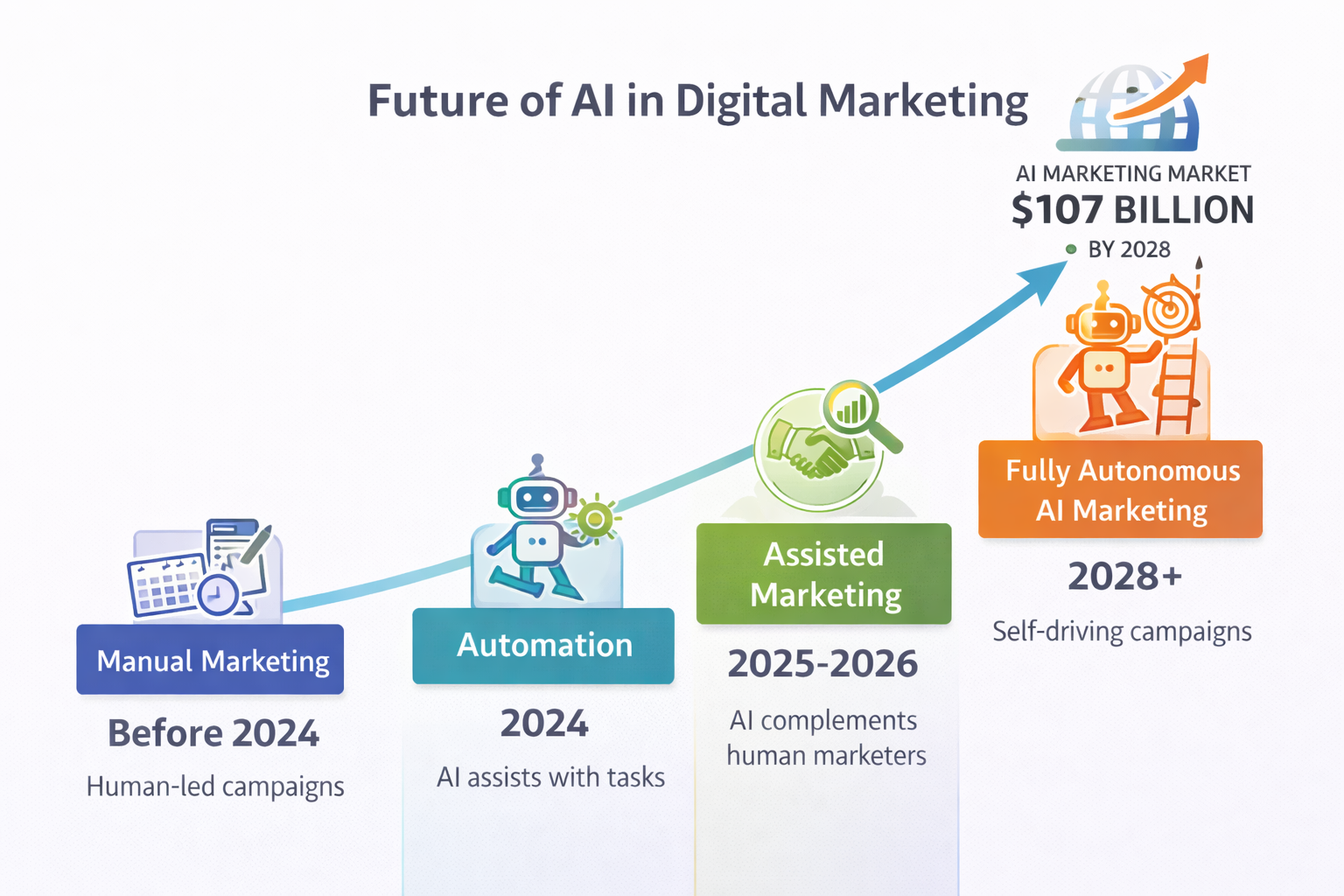
The future of AI in Digital Marketing is defined by deeper automation, smarter personalization, and more accurate predictive capabilities. As AI technology continues to evolve, it will become more integrated into every stage of the marketing process—from audience targeting and content creation to campaign optimization and customer engagement. Businesses that adopt AI early will gain significant competitive advantages by improving efficiency, increasing conversion rates, and delivering better customer experiences.
According to Statista, the global AI marketing market is projected to reach $107 billion by 2028. This rapid growth reflects how essential AI is becoming for modern marketing strategies. As data volumes continue to increase, AI will play an even more important role in helping businesses analyze data, predict customer behavior, and automate marketing decisions.
Increased Automation
Automation will continue to expand, allowing marketers to run fully automated campaigns with minimal manual intervention. Currently, AI assists with tasks such as bid optimization, audience targeting, and email scheduling. In the future, AI will manage entire campaigns independently.
AI systems will automatically analyze performance data, identify optimization opportunities, and adjust campaigns in real time. This includes modifying ad targeting, adjusting budgets, optimizing content delivery, and selecting the best channels for engagement.
Fully automated marketing systems will reduce manual workload and allow marketers to focus on strategy, creativity, and business growth. Campaign management will become faster, more efficient, and more accurate.
Automation will also improve scalability. Businesses will be able to manage large-scale campaigns across multiple platforms without increasing operational complexity.
AI-Driven Personalization
Personalization will become more advanced and precise. AI already enables personalized product recommendations, targeted advertisements, and customized email campaigns. In the future, personalization will become even more detailed and dynamic.
AI will analyze individual user behavior, preferences, browsing history, and engagement patterns to deliver hyper-personalized experiences. Instead of targeting groups of users, AI will target individuals with highly relevant content.
This level of personalization will improve customer engagement and satisfaction. Users will see content, advertisements, and recommendations that align closely with their interests and needs.
AI will also personalize marketing across multiple channels simultaneously. Websites, emails, advertisements, and customer support systems will all deliver personalized experiences based on user data.
This creates a consistent and relevant customer journey, improving overall marketing effectiveness.
Predictive Marketing
Predictive marketing will become one of the most powerful applications of AI. Instead of reacting to customer behavior after it occurs, AI will predict future actions and allow businesses to act proactively.
AI will analyze historical data and identify patterns that indicate future behavior. It will predict which customers are most likely to make purchases, which leads are most valuable, and which campaigns will perform best.
This predictive capability allows businesses to focus resources on high-value opportunities. Marketers will be able to target users before they take action, increasing conversion rates and improving efficiency.
Predictive analytics will also help businesses forecast trends, identify emerging opportunities, and adapt strategies quickly. This allows companies to stay ahead of competitors and respond to market changes more effectively.
As AI continues to evolve, predictive marketing will become more accurate and reliable. Businesses will rely on AI not just for automation, but for strategic decision-making.
The future of AI in Digital Marketing will transform how businesses connect with customers. Increased automation will improve efficiency, advanced personalization will enhance customer experience, and predictive marketing will enable smarter decision-making. These advancements will make AI an essential component of modern marketing strategies.
How Businesses Can Start Using AI in Digital Marketing
Businesses do not need advanced technical expertise or large teams to start using AI in Digital Marketing. Modern AI tools are designed to be user-friendly and accessible, allowing businesses of all sizes to improve marketing performance. The key is to start with practical applications that provide immediate benefits, such as automation, analytics, and content optimization. By integrating AI gradually, businesses can improve efficiency, reduce manual workload, and achieve better marketing results.
AI works best when implemented strategically. Instead of trying to automate everything at once, businesses should begin with specific tasks where AI can deliver clear improvements. Over time, AI can be expanded across multiple marketing functions to enhance overall performance.
Start with AI Tools
The easiest way to begin using AI is by adopting AI-powered marketing tools that automate common tasks. Many platforms already integrate AI features, allowing businesses to benefit from automation without technical complexity.
Google Ads is one of the most effective tools for using AI in advertising. Its Smart Bidding feature uses machine learning to optimize bids, improve targeting, and increase conversions automatically. This allows businesses to run more efficient campaigns without manually adjusting settings.
ChatGPT is a powerful tool for content creation and marketing support. Businesses can use it to generate blog content, marketing copy, social media posts, and email campaigns. This reduces the time required for content creation and improves productivity.
Other AI-powered tools help with SEO optimization, social media management, and customer interaction. Starting with these tools allows businesses to experience immediate benefits while building familiarity with AI technology.
Using AI tools helps businesses improve efficiency, automate repetitive tasks, and enhance marketing performance.
Use AI for Analytics
AI analytics tools help businesses understand customer behavior and make data-driven decisions. Instead of manually analyzing large volumes of data, AI identifies patterns and provides actionable insights.
AI can analyze website traffic, customer engagement, and conversion data to identify trends and opportunities. It helps businesses understand which campaigns perform best, which audiences convert most frequently, and which strategies deliver the highest return on investment.
Platforms like Google Analytics use AI to detect trends, predict outcomes, and provide recommendations. These insights help businesses improve marketing strategies and optimize performance.
AI analytics also helps identify problems early. It can detect performance drops, unusual patterns, or campaign inefficiencies. This allows businesses to take corrective action quickly.
Using AI for analytics improves decision-making, increases efficiency, and ensures marketing strategies are based on accurate data.
Automate Marketing Tasks
Automation is one of the most valuable applications of AI in Digital Marketing. AI can handle repetitive and time-consuming tasks, allowing businesses to focus on strategy and growth.
Email automation is one of the most common uses of AI. AI tools can automatically send personalized emails based on user behavior. For example, AI can send welcome emails, product recommendations, or follow-up messages based on customer actions. This improves engagement and increases conversion rates.
Ad automation is another powerful application. AI can automatically optimize ad targeting, adjust budgets, and improve campaign performance in real time. This ensures that ads reach the most relevant audiences without manual intervention.
AI can also automate customer interactions through chatbots. These systems respond to customer inquiries instantly, improving customer support and engagement.
Automation improves efficiency by reducing manual workload and ensuring marketing systems operate continuously. Businesses can scale their marketing efforts without increasing operational complexity.
By starting with AI tools, using AI-driven analytics, and automating marketing tasks, businesses can successfully integrate AI in Digital Marketing. These practical steps allow businesses to improve efficiency, enhance targeting, and achieve better marketing performance while preparing for the future of AI-driven marketing.
Why AI in Digital Marketing Is Essential Today
AI in Digital Marketing has fundamentally changed how businesses attract, engage, and convert customers. What was once a manual and time-consuming process is now driven by intelligent systems that analyze data, predict behavior, and optimize campaigns automatically. AI enables marketers to make faster, smarter, and more accurate decisions based on real-time insights rather than assumptions. This shift has made marketing more efficient, scalable, and effective.
One of the biggest advantages of AI is its ability to process massive amounts of data in real time. Businesses generate enormous volumes of customer data every day, and AI enables them to transform that data into actionable insights. It identifies patterns, predicts customer behavior, and recommends strategies that improve performance. This allows businesses to target the right audiences, deliver personalized experiences, and increase conversion rates.
Automation is another key reason AI has become essential. AI systems can manage campaigns, adjust targeting, optimize bids, and personalize content without constant human intervention. This reduces manual workload and allows marketers to focus on strategy, creativity, and business growth. Automation also improves efficiency and ensures campaigns are continuously optimized.
AI also enhances customer experience. By analyzing individual preferences and behavior, AI delivers personalized content, product recommendations, and marketing messages. This improves engagement and builds stronger relationships between businesses and customers. Personalized marketing increases customer satisfaction and improves long-term loyalty.
Predictive capabilities make AI even more powerful. Instead of reacting to past performance, AI predicts future behavior and allows businesses to take proactive action. This improves marketing effectiveness and helps businesses stay ahead of competitors.
As technology continues to evolve, AI will become even more integrated into marketing systems. Businesses that adopt AI gain significant advantages, including improved efficiency, better targeting, and higher return on investment. Those that do not adopt AI risk falling behind in an increasingly competitive digital environment. Businesses that adopt AI-powered digital marketing techniques will gain a competitive advantage in the future.
AI in Digital Marketing is no longer optional—it is essential for businesses that want to remain competitive and grow. By leveraging AI tools, automation, and data-driven insights, businesses can improve performance, increase efficiency, and deliver better marketing results.
What is AI in Digital Marketing?
AI in Digital Marketing refers to the use of artificial intelligence technologies like machine learning, predictive analytics, and natural language processing to automate, optimize, and improve marketing activities. It helps businesses analyze customer behavior, personalize content, optimize ads, and make data-driven decisions automatically. AI enables marketers to deliver more relevant experiences while improving efficiency and campaign performance.
How does AI work in Digital Marketing?
AI works by collecting large amounts of user data, analyzing patterns, predicting future behavior, and automating marketing actions. For example, AI can analyze website visits, identify which users are likely to convert, and automatically show them personalized ads or content. Over time, AI learns from new data and continuously improves marketing accuracy and performance.
What are examples of AI in Digital Marketing?
Common examples include Google Ads Smart Bidding, personalized product recommendations on websites like Amazon, email automation tools that send emails at optimal times, AI chatbots that answer customer queries, and AI-powered content creation tools. These systems help businesses improve targeting, engagement, and conversions automatically.
What are the benefits of AI in Digital Marketing?
AI improves targeting accuracy, increases conversion rates, automates repetitive tasks, and enhances customer experience through personalization. It also enables real-time campaign optimization, helping businesses achieve better results with less manual effort. AI helps marketers make faster and more informed decisions using data analysis.
Is AI replacing Digital Marketers?
AI is not replacing digital marketers but enhancing their capabilities. It automates repetitive tasks such as data analysis and campaign optimization, allowing marketers to focus on strategy, creativity, and decision-making. AI works as a powerful tool that supports marketers rather than replacing human expertise.
How is AI used in advertising?
AI is used to automate ad targeting, bidding, and optimization. Platforms like Google Ads and Meta Ads use AI to analyze user behavior and automatically show ads to the most relevant audience. AI also adjusts bids in real time to maximize conversions and improve return on investment (ROI).
How does AI improve customer experience?
AI improves customer experience by delivering personalized content, product recommendations, and instant support through chatbots. It analyzes user behavior and preferences to provide relevant experiences. This increases customer satisfaction, engagement, and loyalty.
What AI tools are used in Digital Marketing?
Popular AI tools include ChatGPT for content creation, Google Ads AI for advertising optimization, HubSpot AI for marketing automation, Surfer SEO for content optimization, and AI chatbots for customer support. These tools help automate and improve various marketing processes.
Is AI important for SEO?
Yes, AI plays a major role in SEO by helping with keyword research, content optimization, competitor analysis, and ranking predictions. Search engines like Google also use AI algorithms to understand content and rank websites based on relevance and quality.
What is the future of AI in Digital Marketing?
The future of AI in Digital Marketing includes fully automated campaigns, hyper-personalized customer experiences, predictive marketing, and advanced analytics. AI will continue to improve marketing efficiency, accuracy, and performance, making it an essential part of digital marketing strategies.
💡 Interested in learning more? Contact RKDMT – Raju Kumar Digital Marketer – Best Digital Marketing Training Institute
🔗www.rajukumardigitalmarketing.com
📞 +91-7303933302, +91-9217057127
📧 rkdmt@rajukumardigitalmarketer.com

Founder at Digital Marketing Marvel | Founder at RKDMT – Raju Kumar Digital Marketing Trainer | Best Digital Marketing Trainer in Delhi/NCR – Digiperform | Project Manager | 5+ years | Genius Study Abroad & Inlingua’s Digital Marketing Head | Learn Digital Marketing