


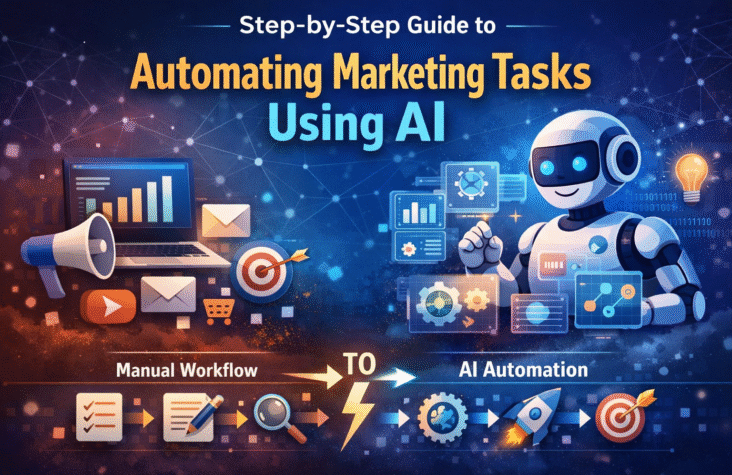
Step-by-Step Guide to Automating Marketing Tasks Using AI
Digital marketing has evolved into a highly complex ecosystem. Marketers today manage multiple channels simultaneously—search advertising, social media, email campaigns, SEO, analytics dashboards, customer journeys, and content production. Each channel generates large volumes of data and requires continuous monitoring and optimization. As marketing strategies become more data-driven and performance-focused, managing every process manually is no longer practical.
This growing complexity is one of the key reasons businesses are increasingly automating marketing tasks using AI. Artificial intelligence has moved far beyond simple automation tools. Modern AI systems can analyze vast datasets, identify patterns in customer behavior, generate marketing content, optimize advertising campaigns, and even predict future performance trends. Instead of relying solely on manual execution and guesswork, marketers can now use AI to make faster and more informed decisions.
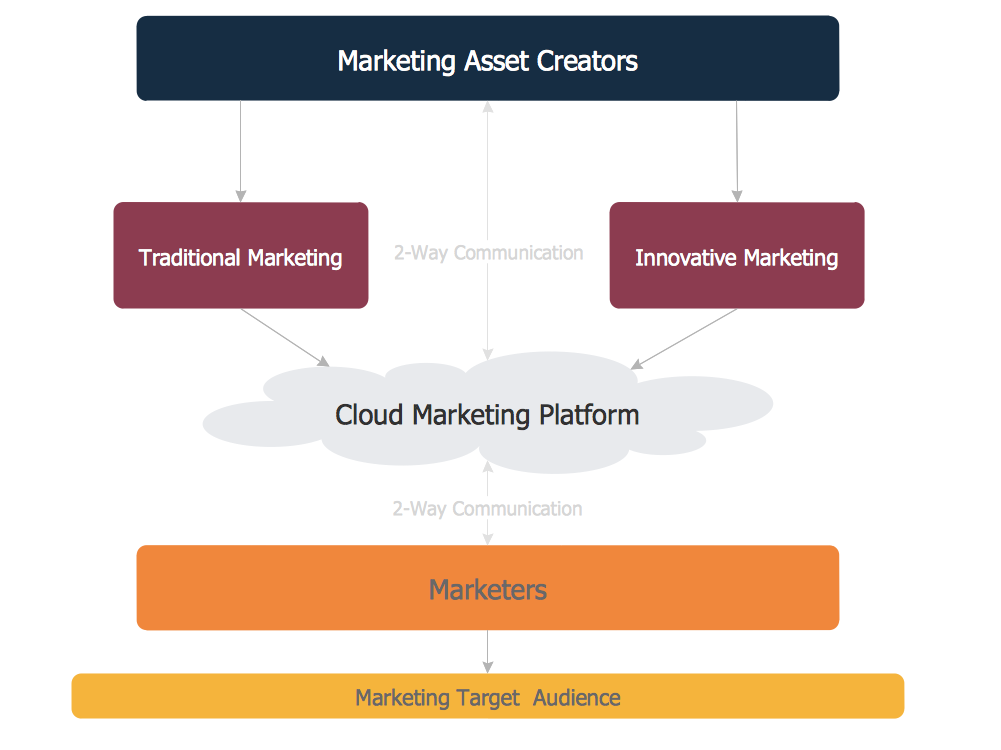
The shift from manual marketing execution to AI-powered automation is happening across nearly every area of digital marketing. Content teams are using AI tools to generate blog outlines, optimize headlines, and improve SEO performance. Advertising specialists rely on AI algorithms to manage bids, target audiences, and improve conversion rates. Marketing teams also use AI-powered analytics tools to process campaign data and identify insights that would otherwise take hours to uncover.
This transformation is not just about convenience—it is fundamentally improving marketing efficiency and performance. According to HubSpot, approximately 64% of marketers already use AI tools in their marketing campaigns, demonstrating how quickly AI adoption is growing in the industry. Similarly, a Salesforce report found that 76% of marketers use automation tools to streamline workflows and reduce manual tasks, highlighting the importance of automation in modern marketing operations.
The economic potential of AI-driven automation is even larger. Research from McKinsey & Company estimates that artificial intelligence could contribute up to $4.4 trillion annually to global productivity, largely by automating repetitive processes and improving decision-making across industries, including marketing.
For marketing teams, this means spending less time on repetitive operational tasks and more time focusing on strategy, creativity, and growth initiatives. AI can automate processes such as content generation, audience segmentation, email scheduling, and advertising optimization—allowing marketers to scale campaigns while maintaining efficiency. Many marketing teams now rely on AI tools for content planning to generate blog ideas, outlines, and editorial calendars faster. Businesses are increasingly integrating AI in digital marketing to automate repetitive workflows and improve campaign performance.
This guide provides a step-by-step framework for automating marketing tasks with AI, helping businesses effectively integrate AI tools into their marketing workflows. Instead of treating AI as a theoretical concept, this article focuses on practical implementation—covering the tools, workflows, and strategies marketers can use to automate routine tasks and improve overall marketing performance.
Understanding Marketing Automation in the Age of AI
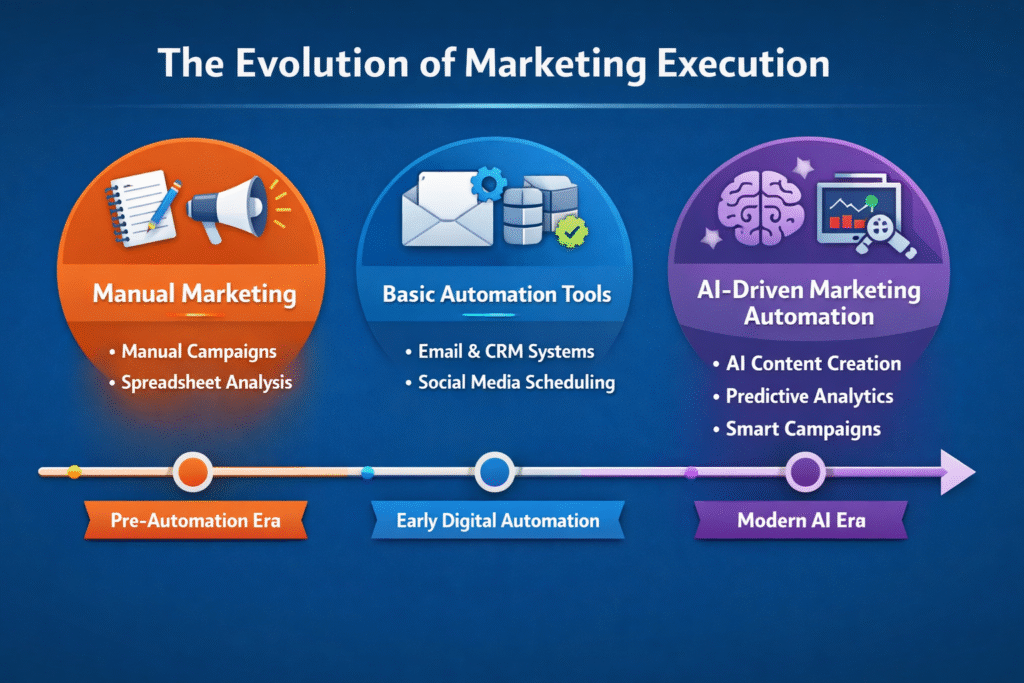
Marketing automation has existed for years, but the introduction of artificial intelligence has fundamentally changed how these systems operate. Traditional automation focused mainly on scheduling and rule-based workflows. Modern platforms now integrate AI to analyze customer behavior, generate insights, and optimize campaigns automatically.
In today’s digital marketing environment, automation is no longer limited to sending scheduled emails or posting social media updates. AI-powered systems can interpret user behavior, personalize content at scale, and continuously improve marketing performance based on real-time data. This shift is why automating marketing tasks using AI has become a central strategy for modern marketing teams.
What Marketing Automation Actually Means
Marketing automation refers to the use of software platforms and technologies that automate repetitive marketing activities. Instead of manually executing tasks across different channels, marketers can create automated workflows that perform these tasks automatically based on predefined triggers and customer actions.
These systems typically rely on three core elements:
- Triggers: Events that initiate an automated action, such as a user signing up for a newsletter or visiting a specific page on a website.
- Workflows: Predefined sequences of actions that occur after a trigger is activated.
- Analytics: Data collection and reporting tools that track campaign performance and customer behavior.
By combining these elements, marketing teams can automate large portions of their operational workload while maintaining consistent communication with their audience.
Some of the most common examples of marketing automation include:
Automated email campaigns
Email marketing platforms can automatically send welcome emails, promotional messages, and follow-up sequences based on user behavior. For example, when a visitor subscribes to a newsletter, the system can trigger a pre-designed onboarding email sequence.
Social media scheduling
Marketing automation tools allow teams to schedule posts across multiple social media platforms in advance. Instead of publishing content manually every day, marketers can plan an entire month of posts through an automated content calendar.
Lead nurturing workflows
Automation platforms help businesses guide potential customers through the sales funnel. When a user downloads a resource or signs up for a webinar, the system can automatically deliver follow-up emails, educational content, or product offers tailored to that user’s stage in the buying journey.
These capabilities help marketing teams scale their campaigns while maintaining consistent engagement with their audience.
How AI Has Transformed Traditional Automation
While traditional marketing automation relies on fixed rules and predefined workflows, AI introduces a new level of intelligence into these systems. Instead of simply executing instructions, AI-driven platforms can analyze patterns in large datasets and make decisions that improve campaign performance.
This transition represents a shift from rule-based automation to data-driven decision systems.
In traditional systems, marketers must manually set the conditions that determine how campaigns run. For example, a marketer might create a rule that sends an email three days after a user signs up. AI-powered automation systems, however, can analyze customer behavior and determine the optimal time, content, and channel for engagement.
Several capabilities illustrate how AI is transforming marketing automation.
Predictive customer segmentation
AI systems analyze behavioral data, browsing patterns, and purchase history to segment audiences automatically. Instead of relying on basic demographic categories, AI can create dynamic customer segments that update in real time.
AI content generation
AI tools can generate marketing copy, social media captions, ad creatives, and even blog outlines. This significantly accelerates content production while allowing marketers to focus on strategic planning and editing. While automation speeds up content creation, the debate around AI generated vs human written content continues to shape how marketers balance efficiency with originality.
Smart campaign optimisation
AI-powered advertising systems continuously adjust bidding strategies, audience targeting, and budget allocation based on campaign performance. This ensures that marketing budgets are directed toward the highest-performing opportunities.
Real-time performance learning
AI platforms constantly analyze campaign data and refine their recommendations. Instead of waiting for manual reporting cycles, marketers receive insights instantly, enabling faster optimization decisions.
Industry research highlights how widespread this transformation has become. According to Gartner, approximately 80% of marketing automation platforms now integrate AI capabilities, reflecting the rapid shift toward intelligent automation across the marketing technology landscape.
AI does not replace marketing professionals; instead, it augments their capabilities. By automating repetitive tasks and analyzing complex datasets, AI allows marketers to focus on higher-value activities such as strategy development, creative campaigns, and customer experience design.
Why Automating Marketing Tasks Using AI Is Becoming Essential
Digital marketing has become increasingly complex as businesses operate across multiple platforms, customer touchpoints, and data systems. Managing campaigns manually across search engines, social media platforms, email channels, and analytics tools can quickly overwhelm marketing teams. As a result, organizations are rapidly shifting toward automating marketing tasks using AI to improve efficiency, reduce operational workload, and enhance campaign performance.
Artificial intelligence allows marketers to move beyond basic automation and adopt systems that continuously learn from data. Instead of manually analyzing reports, adjusting campaigns, or segmenting audiences, AI tools can perform these tasks automatically while optimizing results in real time. This combination of automation and machine learning creates significant operational and financial advantages for businesses.
Increased Efficiency and Time Savings
One of the most immediate benefits of AI-driven marketing automation is the ability to eliminate repetitive and time-consuming tasks. Marketing teams often spend a significant portion of their time performing operational activities such as scheduling content, compiling reports, segmenting audiences, and adjusting campaigns.
By automating these processes, AI allows marketers to focus on higher-value activities such as strategy development, creative planning, and customer experience optimization.
For example, instead of manually analyzing campaign performance every week, AI-powered analytics tools can continuously monitor performance metrics and automatically recommend optimizations. Similarly, AI-based scheduling systems can determine the best time to publish content or send emails based on historical engagement patterns.
Automation also accelerates campaign deployment. Marketing teams can launch campaigns faster because AI tools help generate content drafts, suggest audience segments, and automate campaign workflows.
Research from Nucleus Research highlights the operational impact of automation, reporting that marketing teams using automation experience an average productivity increase of 14.5%. This improvement reflects the time saved by reducing manual processes and streamlining campaign management.
Improved Marketing Personalization
Modern consumers expect personalized experiences from the brands they interact with. Generic marketing messages often fail to capture attention because audiences are exposed to large volumes of digital content every day. AI-driven automation helps marketers deliver personalized communication at scale by analyzing behavioral data and predicting user preferences.
AI systems can process large datasets that include browsing activity, purchase history, engagement patterns, and demographic information. Using this data, marketers can create dynamic audience segments and deliver highly targeted marketing messages.
Some common applications of AI-driven personalization include:
- Behavior-based targeting: AI analyzes how users interact with websites, advertisements, and emails to identify patterns in their behavior. These insights allow marketers to tailor messaging to specific audience segments.
- Personalized email campaigns: AI-powered email platforms can customize subject lines, product recommendations, and messaging based on individual user behavior.
- Predictive content recommendations: AI systems can suggest content, products, or services that are most relevant to each user, increasing engagement and improving conversion rates.
Consumer research strongly supports the importance of personalization. According to Epsilon, approximately 80% of consumers are more likely to engage with brands that provide personalized experiences. This demonstrates how AI-powered personalization can significantly influence marketing effectiveness and customer relationships.
Higher Campaign Performance
AI-driven marketing automation also contributes to measurable improvements in campaign performance. Because AI systems continuously analyze large datasets, they can identify optimization opportunities much faster than manual processes allow.
AI-powered marketing platforms can automatically adjust campaigns by optimizing targeting parameters, bidding strategies, messaging, and content distribution. These adjustments help improve key performance metrics such as click-through rates, conversion rates, and lead quality.
For instance, AI advertising systems analyze user engagement signals to determine which audiences are most likely to convert. They then allocate budgets toward high-performing segments while reducing spend on underperforming campaigns. This data-driven approach ensures that marketing resources are used more efficiently.
Automation has also transformed email marketing performance. According to Campaign Monitor, automated email campaigns generate approximately 320% more revenue than non-automated email campaigns. This dramatic increase demonstrates how automation improves both engagement and revenue generation by delivering the right message to the right audience at the right time.
AI-driven automation therefore not only reduces manual effort but also significantly enhances the effectiveness of marketing campaigns.
Comparison: Manual vs AI-Automated Marketing Processes
The difference between traditional marketing execution and AI-driven automation becomes clearer when comparing how common marketing tasks are performed.
| Marketing Activity | Manual Approach | AI Automated Approach |
| Email campaigns | Manual segmentation and scheduling | Predictive targeting and automated send-time optimization |
| Content creation | Human writing only, slower production cycles | AI-assisted content generation with human editing |
| Campaign optimization | Trial-and-error adjustments based on periodic reports | Data-driven optimization using real-time AI learning |
This shift toward intelligent automation is why automating marketing tasks using AI is rapidly becoming a core capability for modern marketing teams. Businesses that adopt AI-powered workflows can operate more efficiently, deliver more personalized experiences, and achieve stronger campaign performance across their digital marketing channels.
Key Marketing Tasks That Can Be Automated Using AI

Artificial intelligence has expanded the scope of marketing automation far beyond simple scheduling tools. Today, AI systems can assist with nearly every stage of the marketing workflow—from content creation and campaign management to analytics and optimization. By automating marketing tasks using AI, businesses can streamline operations, reduce manual workload, and improve performance across multiple channels.
AI-driven marketing platforms analyze large volumes of data and automate actions that would normally require hours of human effort. These tools allow marketing teams to operate more efficiently while maintaining high levels of creativity, personalization, and strategic oversight.
Below are some of the most important marketing tasks that can now be automated using AI technologies.
Content Creation and Optimization
Content production is one of the most time-intensive aspects of digital marketing. Blog articles, social media posts, advertising copy, and website content require continuous creation and optimization to remain effective in search engines and social platforms.
AI-powered writing tools can significantly accelerate this process by generating content drafts, suggesting improvements, and optimizing text for search engines. While human oversight remains essential for maintaining quality and brand voice, AI can automate many early-stage content tasks.
Common content-related tasks that AI can automate include:
- Blog outlines: AI tools can analyze search intent and generate structured outlines for long-form articles, helping writers organize content efficiently.
- Social media captions: AI can generate captions tailored to different platforms, saving time for social media managers.
- Ad copy creation: AI tools can produce multiple variations of advertising copy for testing and optimization.
- SEO optimization: AI platforms analyze keywords, readability, and search intent to recommend improvements for better search engine visibility.
Popular AI tools used for content creation and optimization include:
- ChatGPT: widely used for generating content ideas, outlines, and drafts.
- Jasper: designed for marketing copywriting and content generation.
- Copy.ai: focused on automated marketing copy, product descriptions, and ad creatives.
By using AI-assisted content workflows, marketing teams can dramatically increase their content production capacity while maintaining editorial control.
Social Media Scheduling and Management
Managing multiple social media platforms can quickly become overwhelming, especially for brands publishing content across channels such as Instagram, LinkedIn, Facebook, and X. AI-powered social media tools help automate content distribution and performance analysis.
Instead of manually posting updates and monitoring engagement, marketers can rely on AI-driven systems that schedule content, analyze audience behavior, and recommend performance improvements.
Common social media tasks that AI can automate include:
- Content scheduling: AI tools determine the best times to publish posts based on historical engagement data.
- Hashtag generation: AI can suggest relevant hashtags that improve reach and discoverability.
- Engagement analysis: AI platforms analyze likes, comments, and shares to identify content that resonates most with the audience.
Some widely used AI-powered social media management tools include:
- Buffer AI: provides scheduling automation and content suggestions.
- Hootsuite AI: offers engagement insights, performance analytics, and automated scheduling.
- Later AI: helps automate content planning, hashtag generation, and social media analytics.
These tools allow marketing teams to maintain a consistent social media presence while reducing the daily effort required to manage multiple platforms.
Email Marketing Automation
Email marketing remains one of the highest-performing digital marketing channels, but managing large subscriber lists and sending targeted campaigns can be time-consuming without automation.
AI-powered email marketing systems enable businesses to deliver personalized communication at scale. Instead of sending the same message to every subscriber, AI tools analyze user behavior and automatically tailor content for each audience segment.
AI can automate several key aspects of email marketing, including:
- Email sequences: AI-driven workflows can automatically send welcome emails, onboarding messages, and follow-up campaigns based on user actions.
- Subject line optimization: AI tools analyze previous campaign performance and generate subject lines designed to improve open rates.
- Audience segmentation: AI can automatically group subscribers based on behavior, interests, and engagement patterns.
Common AI-enabled email marketing platforms include:
- Mailchimp AI: offers automated campaigns, predictive segmentation, and send-time optimization.
- HubSpot AI: integrates email automation with CRM data to personalize campaigns based on customer interactions.
These capabilities help marketers deliver highly targeted email campaigns that increase engagement and conversion rates.
SEO and Keyword Research
Search engine optimization requires continuous analysis of keywords, competitor strategies, and search engine results pages (SERPs). AI-powered SEO platforms simplify this process by automating keyword analysis, content optimization, and SERP monitoring.
Rather than manually reviewing search results and keyword trends, marketers can use AI tools that process large datasets and provide actionable recommendations.
Common SEO tasks automated by AI include:
- Keyword clustering: AI groups related keywords into topic clusters that improve content structure and search visibility.
- SERP analysis: AI tools analyze search engine results to identify ranking patterns and content gaps.
- Content optimization: AI platforms suggest keyword usage, heading structure, and content improvements to enhance SEO performance.
Some of the most widely used AI-powered SEO platforms include:
- Surfer SEO: helps optimize content based on ranking factors and competitor analysis.
- Semrush AI: provides keyword research, competitive analysis, and SEO automation features.
- Frase: focuses on AI-driven content research and optimization.
These tools enable marketers to make faster SEO decisions while improving the accuracy of keyword targeting and content strategy.
Paid Advertising Optimization
Managing paid advertising campaigns manually can be challenging due to the number of variables involved, including bidding strategies, audience targeting, budget allocation, and performance tracking. AI-powered advertising platforms automate many of these processes by continuously analyzing campaign data and making real-time adjustments.
AI systems can automatically improve advertising performance through:
- Bid adjustments: AI algorithms adjust bids in real time to maximize conversions while controlling costs.
- Audience targeting: AI analyzes user behavior and identifies high-value audiences more likely to convert.
- Campaign optimization: AI continuously tests ad variations and reallocates budgets toward top-performing ads.
Two major platforms already use advanced AI automation features:
- Google Ads Smart Bidding: uses machine learning to optimize bids for conversions and conversion value.
- Meta Advantage+: automates ad targeting, budget allocation, and creative optimization for Facebook and Instagram campaigns.
These AI-driven advertising systems allow marketers to scale campaigns while maintaining strong performance and efficient budget management.
Step-by-Step Guide to Automating Marketing Tasks Using AI
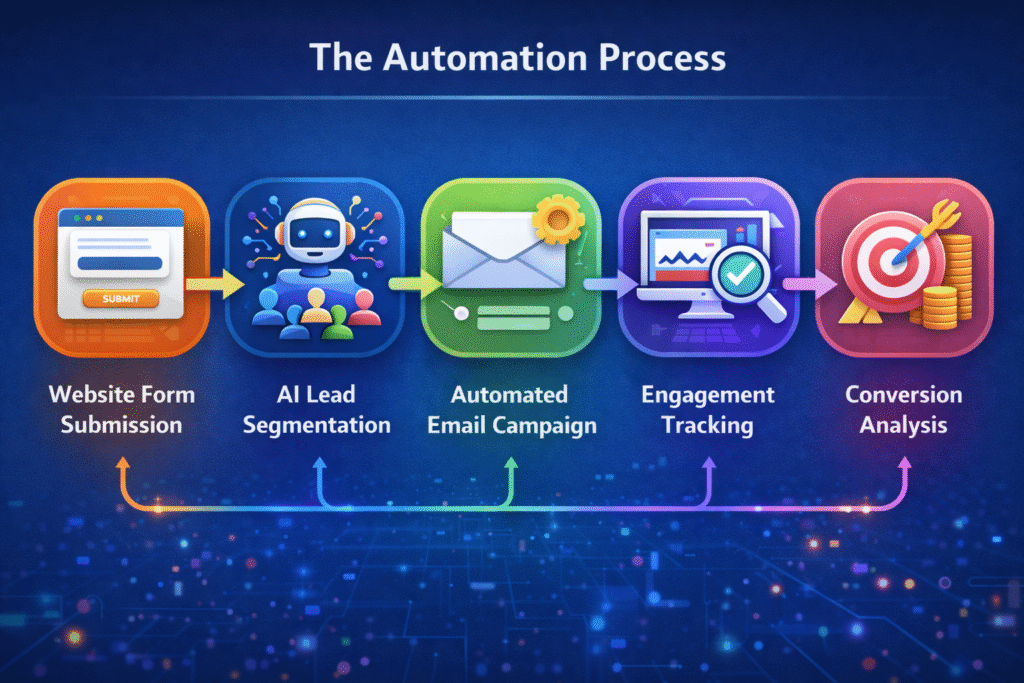
Successfully implementing AI in marketing requires more than simply adopting new tools. Businesses need a structured framework that identifies which processes should be automated, selects the right technologies, and continuously monitors performance. When implemented correctly, automating marketing tasks using AI can transform marketing workflows, reduce operational complexity, and improve campaign results.
The following step-by-step framework outlines how organizations can systematically integrate AI automation into their marketing operations.
Step 1 — Identify Repetitive Marketing Tasks
The first step in AI automation is identifying tasks that consume significant time but provide limited strategic value when performed manually. Many marketing teams spend hours every week on operational activities such as preparing reports, scheduling campaigns, or analyzing performance data.
By identifying these repetitive processes, marketers can determine where AI automation will deliver the greatest efficiency gains.
Common marketing activities that often require large amounts of manual effort include:
- Content production: creating blog outlines, captions, and marketing copy.
- Campaign reporting: compiling performance reports from multiple platforms.
- Ad optimization: adjusting bids, budgets, and targeting settings in advertising platforms.
- Customer segmentation: grouping audiences based on demographics, behavior, or purchase history.
Once these tasks are identified, teams can estimate how much time they currently spend on each activity and evaluate the potential for automation.
| Task | Time Spent Weekly | Automation Potential |
| Content production | 8–12 hours | AI tools can generate outlines, drafts, and optimization suggestions |
| Campaign reporting | 4–6 hours | AI analytics platforms automate reporting dashboards |
| Ad optimization | 5–8 hours | AI bidding systems optimize campaigns automatically |
| Customer segmentation | 3–5 hours | AI tools create dynamic audience segments |
This initial analysis helps organizations prioritize automation opportunities based on the amount of time saved and the potential improvement in marketing efficiency.
Step 2 — Choose the Right AI Marketing Tools
Once high-impact tasks have been identified, the next step is selecting AI tools that align with business objectives and existing marketing infrastructure. Not every AI tool fits every organization, so evaluating technology options carefully is essential.
Several factors should be considered when selecting AI marketing platforms.
Integration with CRM systems
AI tools should integrate seamlessly with existing customer relationship management platforms. This integration allows marketing teams to combine behavioral data, campaign performance metrics, and customer insights within a unified system.
Automation capabilities
Different tools specialize in different types of automation. Some platforms focus on content generation, while others emphasize analytics, advertising optimization, or workflow automation. Selecting tools with strong automation features ensures that repetitive tasks can be handled effectively.
Pricing and scalability
Marketing teams should also consider the pricing model and scalability of AI tools. Solutions should be affordable at the current stage of business growth while also supporting future expansion as marketing operations scale.
The following table illustrates how different AI tools serve various marketing functions.
| Tool | Use Case | Best For |
| ChatGPT | Content ideation and copy generation | Blog writing, social media captions |
| Jasper AI | Marketing content generation | Advertising copy and brand messaging |
| Surfer SEO | SEO optimization and keyword analysis | Content optimization for search engines |
| HubSpot AI | CRM-driven marketing automation | Email campaigns and lead nurturing |
| Zapier | Workflow automation and integrations | Connecting marketing tools and automating processes |
Choosing the right tools ensures that automation workflows operate smoothly across different marketing systems.
Step 3 — Set Up AI Workflows
After selecting appropriate AI tools, the next step is designing automated workflows that connect different marketing activities. AI workflows define how tasks are triggered, processed, and completed within a marketing system.
An effective AI workflow typically includes three key components:
- a trigger that starts the process
- an automated action performed by AI tools
- a resulting outcome that advances the marketing funnel
For example, consider a common marketing automation workflow:
Lead capture → AI audience segmentation → automated email sequence.
When a user fills out a form on a website, the system captures the lead and sends the data to an AI segmentation tool. The AI then analyzes the user’s behavior and assigns them to the most relevant audience segment. Based on that classification, the system automatically triggers a personalized email sequence designed to nurture the lead toward conversion.
This workflow eliminates the need for manual segmentation and email scheduling, allowing marketing teams to scale lead nurturing efforts efficiently.
Step 4 — Integrate AI with Marketing Platforms
For AI automation to function effectively, it must integrate with existing marketing platforms. Most businesses rely on multiple tools for customer relationship management, analytics, advertising, and email marketing. AI systems must connect these platforms so that data flows smoothly across the marketing infrastructure.
Common integrations include:
- CRM systems: storing customer data and tracking interactions across marketing channels.
- Analytics platforms: measuring campaign performance and generating actionable insights.
- Advertising platforms: automating bidding strategies and audience targeting.
- Email marketing systems: sending automated messages based on user behavior.
Automation platforms such as Zapier allow marketers to connect different applications and trigger automated actions between them. For instance, a new lead captured through a website form can automatically be added to a CRM system, segmented using AI analytics, and enrolled in an automated email campaign.
Marketing platforms like HubSpot also provide built-in AI integrations that combine CRM data, email automation, and campaign analytics within a unified environment. This type of integration ensures that AI tools can access the data needed to optimize marketing performance.
Step 5 — Monitor Performance and Optimize
Implementing AI automation is not a one-time process. Continuous monitoring and optimization are essential to ensure that automated systems deliver the expected results.
AI-powered analytics platforms provide real-time insights into campaign performance, allowing marketers to identify opportunities for improvement. By analyzing data across different marketing channels, AI systems can recommend adjustments that improve efficiency and maximize return on investment.
Key performance metrics that should be monitored include:
- Conversion rate: the percentage of users who complete a desired action.
- Click-through rate (CTR): the proportion of users who click on advertisements or links.
- Cost per acquisition (CPA): the amount spent to acquire a new customer.
- Customer lifetime value (CLV): the total revenue generated from a customer over time.
AI analytics tools continuously evaluate these metrics and provide recommendations for optimization, such as adjusting targeting strategies or modifying campaign messaging.
Research from PwC indicates that companies using AI-powered analytics can improve marketing return on investment by 20–30%. These improvements occur because AI systems can process large datasets quickly and identify optimization opportunities that might be overlooked in manual analysis.
By combining automation with continuous performance monitoring, businesses can create marketing systems that learn, adapt, and improve over time—making automating marketing tasks using AI a powerful strategy for scaling marketing operations efficiently.
Challenges and Limitations of AI Marketing Automation
While AI has significantly improved marketing efficiency and campaign performance, it is not without limitations. Businesses that adopt AI automation must also understand the potential risks and operational challenges associated with these technologies. A balanced approach is essential when automating marketing tasks using AI, ensuring that automation supports marketing strategy rather than replacing human judgment entirely.
AI systems are powerful tools, but their effectiveness depends on how they are implemented, monitored, and managed. Overreliance on automation, inadequate data protection practices, or poor-quality datasets can reduce the effectiveness of AI-driven marketing systems.
Over-Automation Risks
One of the most common challenges in AI marketing automation is over-automation. When businesses rely too heavily on automated systems without sufficient human oversight, marketing campaigns can lose authenticity and relevance.
AI tools can generate content, automate email campaigns, and optimize advertising strategies, but they may sometimes produce messaging that feels generic or repetitive. Since AI systems often rely on patterns from existing datasets, they may generate content that lacks originality or emotional nuance.
Another challenge is maintaining a consistent brand voice. AI-generated content may not always reflect a company’s unique tone, messaging style, or brand personality. Without careful editing and supervision, automated messaging may become inconsistent across different channels.
To prevent these issues, marketers should treat AI as an assistive tool rather than a complete replacement for human creativity. Content generated by AI should always be reviewed, edited, and aligned with the brand’s communication strategy before publication.
Maintaining human involvement in campaign planning and creative decision-making helps ensure that automation enhances marketing efforts rather than diminishing brand identity.
Data Privacy Concerns
Another important limitation of AI marketing automation involves data privacy and regulatory compliance. Many AI-powered marketing systems rely on large volumes of customer data to analyze behavior patterns, segment audiences, and deliver personalized experiences.
However, collecting and processing user data introduces legal and ethical responsibilities. Regulations such as the General Data Protection Regulation (GDPR) in the European Union require businesses to protect user data, obtain proper consent, and ensure transparency in how personal information is used.
Companies that fail to comply with data protection laws risk facing significant financial penalties and reputational damage. Even organizations operating outside the European Union must often follow similar privacy standards when dealing with international customers.
To address these concerns, businesses should implement strong data governance practices, including:
- obtaining clear consent before collecting personal data
- securely storing customer information
- limiting access to sensitive data
- maintaining transparency about how data is used in marketing systems
Responsible data management ensures that AI automation remains compliant with privacy regulations while maintaining customer trust.
Dependence on Quality Data
AI systems are only as effective as the data they are trained on. If marketing datasets are incomplete, outdated, or inaccurate, AI tools may generate misleading insights or make poor optimization decisions.
For example, if customer data contains errors or missing information, AI segmentation systems may incorrectly categorize users, leading to ineffective targeting. Similarly, inaccurate campaign data can result in flawed performance analysis and suboptimal optimization recommendations.
Poor-quality data can also introduce bias into AI-driven decision systems. If the underlying dataset does not accurately represent customer behavior, the AI model may produce skewed predictions that negatively affect campaign performance.
To minimize these risks, organizations should invest in strong data management practices. This includes regularly cleaning datasets, validating customer information, and ensuring that analytics systems collect accurate and consistent data across all marketing channels.
By maintaining high-quality data infrastructure, businesses can improve the accuracy and reliability of AI-powered marketing automation systems.
Understanding these challenges helps marketers adopt a more strategic approach to automating marketing tasks using AI, ensuring that automation enhances marketing performance while maintaining ethical standards, brand consistency, and data accuracy.
Best Practices for Implementing AI Marketing Automation
Adopting AI in marketing can significantly improve efficiency and campaign performance, but successful implementation requires a structured and strategic approach. Many organizations make the mistake of introducing multiple AI tools at once without clearly defined workflows or performance goals. To gain the full benefits of automating marketing tasks using AI, businesses should focus on gradual implementation, continuous monitoring, and alignment with their broader marketing strategy.
The following best practices help organizations implement AI marketing automation in a controlled and effective way.
Start with Small Automation Workflows
One of the most effective ways to introduce AI into marketing operations is by starting with smaller automation tasks rather than attempting to automate entire marketing systems immediately. This approach allows teams to understand how AI tools function within their existing workflows while minimizing operational risk.
Simple automation projects may include tasks such as automated email sequences, AI-assisted content generation, or automated campaign reporting. These processes typically require minimal integration and can deliver quick efficiency improvements.
Starting with small workflows also allows teams to evaluate the performance of AI tools and identify potential limitations before expanding automation to more complex marketing activities.
Maintain Human Oversight
Although AI tools can automate many marketing tasks, human oversight remains essential for maintaining quality, creativity, and brand consistency. AI systems operate based on patterns and algorithms, which means they may occasionally generate inaccurate insights or produce content that does not align with a brand’s tone.
Marketing professionals should continue to review AI-generated outputs, adjust campaign strategies, and make final decisions on messaging and creative direction. Human involvement ensures that automated processes support marketing goals without compromising brand identity or customer experience.
AI should therefore be viewed as a decision-support system rather than a fully autonomous marketing solution.
Continuously Analyze Performance
AI-powered marketing systems improve over time through continuous data analysis and optimization. However, this improvement depends on regular monitoring of campaign performance and marketing metrics.
Marketing teams should consistently review key performance indicators such as conversion rates, engagement metrics, cost per acquisition, and customer lifetime value. By analyzing these metrics, businesses can determine whether their AI automation strategies are producing measurable improvements.
Continuous performance analysis also helps identify areas where automation workflows can be refined or expanded. As AI systems process more data, their predictions and optimization recommendations become increasingly accurate.
Align AI Tools with Marketing Strategy
AI tools are most effective when they support clearly defined marketing objectives. Businesses should avoid implementing automation technologies simply because they are trending or widely discussed in the industry.
Instead, AI tools should be selected based on how well they align with existing marketing strategies. For example, a company focused on lead generation may prioritize AI-powered advertising optimization and email automation tools, while a content-driven brand may benefit more from AI-assisted content creation and SEO optimization platforms.
Aligning automation technology with strategic goals ensures that AI enhances marketing performance rather than creating unnecessary complexity.
AI Automation Maturity Model
As organizations expand their automation capabilities, they typically progress through several stages of AI adoption. The following model illustrates how businesses gradually evolve from basic automation to fully integrated AI-driven marketing systems.
| Stage | Description | Key Capabilities |
| Basic Automation | Initial adoption of automation tools for repetitive tasks | Email scheduling, social media scheduling |
| Assisted Automation | AI tools assist marketers in content creation and data analysis | AI content generation, automated reporting |
| Intelligent Automation | AI systems begin optimizing campaigns and targeting | Predictive segmentation, AI ad optimization |
| Fully Integrated AI Marketing | AI systems operate across multiple platforms with real-time optimization | Cross-channel automation, predictive marketing analytics |
Organizations typically move through these stages gradually as they gain experience with AI tools and develop stronger data infrastructure. By following these best practices and scaling automation carefully, businesses can successfully integrate AI into their marketing operations while maintaining control over strategy, brand communication, and performance outcomes.
Conclusion
Artificial intelligence is rapidly reshaping how modern marketing teams operate. As digital channels continue to expand and customer data becomes more complex, relying solely on manual processes is no longer sustainable. AI-driven automation provides a practical solution by streamlining repetitive tasks, improving campaign efficiency, and enabling marketers to make faster, data-informed decisions.
One of the most immediate advantages of automating marketing tasks using AI is the significant reduction in operational workload. Tasks that once required hours of manual effort—such as campaign reporting, audience segmentation, content scheduling, and ad optimization—can now be handled automatically by intelligent systems. This allows marketing teams to manage larger campaigns and multiple channels without increasing operational complexity.
Beyond efficiency, AI also enables smarter marketing decisions. By analyzing large datasets in real time, AI tools can identify trends, predict customer behavior, and recommend optimization strategies that improve overall marketing performance. These capabilities help businesses allocate budgets more effectively, target the right audiences, and continuously refine their campaigns based on measurable results.
Another important benefit is the improvement in campaign performance. AI-driven systems can automatically test variations of marketing messages, optimize advertising bids, and personalize communication for different audience segments. As a result, businesses often see improvements in engagement metrics, conversion rates, and return on investment.
Perhaps most importantly, AI automation allows marketers to focus on the strategic aspects of marketing. Instead of spending large portions of their time on repetitive operational tasks, marketing professionals can concentrate on creative planning, customer experience, and long-term growth strategies.
As AI technologies continue to evolve, their role in marketing will only become more significant. Businesses that adopt structured approaches to automating marketing tasks using AI will be better positioned to scale their marketing efforts, adapt to changing consumer behavior, and maintain a competitive advantage in an increasingly data-driven digital landscape.
What is marketing automation using AI?
Marketing automation using AI means using artificial intelligence tools to automate repetitive marketing tasks such as email campaigns, content creation, ad optimization, and data analysis. AI tools analyze data and perform tasks automatically, helping marketers save time and improve campaign performance.
How does AI help automate digital marketing tasks?
AI automates marketing tasks through machine learning, predictive analytics, and workflow automation. It can segment audiences, generate content, optimize ads, and analyze campaign data to improve marketing results.
What marketing tasks can be automated using AI?
AI can automate many marketing activities, including:
– Content creation and SEO optimization
– Email marketing campaigns
– Paid advertising optimization
– Social media scheduling
– Marketing analytics and reporting
Is AI marketing automation expensive?
Not necessarily. Many AI marketing tools offer free or affordable plans. Businesses can start with tools like ChatGPT or basic email automation platforms before investing in advanced marketing automation systems.
Can small businesses use AI marketing automation?
Yes. Many AI tools are designed for small businesses and require minimal technical skills. These tools help small teams automate tasks like email marketing, content creation, and campaign analysis.
Does AI replace digital marketers?
No. AI assists marketers by automating repetitive tasks, but strategy, creativity, and decision-making still require human expertise.
How do you start automating marketing tasks with AI?
Start by identifying repetitive tasks, choosing suitable AI tools, integrating them with your marketing platforms, and creating simple automation workflows.
What are the risks of AI marketing automation?
Common risks include over-automation, data privacy concerns, and inaccurate results from poor data. Human oversight helps maintain quality and brand consistency.
💡 Interested in learning more? Contact RKDMT – Raju Kumar Digital Marketer – Best Digital Marketing Training Institute
🔗www.rajukumardigitalmarketing.com
📞 +91-7303933302, +91-9217057127
📧 rkdmt@rajukumardigitalmarketer.com

Founder at Digital Marketing Marvel | Founder at RKDMT – Raju Kumar Digital Marketing Trainer | Best Digital Marketing Trainer in Delhi/NCR – Digiperform | Project Manager | 5+ years | Genius Study Abroad & Inlingua’s Digital Marketing Head | Learn Digital Marketing