


Changes in Google Discover After Core Update (2026)
Google Discover is a big deal for people who publish things online. It can bring a lot of people to their websites.. It is also very unpredictable. Google made some changes to Google Discover from 2024 to 2026. These changes affected how Google Discover chooses what to show people, how it ranks things and what it puts in peoples personalized feeds.
Some websites saw a drop, in visitors while others got a lot more visitors even when they did not put up any new stuff. This means that people who do search engine optimization need to figure out how to make their websites work well with Google Discover. Google Discover optimization is very important now.
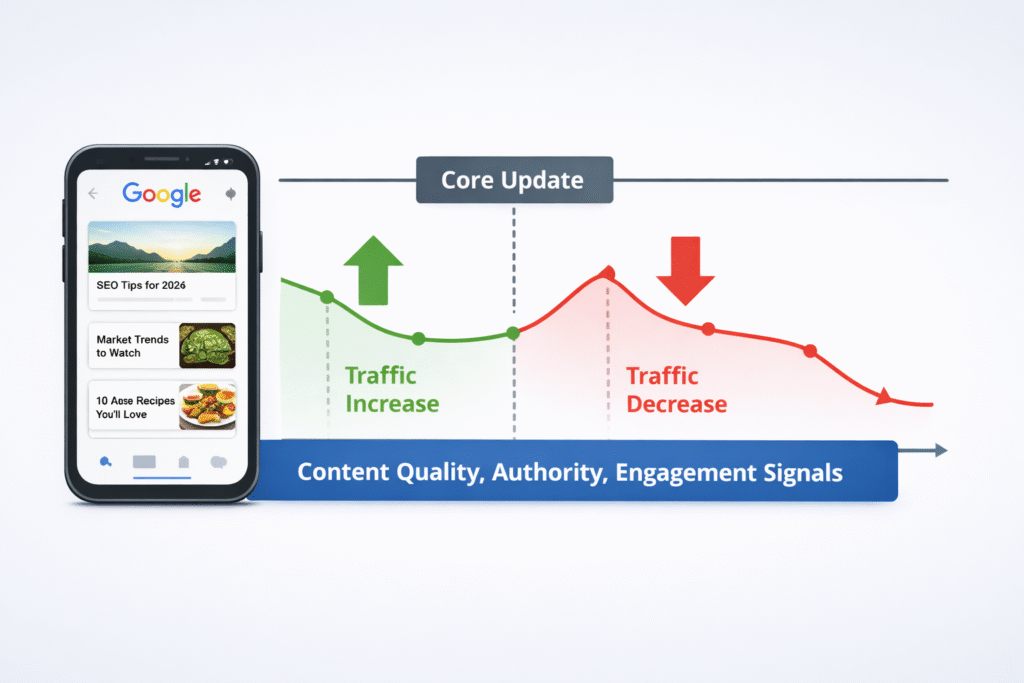
Google Discover is different from the Google Search that we use. Google Search gives us answers when we ask for something.. Google Discover sends us things it thinks we will like. It looks at what we’re interested in and what we do on the internet. It also looks at what we like and do not like. When Google changes the way it decides what is good and what is not Google Discover changes too.
Google Discover shows us things that it thinks are good and relevant. When Google gets better at knowing what is good and what people like, some websites get seen more. These are the websites that people trust and like. They have things on them and people, like going to them. Some websites do not do well. These are the websites that do not have things on them, and people do not like going to them. Google Discover does not show us these websites much.
To understand why Discover traffic changes happen, you must first understand what the Google Core Update, which directly affects Discover visibility.
Google Discover has changed a lot after the updates. Now it is very important for Google to see if the things you write are true and good. Google is better at figuring out which websites have useful information and which ones do not. Google Discover is not just about what’s new or what people are talking about right now. It is more, about the websites that show they really know what they are talking about. That people can trust them. Google likes websites that have a reputation and are trusted by people over time. Google Discover favors these kinds of websites.
The way we look at engagement metrics is changing. Google is now better at seeing how people use Discover content. Things like how often people click on something, how long they stay on a page, and how far they scroll down. If they come back to the site are more important now. If people go back to the feed or do not like content from a certain site Google may show it less often.
On the other hand, content that people like and interact with will be shown more often in Discover feeds. Google looks at engagement metrics to decide what content to show in Discover feeds. If people engage with content from a site, that site will be shown more often in Discover feeds.
The updates have also made Google better at understanding websites and the people who write for them. Google does not just look at each article it looks at the website and the person who wrote it. It wants to know if the website is good and if the person who wrote it knows what they are talking about. Google also likes it when the website writes about the things all the time.
Websites that focus on one thing. Websites about making websites work better or digital marketing or technology or money. Are more likely to show up in Google Discover all the time. This is better, than websites that write about lots of things that are not related to each other. Google likes Google Discover to have websites that know what they are talking about.
This article explores the changes in Google Discover following recent core updates, explains why traffic fluctuations occur, and provides actionable strategies to recover lost visibility and build sustainable Discover growth. By understanding how Google Discover evaluates content in the modern SEO landscape, publishers can adapt their content strategy, strengthen authority signals, and position themselves for long-term success in Discover traffic acquisition.
Why Google Discover Traffic Changed Dramatically After Core Updates
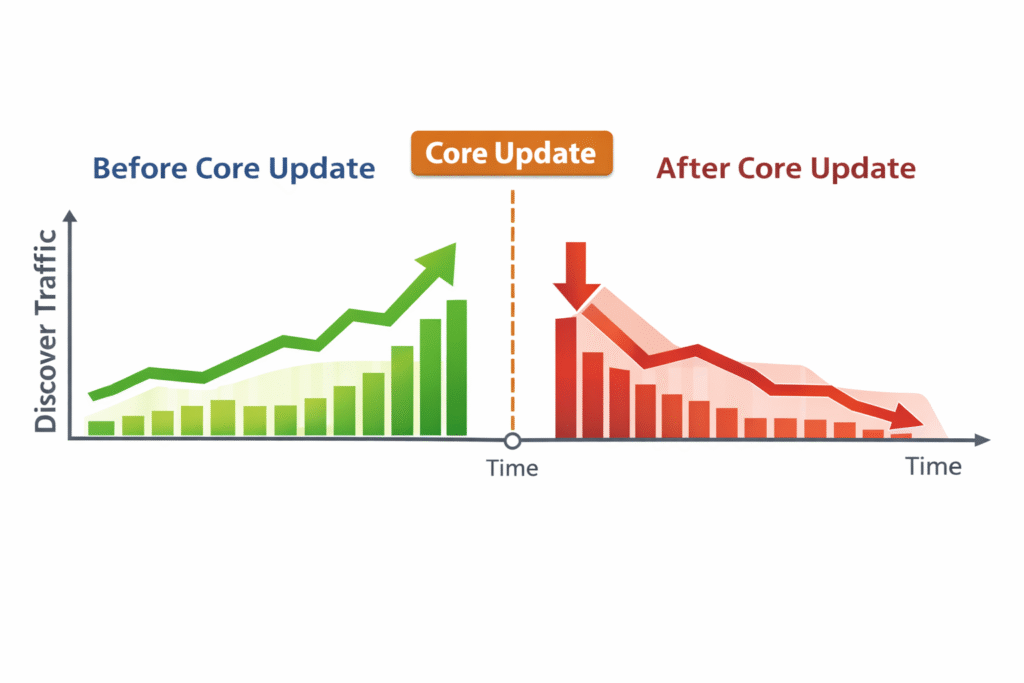
Over the past few years, one pattern has become increasingly clear for website owners and publishers: Google Discover traffic can change overnight. Some websites suddenly experience massive traffic spikes, while others see dramatic drops without changing anything on their site. These fluctuations often happen immediately after a Google core update, leaving many publishers confused about what caused the change.
Unlike traditional Google Search, which responds to specific keywords and queries, Google Discover works very differently. It does not rely on what users type into the search bar. Instead, Discover is driven by user interests, browsing behavior, engagement history, and content preferences.
Google analyzes signals such as the websites users visit, the topics they engage with, their YouTube activity, and their interaction patterns across devices. Based on this data, Google proactively recommends content it believes users will find useful or interesting.
This fundamental difference means Discover traffic behaves differently from search traffic. In search, rankings usually change gradually as SEO improvements or competition evolve. But in Discover, visibility can change instantly because Google continuously reassesses content quality, relevance, and trustworthiness using machine learning systems.
Recent core updates have made this even more noticeable. Google core updates now directly affect which content appears in Discover feeds. When Google rolls out a core update, it reevaluates websites based on quality, trust, expertise, and overall usefulness. As a result, content that previously performed well in Discover may suddenly lose visibility, while higher-quality or more authoritative content gains exposure.
Industry studies and real-world case analyses highlight the scale of these changes. According to research and documented case studies by SEO experts like Glenn Gabe and reports from Search Engine Journal, many publishers experienced Discover traffic drops between 30% and 70% following major core updates. These are not small fluctuations—they represent significant shifts in how Google evaluates and recommends content.
The impact is especially important because Google Discover is now a major traffic source for many websites. For news publishers, Discover can contribute anywhere between 20% and 60% of total website traffic, sometimes even exceeding traditional search traffic during peak periods. For niche blogs, affiliate websites, and informational content platforms, Discover commonly drives 10% to 40% of overall traffic. This makes Discover a powerful but volatile source of visibility.
Google itself explains in its official Google Discover documentation that content quality, relevance, and user trust are critical factors in determining Discover eligibility. Similarly, the Google Search Central core updates guide confirms that core updates are designed to improve how Google evaluates content quality across all surfaces, including Discover.
If you’re unfamiliar with how core updates work, it’s important to understand what is google core update and why does it matter for SEO, because these updates directly influence both search rankings and Discover visibility.
Ultimately, the recent changes in google discover reflect Google’s growing focus on recommending content that demonstrates genuine expertise, trustworthiness, strong engagement, and real value for users. Websites that align with these principles tend to maintain or increase Discover visibility, while those with weaker signals often see traffic decline.
Understanding How Google Discover Works in 2026
To understand the recent changes in google discover, it’s important to first understand how Google Discover actually works. Unlike traditional Google Search, Discover does not wait for users to type queries. Instead, it proactively recommends content based on what Google believes users will find interesting, useful, or relevant at that moment.
Google Discover is essentially a personalized content feed. It appears on the Google app, Chrome mobile homepage, and Android devices, showing articles, news, videos, and other content tailored to each user. Every user’s Discover feed is unique because it is generated using individual behavioral signals, interests, and engagement patterns.
Discover Is Based on User Interests, Not Keywords
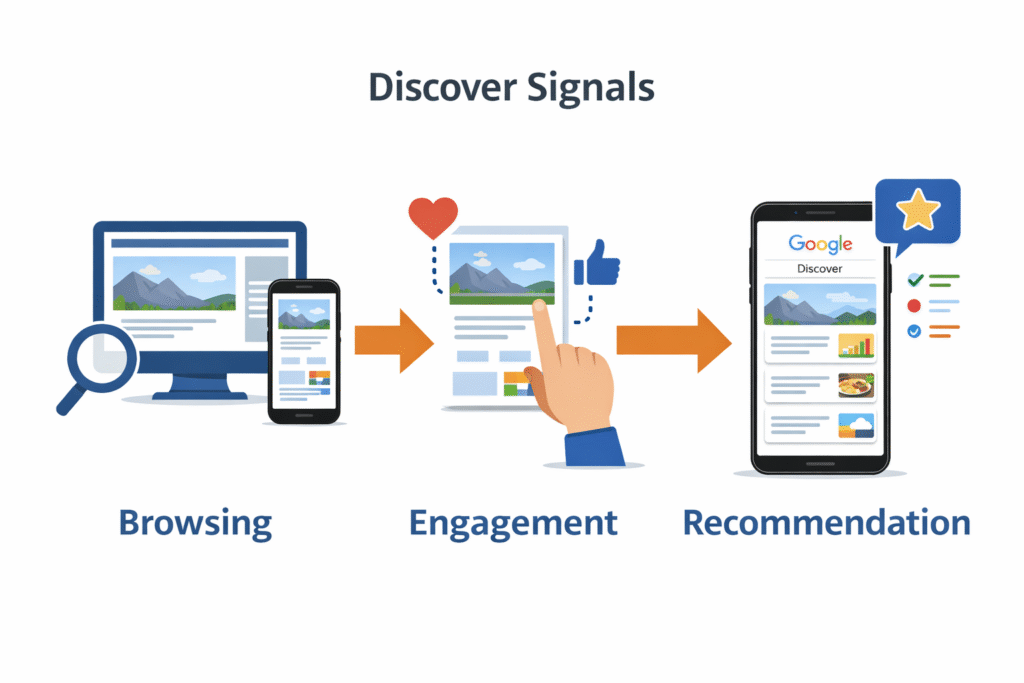
Traditional SEO focuses heavily on keywords and search intent. In contrast, Google Discover focuses on user interest and behavioral patterns. Google analyzes a wide range of signals to understand what topics a user cares about, including:
- Browsing history across websites
- Search activity and topics frequently explored
- YouTube watch history and engagement
- Interaction with Discover content (clicks, skips, scroll behavior)
- Location and language preferences
Based on these signals, Google predicts what content users are most likely to engage with—even before they search for it. This means your content can appear in Discover even if users never searched for your target keyword.
This also explains why Discover traffic can suddenly increase or disappear. If Google’s systems decide your content is highly relevant to a user’s interests, it may recommend it aggressively. If engagement drops or content quality signals weaken, visibility can decline quickly.
Machine Learning and Personalization Drive Discover Visibility
Google Discover is powered heavily by machine learning. These systems constantly evaluate how users interact with content and adjust recommendations in real time. The algorithm learns from user behavior, including:
- Which articles users click
- How long they stay on a page
- Whether they scroll or return immediately
- How frequently users engage with content from a specific website
Content that receives strong engagement signals is more likely to appear more often and to a wider audience. This creates a feedback loop—high-quality, engaging content gets more visibility, while low-engagement content gradually disappears from Discover feeds.
In recent years, especially after core updates, Google has strengthened its focus on identifying authoritative, trustworthy, and useful content. This means Discover now prioritizes websites that consistently demonstrate expertise and reliability within their niche.
Key Difference Between Google Discover and Google Search
One of the biggest misconceptions among website owners is that Discover works like search rankings. In reality, the two systems operate very differently.
Google Search is query-driven. It responds directly to specific keywords users type. Rankings depend heavily on keyword relevance, backlinks, and traditional SEO factors.
Google Discover, on the other hand, is recommendation-driven. It focuses more on content quality, relevance to user interests, freshness, and engagement. Keywords still matter, but they are not the primary trigger.
| Factor | Google Search | Google Discover |
| Keyword required | Yes | No |
| User intent | Query-driven | Interest-driven |
| Ranking factors | SEO signals | Engagement signals |
| Content lifespan | Long-term | Short-term spikes |
For example, a well-written article about digital marketing trends may appear in Discover for users interested in marketing—even if they never searched for that specific topic.
This shift toward recommendation-based visibility is one of the biggest reasons why many websites experienced sudden Discover traffic changes after core updates. Google is continuously refining how it evaluates content quality, user engagement, and authority to improve the recommendations users see.
Understanding this fundamental difference is essential. Once you recognize that Discover rewards content based on interest, trust, and engagement—not just keywords—you can begin optimizing your content more effectively for long-term Discover visibility.
Major Changes in Google Discover After Core Update (2024–2026)
The most important changes in google discover happened between 2024 and 2026, as Google significantly improved how it evaluates content quality, trust, and user engagement. These core updates didn’t just affect traditional search rankings—they reshaped how content is selected and recommended in Discover feeds. Many websites that previously received consistent Discover traffic suddenly saw major drops, while others experienced unexpected growth.
These shifts were not random. Google refined its machine learning systems to prioritize content that demonstrates genuine expertise, authority, freshness, and strong user engagement. As a result, Discover has become more selective, favoring high-quality content from trusted sources while reducing visibility for low-value or mass-produced content.
Below are the most critical changes that directly impacted Discover visibility.
Change #1: Stronger Emphasis on EEAT Signals
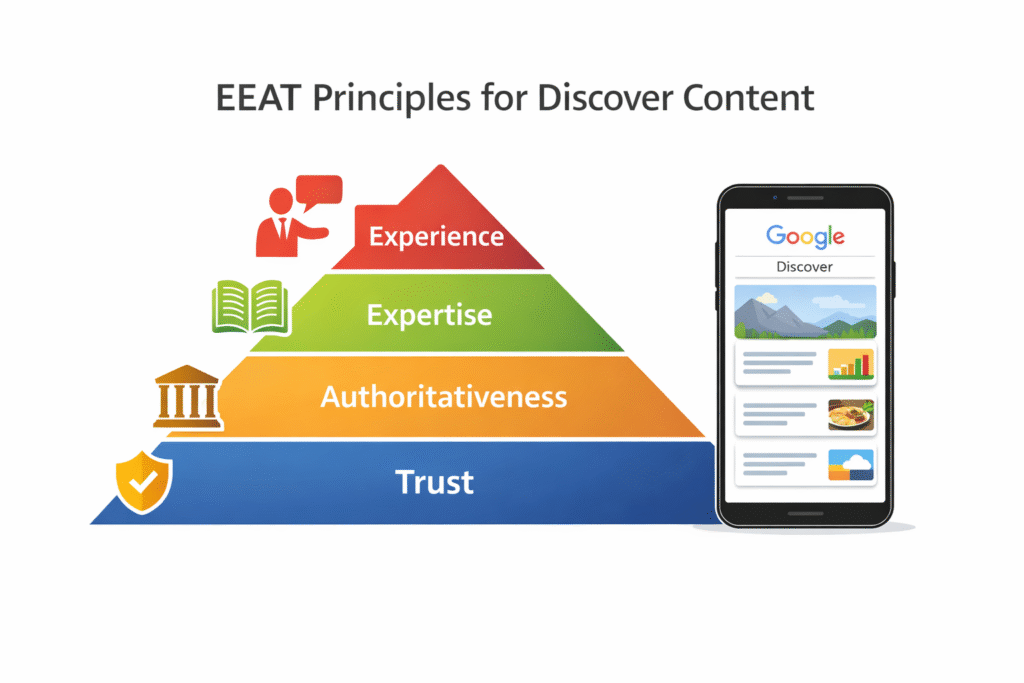
One of the biggest changes was Google’s increased focus on EEAT—Experience, Expertise, Authoritativeness, and Trustworthiness. While EEAT has always been part of Google’s quality evaluation framework, recent core updates strengthened its influence specifically within Google Discover.
Google now places greater importance on content created by identifiable experts and trusted sources. Websites that clearly demonstrate real-world experience, expert authorship, and credibility are more likely to appear in Discover feeds. This includes having detailed author profiles, transparent website information, and consistent topical authority.
Websites with strong EEAT signals saw noticeable improvements in Discover visibility. According to industry analysis and case studies referenced by Search Engine Roundtable, websites that added clear author profiles and improved credibility signals experienced up to 35% growth in Discover traffic. These improvements helped Google’s systems better understand who created the content and whether the source could be trusted.
On the other hand, websites publishing anonymous content or generic articles without clear expertise saw significant declines. Content that lacked identifiable authors, credibility, or original insights became less competitive in Discover recommendations.
Improving content quality and expertise is essential, especially if you want to avoid issues like your disapproved blog, which often happen due to poor content quality and trust signals.
This change reflects Google’s broader goal of recommending content users can trust, especially as the internet becomes saturated with low-quality and AI-generated material.
Change #2: Reduced Visibility for Low-Quality or AI-Spam Content
Another major shift was the aggressive reduction of low-quality, thin, and mass-produced content in Discover feeds. As AI content generation became more widespread, many websites began publishing large volumes of generic articles without adding original insights or value.
Google responded by strengthening its spam detection and quality evaluation systems. Core updates and spam updates now work together to identify and limit the visibility of low-quality content across all Google surfaces, including Discover.
Thin content—articles that provide minimal value, lack depth, or simply rephrase existing information—lost significant Discover visibility. Websites that relied heavily on bulk publishing without focusing on quality were especially affected.
According to Google’s Web Spam Report, spam updates and quality improvements removed approximately 40% of low-quality content visibility from Google systems. This includes Discover recommendations, where Google aims to provide helpful, trustworthy, and engaging content.
This change reinforced a clear message: publishing more content does not guarantee more Discover traffic. Quality, originality, and usefulness matter far more than quantity.
Change #3: Increased Preference for Fresh and Trending Content
Freshness became an even stronger ranking factor in Google Discover after recent core updates. Discover is designed to recommend content that is timely, relevant, and aligned with current user interests.
Unlike traditional SEO, where evergreen content can rank for years, Discover heavily favors recently published or recently updated content. Articles that cover trending topics, current events, or newly updated information are more likely to appear in Discover feeds.
Content freshness now plays a major role in determining visibility:
- Recently published articles are more likely to appear in Discover
- Updated content with new information can regain Discover visibility
- Trending topics generate significantly higher Discover exposure
Content performance in Discover generally follows this pattern:
- Evergreen content without updates often receives low Discover visibility
- Updated evergreen content performs moderately well
- Fresh content covering trending topics performs best
This explains why many websites experience sudden Discover traffic spikes after publishing new or timely content, followed by gradual declines as the content becomes outdated.
Change #4: Engagement Signals Became Stronger Ranking Factors
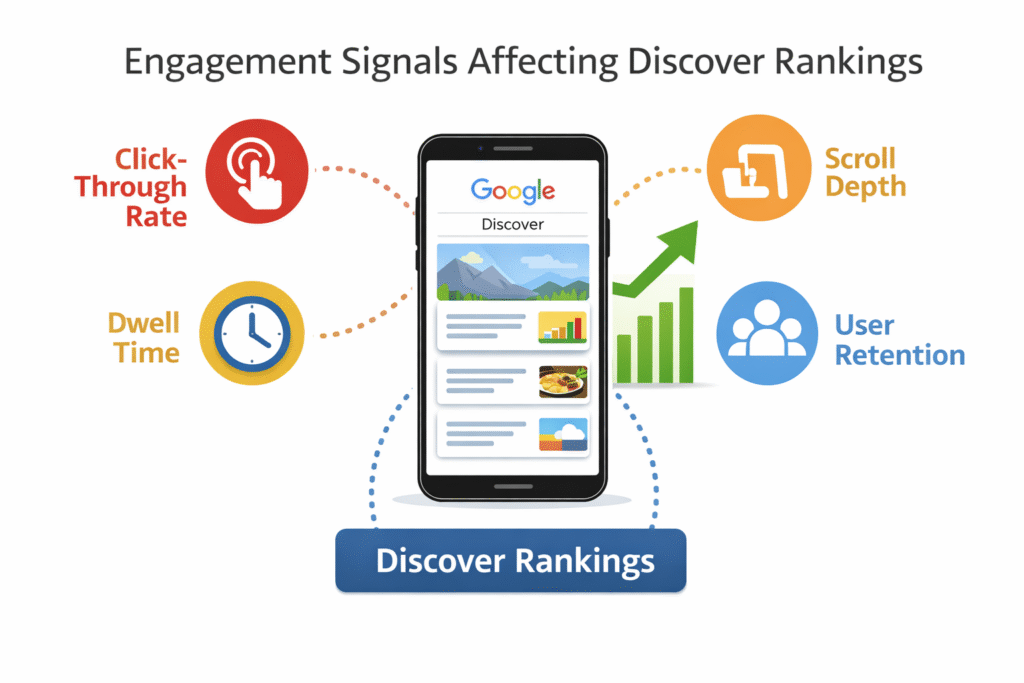
User engagement became one of the most powerful signals influencing Discover visibility. Google closely monitors how users interact with content to determine whether it should continue recommending it.
Key engagement signals include:
- Click-through rate (CTR): How often users click on the content
- Dwell time: How long users stay on the page
- Scroll depth: How much of the content users actually read
- Bounce rate: Whether users leave quickly or continue exploring
Content that keeps users engaged sends strong positive signals to Google. This increases the likelihood that the content will be recommended to more users through Discover.
Industry data and case studies show that pages with strong engagement metrics can receive 2 to 3 times higher Discover visibility compared to pages with poor engagement. This is because Discover’s algorithm prioritizes content that users find genuinely interesting and valuable.
On the other hand, content that users quickly abandon or ignore gradually loses visibility. Even if a website has strong authority, poor engagement can reduce its Discover performance.
These changes collectively transformed Google Discover into a more quality-focused and engagement-driven platform. Instead of rewarding mass publishing or keyword targeting alone, Discover now prioritizes trusted sources, fresh content, and content that users genuinely engage with.
Websites that adapt to these changes by focusing on expertise, quality, freshness, and user experience are far more likely to maintain and grow their Discover traffic.
Sites That Lost Discover Traffic
After recent core updates, one of the clearest patterns was that many smaller and lower-quality websites lost a significant portion of their Google Discover traffic. These losses were not random. Google’s improved quality evaluation systems began filtering out content that lacked authority, depth, and strong user experience signals.
Low authority niche blogs were among the most affected. These websites often focused on narrow topics but lacked strong credibility signals such as expert authorship, brand recognition, or consistent content quality. Even if their content previously performed well, core updates reevaluated their trustworthiness and reduced their Discover visibility.
Websites with thin content also experienced major traffic declines. Thin content refers to articles that provide limited value, lack detailed explanations, or simply summarize information without adding original insights. Many of these pages were initially able to gain Discover traffic due to topic relevance, but after core updates, Google began prioritizing more comprehensive and useful content.
User experience also played a critical role. Websites with poor UX signals saw noticeable Discover traffic drops. Common UX problems included:
- Slow loading speeds
- Poor mobile optimization
- Excessive ads disrupting the reading experience
- Difficult navigation or cluttered layouts
These issues negatively affect user engagement, and Google’s systems interpret poor engagement as a sign that the content is not valuable enough to recommend.
According to industry studies and documented SEO case analyses, many small publishers experienced Discover traffic drops of up to 60% following major core updates. In some cases, Discover traffic disappeared completely, especially for websites that relied heavily on low-depth or generic content.
This shift reflects Google’s stronger focus on recommending content that delivers real value and a positive user experience, rather than simply filling Discover feeds with large volumes of average-quality articles.
Sites That Gained Discover Traffic
While many websites lost Discover visibility, others experienced significant growth. These gains were driven by improvements in content quality, authority, and consistency. Google’s updated systems began favoring websites that demonstrated clear expertise and strong trust signals.
High authority websites benefited the most from these changes. Established websites with strong brand recognition, consistent publishing history, and reliable content quality saw increased Discover exposure. Google’s systems are more confident in recommending content from sources with proven credibility.
Expert-driven blogs also saw strong Discover growth. Websites that publish content written by experienced professionals, industry specialists, or subject matter experts gained an advantage. Clear author profiles, demonstrated expertise, and in-depth analysis helped these websites stand out in Discover recommendations.
Frequently updated websites performed particularly well. Google Discover favors fresh and timely content, so websites that consistently publish new articles or update existing content are more likely to maintain Discover visibility. Regular publishing signals that the website is active and provides up-to-date information.
Certain types of publishers benefited significantly from these changes, including:
- News websites that publish timely and relevant updates
- Industry blogs that provide expert insights and analysis
- Authority niche websites that consistently focus on a specific topic
These websites align closely with Google’s goal of recommending useful, trustworthy, and engaging content. As a result, many of them saw increased Discover traffic after core updates, while lower-quality competitors lost visibility.
This shift makes one thing clear: Google Discover is increasingly rewarding expertise, authority, consistency, and user-focused content. Websites that build strong credibility and prioritize quality are far more likely to succeed in Discover over the long term.
Discover Traffic Drop vs Search Traffic Drop: Key Differences
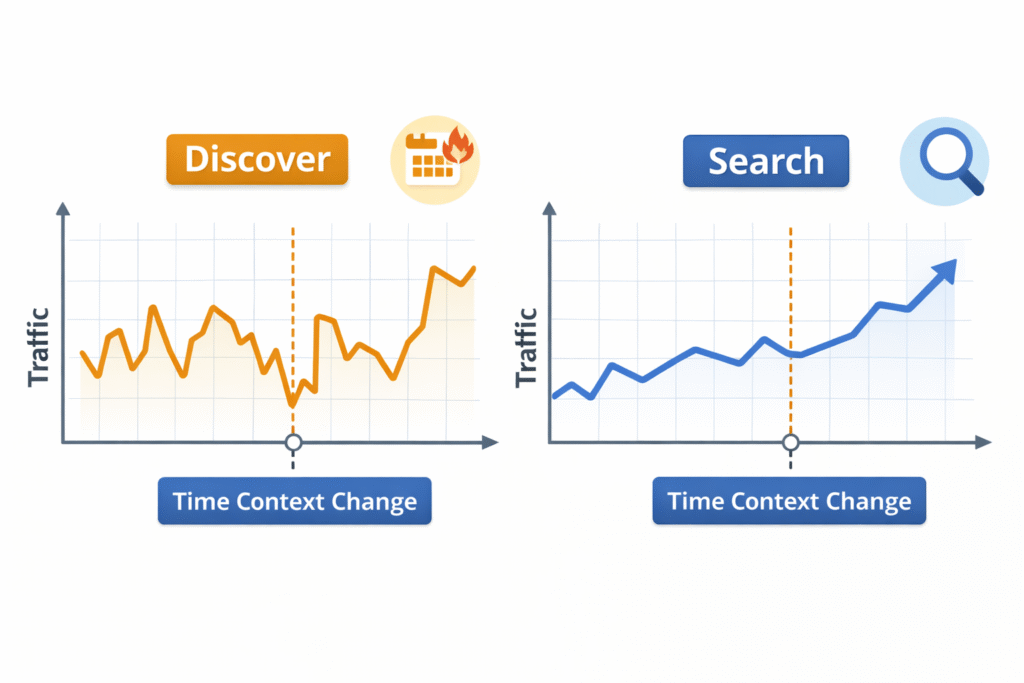
One of the most common mistakes website owners make is assuming that a drop in Google Discover traffic means their entire SEO performance is declining. In reality, Discover traffic and search traffic operate very differently. A drop in Discover traffic does not always mean your website has lost search rankings, and understanding this distinction is critical for diagnosing the real issue.
Google Search is query-driven, meaning your traffic depends on how your pages rank for specific keywords. If your rankings drop, your search traffic declines gradually as competitors outrank your content or as Google reevaluates relevance and quality.
Google Discover, however, is recommendation-driven. It does not rely on keywords or rankings in the traditional sense. Instead, it recommends content based on user interests, engagement, freshness, and content quality. Because of this, Discover traffic can drop suddenly even if your search rankings remain stable.
The core difference lies in how Google evaluates and distributes content across these two systems.
Here is a clear comparison to help understand the difference:
| Metric | Discover Traffic Drop | Search Traffic Drop |
| Primary Cause | Changes in engagement, freshness, or content quality | Changes in keyword rankings and SEO competition |
| Traffic Behavior | Sudden spikes or sudden drops | Gradual increase or gradual decline |
| Recovery Time | Can recover faster with content updates or new posts | Often slower and requires SEO improvements and authority building |
| Keyword Dependency | Not dependent on keywords | Strongly dependent on keyword rankings |
| Content Lifespan | Shorter lifespan, often trend-driven | Longer lifespan, especially for evergreen content |
| Personalization Impact | Highly personalized based on user interests | Less personalized, based more on relevance and authority |
For example, your article may still rank #1 on Google Search and continue receiving steady search traffic, but if users stop engaging with it in Discover—or if newer, fresher content becomes available—Discover may stop recommending it entirely. This creates the impression of a traffic loss, even though your core SEO performance remains intact.
Another key difference is recovery speed. Discover traffic can recover relatively quickly if you publish fresh content, update existing articles, or improve engagement signals such as headlines, visuals, and content quality. Search traffic recovery, on the other hand, often takes longer because it depends on rebuilding rankings, authority, and trust over time.
It is also important to understand that Discover traffic is more volatile by nature. Google continuously tests and adjusts recommendations based on user behavior. Content may perform extremely well in Discover for a few days or weeks, then gradually decline as user interest shifts or new content becomes available.
Understanding this difference helps you avoid unnecessary SEO changes when the real issue is Discover-specific. Instead of focusing only on keyword rankings, improving content freshness, engagement, authority, and user experience becomes essential for maintaining consistent Discover visibility.
Real Traffic Case Studies Showing Discover Changes
The impact of Google core updates on Discover traffic becomes much clearer when you look at real-world examples. Many websites experienced dramatic traffic losses or gains depending on how well their content aligned with Google’s updated quality and trust standards. These case studies highlight a critical truth: Discover traffic is highly sensitive to content freshness, authority, and overall content quality.
These examples are based on documented industry observations, SEO case studies, and patterns reported by publishers and SEO professionals monitoring Discover performance across multiple core updates.
Case Study 1: Blog Lost 70% Discover Traffic After Core Update
One niche informational blog experienced a sudden and severe Discover traffic drop of nearly 70% immediately after a Google core update. Before the update, Discover was one of the website’s largest traffic sources, generating thousands of daily clicks without relying heavily on search rankings.
After analyzing the situation, the primary cause became clear: the content was outdated.
Many of the articles had not been updated in over a year. While the information was still somewhat relevant, it lacked fresh insights, recent data, and current context. Google’s core update reevaluated the content and began favoring newer, more recently updated articles from competing websites.
Even though the website had not made any negative changes, its content freshness signals had weakened over time. As a result, Google stopped recommending those articles in Discover feeds.
The website implemented a recovery strategy focused on updating its existing content. This included:
- Updating outdated statistics and information
- Adding new sections with recent developments
- Improving overall content depth and clarity
- Refreshing headlines and featured images
- Updating publication dates to reflect recent improvements
Within several weeks of updating key articles, Discover traffic began to recover gradually. Over the next two to three months, some updated pages regained Discover visibility and started receiving consistent traffic again.
This case demonstrates a critical lesson: even high-performing Discover content can lose visibility if it becomes outdated. Google prioritizes freshness and relevance, especially for topics that evolve.
Case Study 2: Website Gained 120% Discover Traffic After Improving EEAT
Another website in a competitive niche experienced the opposite outcome. Instead of losing traffic, it saw its Discover traffic increase by over 120% after implementing strong EEAT improvements and content updates.
Initially, the website had decent content quality but lacked clear author information and credibility signals. Articles were published without detailed author bios, and the website provided limited information about who created the content or their expertise.
Recognizing this weakness, the website implemented several key improvements focused on strengthening trust and authority.
First, they added detailed author profiles to every article. These profiles included the author’s name, experience, expertise, and background in the subject area. This helped Google better understand that the content was created by knowledgeable individuals.
Second, they updated existing articles to improve content depth and usefulness. Instead of providing basic information, they added expert insights, examples, updated data, and more comprehensive explanations.
Third, they improved overall content structure and readability. Articles were reorganized to provide clearer explanations, better formatting, and stronger user engagement.
Over the following months, Google began recommending more of its content in Discover. Their Discover impressions and clicks increased significantly, eventually resulting in over 120% growth in Discover traffic compared to previous performance.
This case highlights how improving expertise, trust signals, and content quality can directly increase Discover visibility. Google’s systems actively reward websites that demonstrate real authority and provide valuable, trustworthy content.
These real-world examples show that Discover traffic changes are rarely random. They are usually the result of how Google evaluates content freshness, quality, expertise, and user engagement. Websites that maintain updated, authoritative, and user-focused content are far more likely to succeed in Google Discover, while outdated or low-trust content gradually loses visibility.
How to Check If Your Website Was Affected by Google Discover Changes
If your website traffic suddenly increased or dropped, the first step is to confirm whether Google Discover was responsible. Many website owners mistakenly assume their SEO rankings declined, when in reality, the change came specifically from Discover. Fortunately, Google provides a dedicated Discover report inside Google Search Console that allows you to track this data accurately.
This report shows how often your content appears in Discover feeds, how many users clicked on it, and how your performance changed over time. By analyzing this data, you can quickly identify whether a core update or content change affected your Discover visibility.
Understanding how to read and interpret this report is essential for diagnosing Discover traffic changes and planning the right recovery or growth strategy.
Using Google Search Console Discover Report
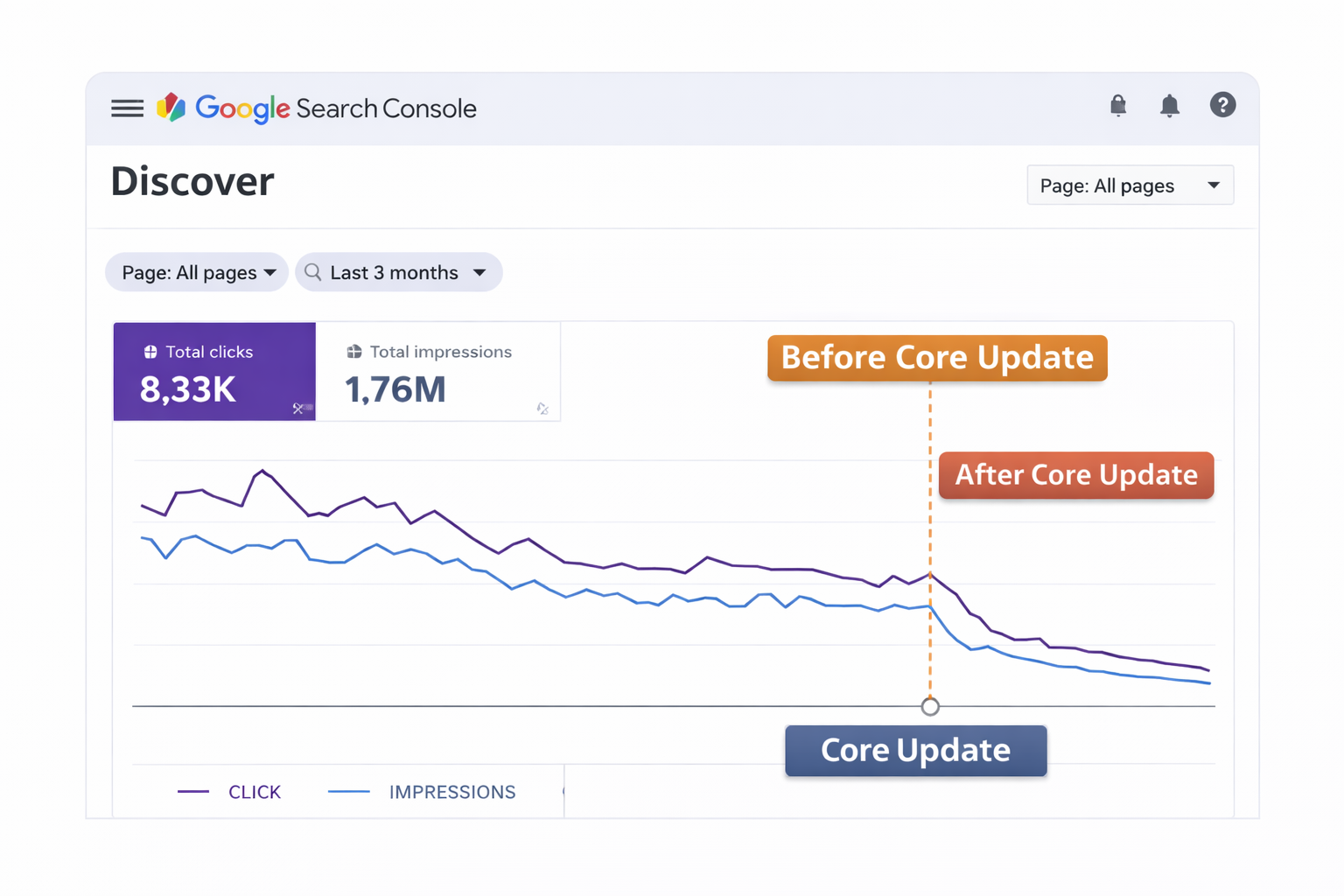
Google Search Console provides a built-in Discover report that shows your website’s performance in Google Discover. This is the most reliable way to confirm whether your website gained or lost Discover traffic after a core update.
Follow these steps to check your Discover performance:
Step 1: Open Google Search Console
Log in to your Google Search Console account and select your website property from the dashboard.
Step 2: Navigate to the Discover Report
In the left-hand menu, look for the “Discover” section under the Performance category. Click on it to open your Discover performance report.
If you do not see the Discover report, it means your website has not generated enough Discover traffic yet. Google only shows this report once your site starts receiving Discover impressions.
Step 3: Compare Traffic Date Ranges
Use the date filter at the top of the report to compare performance before and after a core update.
For example, you can compare:
- Last 28 days vs previous 28 days
- Before core update vs after core update
- Month-over-month performance
This comparison helps you identify whether your Discover traffic dropped, increased, or remained stable after recent algorithm changes.
You can also click on individual pages within the report to see which specific articles gained or lost Discover visibility.
For official guidance, you can refer to the Google Search Console Discover report guide, which explains how Discover performance is tracked and reported.
Key Metrics to Monitor
When analyzing Discover performance, there are three key metrics you should monitor closely. These metrics help you understand how Google is recommending your content and how users are interacting with it.
Clicks
Clicks show how many users opened your content from Discover. A sudden drop in clicks usually indicates that Google stopped recommending your content as frequently, or users are less interested in it.
Impressions
Impressions represent how often your content appeared in Discover feeds. This is one of the most important indicators of Discover visibility. If impressions drop, it means Google is recommending your content less often.
Click-Through Rate (CTR)
CTR shows the percentage of users who clicked your content after seeing it in Discover. A low CTR may indicate weak headlines, poor featured images, or low user interest. A high CTR suggests your content is engaging and attractive to users.
Monitoring these three metrics together provides a clear picture of your Discover performance. For example:
- If impressions drop but CTR stays stable, the issue is Discover visibility
- If impressions stay high but CTR drops, the issue is content appeal or engagement
- If both impressions and clicks drop, the issue is likely related to content quality, freshness, or trust signals
Regularly checking your Discover report helps you identify problems early and take corrective action before traffic losses become permanent.
How to Recover From Google Discover Traffic Drop
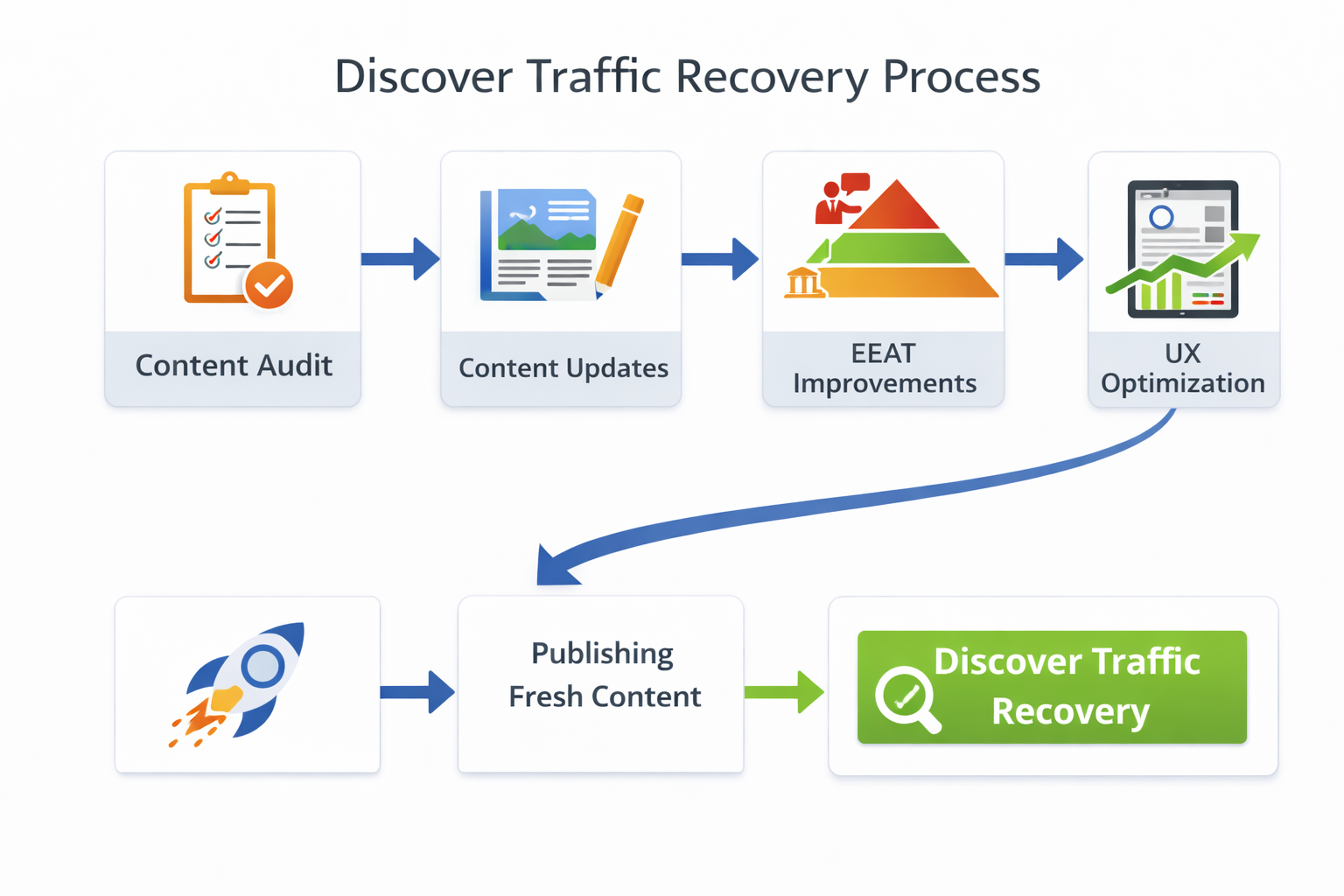
Recovering from a Discover traffic drop is completely possible, but it requires understanding what caused the decline in the first place. Recent changes in Google Discover have made the platform more selective, prioritizing high-quality, trustworthy, fresh, and engaging content. This means websites must focus on improving real content value, not just publishing more articles.
The goal is to align your website with Google’s expectations by strengthening content quality, authority, freshness, and user experience. When Google sees positive improvements in these areas, it gradually starts recommending your content again in Discover feeds.
Recovery does not happen instantly, but websites that implement the right improvements often see Discover traffic return within a few weeks to a few months.
Improve Content Quality and Depth
Content quality is the most important factor in Discover visibility. Google’s systems prioritize content that provides genuine value, original insights, and comprehensive information. Thin or outdated content is far less likely to appear in Discover recommendations.
Start by reviewing your existing articles and identifying pages that previously received Discover traffic. Focus on improving those pages first.
You can improve content quality by:
- Adding expert insights, practical examples, or real-world experience
- Expanding sections that lack depth or clarity
- Including updated statistics, recent developments, and new information
- Making the content more useful, actionable, and informative
Updating content sends a strong signal to Google that your website is actively maintaining quality and relevance. In many cases, updated articles regain Discover visibility over time.
Improve EEAT Signals
Google Discover strongly favors websites that demonstrate clear expertise, authority, and trustworthiness. Improving EEAT signals helps Google trust your content and recommend it more confidently.
One of the most effective improvements is adding detailed author bios. Each article should clearly show who wrote the content and why they are qualified to write about the topic. This helps Google understand the expertise behind the content.
You can strengthen EEAT by:
- Adding author names and professional bios
- Showing credentials, experience, or expertise related to the topic
- Including an About page explaining your website and its purpose
- Adding contact information and transparency details
- Ensuring consistent publishing within your niche
These trust signals help establish credibility, which is essential for long-term Discover visibility.
Focus on Trending Topics and Fresh Content
Fresh content plays a major role in Discover performance. Google Discover is designed to recommend timely, relevant content that reflects current user interests.
Studies and industry observations show that fresh content can receive up to 3 times higher Discover visibility compared to outdated or rarely updated content.
To improve Discover recovery, focus on:
- Publishing new articles regularly
- Covering trending or current topics in your niche
- Updating older articles with new information
- Adding recent insights or industry developments
Even updating existing content with fresh information can help restore Discover’s visibility. Google prefers recommending content that reflects the most current and relevant information available.
Improve User Experience
User experience is another critical factor affecting Discover’s visibility. If users have a poor experience on your website, they are less likely to engage with your content. This sends negative signals to Google.
Improving user experience starts with technical performance and usability.
Focus on:
- Improving page loading speed
- Ensuring your website is fully mobile-friendly
- Reducing intrusive ads or pop-ups
- Improving readability with clear formatting
- Making navigation simple and user-friendly
Since most Discover traffic comes from mobile devices, mobile optimization is especially important. A fast, smooth, and clean user experience encourages users to stay longer and engage more deeply with your content.
Improve Content Engagement
Engagement signals directly influence whether Google continues recommending your content. Even high-quality content may lose Discover visibility if users do not engage with it.
Improving engagement starts with creating more compelling and attractive content presentations.
You can improve engagement by:
- Writing stronger, more curiosity-driven headlines
- Using high-quality, relevant featured images
- Improving storytelling and readability
- Making content easier to scan and understand
- Providing clear value early in the article
Content that captures attention and keeps users engaged sends strong positive signals to Google. This increases the likelihood that your content will be recommended more frequently in Discover.
Recovering Discover traffic requires consistency and continuous improvement. Websites that focus on quality, expertise, freshness, and user experience are far more likely to regain and maintain strong Discover visibility over time.
How to Optimize Content Specifically for Google Discover in 2026
Optimizing for Google Discover in 2026 requires a different approach than traditional SEO. Since Discover is driven by user interests, engagement, and content quality—not just keywords—your strategy must focus on building authority, publishing valuable content consistently, and creating a strong visual and user experience.
Google’s recommendation systems are now more advanced and selective. They prioritize content that demonstrates expertise, aligns with user interests, and delivers a strong engagement experience. Websites that focus on these factors are far more likely to appear consistently in Discover feeds.
The following optimization strategies are essential for improving and future-proofing your Discover visibility.
Use High-Quality Images (Critical Factor)
Images play a crucial role in Google Discover performance. In fact, visuals are often the first thing users notice in their Discover feed. A compelling image can significantly increase click-through rate and engagement, which directly improves Discover visibility.
Google itself recommends using large, high-quality images to improve Discover eligibility and performance. Specifically, Google advises using images with a minimum width of 1200 pixels. Smaller images may not qualify for large previews, which reduces visibility and click potential.
In addition to image size, you should enable the following meta tag on your website:
max-image-preview: large
This tag allows Google to display larger image previews in Discover feeds. Larger previews make your content more visually appealing and increase the chances of attracting clicks.
To optimize images effectively:
- Use clear, high-resolution featured images
- Ensure images are relevant to the content topic
- Avoid blurry, generic, or low-quality stock images
- Use original or unique visuals whenever possible
High-quality images not only improve click-through rates but also signal professionalism and quality, which strengthens your overall Discover performance.
Build Topical Authority
Topical authority is one of the strongest signals influencing Google Discover visibility. Google prefers recommending content from websites that consistently publish high-quality content within a specific niche.
When your website focuses on a clear subject area, Google’s systems begin to recognize it as a reliable source for that topic. This increases the likelihood that your content will appear in Discover feeds for users interested in that niche.
You can build topical authority by publishing consistently around related topics rather than covering unrelated subjects.
For example, if your website focuses on digital marketing, you should consistently publish content related to:
- SEO strategies
- Google updates
- Content marketing
- Paid advertising
- Social media marketing
Avoid publishing random, unrelated topics, as this weakens your authority signals.
Building topic clusters is also highly effective. Topic clusters involve creating multiple related articles around a central theme. This helps Google understand your expertise and improves Discover visibility across multiple articles.
Over time, consistent niche-focused publishing strengthens your authority and increases your chances of appearing regularly in Discover.
Publish Consistently
Consistency is another key factor in Discover optimization. Google Discover favors websites that publish fresh content regularly because it signals that the website is active, relevant, and continuously providing new information.
Websites that publish consistently are crawled more frequently and have more opportunities to appear in Discover feeds.
Industry studies and SEO case observations show that websites publishing consistently experienced up to 40% higher Discover visibility compared to websites that publish infrequently.
Consistency does not mean publishing low-quality content frequently. Quality must always come first. Publishing fewer high-quality articles regularly is far more effective than publishing large amounts of low-value content.
A consistent publishing schedule helps:
- Maintain Discover visibility
- Increase content freshness signals
- Improve topical authority
- Build long-term Discover traffic stability
Websites that combine consistent publishing, strong topical authority, and high-quality visuals are far more likely to succeed in Google Discover in 2026 and beyond.
Timeline of Google Discover Changes After Recent Core Updates
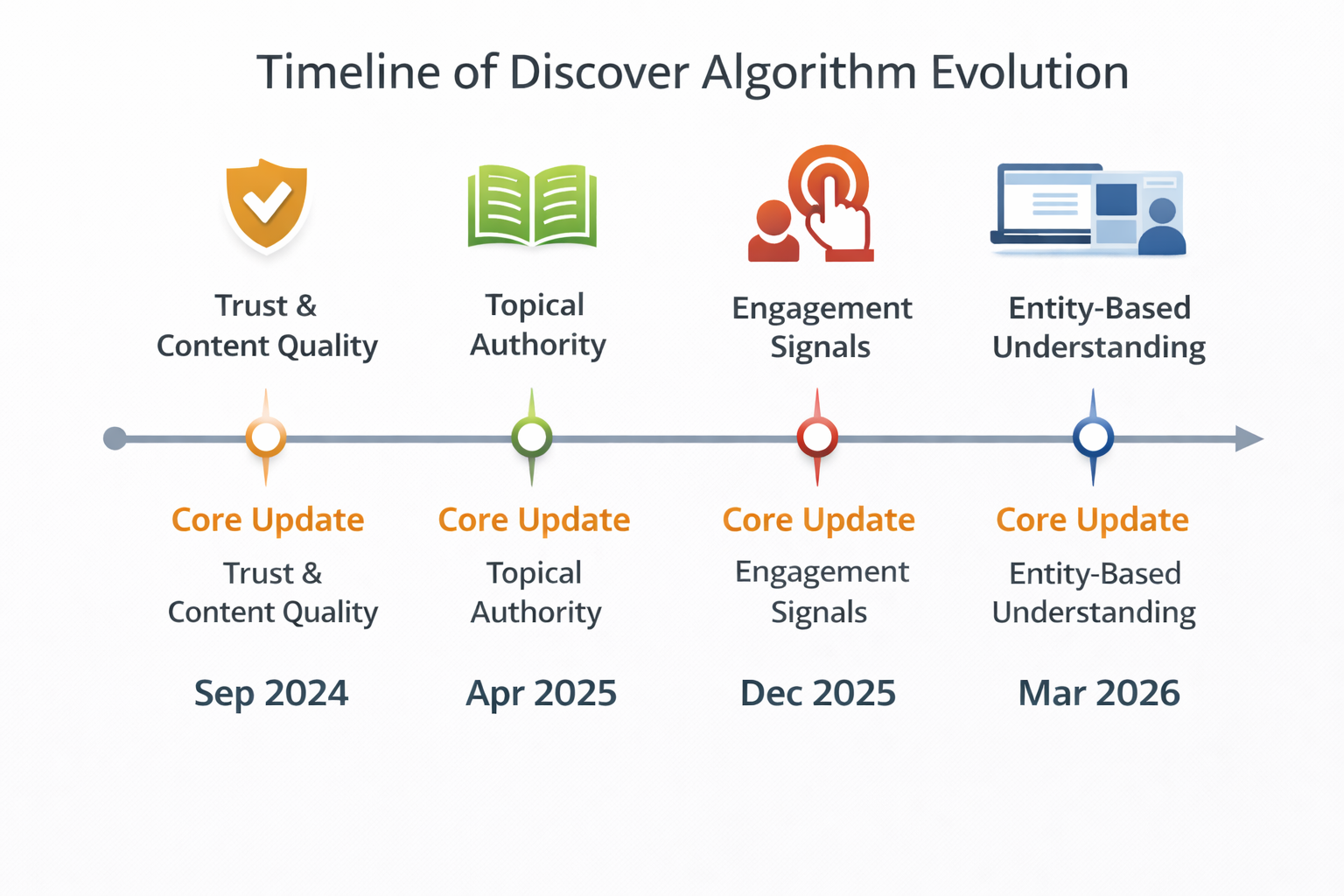
Understanding the timeline of Google Discover changes helps explain why traffic patterns have shifted so dramatically over the past few years. Google’s core updates have gradually reshaped Discover into a more quality-focused, authority-driven, and AI-powered recommendation system. Each update introduced improvements in how content is evaluated, filtered, and recommended to users.
Instead of relying on basic relevance signals, Google Discover now uses advanced machine learning systems to prioritize trustworthy, engaging, and fresh content. This evolution has led to major traffic gains for high-quality websites and significant losses for lower-quality or outdated content.
The following timeline highlights the most important Discover-related changes introduced through recent core updates.
| Core Update | Discover Impact |
| March 2024 Core Update | Major traffic volatility across many websites as Google strengthened content quality evaluation. Many publishers reported sudden Discover traffic drops and gains. |
| August 2024 Core and Spam Updates | Significant reduction in spam and low-quality content. Many mass-produced and thin content websites lost Discover visibility. |
| March 2025 Core Update | Stronger prioritization of EEAT signals. Websites with expert authors, trusted branding, and strong authority gained more Discover exposure. |
| 2026 Algorithm Improvements | Increased use of AI-driven personalization. Discover became more precise in recommending content based on individual user interests and engagement behavior. |
The March 2024 core update was one of the first major turning points. Many websites experienced sudden Discover traffic volatility as Google improved its ability to evaluate content usefulness and trustworthiness. Websites that relied on generic or outdated content saw significant declines, while authoritative websites gained visibility.
The August 2024 updates focused heavily on spam reduction. Google introduced stronger spam detection systems that filtered out low-quality and mass-produced content. This helped improve the overall quality of content appearing in Discover feeds and reduced visibility for websites publishing low-value articles.
The March 2025 core update further strengthened EEAT signals. Google became more effective at identifying expert-driven content and trusted sources. Websites with clear author identities, professional expertise, and strong authority saw Discover traffic increases, while anonymous or low-trust websites experienced declines.
By 2026, Google Discover will have become even more advanced with AI-driven personalization. Google’s systems now analyze user behavior more accurately than ever before, recommending content that closely aligns with individual interests, engagement patterns, and browsing habits. This makes Discover more precise but also more selective.
This timeline shows a clear trend: Google Discover is continuously evolving toward prioritizing quality, trust, expertise, freshness, and user engagement. Websites that adapt to these changes by focusing on long-term content quality and authority are far more likely to maintain stable Discover visibility in the future.
Future of Google Discover: What to Expect Next
Google Discover is evolving rapidly, and recent trends make it clear that its future will be shaped by artificial intelligence, deeper personalization, and stricter quality standards. Google’s goal is simple but ambitious: recommend the most useful, relevant, and trustworthy content to each user at the right time.
Based on recent core updates, spam policies, and improvements in machine learning, Discover is becoming more precise and selective. This means websites that focus on quality, expertise, and user value will benefit the most, while generic or low-value content will continue to lose visibility.
The following trends are expected to define the future of Google Discover.
More Advanced AI Personalization
Advanced machine learning systems already power Google Discover, but its personalization capabilities are expected to become even more sophisticated. Google is improving its ability to understand individual user interests, behavior patterns, and engagement signals.
Instead of recommending content based solely on broad topics, Discover will increasingly recommend content based on highly specific user interests. For example, instead of showing general digital marketing articles, Discover may prioritize content related to very specific subtopics such as Google Ads optimization, SEO algorithm updates, or content strategy—depending on the user’s behavior.
This means Discover visibility will become more targeted. Content will be shown to users who are most likely to engage with it, improving overall user experience but also making Discover more competitive.
Websites that consistently publish high-quality, niche-focused content will have a greater chance of appearing in these personalized feeds.
Stronger Prioritization of Authority and Trusted Sources
Google is placing increasing importance on recommending content from trusted and authoritative sources. This trend will continue to strengthen as Google works to reduce misinformation, spam, and low-quality content.
Websites that demonstrate clear expertise, strong brand identity, and consistent publishing quality will benefit the most. Signals that will become even more important include:
- Clear author identity and expertise
- Strong topical authority within a niche
- Consistent publishing history
- Positive user engagement signals
- Overall website trustworthiness
Established websites and niche authority blogs will continue to gain Discover visibility, while websites without clear expertise or credibility may struggle to appear consistently.
This shift reflects Google’s long-term focus on trust. Discover is designed to recommend content users can rely on, not just content that matches a topic.
Reduced Visibility for Generic and Mass-Produced Content
As Google’s quality evaluation systems improve, generic and mass-produced content will continue to lose Discover visibility. Content that lacks originality, depth, or unique value is less likely to be recommended.
This includes:
- Thin articles with minimal useful information
- Mass-produced AI-generated content without human insights
- Content that simply repeats existing information without adding value
- Websites publishing large volumes of low-quality articles
Google’s systems are becoming more effective at identifying content that provides genuine value versus content created primarily for traffic generation.
In the future, fewer high-quality articles will outperform large volumes of average-quality content. This represents a fundamental shift in strategy—quality and authority now matter far more than quantity.
Overall, the future of Google Discover will be driven by smarter AI, stronger authority signals, and higher quality standards. Websites that focus on building expertise, publishing valuable content consistently, and creating strong user engagement will continue to benefit.
Google Discover is gradually becoming less predictable but more intelligent. It is no longer just recommending content—it is learning which sources deserve attention and which do not. Websites that align with this direction will be best positioned to grow their Discover traffic in the years ahead.
Conclusion: Understanding Changes in Google Discover and How to Adapt
Google Discover has become one of the most powerful yet unpredictable traffic sources for modern websites. Unlike traditional search, where rankings change gradually, Discover visibility can increase or decrease suddenly based on how Google evaluates content quality, freshness, authority, and user engagement. The recent changes in Google Discover reflect Google’s growing focus on recommending content that provides genuine value and comes from trustworthy sources.
One of the most important shifts is that Discover now prioritizes quality over quantity. Websites that publish expert-driven, useful, and engaging content are far more likely to appear consistently in Discover feeds. Strong engagement signals—such as higher click-through rates, longer dwell time, and better user interaction—play a critical role in maintaining Discover visibility. This means creating content that captures attention and delivers real value is more important than ever.
Core updates have also become a major factor influencing Discover performance. These updates reevaluate websites based on trust, expertise, and overall content quality. As a result, many websites experienced Discover traffic drops or gains immediately after core updates. This is not random—Google is refining its ability to recommend the best possible content to users.
The good news is that recovery is absolutely possible. Websites that update outdated content, improve content depth, strengthen author credibility, and publish fresh, high-quality articles often regain Discover visibility over time. Improving user experience, using high-quality images, and building topical authority also significantly increase the chances of long-term Discover success.
Ultimately, Google Discover is moving toward a future where authority, expertise, freshness, and user satisfaction determine visibility. Websites that focus on helping users, demonstrating real expertise, and maintaining consistent content quality will continue to benefit. By understanding these changes and adapting your content strategy accordingly, you can not only recover lost Discover traffic but also build a stronger and more sustainable source of organic visibility.
Why did my Google Discover traffic drop suddenly?
Google Discover traffic usually drops after a core update reevaluates content quality, freshness, and engagement. If your content is outdated, lacks authority, or users are not engaging with it, Google may stop recommending it. Discover is highly dynamic, so even strong-performing content can lose visibility if newer or more valuable content becomes available.
How long does it take to recover Google Discover traffic?
Recovery time can vary from a few weeks to several months depending on the improvements you make. Websites that update outdated content, improve expertise signals, and publish fresh, high-quality articles often start seeing Discover traffic recovery within 30 to 90 days. Consistency and content quality are key factors in recovery speed.
How does Google Discover choose which content to show?
Google Discover selects content based on user interests, browsing behavior, engagement history, and content quality. It analyzes signals such as what users read, click, and engage with. Content that demonstrates expertise, freshness, and strong engagement is more likely to appear in Discover feeds.
Can new websites get traffic from Google Discover?
Yes, new websites can get Discover traffic, but it is more challenging. Google prefers recommending content from websites that show consistent quality, clear expertise, and topical authority. New websites can improve their chances by publishing high-quality, niche-focused content and building credibility over time.
Is Google Discover affected by core updates?
Yes, Google core updates directly impact Discover visibility. Core updates improve how Google evaluates content quality, trustworthiness, and usefulness. Websites that meet Google’s quality standards may gain Discover traffic, while others may lose visibility.
What type of content performs best in Google Discover?
Content that is fresh, engaging, and authoritative performs best. Trending topics, updated articles, expert insights, and visually appealing content with strong headlines and high-quality images tend to get more Discover visibility. Content that aligns with user interests has a higher chance of being recommended.
Does posting frequency affect Google Discover traffic?
Yes, publishing consistently improves your chances of appearing in Discover. Websites that regularly publish high-quality content send strong freshness and activity signals to Google. However, quality is more important than quantity. Publishing useful and well-written content consistently is the best approach.
How can I increase my website traffic from Google Discover?
You can increase Discover traffic by improving content quality, updating outdated articles, using high-quality images, building topical authority, and improving user engagement. Adding expert insights, publishing fresh content, and improving page experience also help increase Discover visibility.
How do I know if my website appears in Google Discover?
You can check this in Google Search Console. If your website receives Discover traffic, you will see a dedicated “Discover” report showing impressions, clicks, and click-through rate. This report helps you track Discover performance and identify traffic changes.
Does EEAT affect Google Discover rankings?
Yes, EEAT (Experience, Expertise, Authoritativeness, and Trustworthiness) plays a major role in Discover visibility. Google prefers recommending content from trusted sources with clear expertise. Adding author bios, improving content quality, and building authority can improve Discover performance.
💡 Interested in learning more? Contact RKDMT – Raju Kumar Digital Marketer – Best Digital Marketing Training Institute
🔗www.rajukumardigitalmarketing.com
📞 +91-7303933302, +91-9217057127
📧 rkdmt@rajukumardigitalmarketer.com

Founder at Digital Marketing Marvel | Founder at RKDMT – Raju Kumar Digital Marketing Trainer | Best Digital Marketing Trainer in Delhi/NCR – Digiperform | Project Manager | 5+ years | Genius Study Abroad & Inlingua’s Digital Marketing Head | Learn Digital Marketing