


What Is B2B Marketing Strategy? Scale Faster Today
What is B2B marketing? In simple and practical terms, B2B (Business-to-Business) marketing means promoting products or services from one business to another business, instead of selling to individual consumers. For example, a software company selling tools to enterprises or a supplier providing raw materials to manufacturers is using B2B marketing.
At its core, what is B2B marketing is about helping businesses solve problems, improve efficiency, reduce costs, or increase revenue. Unlike consumer marketing, where purchases are often emotional and quick, B2B marketing focuses on logic, long-term value, trust, and measurable results.
Understanding what is B2B marketing is especially important in today’s fast-changing business environment. Companies now rely heavily on digital platforms, automation, and data-driven decision-making to grow.
B2B marketing plays a key role in helping businesses attract high-quality leads, build credibility, close larger deals, and retain long-term clients. Without a strong B2B marketing strategy, scaling a business becomes slower, more expensive, and less predictable.
To better understand what is B2B marketing, it’s helpful to compare it with traditional consumer (B2C) marketing. B2C marketing usually targets individuals and focuses on emotional appeal, impulse buying, and short sales cycles.
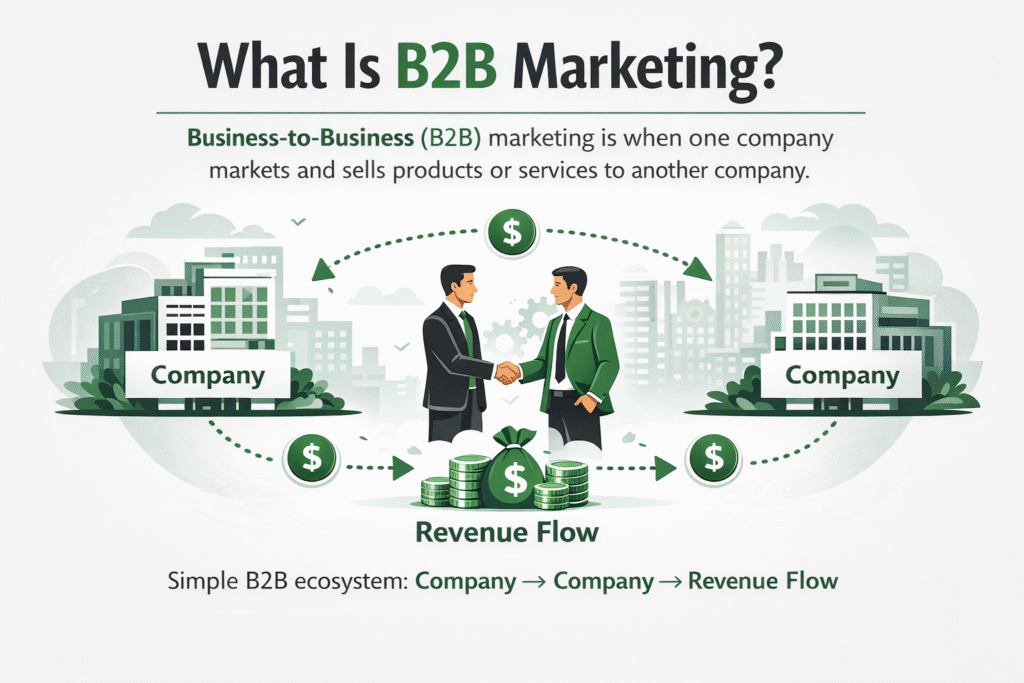
In contrast, B2B marketing targets decision-makers, companies, and organizations, where buying decisions involve multiple stakeholders, longer evaluation periods, and greater financial impact. This makes B2B marketing more strategic, research-driven, and relationship-focused.
In this guide, you’ll learn what is B2B marketing, how it works, why it’s essential for scaling faster, and how to apply proven strategies in real business situations. We’ll break down the B2B buyer journey, marketing funnels, growth strategies, B2B vs B2C differences, tools, and real-world examples — all in a clear, practical way.
Whether you’re building your first marketing system or strengthening your digital marketing fundamentals, this guide will help you understand what is B2B marketing and how to use it to drive consistent growth, higher revenue, and long-term business success.
Also Read Our: Why SEO for B2B Businesses Matters More Than Ever
What Is B2B Marketing?
What is B2B marketing? B2B (Business-to-Business) marketing means promoting and selling products or services from one business to another business, instead of selling to individual consumers.
In practical terms, what is B2B marketing is about helping companies solve business problems, improve efficiency, increase revenue, or reduce operational costs. For example, a software company selling CRM tools to enterprises, a wholesaler supplying goods to retailers, or a marketing agency serving corporate clients is practicing B2B marketing.
At its core, what is B2B marketing focuses on building trust, creating long-term business relationships, and proving measurable value rather than encouraging impulse purchases. Unlike consumer marketing, B2B marketing is more strategic, research-driven, and centered around logical decision-making.
To understand what is B2B marketing, think of it as marketing designed for larger deals, longer buying processes, and ongoing partnerships. The goal is not just to sell once, but to build a reliable, long-term client relationship that benefits both businesses.
Who Does B2B Marketing Target?
A key part of understanding what is B2B marketing is knowing who it targets. Instead of focusing on individual shoppers, B2B marketing targets business professionals and organizations.
B2B marketing typically targets:
- Business buyers are responsible for procurement
- Decision-makers such as CEOs, founders, directors, and managers
- Corporate teams, including IT, finance, HR, and operations
- Enterprises and organizations, from startups to large companies
Because multiple people are usually involved in business purchasing decisions, what is B2B marketing often requires different messaging for different roles — such as executives focused on ROI, managers focused on productivity, and technical teams focused on performance.
Core Goals of B2B Marketing
Another important part of what is B2B marketing is understanding its main objectives. Unlike B2C marketing, which often focuses on fast sales, B2B marketing aims for long-term, sustainable business growth.
The core goals include:
- Lead generation — attracting high-quality business prospects
- Revenue growth — converting leads into high-value customers
- Partnership building — creating long-term business relationships
- Customer retention — keeping clients loyal and encouraging renewals
Ultimately, what is B2B marketing is about building a predictable sales pipeline, increasing customer lifetime value, and creating stable long-term revenue.
For a trusted industry reference, you can explore the B2B marketing definition by HubSpot.
Simple Explanation of What B2B Marketing Is for Beginners
Here’s a beginner-friendly way to understand what is B2B marketing:
B2B marketing means one business selling products or services to another business.
Plain-Language Breakdown
- If a company sells office furniture to corporate offices → that’s B2B
- If a software company sells tools to enterprises → that’s B2B
- If a wholesaler sells products to retailers → that’s B2B
Real-World Analogy
Think of a bakery:
- Selling cakes to individual customers → B2C
- Supplying cakes in bulk to hotels or restaurants → B2B
So, what is B2B marketing in simple words?
It’s marketing designed to help businesses sell to other businesses, usually involving larger deals, longer relationships, and more careful decision-making.
Key Characteristics of B2B Marketing
To fully understand what is B2B marketing, it helps to know what makes it different from consumer marketing.
1. Longer Sales Cycles
B2B purchases often take weeks or months, because businesses:
- Compare multiple vendors
- Review ROI and pricing
- Require internal approvals
This means B2B marketing focuses on nurturing leads and building trust over time, not quick sales.
2. Multiple Decision-Makers
Unlike consumer purchases made by one person, B2B decisions often involve:
- Executives
- Managers
- Procurement teams
- Finance departments
So what is B2B marketing includes is crafting different messages for different stakeholders.
3. Logic-Driven Buying Decisions
B2B buyers rely on data, logic, and business value, not emotions.
They care about:
- ROI
- Cost savings
- Efficiency
- Performance results
That’s why strong B2B marketing uses case studies, reports, testimonials, and real performance proof.
4. Relationship-Focused Marketing
A major part of what is B2B marketing is building long-term relationships, not one-time sales.
Successful B2B marketing focuses on:
- Trust and credibility
- Ongoing communication
- Long-term partnerships
- Customer retention and loyalty
This leads to repeat business, referrals, and stable revenue over time.
How B2B Marketing Works — Step-by-Step
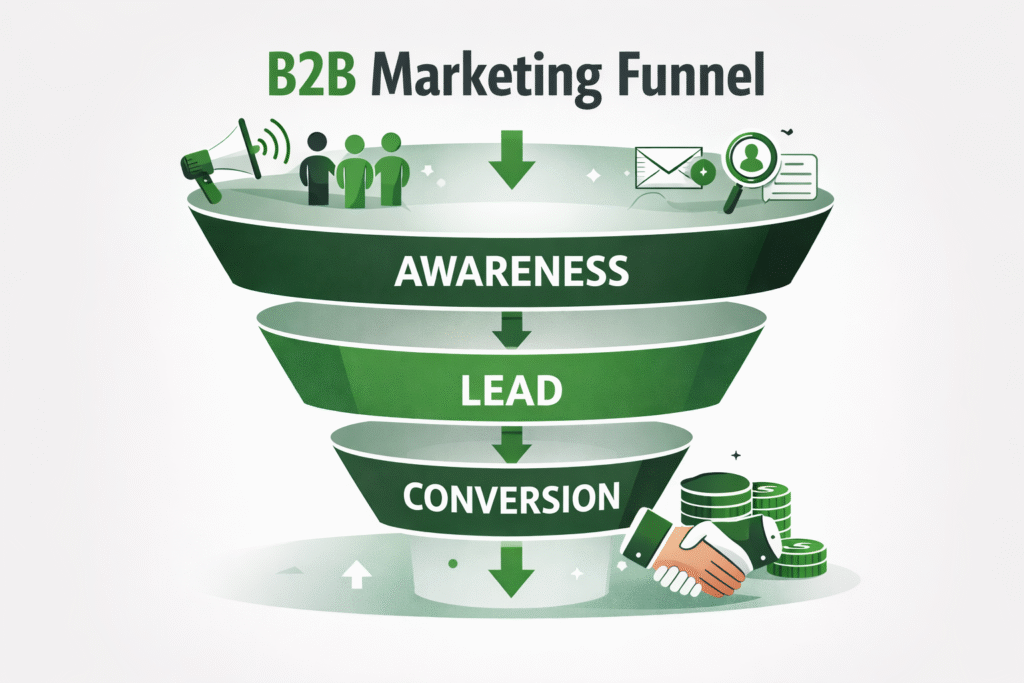
To understand how B2B marketing works, think of it as a guided journey that moves a business buyer from first hearing about your brand to becoming a long-term customer.
Unlike consumer marketing, how B2B marketing works focuses on longer sales cycles, multiple decision-makers, trust-building, and relationship management. It’s not about quick purchases — it’s about earning confidence, proving value, and supporting long-term business growth.
At a high level, how B2B marketing works follows a structured flow:
- Create awareness among potential business buyers
- Nurture interest and educate leads
- Convert prospects into customers
- Retain clients and build long-term loyalty
When done correctly, how B2B marketing works becomes a repeatable growth system that generates qualified leads, supports sales teams, and increases customer lifetime value. Instead of relying on random deals, businesses build a predictable and scalable pipeline.
In short, how B2B marketing works means guiding decision-makers through a logical process that builds trust, reduces risk, and leads to confident purchasing decisions.
From Awareness to Conversion and Retention in B2B Marketing
A key part of how B2B marketing works is understanding that it doesn’t stop after a sale. The goal is to manage the full customer lifecycle — from first contact to long-term partnership.
1. Awareness — Attracting the Right Businesses
At this stage, companies realize they have a problem, need, or opportunity.
B2B marketing creates awareness through:
- SEO and educational blog content
- Social media and LinkedIn outreach
- Paid ads and industry campaigns
- PR, webinars, and industry events
The objective is to get noticed and build credibility, not to sell aggressively.
2. Consideration — Educating and Nurturing Leads
Once buyers are aware, they start researching solutions and comparing vendors.
B2B marketing supports this stage with:
- Case studies and whitepapers
- Email nurturing campaigns
- Product demos and webinars
- Retargeting ads and explainer content
This stage is where how B2B marketing works focuses on building trust, answering questions, and showing proof of value.
3. Decision — Converting Prospects into Customers
At the decision stage, buyers are ready to evaluate pricing, ROI, and final options.
Marketing helps sales teams by providing:
- Testimonials and customer success stories
- ROI calculators and business case documents
- Pricing pages and comparison guides
- Proposal and sales enablement materials
This stage ensures buyers feel confident, informed, and low-risk when choosing your solution.
4. Retention — Building Loyalty and Long-Term Value
After conversion, how B2B marketing works shifts to retention and relationship building.
Retention strategies include:
- Customer onboarding and success programs
- Email updates, newsletters, and education
- Account-based marketing for upsells
- Loyalty programs and referral campaigns
The goal is to turn customers into repeat clients, long-term partners, and brand advocates.
B2B Buyer Journey Stages
The B2B buyer journey represents the mindset and actions a business takes before making a purchase. Understanding these stages is essential to mastering how B2B marketing works.
Awareness
Buyers recognize a problem or opportunity and start exploring information.
Marketing focuses on:
- Educational content
- Industry insights
- Thought leadership
Consideration
Buyers begin comparing solutions and vendors.
Marketing supports with:
- Case studies
- Guides and demos
- Proof of results
Decision
Buyers are ready to choose a provider.
Marketing helps reduce risk using:
- Testimonials
- Pricing clarity
- ROI evidence
Loyalty
After purchase, the focus moves to retention and growth.
Marketing works on:
- Customer engagement
- Renewals and upsells
- Referrals and advocacy
Role of Trust, Authority, and Data in B2B Marketing
A major reason why B2B marketing works differently from consumer marketing is the importance of trust, authority, and data.
Business buyers make high-value, high-risk decisions, so credibility matters more than flashy advertising.
Why Credibility Matters More in B2B
Decision-makers want proof that a solution will:
- Deliver measurable ROI
- Reduce risk
- Improve efficiency
- Provide long-term value
B2B marketing builds trust through:
- Case studies and testimonials
- Industry recognition and certifications
- Thought leadership and expert content
- Transparent pricing and performance metrics
Role of Data in B2B Marketing
Data strengthens how B2B marketing works by helping:
- Identify high-intent prospects
- Personalize campaigns
- Measure ROI and performance
- Optimize conversion funnels
- Provide evidence for buyer decisions
In B2B, numbers, results, and performance proof are often more persuasive than emotional messaging.
B2B vs B2C Marketing — Key Differences
To clearly understand what is B2B marketing, it helps to compare it with B2C (Business-to-Consumer) marketing. While both aim to promote products and drive sales, what is B2B marketing focuses on selling to other businesses, whereas B2C marketing focuses on selling to individual consumers.
In practical terms, what is B2B marketing is about building long-term business relationships, proving ROI, and supporting complex decision-making. On the other hand, consumer marketing often targets emotions, quick decisions, and high-volume sales.
Understanding what is B2B marketing versus B2C helps companies choose the right messaging, channels, and strategies based on their target audience.
Strategy Differences Between B2B and B2C Marketing
Here’s how what is B2B marketing differs from consumer marketing in real-world execution:
1. Target Audience
- B2B marketing targets companies, executives, managers, and decision-makers.
- B2C marketing targets everyday individuals and end consumers.
B2B audiences are more focused on business value, while B2C audiences focus on personal needs and preferences.
2. Sales Cycle
- B2B marketing involves longer sales cycles, often lasting weeks or months.
- B2C marketing usually involves shorter, faster purchase decisions.
B2B buyers take more time because purchases often involve larger budgets and multiple approvals.
3. Decision-Making Process
- B2B marketing decisions are based on logic, ROI, efficiency, and business impact.
- B2C marketing decisions are more influenced by emotions, trends, and impulse buying.
This is why what is B2B marketing relies heavily on data, case studies, and performance proof.
4. Marketing Channels
- B2B marketing uses LinkedIn, email marketing, content marketing, webinars, SEO, and account-based marketing.
- B2C marketing focuses more on social media, influencers, paid ads, TV, and retail promotions.
B2B channels prioritize professional communication, while B2C channels focus on mass reach and entertainment.
5. Messaging Style
- B2B marketing messaging highlights expertise, results, reliability, and long-term value.
- B2C marketing messaging focuses on benefits, excitement, lifestyle, and price deals.
In simple terms, what is B2B marketing is more professional, educational, and solution-oriented.
B2B vs B2C Marketing Comparison
Purpose: Compare B2B vs B2C marketing
| Feature | B2B Marketing | B2C Marketing |
| Audience | Businesses, enterprises, decision-makers | Individual consumers |
| Sales Cycle | Long, multi-step | Short, fast |
| Decision Process | Logic-based, ROI-driven | Emotion-based, impulse-driven |
| Channels | LinkedIn, email, SEO, webinars, content | Social media, influencers, ads, retail |
| Messaging | Professional, value-focused, data-driven | Emotional, lifestyle-focused, promotional |
What Is B2B Marketing vs B2C?
What is B2B marketing?
It’s marketing designed to sell products or services to other businesses, focusing on logic, trust, long-term relationships, and business results.
What is B2C marketing?
It’s marketing designed to sell directly to consumers, focusing on emotions, fast decisions, and mass appeal.
Both are powerful — but they require very different strategies to succeed.
Why B2B Marketing Strategy Is Important for Growth
A strong B2B marketing strategy is essential for businesses that want to grow faster, increase revenue, and build long-term success. Unlike short-term sales tactics, a well-planned B2B marketing strategy creates a predictable system for attracting high-quality clients, nurturing relationships, and generating consistent income.
In today’s competitive market, companies that invest in a clear B2B marketing strategy are better positioned to scale operations, strengthen their brand, and outperform competitors who rely only on referrals or random marketing efforts.
Let’s look at why a B2B marketing strategy is so important for business growth.
Business Scalability
A major benefit of a strong B2B marketing strategy is scalability — the ability to grow without depending entirely on manual sales or personal networks.
With the right systems in place, businesses can:
- Generate consistent leads through SEO, content, and ads
- Reach larger and more valuable clients
- Expand into new industries or markets
- Automate lead nurturing and follow-ups
A scalable B2B marketing strategy allows companies to grow faster and more efficiently, without increasing costs at the same rate as revenue.
Revenue Expansion
A smart B2B marketing strategy plays a direct role in revenue expansion. Because B2B deals are often higher in value than consumer purchases, even a small improvement in lead quality or conversion rates can significantly increase income.
Revenue grows through:
- Better lead targeting and qualification
- Higher conversion rates from marketing to sales
- Larger contract sizes and long-term agreements
- Upselling and cross-selling to existing clients
A well-optimized B2B marketing strategy helps businesses focus on high-value customers who bring more profit over time.
Long-Term Partnerships
Unlike one-time consumer sales, B2B success depends heavily on long-term relationships. A strong B2B marketing strategy focuses on building trust, maintaining communication, and creating ongoing value for clients.
Long-term partnerships lead to:
- Repeat business and contract renewals
- Higher customer lifetime value
- Client referrals and word-of-mouth growth
- Strategic collaborations and co-marketing opportunities
A relationship-driven B2B marketing strategy turns customers into loyal partners, not just buyers.
Competitive Advantage
In crowded markets, a clear B2B marketing strategy gives businesses a strong competitive advantage. Instead of competing only on price, companies can stand out by highlighting expertise, results, credibility, and proven performance.
A strong strategy helps businesses:
- Build brand authority and trust
- Position themselves as industry leaders
- Showcase case studies and real-world success
- Use data and insights to outperform competitors
Companies with a clear B2B marketing strategy are more likely to win larger clients, retain customers longer, and grow sustainably.
Why This Matters for Modern Businesses
A successful B2B marketing strategy is more than just promotion — it becomes a growth engine that drives leads, revenue, retention, and long-term stability.
If you want to understand the systems behind this process, explore how digital marketing works and how it supports sustainable business growth.’
Core Components of a B2B Marketing Strategy
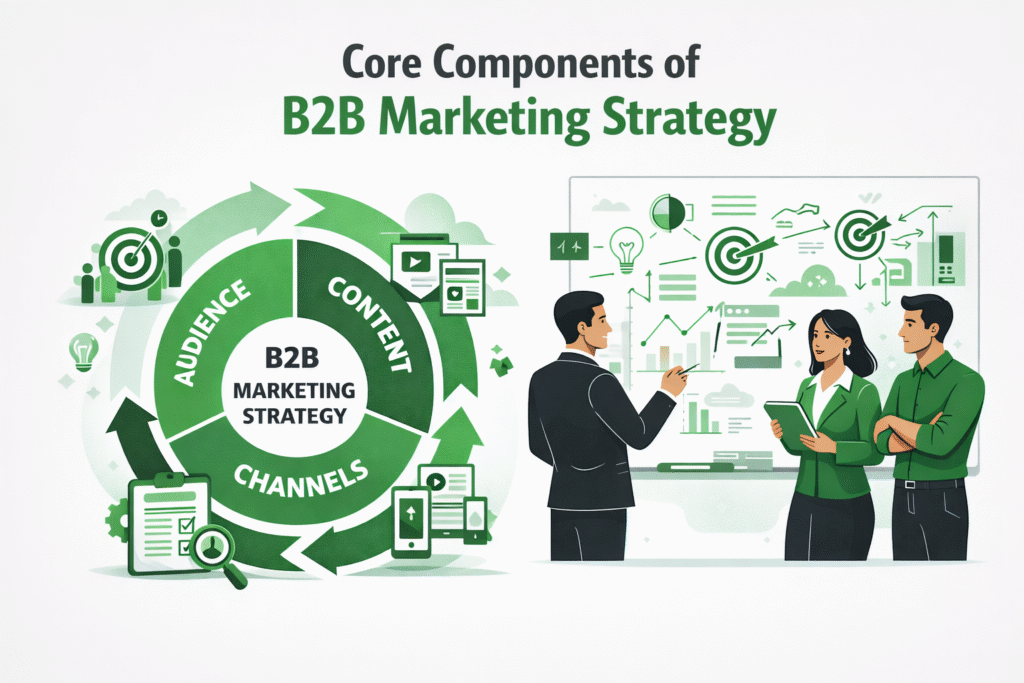
A successful B2B marketing strategy is built on several core components that work together to attract the right businesses, communicate value, generate leads, and convert prospects into long-term clients.
Think of a strategy like a system — each part supports the others. Without a clear audience, strong positioning, helpful content, and lead systems, marketing efforts become scattered and less effective.
The main pillars of a strong B2B marketing strategy include:
- Defining the right target audience
- Creating a compelling value proposition
- Building a consistent content strategy
- Setting up lead generation and nurturing systems
Together, these components form the foundation of a scalable and results-driven marketing strategy.
Target Audience & Ideal Customer Profile (ICP)
One of the most important parts of a B2B marketing strategy is identifying who you want to target. This starts with defining your Ideal Customer Profile (ICP) — the type of business that is most likely to benefit from your product or service.
Buyer Personas
Buyer personas represent the decision-makers and influencers within target companies. These may include:
- CEOs and founders
- Marketing or sales managers
- IT leaders or operations heads
- Procurement or finance teams
Each persona may have different goals, challenges, and concerns, so a strong marketing strategy tailors messaging for each role.
Company Size, Industry, and Role
A clear ICP includes:
- Company size (small business, mid-market, enterprise)
- Industry (technology, healthcare, manufacturing, finance, etc.)
- Job roles involved in purchasing decisions
The more clearly you define your audience, the more targeted and effective your marketing strategy becomes.
Value Proposition & Positioning
A strong B2B strategy must clearly explain why a business should choose you over competitors. This is where your value proposition and positioning come in.
Differentiation Strategy
Your value proposition should highlight:
- What makes your product or service unique
- How you solve business problems better than others
- The measurable results or ROI you deliver
- The specific benefits your ideal customers care about
Effective positioning ensures your brand stands out as the best solution for a specific type of business, not just another generic option.
A clear differentiation strategy helps decision-makers quickly understand why your business is worth trusting.
Content Strategy for B2B Marketing
Content plays a major role in a modern B2B marketing strategy. Because business buyers research extensively before making decisions, educational and informative content helps build trust and influence choices.
Common B2B content types include:
- Blogs — to educate, rank on search engines, and attract leads
- Whitepapers — to provide deep industry insights and thought leadership
- Case studies — to show real-world success and proof of results
- Guides and reports — to help buyers evaluate solutions
A strong content strategy positions your business as a credible expert and supports buyers at every stage of the decision-making process.
Lead Generation & Nurturing Systems
A key part of any B2B marketing strategy is setting up systems to capture leads, nurture prospects, and convert them into customers.
CRM, Automation, and Email
Effective lead systems include:
- CRM tools to track prospects and manage customer relationships
- Marketing automation to send timely messages and follow-ups
- Email marketing to nurture leads with educational content and offers
These systems help businesses:
- Stay organized
- Follow up consistently
- Build trust over time
- Improve conversion rates
A well-built lead generation and nurturing system ensures your B2B marketing strategy works continuously, even when you’re not actively selling.
Why These Components Matter
A strong B2B marketing strategy succeeds because it:
- Targets the right businesses
- Communicates a clear and compelling value
- Uses content to educate and influence buyers
- Builds systems that convert leads into long-term clients
When all these components work together, your B2B marketing strategy becomes a powerful growth engine — driving consistent leads, revenue, and partnerships.
Best B2B Marketing Channels That Drive Results
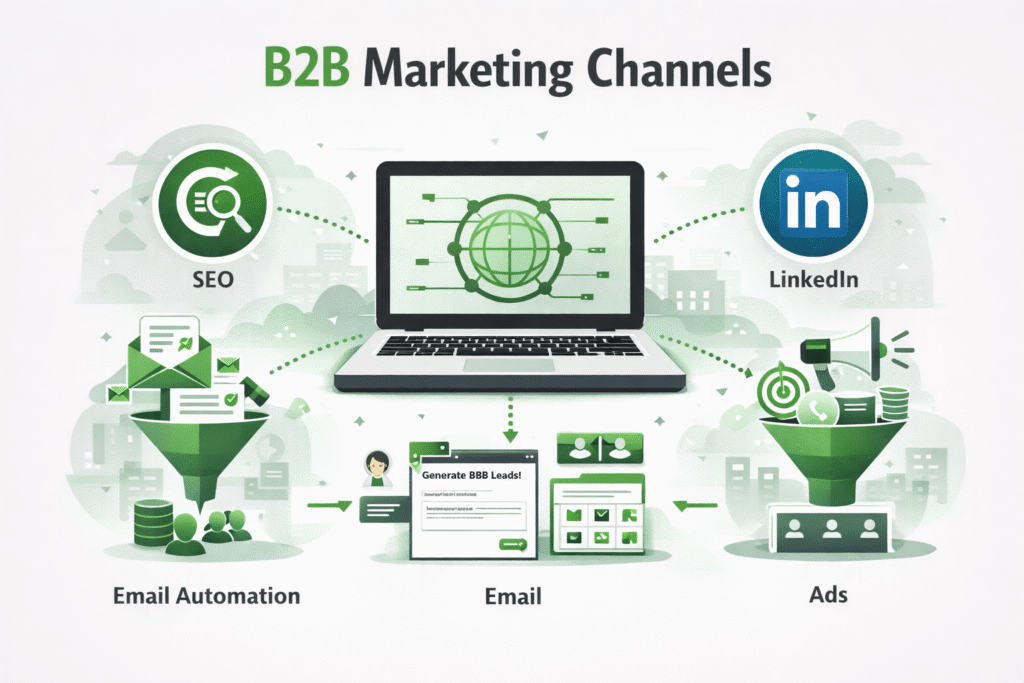
Choosing the right B2B marketing channels is essential for reaching decision-makers, generating high-quality leads, and driving consistent business growth. Not all channels perform the same — some work better for long-term brand building, while others are ideal for fast lead generation and conversions.
The most effective B2B marketing channels focus on targeting the right audience, building trust, nurturing leads, and supporting long sales cycles. A strong B2B strategy often combines multiple channels to maximize reach, ROI, and lead quality.
Below are the best-performing B2B marketing channels that consistently drive real business results.
SEO & Content Marketing
SEO and content marketing are among the most powerful long-term B2B marketing channels. Business buyers actively search for solutions online, making search-optimized content a reliable way to attract high-intent prospects.
SEO & content marketing help with:
- Ranking on Google for industry keywords
- Attracting organic, high-quality leads
- Building brand authority and thought leadership
- Educating buyers during the research and decision stages
Effective content formats include:
- Blog articles
- Whitepapers and guides
- Case studies and reports
- Landing pages and pillar content
This channel is ideal for sustainable, cost-effective, and scalable growth.
LinkedIn & Professional Social Media
LinkedIn and professional social platforms are highly effective B2B marketing channels because they allow businesses to reach decision-makers, executives, and industry professionals directly.
These platforms work well for:
- Building personal and company brand authority
- Networking with business leaders
- Running targeted B2B ads
- Sharing thought leadership and industry insights
- Lead generation through direct outreach
LinkedIn is especially powerful for enterprise marketing, recruitment, partnerships, and high-value lead acquisition.
Email Marketing & Lead Nurturing
Email marketing remains one of the highest-ROI B2B marketing channels, especially for nurturing long-term prospects.
Email marketing helps businesses:
- Stay in touch with leads over long sales cycles
- Educate prospects with valuable content
- Promote offers, demos, and case studies
- Convert warm leads into paying customers
When combined with automation and CRM systems, email becomes a scalable engine for relationship-building and conversion.
Paid Ads & Retargeting
Paid advertising is one of the fastest ways to generate visibility and leads in B2B.
Effective paid B2B channels include:
- Google Search Ads
- LinkedIn Ads
- Display and retargeting ads
- YouTube and video ads
Paid ads are best for:
- Driving quick traffic and leads
- Retargeting website visitors
- Promoting high-value content or demos
- Supporting product launches and campaigns
Retargeting is especially effective for bringing back interested decision-makers who didn’t convert initially.
Account-Based Marketing (ABM)
Account-Based Marketing (ABM) is one of the most advanced and high-impact B2B marketing channels. Instead of targeting broad audiences, ABM focuses on specific high-value companies and key decision-makers.
ABM is effective for:
- Enterprise-level sales
- High-ticket B2B services and products
- Personalized outreach and campaigns
- Building strong relationships with strategic accounts
This channel delivers higher conversion rates and deal sizes, making it ideal for businesses targeting premium clients.
B2B Marketing Channel Performance Comparison
Purpose: Compare B2B marketing channel performance
| Channel | Cost | ROI Potential | Best Use Case |
| SEO & Content Marketing | Low–Medium | High (Long-Term) | Sustainable organic lead generation |
| LinkedIn & Professional Social Media | Medium | High | Reaching decision-makers & branding |
| Email Marketing | Low | Very High | Lead nurturing & retention |
| Paid Ads & Retargeting | Medium–High | Medium–High | Fast lead generation & remarketing |
| Account-Based Marketing (ABM) | High | Very High | Enterprise & high-value clients |
How to Choose the Right B2B Marketing Channels
The best B2B marketing channels depend on your business goals, budget, target audience, and sales cycle.
- Want long-term growth? → Focus on SEO & content
- Want direct access to decision-makers? → Use LinkedIn
- Want to nurture leads? → Invest in email marketing
- Want fast results? → Run paid ads & retargeting
- Want high-value enterprise clients? → Use ABM
The most successful B2B companies combine multiple channels into one integrated strategy to maximize reach and revenue.
Proven B2B Marketing Strategy Frameworks
Many successful companies use structured B2B marketing strategy frameworks to plan campaigns, attract the right customers, increase revenue, and scale faster. These frameworks act like roadmaps — helping businesses organize marketing efforts, prioritize the right actions, and achieve predictable results.
A strong B2B marketing strategy is more effective when built on proven models that guide targeting, lead generation, customer conversion, and long-term growth. Below are some of the most widely used B2B marketing strategy frameworks trusted by top brands and growth teams.
STP Framework (Segmentation, Targeting, Positioning)
The STP Framework is one of the most foundational B2B marketing strategy models. It helps businesses identify the right audience and position their brand effectively.
Segmentation
This step involves dividing the market into groups based on:
- Industry
- Company size
- Location
- Business needs
- Behavior or buying intent
Targeting
After segmentation, businesses choose the most profitable and relevant segments to focus on — instead of trying to market to everyone.
Positioning
This step defines how your brand should be perceived in the minds of your target customers. It focuses on:
- What makes you different
- Why customers should choose you
- How do you solve business problems better than competitors
The STP model helps create a focused, customer-centric B2B marketing strategy that avoids wasted effort and improves campaign effectiveness.
AARRR Funnel (Acquisition to Revenue)
The AARRR Funnel — also known as the Pirate Metrics Framework — is a popular B2B marketing strategy framework for tracking how customers move through the funnel from first contact to revenue.
AARRR stands for:
Acquisition
How you attract potential customers (SEO, ads, LinkedIn, referrals)
Activation
How you engage them for the first time (sign-ups, demos, onboarding)
Retention
How you keep customers engaged and coming back
Referral
How satisfied customers recommend your business to others
Revenue
How you monetize customers and maximize lifetime value
This framework helps businesses optimize every stage of the B2B marketing strategy funnel, ensuring leads don’t drop off before converting into paying customers.
Flywheel Model for B2B Growth
The Flywheel Model focuses on building momentum through customer experience, satisfaction, and advocacy instead of treating marketing as a one-time funnel.
In this B2B marketing strategy, growth comes from three connected forces:
- Attract — bring in the right customers with helpful content and outreach
- Engage — build trust and provide value throughout the buyer journey
- Delight — turn customers into promoters and long-term partners
Unlike traditional funnels, the Flywheel emphasizes retention, referrals, and customer loyalty as the main drivers of continuous growth.
This model is ideal for businesses that want sustainable, long-term success instead of one-time wins.
Account-Based Marketing (ABM) Framework
The Account-Based Marketing (ABM) Framework is a highly targeted B2B marketing strategy designed for high-value clients and enterprise accounts.
Instead of marketing to a broad audience, ABM focuses on:
- Identifying specific high-value companies
- Researching key decision-makers within those companies
- Creating personalized marketing and sales campaigns
- Building deep, long-term relationships with strategic accounts
ABM works especially well for:
- Enterprise software companies
- B2B service providers
- High-ticket consulting firms
- Businesses with long and complex sales cycles
This framework delivers higher deal sizes, stronger relationships, and better ROI compared to generic mass marketing.
Why These Frameworks Matter
Using proven B2B marketing strategy frameworks helps businesses:
- Build clear, structured marketing plans
- Focus on the right audience and highest-value opportunities
- Improve lead conversion and revenue growth
- Create scalable and repeatable marketing systems
- Reduce guesswork and increase performance
In simple terms, a strong B2B marketing strategy framework turns marketing from random activities into a predictable growth engine.
Real-World Examples of Successful B2B Marketing
Looking at real-world B2B marketing examples helps businesses understand what actually works in practice — not just in theory. These case studies show how companies across different industries use smart B2B marketing strategies to generate leads, increase revenue, build partnerships, and scale faster.
Each example below highlights a different approach to successful B2B marketing, proving that strong strategy, targeting, and execution can deliver measurable growth.
SaaS Company Example (Lead Generation & Growth)
Scenario: A SaaS company offering project management software wanted to increase qualified business leads and reduce reliance on paid ads.
Strategy Used
The company built a B2B marketing strategy focused on:
- SEO-driven blog content targeting business keywords
- Free tools and downloadable templates as lead magnets
- Email nurturing campaigns to convert free users into paying customers
- Case studies showing ROI for teams and enterprises
Results
- Increased inbound leads by over 200% in 12 months
- Reduced customer acquisition costs
- Improved trial-to-paid conversion rates
- Built long-term customer relationships through onboarding and education
Key takeaway: Content-driven B2B marketing can generate scalable, cost-effective SaaS growth.
Manufacturing & Industrial Example (Brand Authority & Partnerships)
Scenario: A manufacturing company supplying industrial equipment wanted to reach large corporate buyers and distributors.
Strategy Used
They implemented a B2B marketing strategy that included:
- LinkedIn outreach targeting procurement managers
- Industry-focused case studies and whitepapers
- Trade show marketing combined with digital lead capture
- Long-term email nurturing for distributors and partners
Results
- Built strong relationships with enterprise buyers
- Increased distributor partnerships
- Won higher-value, long-term supply contracts
- Strengthened brand authority in the industrial sector
Key takeaway: Relationship-focused B2B marketing helps manufacturers secure long-term, high-value deals.
B2B Services Example (Agency & Consulting Growth)
Scenario: A B2B digital marketing agency wanted to attract higher-paying corporate clients instead of small local businesses.
Strategy Used
Their B2B marketing strategy focused on:
- Publishing case studies with real client results
- Personal branding on LinkedIn by agency founders
- Hosting webinars and offering free strategy audits
- Running retargeting ads for website visitors
Results
- Attracted enterprise-level clients
- Increased average project value
- Shortened sales cycles by using proof-driven content
- Built authority as a niche industry expert
Key takeaway: Thought leadership and proof-based B2B marketing can upgrade client quality and pricing power.
Enterprise Technology Example (Account-Based Marketing Success)
Scenario: An enterprise technology company selling high-ticket IT solutions wanted to close large corporate accounts.
Strategy Used
They used an Account-Based Marketing (ABM) strategy, including:
- Identifying high-value target companies
- Personalizing campaigns for each decision-maker
- Aligning marketing and sales teams to coordinate outreach
- Using LinkedIn Ads and email personalization for engagement
Results
- Closed multi-million-dollar enterprise deals
- Improved conversion rates for high-value accounts
- Strengthened long-term relationships with large corporations
- Increased customer lifetime value significantly
Key takeaway: ABM-focused B2B marketing works best for enterprise sales and high-ticket solutions.
What These B2B Marketing Examples Prove
These real-world B2B marketing examples show that successful companies:
- Focus on clear targeting and positioning
- Use content and proof to build trust
- Build long-term relationships instead of chasing quick sales
- Combine multiple channels into a scalable strategy
- Track performance and continuously optimize results
In short, B2B marketing success comes from strategy, consistency, and customer-focused execution — not random tactics.
Industry Use Cases of B2B Marketing
B2B marketing is not limited to one type of business — it plays a major role across multiple industries, helping organizations generate leads, build partnerships, increase revenue, and scale operations.
While the core principles of B2B marketing remain the same, the strategies, messaging, and channels often vary depending on the industry’s audience, regulations, sales cycles, and customer needs.
Below are key industry use cases of B2B marketing, showing how businesses apply it in different sectors.
B2B Marketing in SaaS
In the SaaS (Software-as-a-Service) industry, B2B marketing focuses on lead generation, product education, free trials, and customer retention.
Common SaaS B2B strategies include:
- SEO and content marketing to attract high-intent users
- Free trials, demos, and freemium models to drive sign-ups
- Email nurturing to convert trial users into paid customers
- Case studies and testimonials to build trust
- Product onboarding and lifecycle marketing to reduce churn
Goal: Acquire scalable leads, improve conversions, and maximize customer lifetime value.
B2B Marketing in Healthcare
In healthcare, B2B marketing targets hospitals, clinics, medical suppliers, pharmaceutical companies, and healthcare decision-makers.
Key strategies include:
- Educational content for medical professionals
- Compliance-focused messaging and trust-building
- Relationship marketing with hospital procurement teams
- Conferences, webinars, and professional networking
- Data-driven case studies proving patient and cost outcomes
Goal: Build credibility, meet regulatory standards, and form long-term institutional partnerships.
B2B Marketing in Education
In the education sector, B2B marketing supports institutions, edtech companies, training providers, and corporate learning platforms.
Effective approaches include:
- Partnerships with schools, universities, and training centers
- Marketing online courses, certifications, and corporate programs
- Lead nurturing campaigns targeting academic administrators
- Webinars, events, and informational content for educators
- Brand building as a trusted learning provider
Goal: Attract institutional clients, increase enrollments, and build long-term academic partnerships.
B2B Marketing in Manufacturing
In manufacturing, B2B marketing focuses on long-term contracts, distributor relationships, and enterprise buyers.
Common tactics include:
- Industrial SEO targeting procurement and engineering teams
- Product catalogs, technical documentation, and spec sheets
- Distributor and reseller marketing programs
- Trade shows combined with digital lead capture
- Case studies proving operational efficiency and cost savings
Goal: Secure bulk orders, maintain supplier relationships, and win high-value contracts.
B2B Marketing in Finance
In finance, B2B marketing targets corporate clients, banks, fintech firms, CFOs, and financial institutions.
Key strategies include:
- Thought leadership on risk management and investment
- Personalized outreach to enterprise finance teams
- Webinars, reports, and financial insights
- Trust-focused branding and compliance messaging
- Relationship marketing and account-based strategies
Goal: Build credibility, attract high-value corporate clients, and establish long-term financial partnerships.
Common B2B Marketing Mistakes to Avoid
Even with a strong product or service, many businesses struggle with B2B marketing because of strategic and execution mistakes. These errors can lead to wasted budget, poor lead quality, low conversions, and slow business growth.
Understanding common B2B marketing mistakes helps companies refine their strategy, improve ROI, and build more effective, scalable marketing systems. Below are the most frequent errors — and why they hurt performance.
Targeting the Wrong Audience
One of the biggest B2B marketing mistakes is targeting the wrong businesses or decision-makers.
Common targeting errors include:
- Marketing to companies that don’t need your solution
- Ignoring key decision-makers like CEOs, managers, or procurement teams
- Targeting businesses that lack budget or buying power
- Using broad messaging instead of industry-specific positioning
Why it hurts:
If your audience is wrong, even the best marketing campaigns won’t convert. Successful B2B marketing starts with a clear Ideal Customer Profile (ICP) and accurate buyer personas.
Ignoring Long Sales Cycles
Many businesses treat B2B marketing like consumer marketing — expecting quick conversions and fast results. This is a mistake because B2B sales cycles are usually longer and more complex.
Mistakes include:
- Giving up on leads too early
- Not nurturing prospects over time
- Expecting instant ROI from campaigns
- Focusing only on short-term sales
Why it hurts:
B2B buyers often need weeks or months to make decisions. Strong B2B marketing supports long-term nurturing, education, and relationship-building.
Weak Lead Nurturing
Generating leads is only half the job — nurturing them properly is critical. Weak follow-up is a major B2B marketing mistake.
Examples of weak nurturing:
- No email follow-up or automation
- Generic messaging instead of personalized communication
- Lack of educational content for prospects
- Poor coordination between marketing and sales teams
Why it hurts:
Without proper nurturing, leads lose interest, forget your brand, or choose competitors. Effective B2B marketing builds trust through consistent communication and value-driven content.
Poor Content Strategy
Content is a key pillar of B2B marketing, but many companies publish low-quality or irrelevant content.
Common content mistakes include:
- Creating content that doesn’t solve business problems
- Focusing on promotion instead of education
- Ignoring case studies, whitepapers, and proof-based content
- Not aligning content with the buyer journey
Why it hurts:
B2B buyers rely on content to research and evaluate solutions. Poor content reduces credibility, authority, and conversion potential.
Not Tracking ROI
One of the most damaging B2B marketing mistakes is not tracking performance and ROI.
Businesses often fail to:
- Monitor lead sources and conversion rates
- Track campaign profitability
- Analyze customer acquisition cost (CAC)
- Measure long-term customer lifetime value (LTV)
Why it hurts:
Without data, businesses can’t optimize campaigns, scale what works, or stop wasting money on ineffective channels. Strong B2B marketing relies on analytics, reporting, and continuous optimization.
How to Measure B2B Marketing Performance
To succeed in B2B marketing, you need more than campaigns and content — you need to measure performance, track ROI, and optimize what works. Without data, businesses risk wasting budget, targeting the wrong audience, and scaling ineffective strategies.
Measuring B2B marketing performance helps you understand:
- Which channels generate the best leads
- How much does it cost to acquire customers
- Which campaigns drive the highest ROI
- How efficiently do leads turn into revenue
By tracking the right B2B marketing metrics, companies can make smarter decisions, improve conversions, and build a more predictable growth engine.
Key Metrics for B2B Marketing Success
Below are the most important B2B marketing KPIs (Key Performance Indicators) that help evaluate growth, efficiency, and profitability.
CPL (Cost Per Lead)
Cost Per Lead (CPL) measures how much money you spend to generate one lead.
Formula:
Total marketing spend ÷ Number of leads generated
Why it matters:
CPL helps businesses understand whether their B2B marketing campaigns are cost-effective. A lower CPL usually means better targeting and more efficient campaigns.
Example:
If you spend $1,000 on ads and generate 100 leads → CPL = $10 per lead.
CAC (Customer Acquisition Cost)
Customer Acquisition Cost (CAC) measures how much it costs to convert a lead into a paying customer.
Formula:
Total marketing + sales cost ÷ Number of new customers
Why it matters:
CAC helps determine whether your B2B marketing strategy is profitable. If CAC is higher than the revenue generated per customer, your strategy needs improvement.
A strong goal is to reduce CAC while increasing customer quality.
LTV (Customer Lifetime Value)
Customer Lifetime Value (LTV) measures how much revenue a customer generates over their entire relationship with your business.
Formula:
Average customer revenue × Customer lifespan
Why it matters:
LTV shows how valuable long-term clients are — especially important in B2B marketing, where customers often sign long contracts or renew services.
A healthy business usually aims for LTV to be significantly higher than CAC.
Conversion Rate
Conversion Rate measures how many leads take the desired action, such as signing up, requesting a demo, or becoming customers.
Formula:
(Number of conversions ÷ Total visitors or leads) × 100
Why it matters:
Conversion rate helps evaluate how effective your B2B marketing funnel is — from awareness to lead generation to final sales.
Higher conversion rates mean better messaging, targeting, and lead nurturing.
How These Metrics Work Together in B2B Marketing
To get a full picture of B2B marketing performance, businesses should track all metrics together, not in isolation.
- CPL shows lead generation efficiency
- CAC shows cost of acquiring customers
- LTV shows long-term revenue value
- Conversion Rate shows funnel effectiveness
When combined, these KPIs help marketers:
- Optimize campaigns
- Allocate budget more effectively
- Improve ROI
- Scale profitable channels
Strong B2B marketing analytics turns guesswork into data-driven growth.
Tools & Software Used in B2B Marketing
Modern B2B marketing relies heavily on technology — often called a MarTech (Marketing Technology) stack — to manage leads, automate campaigns, track performance, and scale growth.
Using the right B2B marketing tools helps businesses:
- Organize leads and customer data
- Automate follow-ups and campaigns
- Track performance and ROI
- Improve targeting, personalization, and conversions
- Save time while increasing efficiency
A strong B2B marketing software stack typically includes CRM tools, automation platforms, analytics tools, and paid advertising systems. Below is a breakdown of the most important categories.
CRM Tools (Customer Relationship Management)
CRM tools are the backbone of any B2B marketing and sales strategy. They help businesses store, track, and manage leads, prospects, and customers in one centralized system.
CRM tools help with:
- Managing lead and customer information
- Tracking sales pipelines and deal progress
- Monitoring communication history
- Assigning leads to sales teams
- Improving customer retention and follow-ups
Why they matter in B2B marketing:
Because B2B sales cycles are long and involve multiple touchpoints, CRM tools ensure no lead is lost and every opportunity is followed up properly.
Email & Automation Platforms
Email marketing and automation platforms are essential for nurturing leads over long B2B sales cycles.
These tools allow businesses to:
- Send automated email sequences
- Nurture leads with educational content
- Trigger follow-ups based on user actions
- Personalize messages at scale
- Re-engage inactive prospects
Why they matter in B2B marketing:
Automation ensures consistent communication, builds trust over time, and helps convert leads into customers without relying entirely on manual outreach.
SEO & Analytics Tools
SEO and analytics tools help businesses understand how people find their website, what content performs best, and how campaigns impact revenue.
These tools are used for:
- Keyword research and SEO optimization
- Tracking website traffic and conversions
- Monitoring content performance
- Measuring campaign ROI
- Identifying growth opportunities
Why they matter in B2B marketing:
Data-driven decisions improve targeting, reduce wasted spend, and help marketers optimize campaigns based on real performance metrics.
Paid Advertising Tools
Paid advertising tools help businesses reach decision-makers quickly through targeted campaigns.
These platforms support:
- Search ads for high-intent keywords
- Display and retargeting campaigns
- LinkedIn and professional audience targeting
- Campaign tracking and optimization
- Budget control and ROI measurement
Why they matter in B2B marketing:
Paid ads are useful for fast lead generation, retargeting warm prospects, promoting offers, and supporting account-based marketing strategies.
Future Trends in B2B Marketing
The future of B2B marketing is being shaped by technology, changing buyer expectations, privacy regulations, and the growing need for personalized, data-driven experiences. Businesses that adapt to these trends early will gain a strong competitive advantage in lead generation, customer retention, and revenue growth.
Modern B2B marketing is moving beyond traditional campaigns toward automation, personalization, video engagement, and smarter use of data. Below are the most important future trends in B2B marketing that will define the next phase of business growth.
AI & Automation in B2B Marketing
Artificial Intelligence (AI) and automation are transforming how companies run B2B marketing campaigns.
AI helps businesses:
- Predict buyer behavior and intent
- Automate email campaigns and lead nurturing
- Score leads based on conversion likelihood
- Personalize content and messaging in real time
- Optimize ad campaigns for better ROI
Automation also reduces manual work, allowing marketing teams to scale campaigns faster while improving efficiency and accuracy.
Why it matters:
AI-driven B2B marketing enables smarter targeting, faster decision-making, and better performance with lower effort.
Personalization at Scale
Modern B2B buyers expect highly relevant and personalized experiences, even when dealing with large brands.
Personalization at scale means:
- Customizing content for specific industries
- Personalizing emails based on user behavior
- Showing tailored website experiences for different company types
- Creating role-based messaging for decision-makers
With automation and data tools, businesses can now personalize marketing without manually handling every lead.
Why it matters:
Personalized B2B marketing improves engagement, builds stronger relationships, and increases conversion rates.
Video & Interactive Content
Video and interactive content are becoming powerful tools in B2B marketing as attention spans shrink and competition increases.
Popular formats include:
- Product demos and explainer videos
- Webinar recordings and live sessions
- Interactive calculators and assessments
- Case study videos and testimonials
- Short-form educational videos for LinkedIn and YouTube
Why it matters:
Video-based B2B marketing helps explain complex solutions faster, builds trust, and keeps prospects engaged longer.
Privacy-First Marketing
With stricter privacy laws and the decline of third-party cookies, privacy-first marketing is becoming a major priority in B2B marketing.
This trend focuses on:
- Collecting first-party data ethically
- Being transparent about data usage
- Respecting customer consent and preferences
- Reducing reliance on invasive tracking
- Building trust through responsible data practices
Why it matters:
Businesses that respect privacy will earn more trust, avoid compliance risks, and build stronger long-term relationships.
Data-Driven Decision Making
The future of B2B marketing will rely even more on data to guide strategy, budget, and optimization.
Data-driven marketing helps businesses:
- Track campaign ROI and performance
- Identify high-converting channels
- Optimize customer acquisition costs
- Predict revenue and growth trends
- Make smarter, faster business decisions
Instead of guessing what works, companies can use real metrics to scale successful campaigns and cut ineffective ones.
Step-by-Step Guide to Building a B2B Marketing Strategy
Building a successful B2B marketing strategy doesn’t have to be complicated. The key is to follow a structured, step-by-step process that helps you set goals, target the right businesses, choose effective channels, launch campaigns, and continuously improve results.
A strong B2B marketing strategy focuses on long-term growth, high-quality leads, predictable revenue, and scalable systems — not random marketing tactics. Below is a practical roadmap you can use to build and execute an effective strategy from scratch.
Step 1 — Define Business Goals
The first step in any B2B marketing strategy is to clearly define what you want to achieve.
Ask questions like:
- Do you want more leads, more sales, or more brand awareness?
- Are you focused on short-term revenue or long-term growth?
- Do you want to enter new markets or grow existing accounts?
Examples of clear goals:
- Generate 500 qualified leads per month
- Increase enterprise clients by 30%
- Reduce customer acquisition cost (CAC)
- Improve customer retention and lifetime value
Why this matters:
Clear goals keep your B2B marketing strategy focused, measurable, and aligned with business growth.
Step 2 — Identify Target Accounts
Once goals are set, the next step is to define who you want to target.
This includes creating:
- An Ideal Customer Profile (ICP) — the type of business you want to serve
- Buyer personas — the decision-makers inside those companies
Key targeting factors:
- Company size (SMB, mid-market, enterprise)
- Industry (SaaS, manufacturing, finance, healthcare, etc.)
- Job roles (CEO, manager, procurement, IT, finance)
- Budget range and buying capacity
Why this matters:
A focused B2B marketing strategy works best when it targets high-value accounts instead of trying to reach everyone.
Step 3 — Choose Channels & Budget
Now you decide where to run your marketing and how much to invest.
Common B2B marketing channels include:
- SEO & content marketing
- LinkedIn & professional social media
- Email marketing & automation
- Paid ads & retargeting
- Account-Based Marketing (ABM)
You should also define:
- Monthly or quarterly marketing budget
- Expected cost per lead (CPL) and ROI targets
- How the budget will be split across channels
Why this matters:
Choosing the right channels ensures your B2B marketing strategy reaches decision-makers efficiently and cost-effectively.
Step 4 — Launch Campaigns
With goals, audience, channels, and budget defined, it’s time to execute your B2B marketing strategy.
This step includes:
- Creating campaigns (content, ads, email sequences, outreach)
- Designing landing pages and lead capture forms
- Setting up CRM tracking and automation
- Aligning sales and marketing teams for follow-ups
Execution tip:
Start with pilot campaigns, test messaging, analyze early results, and refine before scaling.
Why this matters:
A strong launch phase ensures your B2B marketing strategy performs well from the beginning instead of wasting budget.
Step 5 — Track, Optimize, and Scale
The final step in a successful B2B marketing strategy is measurement and continuous improvement.
Track key performance metrics like:
- Leads generated
- Conversion rate
- Cost per lead (CPL)
- Customer acquisition cost (CAC)
- Revenue and ROI
- Customer lifetime value (LTV)
Use performance data to:
- Optimize campaigns and messaging
- Increase the budget on high-performing channels
- Pause or fix underperforming campaigns
- Scale winning strategies for faster growth
Why this matters:
The best B2B marketing strategy is never “set and forget” — it evolves based on real results and data.
Conclusion — What Is B2B Marketing and How to Scale Faster
What is B2B marketing? It is the process of promoting products or services from one business to another, focusing on long-term relationships, logic-driven decisions, trust, and measurable business value. Unlike consumer marketing, B2B marketing is built around higher-value deals, longer sales cycles, and ongoing partnerships.
When done right, B2B marketing becomes a powerful growth engine. It helps businesses generate high-quality leads, increase revenue, build brand authority, retain clients, and scale faster with predictable results. From choosing the right channels and frameworks to tracking performance and using modern tools, a strong B2B marketing strategy creates sustainable, long-term business success.
Now is the time to apply what you’ve learned — refine your strategy, test smarter campaigns, invest in data-driven decisions, and continuously optimize for growth. Keep learning, keep experimenting, and use B2B marketing to scale faster, win better clients, and build a future-ready business.
💡 Interested in learning more? Contact RKDMT – Raju Kumar Digital Marketer – Best Digital Marketing Training Institute
🔗 www.rajukumardigitalmarketing.com
📞 +91-7303933302, +91-9217057127
📧 rkdmt@rajukumardigitalmarketer.com
What is B2B marketing in simple words?
B2B marketing means one business promoting and selling products or services to another business. It focuses on solving business problems rather than selling to individual consumers.
What is B2B marketing with examples?
B2B marketing includes companies selling software to businesses, manufacturers supplying factories, or agencies offering services to corporate clients. The customer is always another business.
What is the difference between B2B and B2C marketing?
B2B marketing targets businesses and focuses on logic, ROI, and long-term relationships, while B2C marketing targets consumers and focuses on emotions, quick decisions, and mass appeal.
Why is B2B marketing important?
B2B marketing helps businesses generate high-quality leads, increase revenue, build long-term partnerships, and scale growth in a predictable and sustainable way.
What are the best B2B marketing strategies?
Effective B2B marketing strategies include SEO, LinkedIn marketing, email nurturing, content marketing, Account-Based Marketing (ABM), and paid advertising tailored to decision-makers.
What is B2B digital marketing?
B2B digital marketing uses online channels like SEO, social media, email, paid ads, and content marketing to reach business clients and generate measurable leads and revenue.
How does B2B marketing work?
B2B marketing works by guiding business buyers through awareness, consideration, decision, and loyalty stages while building trust, proving value, and nurturing long-term relationships.
What industries use B2B marketing?
Industries such as SaaS, healthcare, education, manufacturing, finance, and professional services use B2B marketing to attract corporate clients and enterprise customers.
What tools are used in B2B marketing?
B2B marketing tools include CRM systems, email automation platforms, SEO and analytics tools, paid advertising platforms, and marketing automation software to manage leads and performance.
What are the latest B2B marketing trends?
Current B2B marketing trends include AI automation, personalization at scale, video content, privacy-first marketing, Account-Based Marketing, and data-driven decision-making.

Founder at Digital Marketing Marvel | Founder at RKDMT – Raju Kumar Digital Marketing Trainer | Best Digital Marketing Trainer in Delhi/NCR – Digiperform | Project Manager | 5+ years | Genius Study Abroad & Inlingua’s Digital Marketing Head | Learn Digital Marketing