


Why SEO for B2B Businesses Matters More Than Ever
The way B2B buyers research, evaluate, and choose solutions has changed dramatically. Traditional sales-led journeys—cold calls, brochures, and direct pitches—no longer drive the first interaction.
Today, B2B decision-makers prefer to research independently, compare options online, and short-list vendors before speaking to a sales team. This shift has reshaped how B2B businesses must approach growth and visibility.
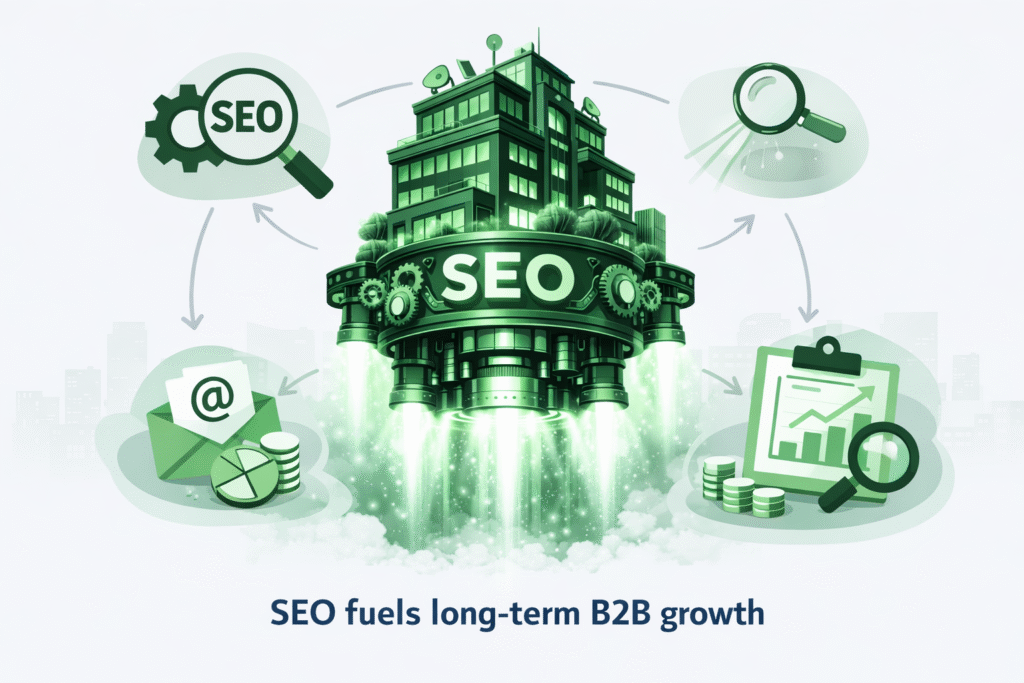
Search engines have become the first and most trusted touchpoint in B2B buying decisions. Whether it’s a founder, procurement manager, or CTO, buyers now start with Google to understand problems, explore solutions, and validate providers.
If your business doesn’t appear during this discovery phase, you’re often excluded before the conversation even begins. This is where SEO for B2B businesses plays a critical role.
Unlike short-term promotional tactics, SEO for B2B businesses is not about chasing quick traffic or vanity rankings. It is a long-term growth foundation that helps businesses show up consistently when buyers are actively searching.
Strong SEO ensures visibility across the entire buying journey—from early research queries to comparison and decision-stage searches. In B2B markets with long sales cycles and multiple stakeholders, this consistent presence builds trust, authority, and consideration over time.
SEO also integrates naturally into a broader B2B digital marketing strategy. While paid ads, email marketing, and social media support outreach, SEO compounds results by attracting high-intent users organically.
It works continuously, supports content marketing, and reduces long-term dependency on rising ad costs. For B2B companies focused on sustainable growth, SEO is no longer optional—it’s foundational.
In this article, you’ll learn why SEO for B2B businesses matters more than ever, how modern B2B buying behavior makes search visibility essential, and what strategic role SEO plays in driving qualified leads. You’ll also understand how B2B SEO differs from B2C, what benefits matter most, and how businesses can apply SEO practically—not theoretically—to support real revenue growth.
Understanding SEO for B2B Businesses
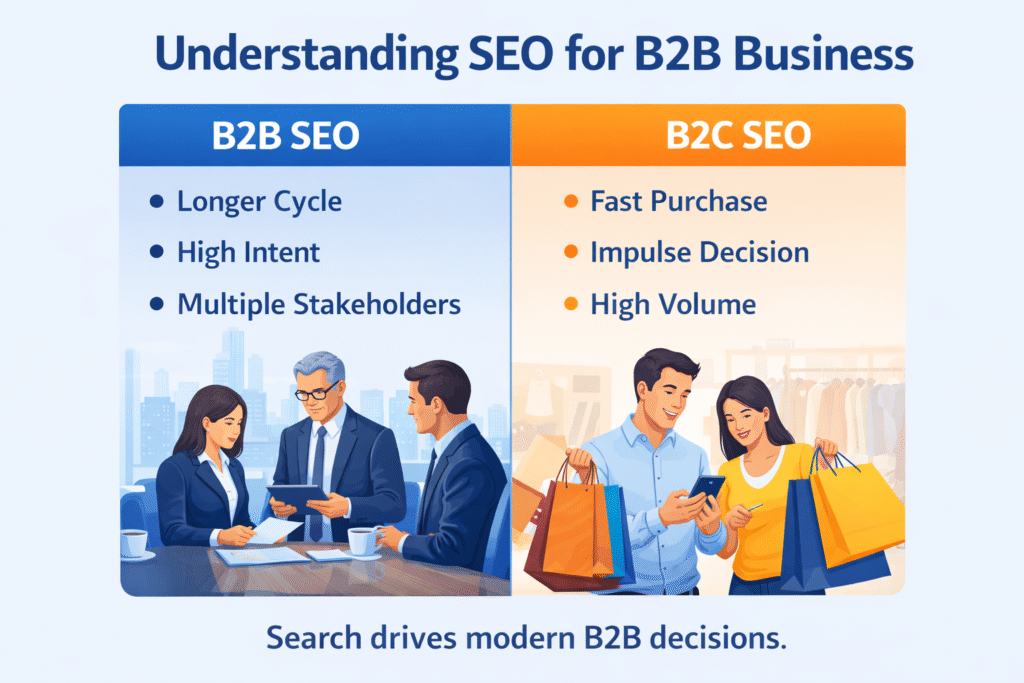
To understand why SEO is so critical today, it’s important to first clarify what SEO for B2B businesses actually means. At its core, it focuses on helping businesses appear in search results when other businesses are actively researching problems, solutions, and providers. Unlike consumer-focused SEO, B2B SEO is less about impulse clicks and more about visibility, credibility, and relevance across a longer decision-making process.
SEO for B2B businesses is built around high-intent, problem-driven searches rather than high-volume keywords. B2B buyers search with specific goals—such as comparing solutions, evaluating vendors, or understanding complex services.
Effective B2B SEO ensures that the right content appears at the right stage of the buyer journey, supporting research, validation, and final decision-making.
The biggest difference between B2B SEO and B2C SEO lies in intent and behavior. B2C SEO often targets emotionally driven or price-focused searches with quick conversions. In contrast, SEO for B2B businesses targets logic-based, research-heavy queries.
Sales cycles are longer, decisions involve multiple stakeholders, and trust plays a much larger role. Rankings alone don’t convert; authority and depth of information do.
Another defining factor of SEO for B2B businesses is the complexity of the buying process. A single purchase decision may involve founders, marketing heads, finance teams, and technical experts.
Each stakeholder searches for different information, which means SEO must address multiple perspectives and concerns through well-structured, informative content. This makes content depth, internal linking, and topic authority essential.
For example, SaaS companies rely on SEO to attract users searching for comparisons, integrations, and feature-specific solutions. Manufacturing firms use SEO to rank for technical specifications, industry use cases, and supplier searches.
Consulting and service-based B2B brands depend on SEO to demonstrate expertise, thought leadership, and problem-solving capability before any direct contact happens.
In all these cases, SEO for B2B businesses is not about mass traffic. It’s about being discoverable, credible, and trusted at every step of a complex buying journey.
Also Read Our: Comparison of AI-Generated vs. Human-Written Content
How B2B Buyers Search Before Making Decisions

Modern B2B buying behavior is no longer linear or sales-driven. Today’s buyers move through a self-guided research journey long before they engage with a vendor. This journey typically follows three stages—Awareness, Consideration, and Decision—and search plays a central role at every step. Understanding how buyers search at each stage is essential to building effective SEO for B2B businesses.
In the awareness stage, B2B buyers are identifying problems rather than solutions. Their searches are largely informational, focusing on symptoms, challenges, or industry trends. Queries such as “why is lead quality declining” or “how to improve supply chain efficiency” are common.
At this stage, buyers are not looking to buy—they are looking to understand. SEO-driven educational content helps businesses appear early and establish authority.
As buyers move into the consideration stage, their searches become more solution-oriented. They begin comparing approaches, tools, and service models. Searches may include phrases like “best CRM for mid-size companies” or “inbound marketing vs outbound marketing.”
This is where SEO for B2B businesses supports deeper evaluation by offering comparison guides, case studies, and expert insights that help buyers assess options logically.
In the decision stage, search intent becomes highly specific and commercial. Buyers look for validation before committing, using searches such as “top SaaS vendors,” “B2B SEO agency pricing,” or “enterprise analytics platform reviews.” Strong SEO presence here ensures visibility at the moment decisions are finalized. Trust signals, testimonials, and detailed service pages play a key role in influencing outcomes.
What makes SEO for B2B businesses powerful is its ability to support every funnel stage simultaneously. Rather than pushing buyers forward prematurely, SEO meets them where they are—informing, educating, and validating at each step. This alignment creates consistency across the buyer journey and improves lead quality.
This mapping highlights how SEO connects search intent directly to business growth.
Why SEO for B2B Businesses Matters More Than Ever Today
The importance of SEO for B2B businesses has grown sharply as buyer behavior, trust dynamics, and acquisition costs continue to evolve. What once worked—heavy ad spend, outbound sales, and aggressive promotions—is no longer enough to influence modern B2B decision-makers. Today’s environment demands visibility, credibility, and value at the exact moment buyers search for answers.
One of the biggest shifts is the declining trust in ads. B2B buyers are increasingly skeptical of paid messages, sponsored placements, and promotional claims. Ads are often perceived as biased, especially in high-value or complex purchases.
Decision-makers prefer neutral, informative content that helps them understand problems and evaluate solutions independently. This trust gap makes organic visibility far more powerful than paid exposure. SEO allows B2B brands to earn attention rather than buy it, positioning them as reliable sources instead of advertisers.
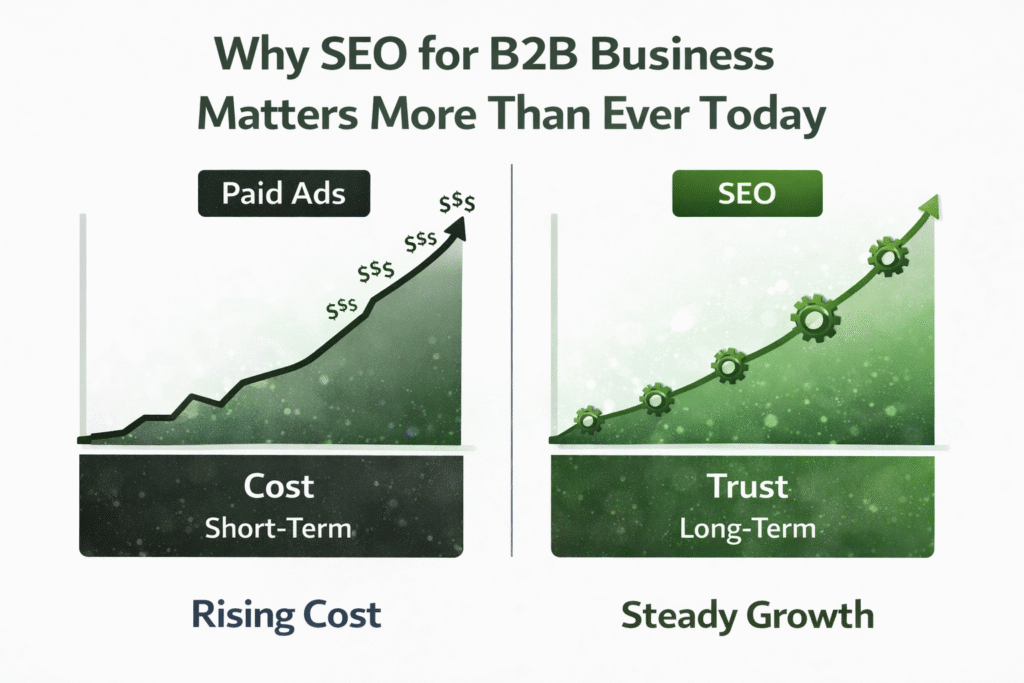
At the same time, the cost of paid acquisition continues to rise. Competition for B2B keywords has driven up cost-per-click across search and social platforms. While paid campaigns can still support short-term goals, they stop delivering the moment budgets pause.
In contrast, SEO for B2B businesses compounds over time. Content, rankings, and authority continue working long after the initial investment, making SEO significantly more cost-efficient in the long run compared to ongoing ad spend.
Another critical factor is search-first research behavior. Most B2B buyers now begin their journey with Google, not sales conversations. Before contacting vendors, they research challenges, compare solutions, and shortlist providers through a search.
This behavior is consistent across industries, whether the buyer is evaluating SaaS platforms, manufacturing suppliers, or professional services. If a B2B business doesn’t appear during this early research phase, it often never enters consideration at all.
SEO for B2B businesses also aligns perfectly with longer decision timelines. B2B purchases rarely happen overnight. Buyers may spend weeks or months gathering information, revisiting content, and validating choices. SEO supports this process by maintaining visibility across multiple touchpoints—blog content for early education, comparison pages for evaluation, and service pages for final decisions. Paid ads alone cannot sustain this level of presence without a high cost.
When comparing SEO versus paid ads, the difference becomes clear. Paid campaigns deliver immediate visibility but diminishing returns over time.
SEO requires patience but builds a sustainable growth engine that lowers acquisition costs and improves lead quality. As more B2B buyers rely on organic search to guide decisions, SEO becomes less of a marketing channel and more of a business necessity.
In today’s market, SEO for B2B businesses matters more than ever because it aligns with how buyers think, search, and decide—making it one of the most reliable drivers of long-term growth.
Key Benefits of SEO for B2B Businesses
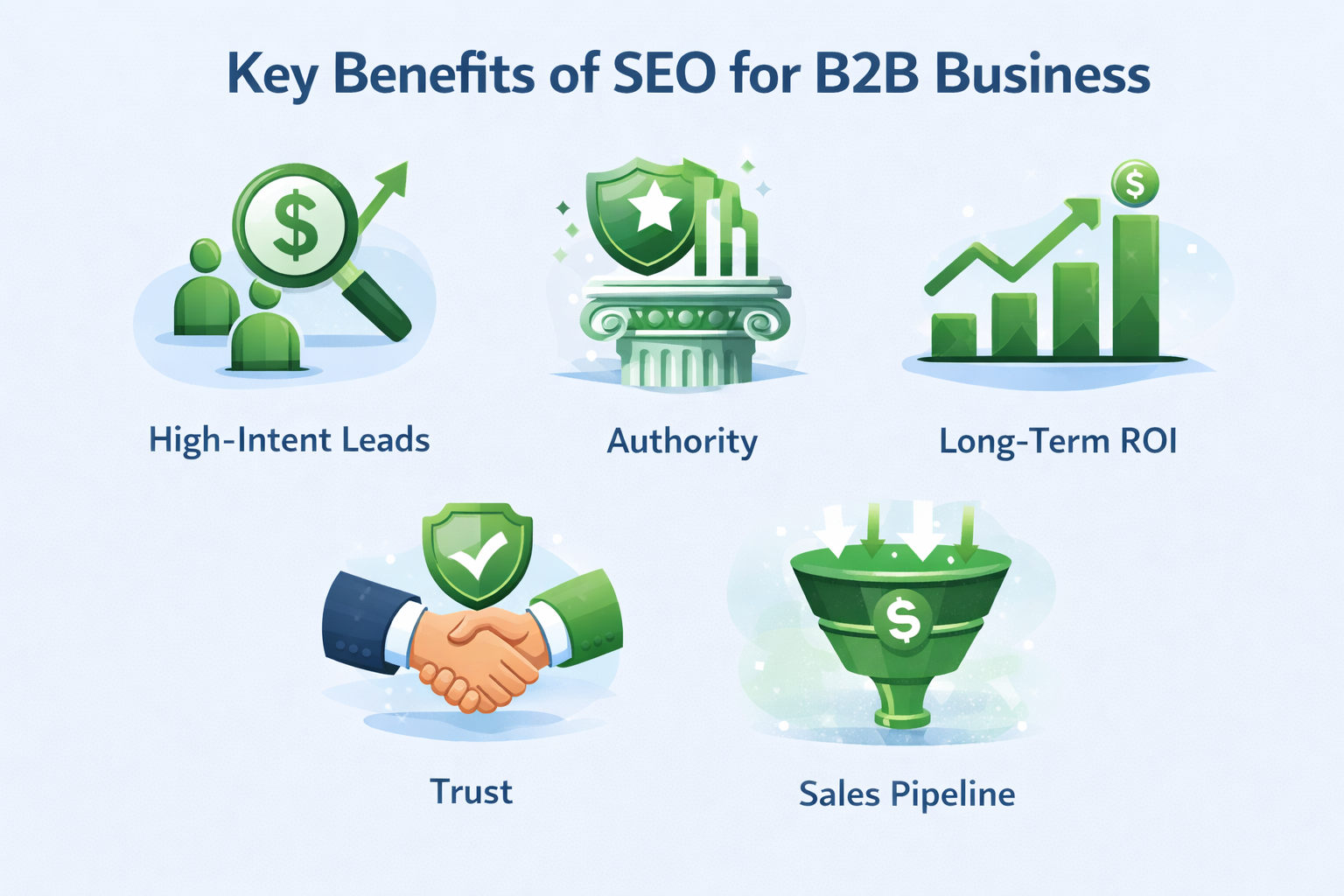
The real value of SEO for B2B businesses lies not in traffic volume, but in lead quality, sustainability, and trust. Unlike short-term campaigns, SEO builds a long-term growth foundation that supports every stage of the B2B buying journey. Below are the most important SEO benefits for B2B businesses that make it a critical investment today.
High-Intent Lead Generation
One of the strongest advantages of SEO is its ability to attract high-intent leads. B2B buyers actively searching for solutions already have a defined problem and a clear purpose. When your website ranks for these searches, you’re reaching decision-makers at the exact moment of need. This makes B2B lead generation through SEO far more effective than interruption-based tactics like cold outreach or display ads. Leads generated via search are typically more informed, better qualified, and closer to making a decision.
Long-Term Traffic & ROI
SEO for B2B businesses delivers compounding returns. Unlike paid ads that stop producing results when budgets end, SEO-driven content continues to attract traffic over time. A well-optimized page can generate consistent leads for months or even years. This long-term impact lowers customer acquisition costs and improves ROI, making SEO one of the most cost-efficient channels for B2B growth. Over time, businesses relying on SEO become less dependent on rising ad costs.
Brand Authority in Niche Markets
B2B markets are often highly specialized. Buyers look for providers who demonstrate deep industry knowledge and expertise. SEO helps establish brand authority by positioning your business as a trusted source of information. Ranking consistently for niche keywords builds familiarity and credibility before any direct interaction takes place. When buyers repeatedly encounter your brand during research, trust is established naturally—an essential factor in complex B2B decisions.
Support for Long Sales Cycles
B2B sales cycles are rarely short. Decisions can take weeks or months and involve multiple stakeholders. SEO supports these extended cycles by maintaining visibility throughout the journey. Informational content educates early-stage buyers, comparison content supports evaluation, and service pages help validate final decisions. SEO for B2B businesses ensures your brand remains present at every stage, nurturing prospects without aggressive selling.
Better Alignment with Content Marketing
SEO and content marketing work best when aligned. SEO provides insight into what buyers are searching for, while content delivers the answers. This alignment ensures that blogs, guides, case studies, and landing pages are built around real demand.
As a result, content becomes more discoverable, more relevant, and more impactful. This synergy strengthens overall digital strategy and maximizes the effectiveness of every content asset.
Together, these SEO for B2B businesses benefits make SEO a powerful, sustainable driver of growth—focused not just on visibility, but on meaningful, revenue-generating outcomes.
Core SEO Strategies That Work for B2B Business
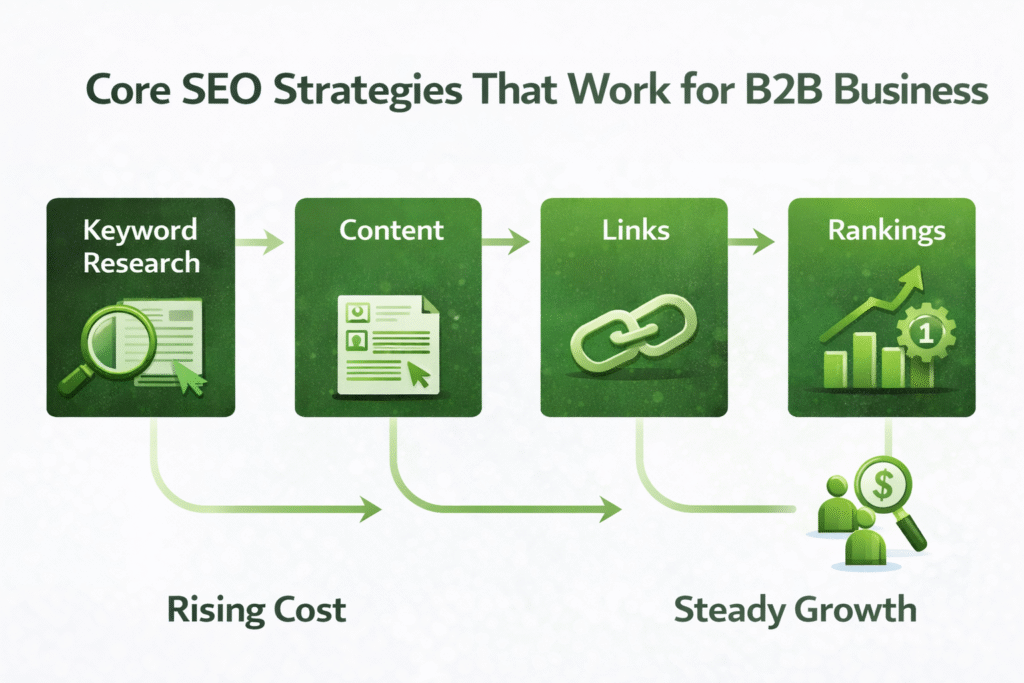
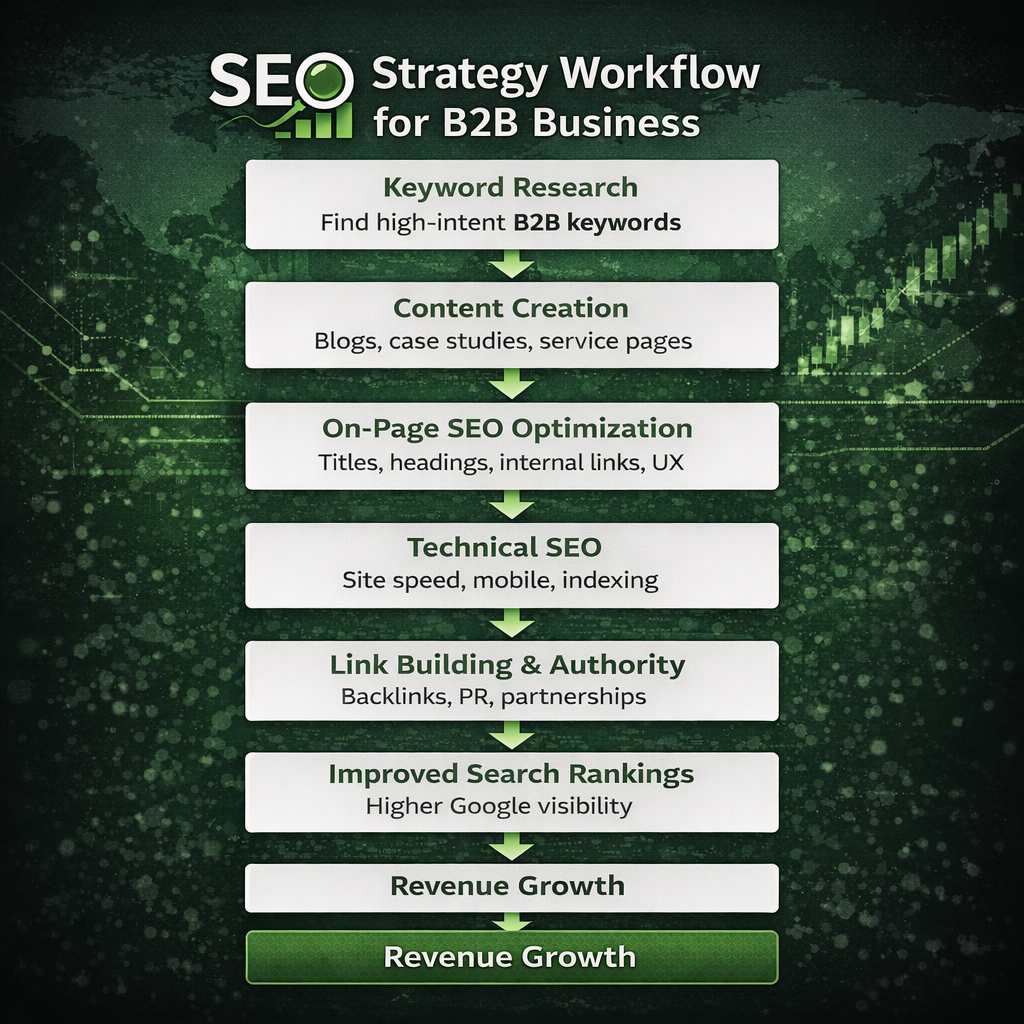
Building sustainable growth through SEO for B2B businesses requires a strategic approach that aligns with how B2B buyers search, evaluate, and decide. Unlike consumer SEO, B2B SEO focuses on intent, authority, and long-term value. A strong B2B SEO strategy combines precise keyword research, purposeful content, technical excellence, and authority-building links to support complex buying journeys.
Keyword Research for B2B SEO
Effective keyword research is the foundation of SEO for B2B businesses. The goal is not to chase high search volume, but to identify low-volume, high-intent keywords that indicate real buying interest. B2B buyers often search using specific phrases related to problems, use cases, or solutions. These queries may attract fewer searches, but they convert at a much higher rate.
Industry-specific terms are especially important in B2B SEO. Buyers frequently use technical language, product categories, or service-related phrases unique to their industry. Targeting these keywords ensures your content reaches qualified decision-makers rather than general traffic. A strong B2B SEO strategy maps keywords to different stages of the buyer journey—informational terms for early research and solution-focused terms for evaluation and decision-making.
Content Strategy for B2B SEO
Content is the engine that drives SEO for B2B businesses. However, B2B content must educate, clarify, and build trust—not just attract clicks. A successful content strategy focuses on problem-solving and decision support.
Blogs help address common questions, trends, and challenges buyers face early in their journey. Whitepapers and guides allow deeper exploration of complex topics and position your brand as an authority. Case studies are especially powerful in B2B SEO because they provide proof, outcomes, and real-world relevance. Together, these formats create a content ecosystem that supports buyers from awareness to decision.
Educational content works best when it directly answers what buyers are searching for. Instead of promotional messaging, B2B SEO content should explain concepts, compare solutions, and offer actionable insights. This approach builds credibility and keeps prospects engaged over long decision cycles.
On-Page SEO for B2B Websites
Strong on-page SEO ensures that both users and search engines can clearly understand your website. For an SEO for B2B business website, technical clarity is essential. This includes clean site structure, fast loading times, mobile responsiveness, and clear internal linking. These elements help search engines crawl and index content efficiently while improving user experience.
Equally important is a conversion-focused structure. B2B websites should guide visitors logically, using clear headings, relevant CTAs, and supportive content. Pages should be designed to inform first and convert later, recognizing that B2B buyers may revisit multiple times before taking action. Well-optimized service pages, solution pages, and resource hubs play a crucial role in turning organic traffic into qualified leads.
Link Building for B2B Authority
Link building remains a key ranking factor, but in B2B SEO, quality matters far more than quantity. Editorial links from reputable industry websites, publications, and partners signal trust and authority to search engines. These links also introduce your brand to relevant audiences already engaged in your niche.
Industry mentions, guest contributions, and thought leadership content help build a strong backlink profile naturally. Instead of mass link-building tactics, B2B businesses should focus on relationships, expertise, and value-driven outreach. Over time, this approach strengthens domain authority and improves rankings for competitive keywords.
When these strategies work together—precise keyword targeting, educational content, technically sound pages, and authoritative links—SEO becomes a powerful growth engine. A well-executed B2B SEO strategy ensures that an SEO for B2B business website is discoverable, credible, and aligned with how real buyers search and decide.
SEO for B2B Business Across the Funnel
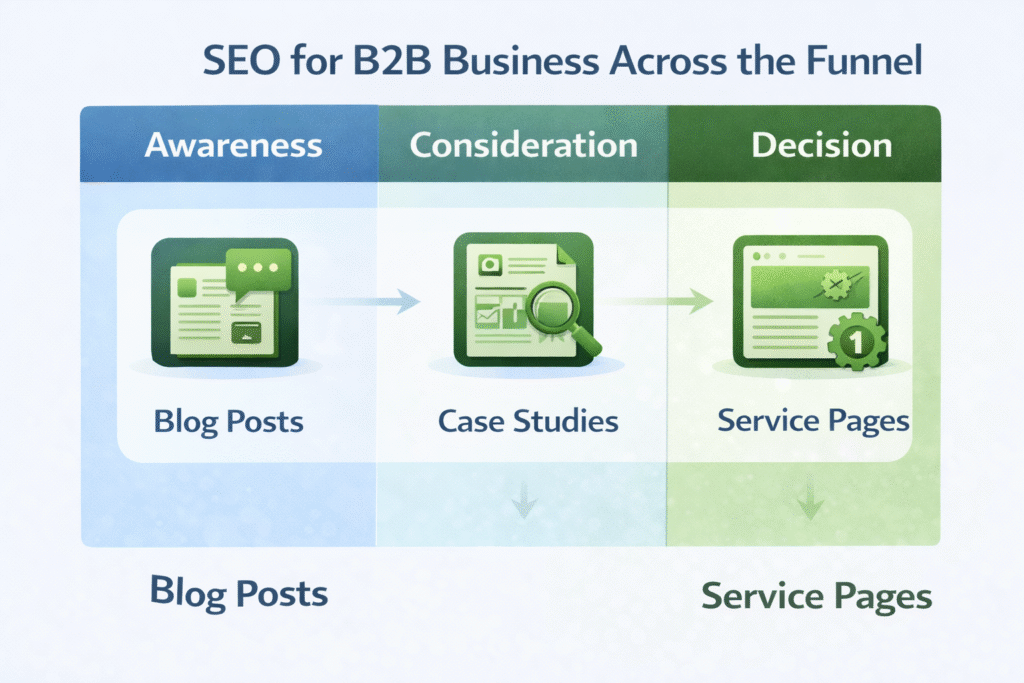
One of the biggest strengths of SEO for B2B business is its ability to support the entire buyer journey—not just lead acquisition. Unlike single-purpose marketing channels, SEO works across multiple touchpoints, aligning content and visibility with how buyers move from awareness to decision.
When structured correctly, SEO becomes the backbone of a strong B2B SEO funnel and a reliable SEO-driven sales pipeline.
Top-of-Funnel SEO
Top-of-funnel SEO focuses on awareness and education. At this stage, B2B buyers are identifying problems, not vendors. Their searches are broad and informational, often framed as questions or challenges. Keywords typically include “what,” “why,” and “how” queries related to industry pain points.
SEO for B2B business at the top of the funnel prioritizes educational blog posts, explainers, and industry insights. The goal is not immediate conversion, but visibility and trust-building. By consistently answering early-stage questions, businesses position themselves as knowledgeable resources and enter the buyer’s consideration set long before sales involvement.
Middle-of-Funnel SEO
In the middle of the funnel, buyers shift from understanding problems to evaluating solutions. Searches become more solution-focused and comparative. Keywords may include phrases like “best tools,” “solutions for,” or “alternatives to.” This is where SEO plays a critical role in guiding buyers toward your offering without aggressive selling.
Middle-of-funnel SEO content includes comparison guides, use cases, detailed service pages, and case studies. SEO for B2B business supports this stage by matching content depth with buyer intent, helping prospects logically assess options. This content also supports sales teams by addressing common objections and questions before direct contact occurs.
Bottom-of-Funnel SEO
Bottom-of-funnel SEO targets decision-stage searches. At this point, buyers are close to converting and are looking for validation. Keywords often include brand names, service-specific terms, pricing-related queries, and reviews. Visibility here directly impacts revenue.
SEO for B2B business at the bottom of the funnel focuses on optimized landing pages, service pages, testimonials, and detailed FAQs. Clear messaging, strong trust signals, and conversion-focused structure are essential. When buyers find accurate, confidence-building information at this stage, sales conversations become faster and more productive.
Mapping Keywords to Funnel Stages
A successful B2B SEO funnel maps keyword intent directly to funnel stages. Informational keywords support awareness, solution-based keywords support consideration, and transactional or brand keywords support decisions. This mapping ensures that content meets buyers exactly where they are.
Supporting Sales Enablement
When SEO is aligned with sales, it strengthens the SEO-driven sales pipeline. Content generated through SEO educates prospects, reduces friction, and shortens sales cycles—allowing sales teams to focus on qualified, informed leads rather than cold prospects.
Common Mistakes B2B Businesses Make with SEO
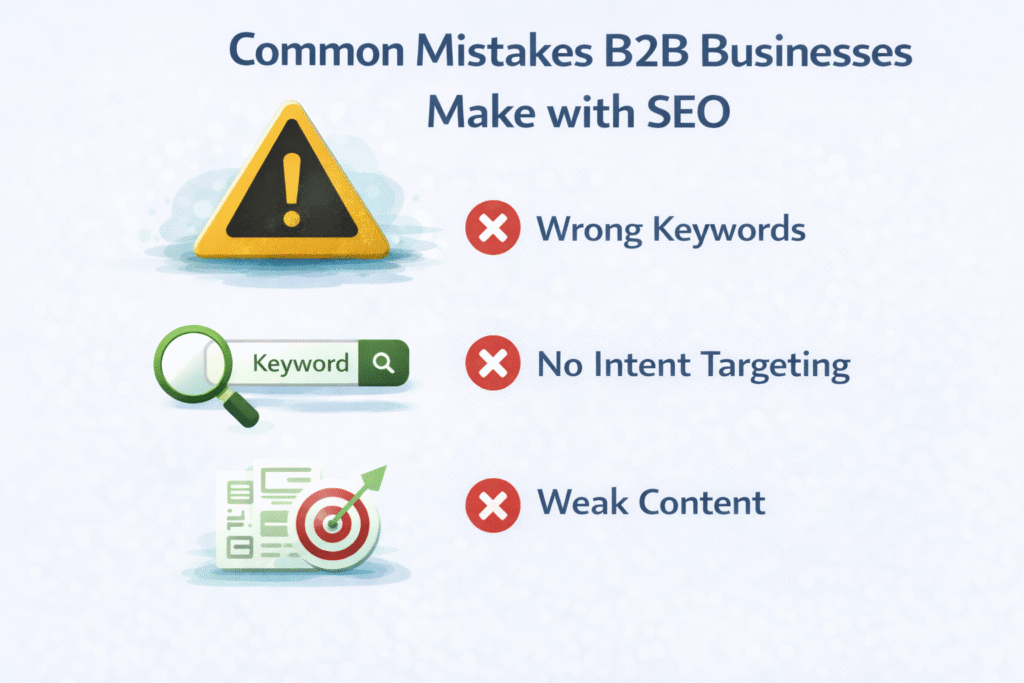
Despite understanding the importance of search visibility, many companies struggle to see results because of avoidable B2B SEO mistakes. These issues often stem from applying B2C-style tactics to B2B environments or treating SEO as a short-term campaign. Recognizing these SEO for B2B businesses is the first step toward building a strategy that actually drives growth.
One of the most common mistakes is targeting only high-volume keywords. While these keywords may look attractive on paper, they often lack intent and relevance in B2B contexts. High-volume terms tend to be broad, competitive, and dominated by large brands.
B2B buyers usually search with specific, problem-focused queries. Ignoring low-volume but high-intent keywords results in traffic that doesn’t convert into qualified leads.
Another critical error is ignoring search intent. Ranking for a keyword is meaningless if the content doesn’t match what the user is actually looking for. Many B2B businesses publish promotional pages for informational searches or generic blogs for decision-stage queries.
This mismatch leads to poor engagement and lost opportunities. Successful SEO for B2B businesses requires aligning content type, depth, and messaging with buyer intent at each stage.
Treating SEO as a one-time task is another major challenge. SEO is not a setup-and-forget activity. Search algorithms, buyer behavior, and competition constantly evolve. B2B businesses that stop optimizing after initial improvements often see rankings decline over time.
Continuous content updates, technical improvements, and performance analysis are essential to maintaining long-term results.
Finally, many organizations fail by not aligning SEO with sales teams. SEO content often exists in isolation, disconnected from real sales conversations. When SEO and sales operate separately, valuable insights about buyer objections, questions, and objections are lost.
Aligning SEO with sales ensures that content addresses real-world concerns, supports sales enablement, and attracts leads that are more likely to convert.
Avoiding these B2B SEO mistakes helps businesses overcome common SEO for B2B business challenges and build a strategy focused on relevance, intent, and sustainable growth.
Measuring SEO Success for B2B Business
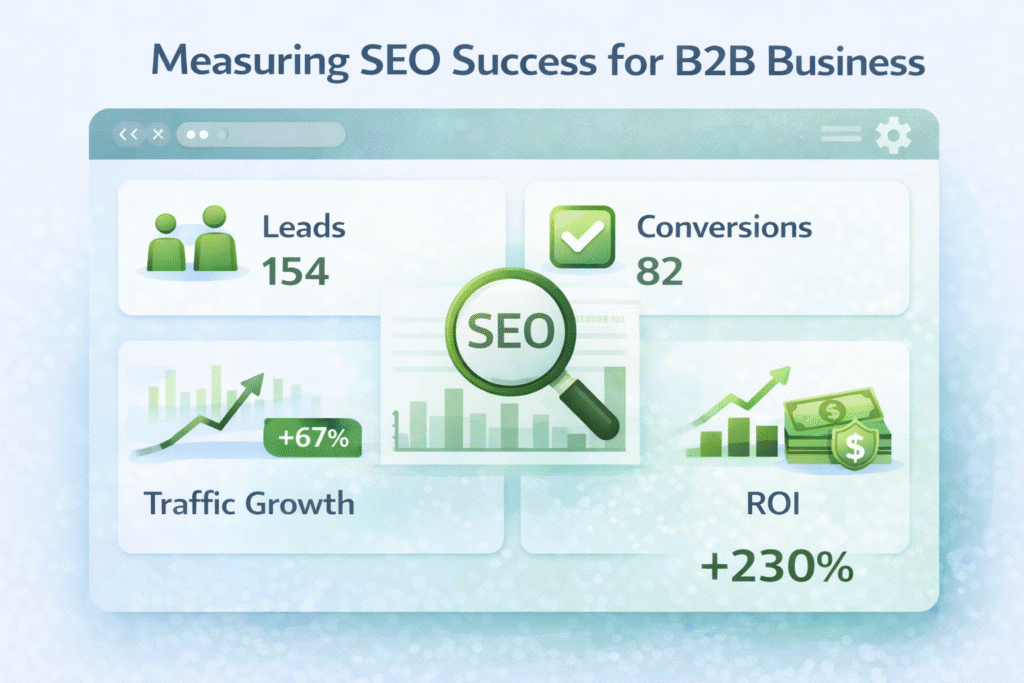
To evaluate the real impact of SEO for B2B business, it’s important to move beyond surface-level metrics and focus on performance indicators tied to revenue and lead quality. Unlike B2C, where success may be measured by clicks or purchases, B2B SEO success is best tracked through pipeline contribution, lead intent, and long-term ROI.
Choosing the right B2B SEO metrics ensures that efforts are aligned with business growth rather than vanity numbers.
KPIs That Actually Matter
Key performance indicators for B2B SEO should reflect meaningful outcomes. Metrics such as organic lead volume, lead quality, conversion rate, pipeline influence, and customer acquisition cost are far more valuable than raw traffic numbers.
Engagement metrics—like time on page, content interactions, and return visits—also provide insight into buyer intent and interest during longer sales cycles.
Leads vs Traffic
While traffic growth can indicate improved visibility, leads matter more than visitors in B2B contexts. A smaller volume of highly qualified organic leads often delivers more value than large volumes of low-intent traffic. SEO for B2B businesses should prioritize ranking for decision-stage and solution-focused keywords, ensuring that organic visitors are more likely to convert into real opportunities.
Attribution and Assisted Conversions
B2B buying journeys involve multiple touchpoints, meaning SEO often plays an assisting role rather than being the final conversion trigger. Attribution models help track how organic search supports early research, mid-funnel engagement, and final decisions.
Measuring assisted conversions reveals how SEO contributes to deal progression, even when it’s not the last interaction.
By focusing on SEO ROI for B2B businesses, companies can understand the true financial impact of their efforts—tracking how organic visibility translates into pipeline growth, revenue, and long-term customer value.
Future of SEO for B2B Business
The future of B2B SEO is being shaped by rapid advances in technology, changing buyer behavior, and evolving search engine priorities. As competition increases and buyers become more selective, SEO for B2B business trends are shifting toward deeper expertise, stronger trust signals, and more intelligent content strategies.
AI-Driven Search Behavior
Artificial intelligence is transforming how search engines interpret queries and rank content. Search is becoming more conversational, intent-focused, and predictive. Instead of matching only keywords, AI-driven algorithms prioritize context, relevance, and usefulness.
For SEO for B2B business, this means content must answer real business questions clearly and comprehensively. Optimizing for intent, topic authority, and user experience will matter more than simple keyword placement.
EEAT and Authority Signals
Google’s emphasis on EEAT (Experience, Expertise, Authoritativeness, and Trustworthiness) is becoming increasingly important for B2B brands. Buyers want credible, reliable sources—especially when making high-stakes business decisions.
SEO success in the future will depend on demonstrating industry expertise, real-world experience, transparent authorship, and strong brand reputation. Building authority through expert content, case studies, and trusted backlinks will be a key competitive advantage.
Content Depth Over Volume
The era of mass-producing shallow content is fading. Search engines now reward in-depth, high-quality content that provides genuine value. For B2B companies, fewer but more comprehensive resources—such as detailed guides, research reports, and solution frameworks—will outperform large volumes of generic blogs.
Content depth supports complex buyer journeys, strengthens topical authority, and improves long-term rankings.
Looking ahead, SEO for B2B business will be less about gaming algorithms and more about serving buyer intent with credible, valuable, and experience-driven content.
Businesses that adapt early to these SEO for B2B business trends will be better positioned to earn trust, visibility, and sustainable growth in an AI-powered search landscape.
Final Thoughts — Why SEO for B2B Business Is a Growth Essential
As B2B buying behavior continues to evolve, SEO for B2B businesses has become more than a marketing channel—it’s a core growth driver. Throughout this guide, we’ve seen how modern buyers rely on search to research, compare, and validate decisions, making SEO a critical touchpoint across the entire funnel.
The key takeaways are clear: SEO helps attract high-intent leads, builds long-term authority, supports long sales cycles, and delivers sustainable ROI compared to short-term paid tactics.
When executed with the right strategy—focused on intent, content depth, technical excellence, and authority—SEO creates consistent visibility where B2B decisions actually begin.
Unlike campaigns that stop when budgets pause, SEO operates as a compounding asset. Every optimized page, backlink, and high-quality content piece strengthens your digital presence over time.
Results may not be instant, but the long-term payoff includes lower acquisition costs, stronger brand trust, and scalable lead generation.
Adopting a long-term mindset is essential. SEO for B2B businesses works best when treated as an ongoing investment rather than a one-time effort.
Companies that commit early and consistently will be best positioned to win attention, trust, and revenue in an increasingly competitive search-driven market.
💡 Interested in learning more? Contact RKDMT – Raju Kumar Digital Marketer – Best Digital Marketing Training Institute
🔗www.rajukumardigitalmarketer.com 📞 +91-7303933302, +91-9217057127
📧 rkdmt@rajukumardigitalmarketer.com
What is SEO for B2B business?
SEO for B2B businesses is the process of optimizing a company’s website and content to attract other businesses through organic search. It focuses on ranking for high-intent, industry-specific keywords that decision-makers use when researching solutions, services, or suppliers.
Why is SEO important for B2B companies?
SEO is important because B2B buyers rely heavily on search to research problems, compare options, and validate vendors. Strong SEO increases visibility, builds trust, and helps businesses generate qualified leads without relying solely on paid ads.
How long does SEO take for B2B business results?
SEO for B2B businesses typically takes 3 to 6 months to show meaningful progress, and 6 to 12 months for strong results. Timelines vary based on competition, content quality, website authority, and industry demand
Is SEO better than paid ads for B2B?
SEO and paid ads serve different roles. Paid ads deliver immediate traffic, while SEO provides long-term, cost-effective lead generation. Over time, SEO often delivers higher ROI because results continue even when ad spending stops
What type of content works best for B2B SEO?
The most effective content includes blogs, case studies, whitepapers, comparison guides, service pages, and educational resources. B2B buyers prefer content that explains problems, compares solutions, and demonstrates real expertise
How does SEO support long B2B sales cycles?
SEO supports long sales cycles by keeping a brand visible across multiple research stages. Informational content educates early buyers, solution-focused content helps evaluation, and decision-stage content builds confidence before purchase.
What keywords should a B2B business target?
B2B businesses should target low-volume, high-intent keywords, including industry-specific terms, problem-based searches, solution queries, and buyer-stage keywords. These attract fewer visitors but higher-quality leads.
Can small B2B businesses benefit from SEO?
Yes. Small B2B businesses can compete effectively by targeting niche keywords, focusing on local or industry-specific searches, and creating expert-driven content. SEO allows smaller brands to compete without large ad budgets.
How do you measure SEO success in B2B?
SEO success in B2B is measured through qualified leads, conversion rates, pipeline contribution, assisted conversions, keyword rankings, and SEO ROI. Traffic matters, but lead quality and revenue impact matter more.
Is SEO still relevant for B2B businesses in 2026?
Yes. SEO remains highly relevant as search behavior becomes more AI-driven and research-focused. With rising ad costs and declining trust in paid promotions, SEO for B2B businesses continues to be one of the most sustainable growth channels.

Founder at Digital Marketing Marvel | Founder at RKDMT – Raju Kumar Digital Marketing Trainer | Best Digital Marketing Trainer in Delhi/NCR – Digiperform | Project Manager | 5+ years | Genius Study Abroad & Inlingua’s Digital Marketing Head | Learn Digital Marketing