


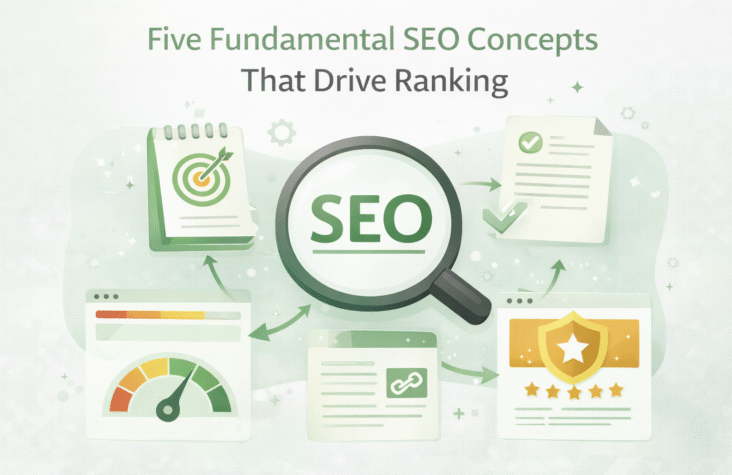
5 Fundamental SEO Concepts That Drive Ranking
If SEO were as simple as adding keywords and building a few backlinks, most websites would already be ranking on page one. But the reality is different. Thousands of websites publish content regularly, “do SEO,” and still fail to gain visibility on Google.
The reason isn’t lack of effort—it’s lack of understanding. Most sites focus on random tactics instead of mastering the SEO concepts that drive ranking.
Many businesses fall into the trap of chasing shortcuts. One month it’s keyword stuffing, the next it’s aggressive link building, then some new “SEO hack” promised by a YouTube video.
These fragmented efforts may create temporary spikes, but they rarely lead to sustainable rankings. That’s because Google doesn’t rank websites based on tricks—it ranks them based on how well they follow fundamental SEO concepts.
To understand how SEO ranking works, you need to shift your mindset. SEO isn’t a checklist of isolated tasks; it’s a system. Every ranking website aligns with a core set of principles that guide how search engines discover, understand, trust, and rank content.
When those principles are ignored, even technically optimized websites struggle. When they’re applied correctly, rankings follow naturally—often without chasing trends or loopholes.
This is where the difference between random SEO tactics and SEO concepts that drive ranking becomes clear. Tactics change. Algorithms evolve. But core SEO concepts remain stable because they’re rooted in Google’s primary goal: delivering the best possible result for every search query.
That’s why rankings depend on fundamentals, not hacks. Google rewards clarity, relevance, authority, and user satisfaction—no matter how many times the algorithm updates.
A common question beginners and even experienced marketers ask is: What are the five concepts of SEO that actually influence rankings? While the answer is often oversimplified or scattered across multiple guides, the truth is that strong SEO performance is built on five interconnected concepts.
These concepts work together to determine whether your site gets indexed, understood, trusted, and ultimately ranked by Google.
In this guide, we’ll clearly outline the five concepts of SEO, explain why they matter, and show how they directly impact rankings in real-world scenarios. This isn’t theory-heavy SEO or recycled advice—it’s a practical breakdown of fundamental SEO concepts used by websites that consistently rank and convert.
By the end, you won’t just know SEO terms—you’ll understand how SEO ranking works, why your current efforts may not be delivering results, and how focusing on the right concepts can change that. Before diving deep into each one, let’s first take a high-level look at the five core SEO concepts that drive rankings today.
Keyword Research as the Foundation of SEO Ranking
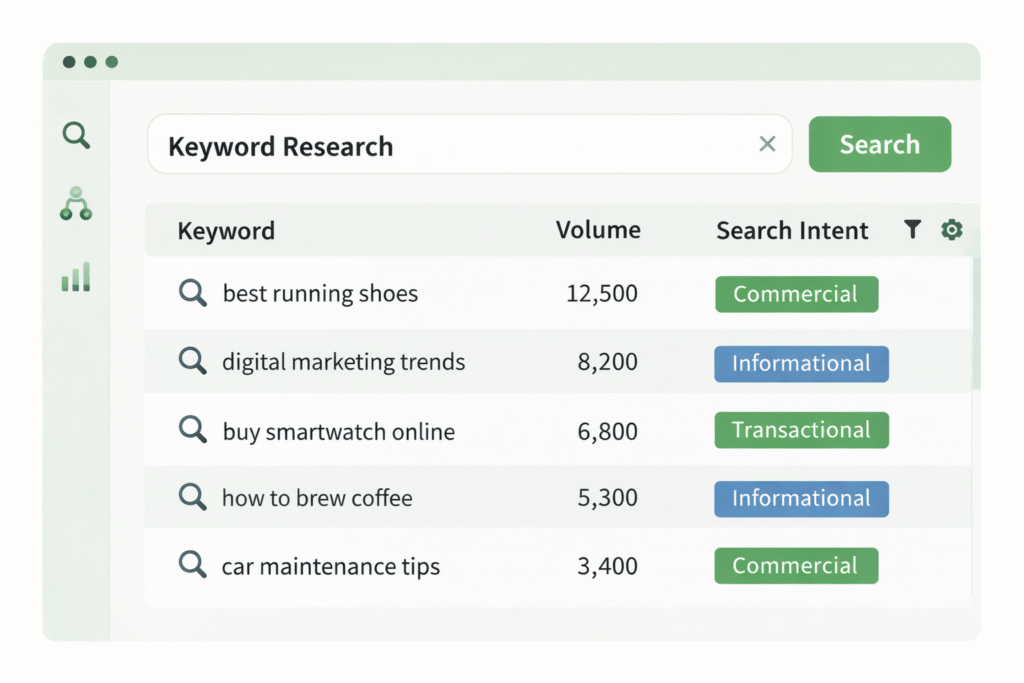
If SEO were a building, keyword research would be its foundation. Without it, everything else—content, backlinks, technical SEO—rests on shaky ground. Among all SEO concepts that drive ranking, none is more misunderstood or misused than keyword research for SEO.
Many websites fail not because their content is bad, but because they’re targeting the wrong keywords for the wrong audience at the wrong stage.
Keyword research is not about finding popular words and inserting them into content. It’s about understanding why people search, what they expect to see, and how Google decides which page best satisfies that expectation.
When done correctly, keyword research aligns your content with real demand, real intent, and real ranking potential.
What Keyword Research Really Means in Modern SEO
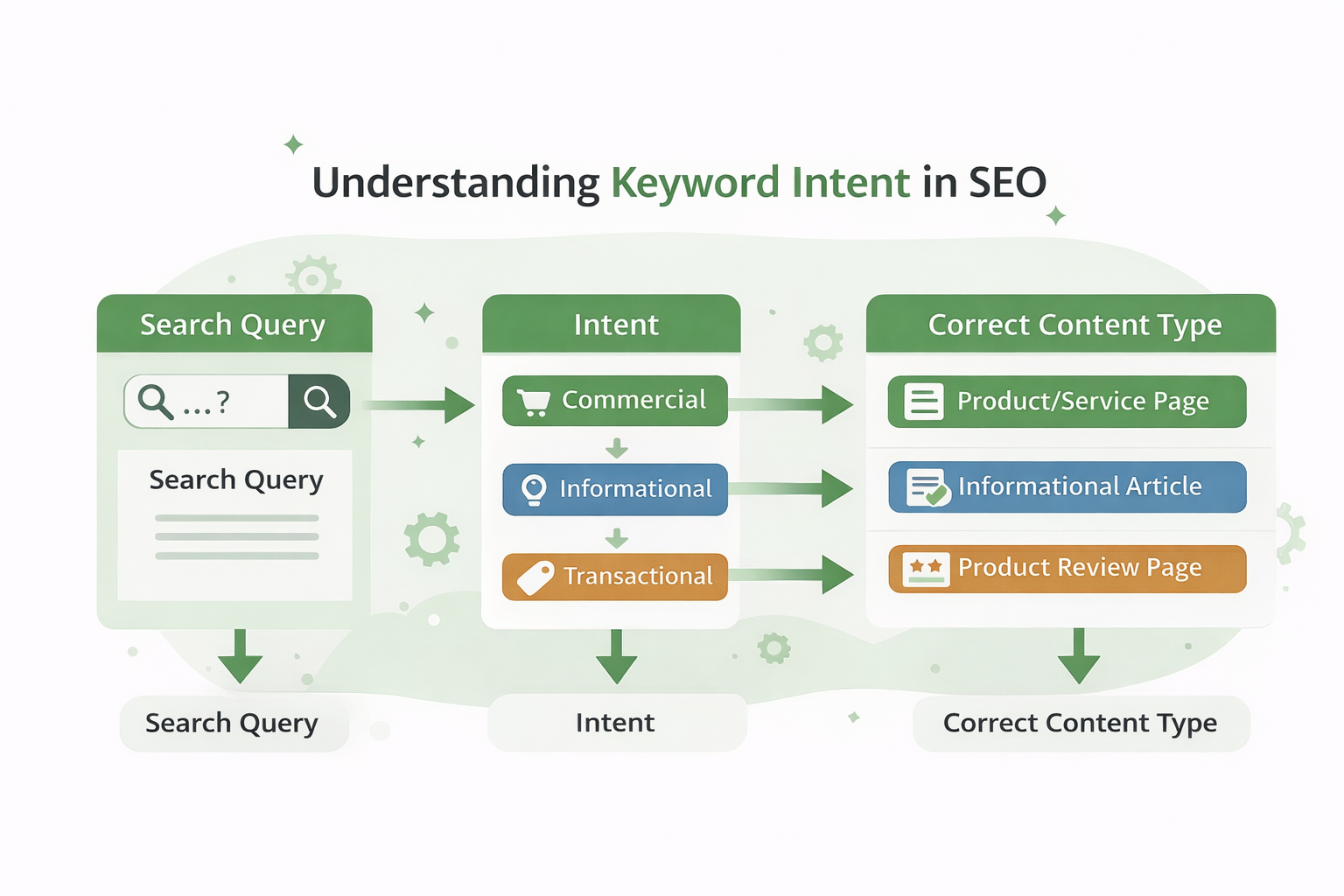
In modern SEO, keyword research is no longer just about search volume. A keyword with 50,000 searches is useless if it doesn’t match user intent or if your site can’t realistically compete. This is where the shift from volume-focused SEO to intent-driven SEO becomes critical.
Search intent vs search volume
Search volume tells you how often a term is searched. Search intent tells you why it’s searched. Google prioritizes intent over volume every time.
Two pages targeting the same keyword can rank very differently based on how well they satisfy intent. This is why keyword intent in seo is now a core ranking factor.
Buyer keywords vs informational keywords
Buyer keywords (also called transactional or commercial keywords) signal readiness to act—purchase, sign up, or contact. Informational keywords signal learning intent. Both matter, but they serve different goals.
Ranking blogs usually relies on informational keywords, while service and product pages rely on buyer keywords. Confusing the two leads to poor engagement and lost rankings.
Why Keyword Research Is One of the Core SEO Concepts That Drive Ranking
Google doesn’t rank pages—it ranks solutions. When someone types a query, Google’s algorithm looks for the page that best solves the problem behind that search.
This matching process is central to how SEO ranking works and explains why keyword research for SEO is one of the most important SEO concepts that drive ranking.
How Google matches queries to content
Google analyzes keywords, context, intent, content depth, and engagement signals. If your page targets a keyword but delivers mismatched intent, Google will bypass it—no matter how well-written it is.
Why wrong keywords = zero rankings
You can have perfect on-page SEO, fast loading speed, and strong backlinks, yet still not rank. Why? Because you chose keywords your audience isn’t searching for—or keywords that don’t match their intent. This is why poor keyword selection quietly kills rankings before SEO even begins.
Types of Keywords That Actually Drive Rankings
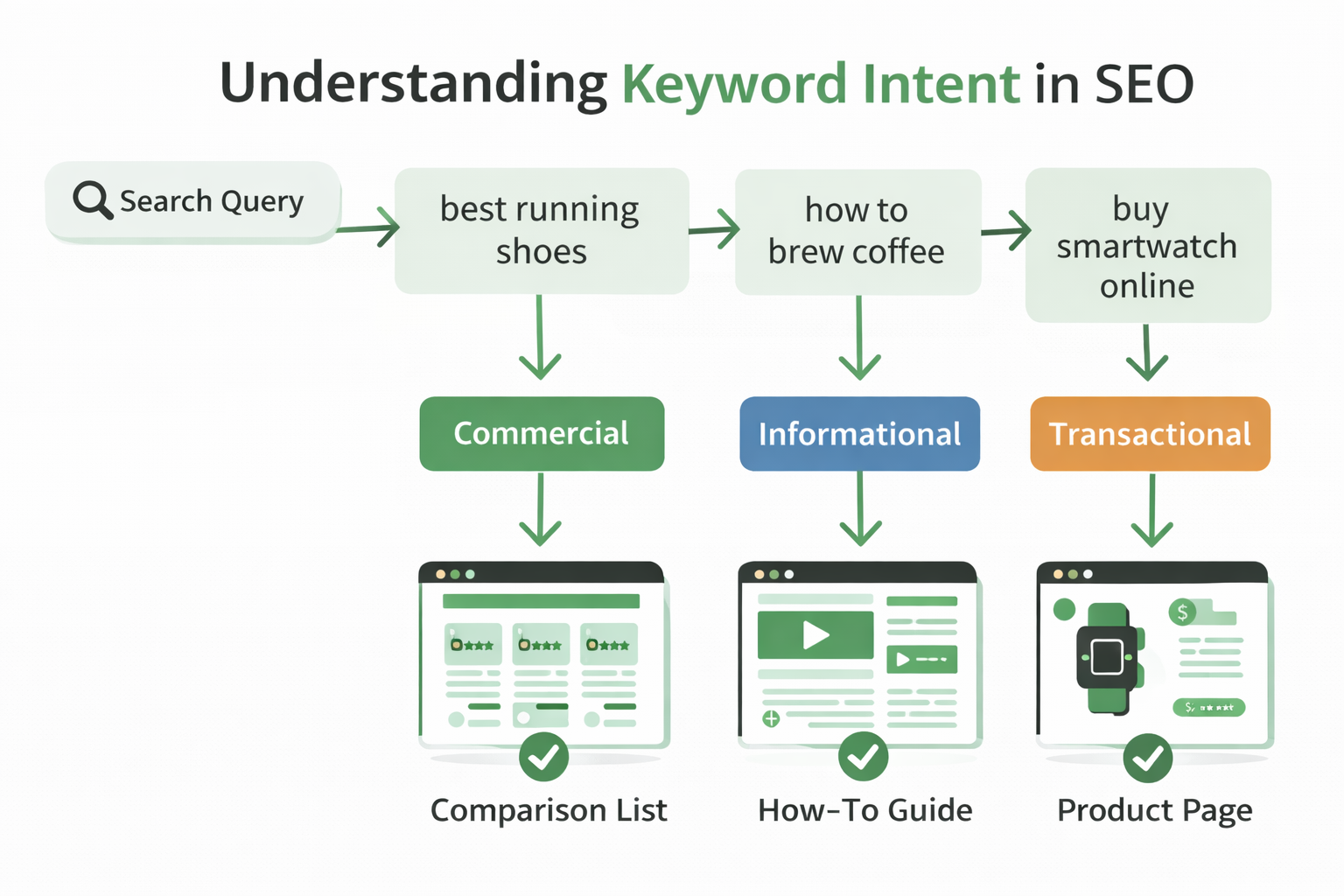
Not all keywords serve the same purpose. Understanding keyword types helps you build a balanced strategy that aligns with SEO concepts that drive ranking, not random content creation.
Short-tail keywords
These are broad, high-volume keywords (e.g., “SEO”). They’re competitive and often vague in intent. New or mid-level sites rarely rank for them without strong authority.
Long-tail keywords
Long-tail keywords are longer, more specific phrases (e.g., “keyword research for seo beginners”). They usually have lower competition, clearer intent, and higher conversion potential. These are ideal for blogs and niche pages.
Transactional keywords
These signal action—buying, subscribing, hiring. Examples include “SEO agency pricing” or “buy SEO tools.” These keywords are essential for revenue-focused pages.
Informational keywords
These focus on learning and problem-solving, such as “how keyword research works” or “keyword intent in seo.” Blogs that rank consistently rely heavily on informational keywords that satisfy curiosity and build trust.
A strong SEO strategy uses all four types strategically, not randomly.
Common Keyword Research Mistakes That Kill Rankings
Even experienced marketers make mistakes that undermine keyword research for SEO. These errors prevent sites from benefiting from even the best content.
Chasing high-volume keywords only
High search volume looks attractive, but competition and intent matter more. Ranking for smaller, intent-driven keywords often delivers better traffic and conversions.
Ignoring intent
Targeting informational keywords with sales pages—or transactional keywords with blogs—confuses users and search engines. Misaligned intent leads to low dwell time and ranking drops. This is why understanding keyword intent in seo is non-negotiable.
Keyword stuffing
Repeating keywords unnaturally doesn’t improve rankings. It damages readability and signals manipulation. Google favors relevance, not repetition.
These mistakes don’t just slow growth—they stop rankings entirely.
How to Do Keyword Research the Right Way (Beginner-Friendly)
Effective keyword research for SEO doesn’t require advanced tools or years of experience. It requires clarity, structure, and intent awareness.
Manual Google methods
Start with Google Search. Use autocomplete, “People Also Ask,” and related searches to understand real user queries. These are direct signals from Google about demand and intent.
Tool-based approach
Use tools like Google Keyword Planner, Ahrefs, SEMrush, or Ubersuggest to analyze search volume, competition, and keyword variations. Tools help scale research, but they don’t replace thinking.
Competitor keyword analysis
Analyze pages that already rank on page one. Identify what keywords they target, how they structure content, and what intent they satisfy. This reverse-engineering approach aligns directly with SEO concepts that drive ranking.
When keyword research is done correctly, SEO becomes predictable instead of confusing. You stop guessing, stop chasing hacks, and start building content that aligns with how Google actually ranks pages.
Keyword research isn’t just a step in SEO—it’s the strategic base that supports every other optimization effort. And among all SEO concepts that drive ranking, it’s the one that determines whether your site has a chance to rank at all.
High-Quality Content That Satisfies Search Intent
If keyword research is the foundation of SEO, content is the structure built on top of it. You can target the right keywords and still fail to rank if your content doesn’t meet Google’s expectations. That’s why content quality in SEO remains one of the most powerful SEO concepts that drives ranking. Google’s algorithm has become exceptionally good at identifying which content truly helps users—and which content merely exists to rank.
Modern SEO no longer rewards pages written for search engines. It rewards pages written for users, optimized intelligently for search engines. Understanding this shift is critical if you want consistent rankings rather than short-lived wins.
Why Content Is Still One of the Strongest SEO Concepts That Drive Ranking
Google’s mission has always been simple: deliver the best possible answer for every query. Every algorithm update—Panda, Hummingbird, Helpful Content Update—reinforces that goal. Among all SEO concepts that drive ranking, content remains central because it’s the medium through which value is delivered.
Google’s goal: best answer wins
When multiple pages target the same keyword, Google evaluates which page answers the search query most clearly, completely, and accurately. This includes relevance, depth, clarity, freshness, and user engagement. Rankings are not awarded for effort—they’re awarded for usefulness.
Thin content vs helpful content
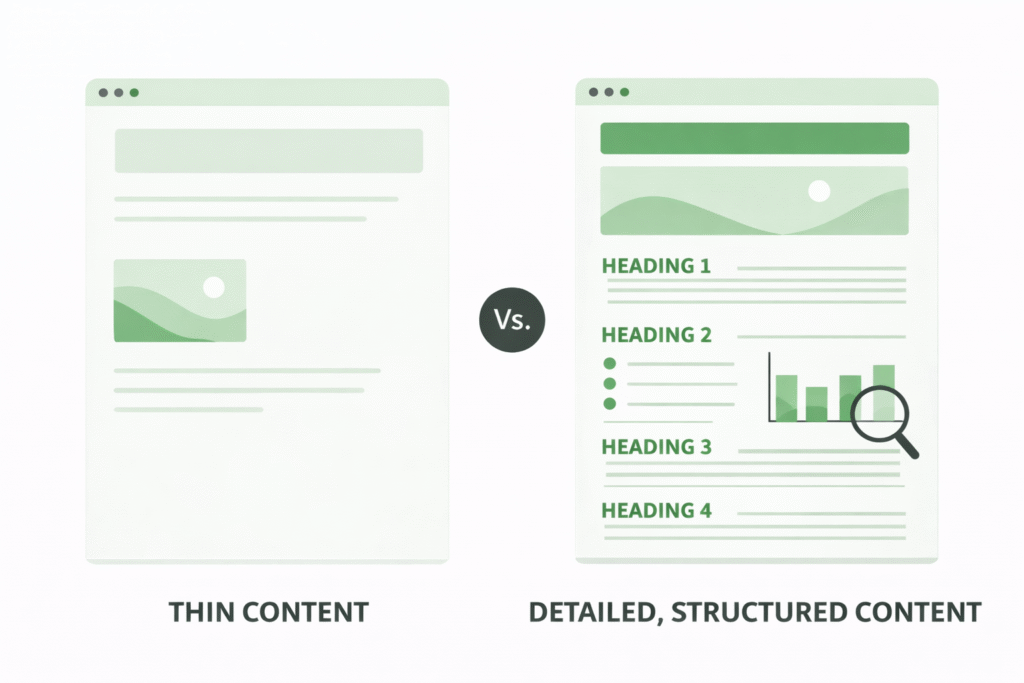
Thin content typically includes shallow explanations, generic advice, or reworded information already available elsewhere. Helpful content demonstrates expertise, solves a specific problem, and anticipates follow-up questions.
Google increasingly suppresses thin pages, even if they are technically optimized, because they don’t meet user expectations. This is why content quality in SEO outweighs outdated tactics like keyword repetition.
Understanding Search Intent (Critical for Ranking)
High-quality content means nothing if it satisfies the wrong intent. One of the biggest ranking failures happens when content and intent don’t align. This is where search intent optimization becomes essential.
Informational intent
The user wants to learn something. Queries like “how SEO works” or “what is content quality in seo” expect explanations, guides, or tutorials. Blog posts, how-to articles, and educational resources perform best here.
Navigational intent
The user wants to reach a specific brand, website, or platform. Examples include “Google Search Console login” or “Ahrefs dashboard.” Ranking for these queries usually favors brand authority, not generic content.
Transactional intent
The user is ready to act—buy, subscribe, book, or contact. Queries like “SEO services pricing” or “hire SEO expert” require conversion-focused content, not long educational blogs.
Google evaluates how well your page matches intent using engagement signals like click-through rate, dwell time, and bounce rate. If intent is mismatched, rankings drop—even if everything else is done right. That’s why intent alignment is a non-negotiable part of SEO concepts that drive ranking.
What Makes Content “High Quality” in SEO Terms
High-quality content is not subjective in SEO. Google evaluates quality using multiple measurable and behavioral signals. Strong content quality in SEO typically includes the following elements:
Depth
Depth doesn’t mean fluff or filler. It means covering the topic thoroughly, answering primary and secondary questions, and reducing the need for users to search again. Pages that solve problems completely tend to rank higher.
Structure
Well-structured content improves readability and comprehension. Clear headings, logical flow, bullet points, and short paragraphs help both users and search engines understand your content faster.
Originality
Original insights, examples, case studies, or explanations differentiate your content from competitors. Rewriting existing articles rarely leads to long-term rankings.
Readability
Simple language, active voice, and clear formatting improve user experience. If users struggle to read or understand your content, they leave—and Google notices.
Together, these elements form the backbone of content quality in SEO and directly influence rankings.
Content Length vs Content Value
One of the most common SEO myths is that longer content always ranks better. In reality, Google doesn’t rank word counts—it ranks value.
Why word count alone doesn’t rank
A 3,000-word article that avoids answering the main question will lose to a 900-word article that addresses it clearly. Length without relevance leads to poor engagement, which harms rankings.
How long-form content helps SEO
Long-form content works when it adds value. It allows deeper explanations, better internal linking, broader keyword coverage, and stronger topical authority. When long content is aligned with search intent optimization, it naturally performs better.
The key is not writing more—but writing what’s needed to fully satisfy intent.
Content Optimization Without Over-Optimization
Optimization should enhance clarity, not manipulate rankings. Over-optimization often signals low quality and can suppress visibility.
Natural keyword placement
Primary and secondary keywords should appear where they make sense—titles, headings, introductions, and contextually within the content. Forced repetition damages trust and readability.
Semantic keywords
Google understands topics, not just keywords. Using related terms, synonyms, and context helps search engines understand content depth and relevance without repetition.
Internal linking
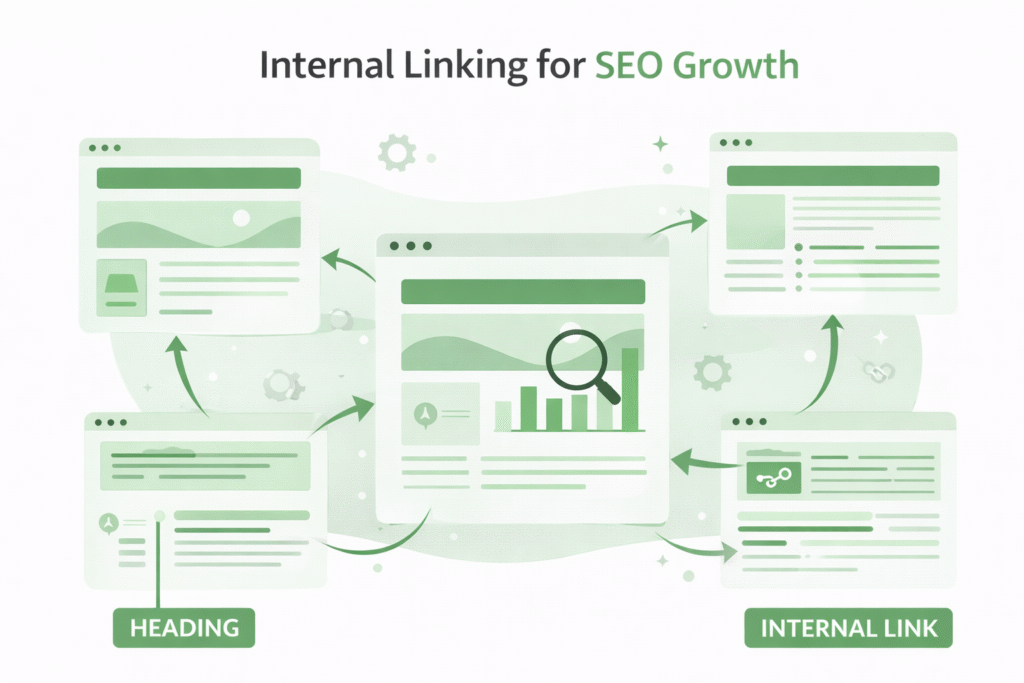
Internal links guide users to related content, improve crawlability, and distribute authority across your site. Strategic internal linking strengthens topical relevance and supports SEO concepts that drive ranking without risking penalties.
High-quality content isn’t about gaming algorithms. It’s about clarity, relevance, and usefulness. When your content consistently satisfies intent, delivers value, and avoids manipulation, rankings become a byproduct—not a struggle.
Among all SEO concepts that drive ranking, content quality is where strategy becomes visible. Keywords may bring users to your page, but content quality determines whether Google keeps sending them.
On-Page SEO That Helps Search Engines Understand Content
Even the best keyword research and highest-quality content can fail if search engines can’t properly understand what a page is about. This is where on-page SEO comes in. Among all SEO concepts that drive ranking, on-page SEO acts as the translator between your content and Google’s algorithm.
It tells search engines what your page covers, how important each section is, and how it fits into your overall site.
On-page SEO doesn’t manipulate rankings—it clarifies relevance. When done right, it helps search engines interpret your content accurately and rank it for the right queries.
What Is On-Page SEO and Why It Matters
On-page SEO refers to all the optimizations you make within a webpage to improve its visibility in search results. This includes content structure, HTML elements, keyword placement, internal links, and image optimization.
These on-page SEO factors are fully under your control, making them some of the most reliable levers in SEO.
Difference between on-page and off-page SEO
On-page SEO focuses on what’s on your site—content, structure, and signals that explain relevance. Off-page SEO focuses on external signals like backlinks and brand mentions that build authority.
Both matter, but on-page SEO comes first. Without proper on-page optimization, off-page efforts lose effectiveness because Google doesn’t clearly understand what your page deserves to rank for.
That’s why on-page optimization remains one of the most consistent SEO concepts that drive ranking, regardless of algorithm updates.
Core On-Page SEO Factors That Drive Ranking
Google uses multiple on-page signals to evaluate relevance and quality. While there are many on-page SEO factors, some carry significantly more weight than others.
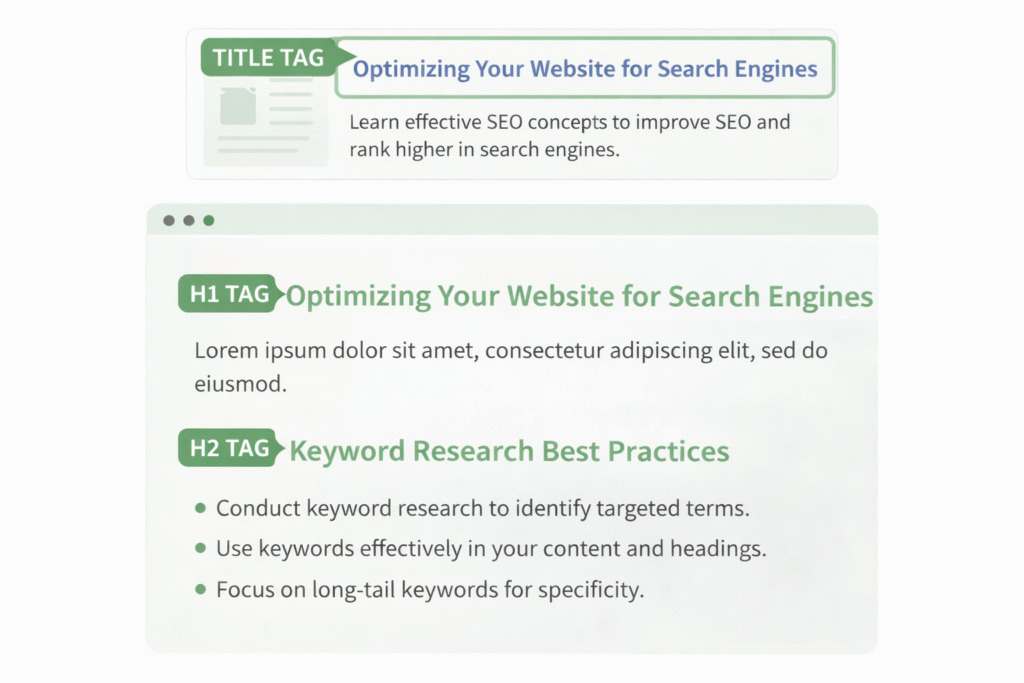
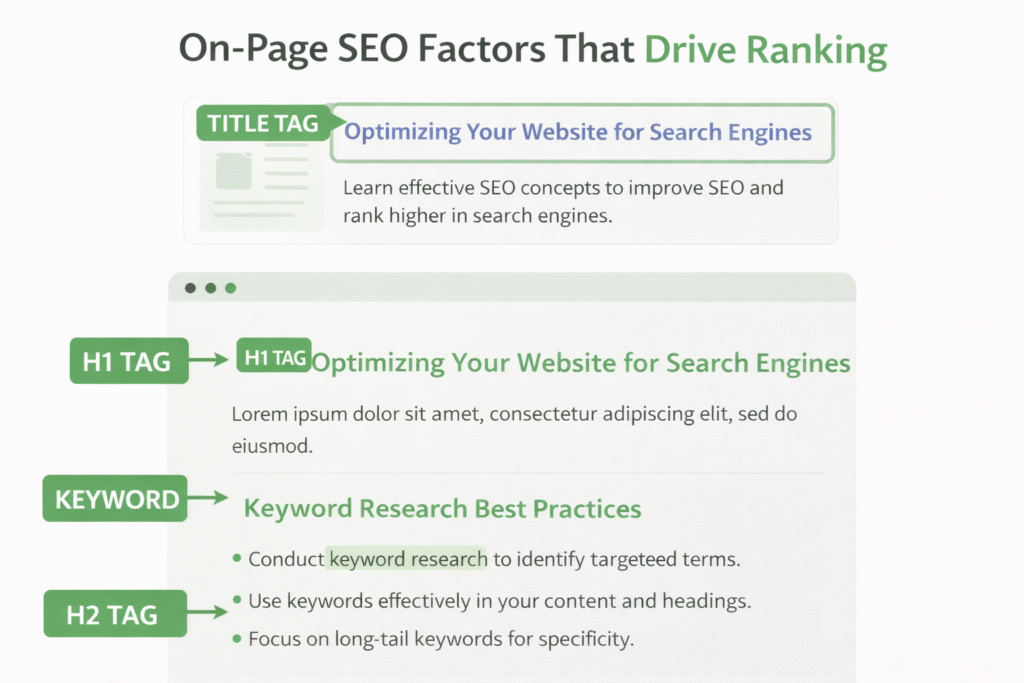
Title tags
The title tag is one of the strongest on-page ranking signals. It tells both users and search engines what the page is about. A clear, keyword-aligned title improves click-through rates and relevance scoring. Titles should be concise, descriptive, and intent-focused—not stuffed with keywords.
Meta descriptions
Meta descriptions don’t directly affect rankings, but they influence user behavior. A compelling meta description increases clicks, which indirectly supports performance. Think of it as an ad copy for your organic result.
URL structure
Clean, readable URLs help both users and search engines. Short URLs with descriptive words perform better than long strings of numbers or unnecessary parameters. A well-structured URL reinforces topical relevance.
Header tags (H1–H6)
Header tags define content hierarchy. The H1 tells Google the primary topic, while H2s and H3s organize supporting ideas. Proper header usage improves readability, accessibility, and keyword relevance—all key on-page SEO factors.
Keyword Placement Best Practices
Keyword placement is not about frequency—it’s about context. Strategic placement helps search engines understand relevance without triggering over-optimization signals.
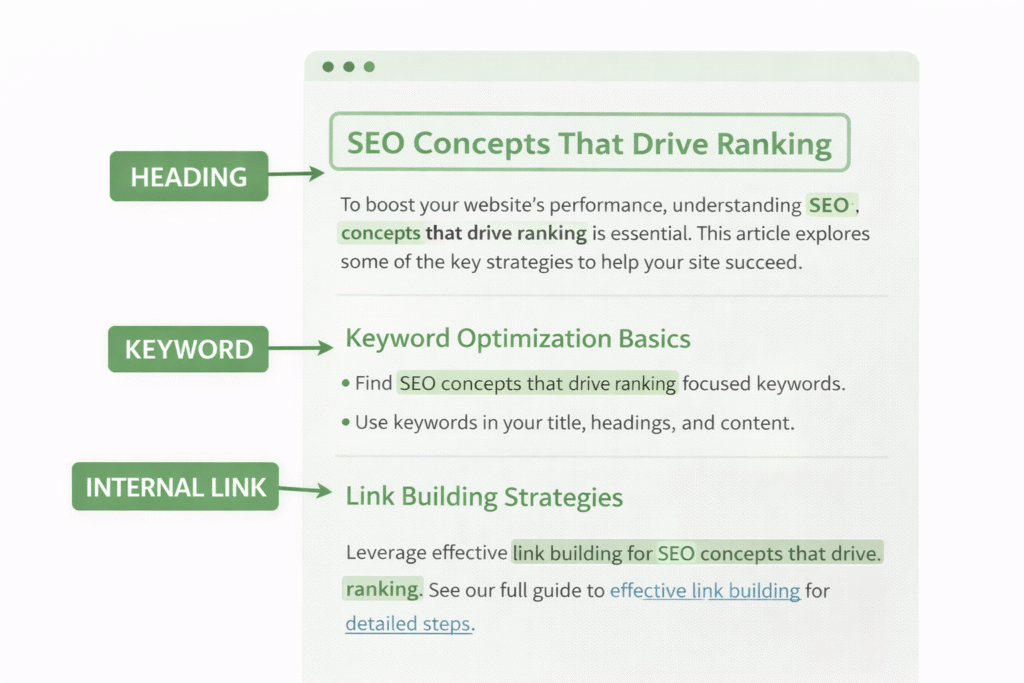
Titles
Primary keywords should appear naturally in the title tag, ideally toward the beginning. This reinforces relevance and improves visibility in search results.
Headings
Including keywords and variations in headings helps define topic coverage. Headings should reflect actual section topics, not exist solely for SEO.
Body content
Within the body, keywords should appear naturally where they add clarity. Google evaluates surrounding context, not just exact matches. Pages that read naturally almost always perform better than pages optimized aggressively.
Correct placement strengthens SEO concepts that drive ranking without harming user experience.
Image Optimization and Alt Text for SEO
Images are often overlooked in SEO, but they play a meaningful role in performance and accessibility.
Why images impact ranking
Optimized images improve page load speed, user engagement, and visual clarity. Faster pages and better user experience lead to stronger ranking signals. Additionally, images can rank independently in image search, creating additional traffic opportunities.
Accessibility + SEO
Alt text serves two purposes: accessibility for screen readers and contextual information for search engines. Descriptive alt text helps Google understand what an image represents and how it relates to the page topic. This improves topical relevance while making your site more accessible.
Image optimization is a subtle but important part of on-page SEO factors that support long-term rankings.
Internal Linking as an On-Page SEO Power Move
Internal linking is one of the most underrated yet powerful SEO concepts that drive ranking. It connects your content, distributes authority, and guides both users and search engines through your site.
Passing link equity
Internal links help pass authority from stronger pages to newer or weaker ones. This improves the ranking potential of important pages without relying solely on external backlinks. Strategic internal linking for seo ensures that valuable pages aren’t isolated.
Improving crawlability
Search engines use links to discover and understand pages. A well-linked site structure helps Google crawl content efficiently and understand topical relationships. Poor internal linking can prevent pages from being indexed or ranked properly.
Anchor text also matters. Descriptive, relevant anchor text helps clarify what the linked page is about, strengthening relevance signals across your site.
On-page SEO isn’t about ticking boxes—it’s about communication. You’re communicating with search engines, helping them understand your content clearly and confidently. When your on-page elements align with user intent, content quality, and structure, rankings become easier to achieve and maintain.
Among all SEO concepts that drive ranking, on-page SEO is where clarity meets control. You may not control Google’s algorithm, but you fully control how well your content is explained to it.
Technical SEO That Supports Ranking Performance
Technical SEO is the part of SEO most people avoid—not because it’s unimportant, but because it feels complex and “developer-only.” In reality, technical SEO basics are simply about making sure search engines can access, understand, and efficiently rank your website. Among all SEO concepts that drive ranking, technical SEO works quietly in the background, but when it’s broken, nothing else performs the way it should.
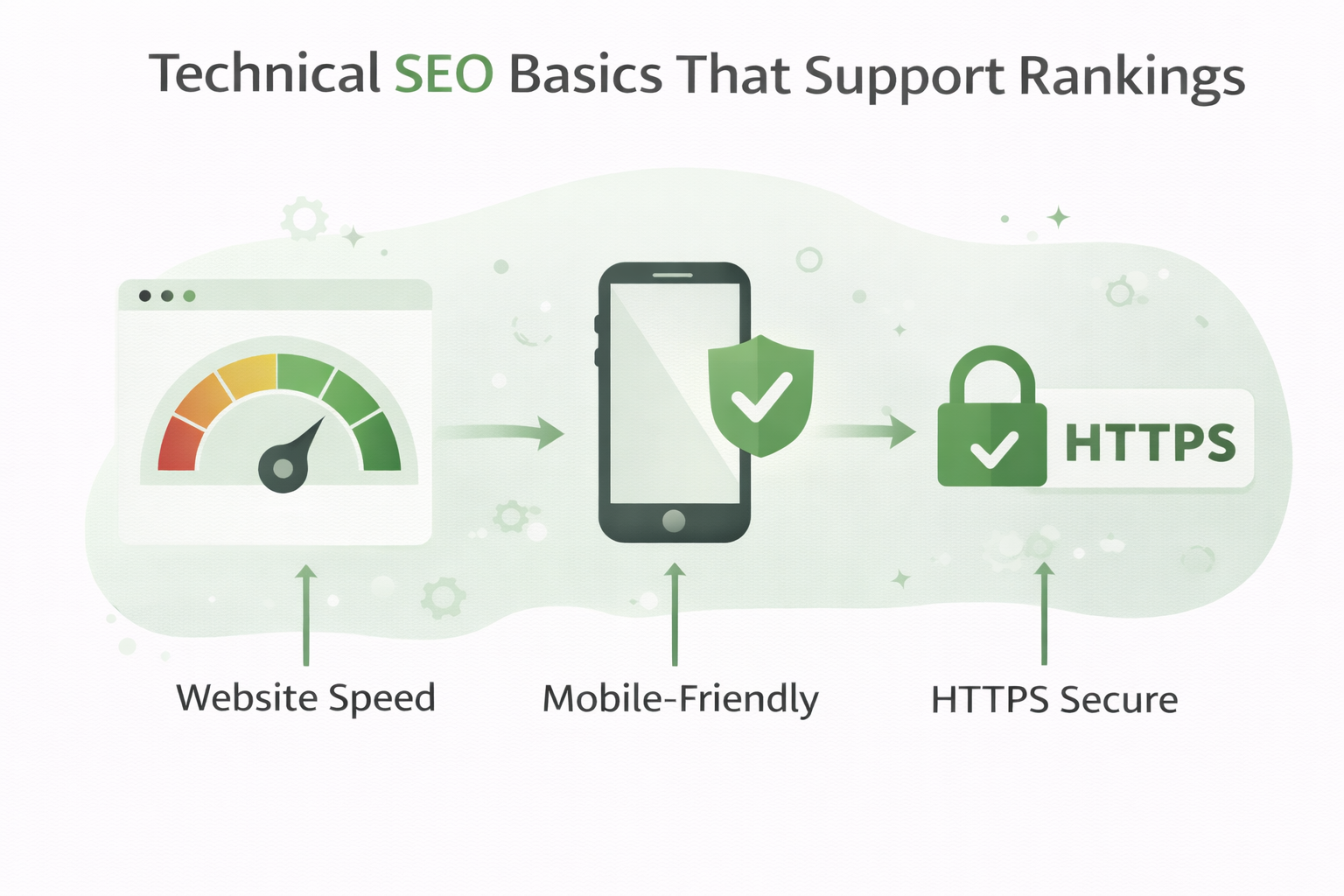
You can have excellent keyword research, strong content, and solid on-page SEO, but if your technical foundation is weak, rankings will always be limited.
What Is Technical SEO in Simple Terms
Technical SEO refers to all the behind-the-scenes elements that help search engines crawl, interpret, and index your website properly. It doesn’t change what your content says—it affects how well search engines can process it.
SEO behind the scenes
When Google visits your site, it behaves like a scanner. It checks page speed, mobile usability, security, structure, and whether it’s allowed to access your content. If your site is slow, broken, or confusing to crawl, Google deprioritizes it—regardless of content quality.
This is why technical SEO basics are essential. They ensure that all your SEO efforts are actually visible and usable by search engines.
Why Technical SEO Is One of the Most Ignored SEO Concepts That Drive Ranking
Most SEO guides focus heavily on keywords and content because they’re easier to understand. Technical SEO is often ignored until rankings stall. Unfortunately, that’s usually too late.
Good content + bad tech = no rankings
Imagine publishing a well-written article that loads slowly, breaks on mobile, or isn’t indexed properly. From Google’s perspective, that content is a poor user experience. As a result, it won’t rank competitively—even if it’s the best answer available.
This is why technical SEO is one of the most overlooked SEO concepts that drive ranking. It doesn’t create rankings by itself, but it removes the barriers that prevent rankings from happening.
Core Technical SEO Elements
You don’t need to master advanced coding to understand the technical factors that influence rankings. The following elements form the core of technical SEO basics.
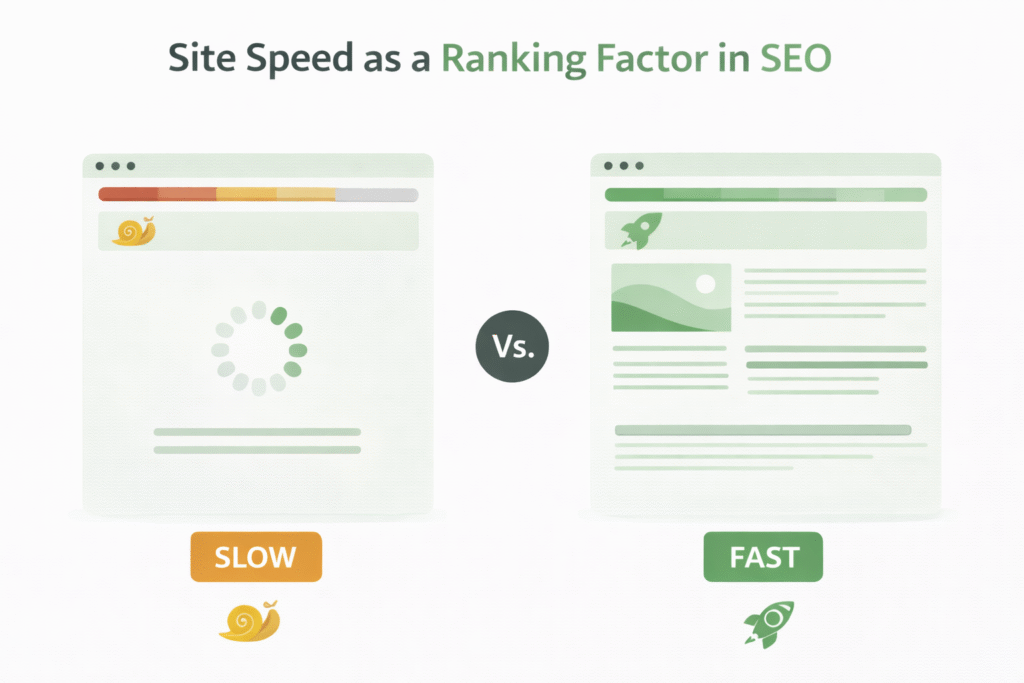
Site speed
Page speed directly affects user experience and rankings. Slow-loading pages increase bounce rates and reduce engagement, which negatively impacts performance. Google has confirmed that site speed and seo are closely linked, especially on mobile devices.
Mobile-friendliness
Google uses mobile-first indexing, meaning it primarily evaluates the mobile version of your site. If your site doesn’t work well on mobile, rankings suffer—even for desktop searches.
HTTPS
Secure websites build trust with both users and search engines. HTTPS is a confirmed ranking signal, and non-secure sites may be flagged or deprioritized.
Crawlability
Search engines must be able to access your pages. Issues with robots.txt, broken internal links, or blocked resources can prevent Google from crawling important content.
Indexing
Crawled pages aren’t always indexed. Duplicate content, thin pages, or technical errors can stop pages from being added to Google’s index, making them invisible in search results.
These elements work together to support all other SEO concepts that drive ranking.
Common Technical SEO Issues That Hurt Rankings
Many ranking problems aren’t caused by poor content—but by technical issues that go unnoticed.
Duplicate content
Multiple URLs showing the same or similar content confuse search engines and dilute ranking signals. Proper canonical tags and URL structure help prevent this issue.
Broken links
Broken internal or external links create a poor user experience and waste crawl budget. Over time, they weaken site trust and performance.
Poor site architecture
A confusing site structure makes it harder for users and search engines to find important pages. Deeply buried pages often struggle to rank because they receive less crawl priority and internal authority.
These problems quietly undermine SEO concepts that drive ranking without obvious warnings.
How to Improve Technical SEO Without Being a Developer
You don’t need coding skills to make meaningful improvements in technical SEO. Many fixes are simple, accessible, and highly effective.
Basic tools
Google Search Console, PageSpeed Insights, and mobile-friendly testing tools reveal most technical issues clearly. They show crawl errors, indexing problems, and performance bottlenecks in plain language.
Simple fixes
Optimizing images, improving hosting, reducing unnecessary plugins, fixing broken links, and improving internal linking can dramatically enhance performance. Even small changes can lead to noticeable ranking improvements.
Understanding technical SEO basics allows you to identify problems early and fix them before they limit growth. You don’t need perfection—you need functionality, speed, and accessibility.
Technical SEO rarely gets credit when rankings improve, but it’s often the reason they do. It acts as the support system for content, keywords, and links. Without it, even the strongest SEO strategy struggles to perform.
Among all SEO concepts that drive ranking, technical SEO is the silent enabler. It doesn’t attract attention, but it ensures everything else works the way it should.
Backlinks and Authority Building for SEO Rankings
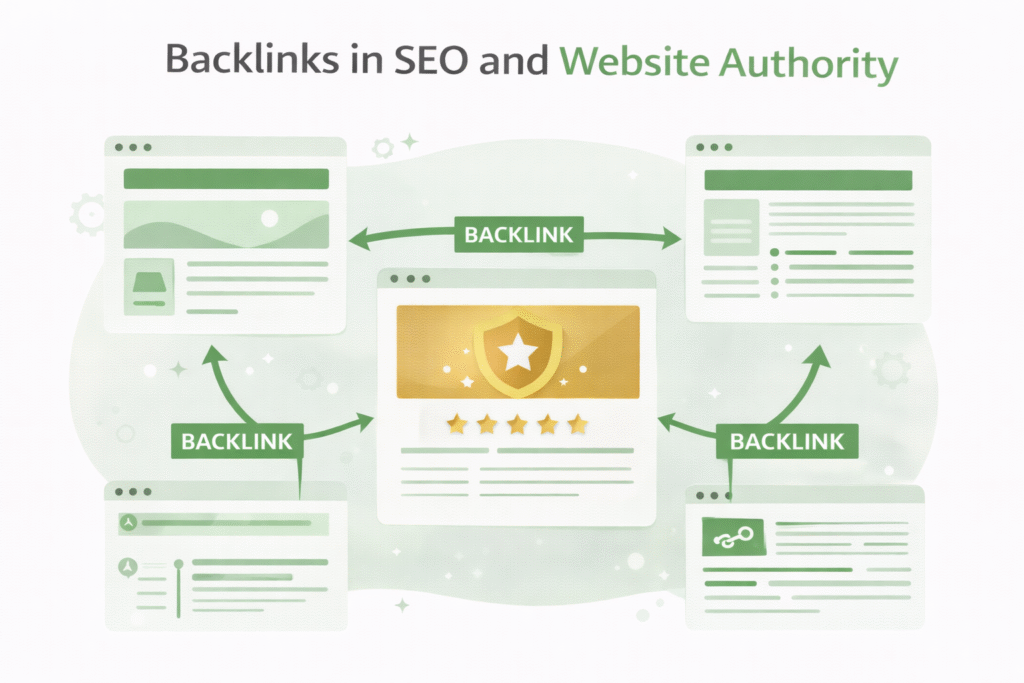
No matter how strong your content is or how well your site is optimized, Google still asks one critical question: Can this website be trusted? The answer largely depends on backlinks. Among all SEO concepts that drive ranking, backlinks remain one of the strongest signals of credibility, authority, and relevance. They tell Google that other websites recognize your content as valuable enough to reference.
Backlinks are not shortcuts to rankings—but when built correctly, they act as long-term assets that compound SEO growth over time.
What Are Backlinks and Why Do They Matter
A backlink is a link from one website to another. In Google’s eyes, backlinks function like votes of confidence. When reputable websites link to your content, they signal trust, relevance, and authority.
Trust signals for Google
Google doesn’t trust websites equally. A link from a respected, authoritative site carries significantly more weight than a link from an unknown or low-quality site. This is why backlinks in SEO are not just about links—they’re about who is linking to you.
Search engines use backlinks to:
- Discover new content
- Evaluate topic authority
- Measure trustworthiness
Without backlinks, even excellent content can struggle to rank because Google lacks external validation.
Why Authority Is One of the Strongest SEO Concepts That Drive Ranking
Authority is the cumulative trust your website earns over time. It’s not something you can fake, rush, or buy safely. Among all SEO concepts that drive ranking, authority determines how competitive your site can be.
Domain authority explained simply
While “domain authority” itself is not a Google metric, it represents a real concept: how much trust and credibility your site has earned through backlinks, content quality, and consistency. Sites with higher authority rank faster, rank higher, and recover more easily from algorithm updates.
This is why new websites often struggle—even with great content. They haven’t yet earned the authority Google relies on to rank competitive keywords. Backlinks accelerate this trust-building process when acquired ethically.
Quality vs Quantity in Backlinks
One of the most damaging SEO myths is that more backlinks automatically mean better rankings. In reality, quality outweighs quantity every time.
Good backlinks
High-quality backlinks typically come from:
- Relevant websites in your niche
- Authoritative blogs or publications
- Contextual placements within real content
These links strengthen topical relevance and pass meaningful authority. A few strong links can outperform hundreds of weak ones.
Toxic backlinks
Low-quality links from spammy sites, link farms, or irrelevant directories can hurt rankings. Google’s algorithms are designed to detect unnatural link patterns. Instead of boosting rankings, toxic links can suppress visibility or trigger penalties.
Understanding this balance is critical when working with backlinks in SEO and choosing sustainable link-building strategies.
Ethical Ways to Build Backlinks
Modern link building is about value creation, not manipulation. Ethical strategies align with Google’s guidelines and support long-term rankings.
Content-based links
The most natural backlinks come from high-value content—guides, original research, case studies, tools, or data-driven articles. When content genuinely helps users, other websites link to it organically.
Outreach
Outreach involves reaching out to relevant site owners, bloggers, or publishers and introducing your content as a helpful resource. Effective outreach is personalized, relevant, and value-focused—not spammy.
Digital PR
Digital PR combines content creation with media outreach. Thought leadership, expert quotes, and newsworthy insights can earn links from high-authority publications. These links significantly strengthen authority and trust.
All three methods focus on earning links, not forcing them—an essential distinction within SEO concepts that drive ranking.
Backlink Mistakes That Can Destroy Rankings
Backlinks can help rankings—but they can also destroy them when handled poorly.
Paid links
Buying links violates Google’s guidelines. While paid links may offer short-term gains, they carry long-term risk. Once detected, rankings can drop sharply, and recovery can be difficult.
Spammy directories
Submitting your site to low-quality directories, automated link networks, or irrelevant listing sites adds little value and often signals manipulation. These links dilute trust rather than build it.
Poor anchor text practices, excessive exact-match anchors, and unnatural link velocity also raise red flags. Effective link-building strategies focus on consistency, relevance, and gradual growth—not shortcuts.
Backlinks are not just another SEO tactic—they are reputation signals. They represent how the web perceives your site. When authoritative sites link to you, Google listens.
Among all SEO concepts that drive ranking, backlinks and authority building are what separate average websites from dominant ones. You don’t need thousands of links—but you do need the right ones, earned the right way, over time.
Conclusion: Mastering the SEO Concepts That Drive Ranking Long-Term
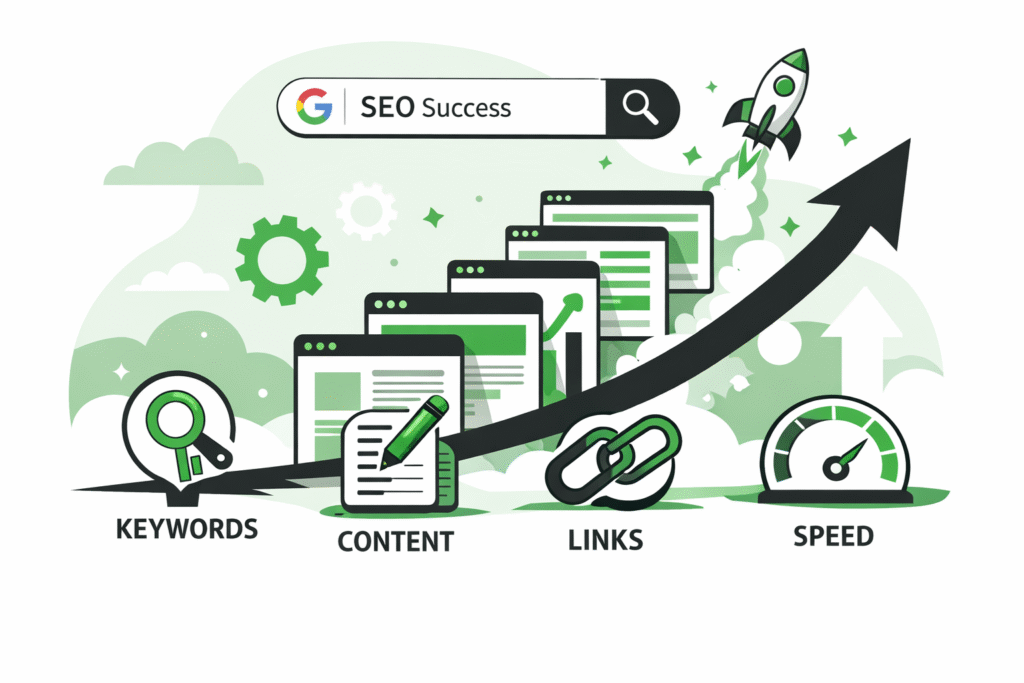
SEO success rarely comes from a single tactic or sudden breakthrough. It comes from understanding and consistently applying the SEO concepts that drive ranking over time. Websites that dominate search results don’t rely on hacks, trends, or shortcuts—they rely on fundamentals executed well, month after month.
Throughout this guide, we’ve answered a critical question many marketers struggle with: What are the five concepts of SEO that actually influence rankings? The answer is not complicated, but it does require discipline.
First, keyword research ensures you’re targeting real searches with real intent—not guessing what users want. Without this foundation, even the best content struggles to gain traction.
Second, high-quality content that satisfies search intent turns visibility into engagement. Content that solves problems, matches intent, and delivers value consistently outperforms thin, keyword-focused pages.
Third, on-page SEO helps search engines understand your content clearly. From titles and headings to internal links and image optimization, it removes ambiguity and reinforces relevance.
Fourth, technical SEO ensures your site is fast, accessible, secure, and easy for search engines to crawl and index. It doesn’t create rankings by itself—but without it, rankings stall.
Finally, backlinks and authority building establish trust. They tell Google your content is credible, referenced, and worthy of higher visibility.
Together, these five pillars form the fundamental SEO concepts behind every ranking website. Miss one, and performance weakens. Align all five, and SEO becomes predictable instead of frustrating.
One of the biggest mistakes businesses make is treating SEO as a collection of random tasks—writing occasional blogs, building a few links, tweaking pages without a strategy. This scattered approach leads to inconsistent results. Search engines reward clarity, consistency, and alignment—not sporadic effort.
SEO should be viewed as a long-term growth asset, not a quick win. When you invest in the SEO concepts that drive ranking, you’re building an engine that compounds over time. Content continues to attract traffic. Authority strengthens. Rankings stabilize. Unlike paid ads, SEO doesn’t stop working the moment you stop paying—it continues to deliver value when built correctly.
The key takeaway is simple: stop chasing shortcuts and start mastering the basics. Understand what are the five concepts of SEO, apply them strategically, and refine them consistently. When SEO is approached with intention instead of urgency, rankings become a natural outcome—not a constant struggle.
💡 Want to apply these SEO concepts the right way instead of guessing?
Learn directly from industry-focused, practical training that teaches how SEO actually works in real-world scenarios.
👉 Contact RKDMT – Raju Kumar Digital Marketer (Best Digital Marketing Training Institute)
🔗 www.rajukumardigitalmarketer.com
📞 +91-7303933302, +91-9217057127
📧 rkdmt@rajukumardigitalmarketer.com
Master the fundamentals, stay consistent, and let the SEO concepts that drive ranking work for you long-term.
What are the five concepts of SEO?
The five concepts of SEO are keyword research, content quality, on-page SEO, technical SEO, and backlinks. Together, these seo concepts that drive ranking help search engines understand content, evaluate relevance, and determine which pages deserve higher visibility in search results.
Why are SEO concepts that drive ranking important for websites?
SEO concepts that drive ranking are important because they form the foundation of how search engines evaluate websites. Without applying these core concepts correctly, even well-designed websites struggle to attract organic traffic and rank consistently.
How does keyword research impact SEO ranking?
Keyword research impacts SEO ranking by helping websites target search terms that match user intent. When keyword research for seo is done correctly, content aligns better with what people are searching for, increasing the chances of ranking higher.
Is content quality more important than technical SEO?
Both content quality and technical SEO are essential. High-quality content answers user queries, while technical SEO ensures search engines can crawl and index that content properly. Ignoring either weakens seo concepts that drive ranking.
What role does on-page SEO play in rankings?
On-page SEO helps search engines understand what a page is about. Elements like title tags, headings, internal linking, and keyword placement directly influence how seo concepts that drive ranking are applied at the page level.
Can technical SEO alone improve search engine rankings?
Technical SEO alone cannot guarantee rankings, but it removes barriers that prevent content from performing well. Technical seo basics such as site speed, mobile optimization, and crawlability support other seo concepts that drive ranking.
Why are backlinks still important for SEO?
Backlinks remain important because they act as trust signals. When authoritative websites link to your content, it increases credibility and strengthens seo concepts that drive ranking through improved domain authority.
How long does it take for SEO concepts to show results?
SEO results usually take time because search engines evaluate changes gradually. Applying seo concepts that drive ranking consistently can show measurable improvements within three to six months, depending on competition and execution quality.
Do small websites need to follow all five SEO concepts?
Yes, small websites benefit the most from following all five seo concepts that drive ranking. Strong fundamentals help smaller sites compete by building relevance, trust, and technical stability over time.
Are SEO concepts that drive ranking changing over time?
The core seo concepts that drive ranking remain stable, but how they are applied evolves. Search engines update algorithms, yet keyword relevance, content quality, technical health, and authority continue to be the backbone of SEO success.

Founder at Digital Marketing Marvel | Founder at RKDMT – Raju Kumar Digital Marketing Trainer | Best Digital Marketing Trainer in Delhi/NCR – Digiperform | Project Manager | 5+ years | Genius Study Abroad & Inlingua’s Digital Marketing Head | Learn Digital Marketing